Thank you for visiting SNEWPapers!
Sign up free
Editorial
February 8, 1809
Norfolk Gazette And Publick Ledger
Norfolk, Virginia
What is this article about?
Editorial opposes Mr. Bacon's resolution authorizing U.S. merchant vessels to resist searches by French or British armed vessels, arguing it equates to declaring war and violates international law on neutral rights and right of search. Discusses historical precedents and suggests raising the embargo and allowing defensive arming instead. Notes House of Representatives' progress on related resolutions by Nicholas and Bacon.
Clipping
OCR Quality
95%
Excellent
Full Text
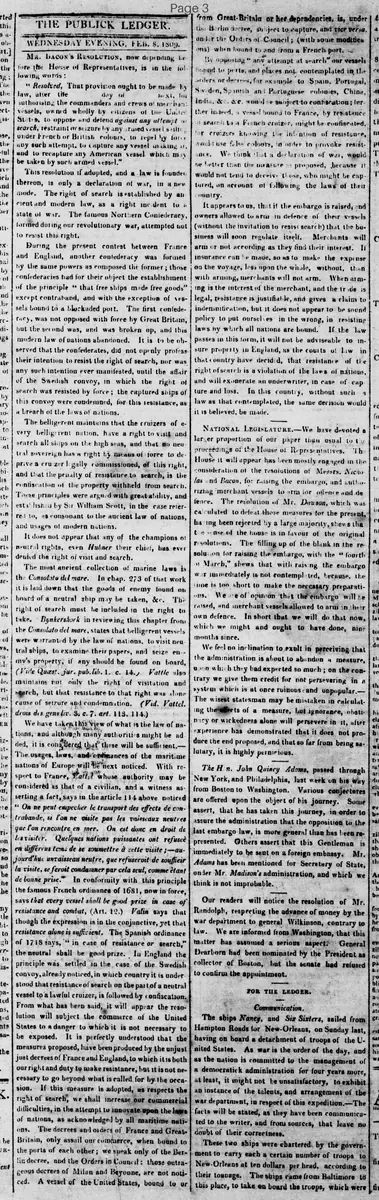
Mr. Bacon's Resolution, now depending before the House of Representatives, is in the following words:
"Resolved, That provision ought to be made by law, after the day of next, for authorising the commanders and crews of merchant vessels, owned wholly by citizens of the United States, to oppose and defend against any attempt at search, restraint or seizure by any armed vessel still under French or British colours, to repel by force any such attempt, to capture any vessel making it, and to recapture any American vessel which may be taken by such armed vessel."
This resolution if adopted, and a law is founded thereon, is only a declaration of war, in a new mode. The right of search is established by ancient and modern law, as a right incident to a state of war. The famous Northern Confederacy, formed during our revolutionary war, attempted not to resist this right.
During the present contest between France and England, another confederacy was formed by the same powers as composed the former; those confederacies had for their object the establishment of the principle "that free ships make free goods" except contraband, and with the exception of vessels bound to a blockaded port. The first confederacy, was not opposed with force by Great Britain, but the second was, and was broken up, and this modern law of nations abandoned. It is to be observed that the confederates, did not openly profess their intention to resist the right of search, nor was any such intention ever manifested, until the affair of the Swedish convoy, in which the right of search was resisted by force; the captured ships of this convoy were condemned, for this resistance, as a breach of the laws of nations.
The belligerent maintains that the cruizers of every belligerent nation, have a right to visit and search all ships on the high seas, and that no neutral sovereign has a right by means of force to deprive a cruizer legally commissioned, of this right, and that the penalty of resistance to search, is the confiscation of the property withheld from search.
These principles were argued with great ability, and established by Sir William Scott, in the case referred to, as consonant to the ancient law of nations, and usages of modern nations.
It does not appear that any of the champions of neutral rights, even Hubner their chief, has ever denied the right of visit and search.
The most ancient collection of marine laws is the Consolato del mare. In chap. 273 of that work it is laid down that the goods of enemy found on board of a neutral ship may be taken, &c. The right of search must be included in the right to take. Bynkershock in reviewing this chapter from the Consolato del mare, states that belligerent vessels were warranted by the law of nations, to visit neutral ships, to examine their papers, and seize enemy's property, if any should be found on board, (Vide Quæst. jur. pub. lib. 1. c. 14.) Vattel also maintains not only the right of visitation and search, but that resistance to that right was alone cause of seizure and condemnation. (Vid. Vattel. droit des gens liv. 3. c. 7. art. 113. 114.)
We have taken this view of what is the law of nations, and although many authorities might be added, it is considered that these will be sufficient.-- The usages, laws, and ordinances of the maritime nations of Europe will be next noticed. With respect to France, Pothier, whose authority may be considered as that of a civilian, and a witness asserting a fact, says in the article 114 above noticed "On ne peut empecher le transport des effects de contrabande, si l'on ne visite pas les vaisseaux neutres que l'on rencontre en mer. On est donc en droit de les visiter. Quelques nations puissantes ont refusee en differens tems de se soumettre à cette visite; aujourd'hue un vaisseau neutre, qui refuseroit de soumettre la visite, se feroit condamner par cela seul, comme etant de bonne prise." In conformity with this principle the famous French ordinance of 1681, now in force, says that every vessel shall be good prize in case of resistance and combat, (Art. 12.) Valin says that though the expression is in the conjunctive, yet that resistance alone is sufficient. The Spanish ordinance of 1718 says, "in case of resistance or search," the neutral shall be good prize. In England the principle was settled in the case of the Swedish convoy, already noticed, in which country it is understood that resistance of search on the part of a neutral vessel to a lawful cruizer; is followed by confiscation.
From what has been said, it will appear the resolution will subject the commerce of the United States to a danger to which it is not necessary to be exposed. It is perfectly understood that the measures proposed, have been produced by the unjust and outrageous decrees of France and England, to which it is both our right and duty to make resistance, but it is not necessary to go beyond what is called for by the occasion, If this measure is adopted, as respects the right of search, we shall increase our commercial difficulties, in the attempt to innovate upon the laws of nations, as acknowledged by all maritime nations. The decrees and orders of France and Great-Britain, only assail our commerce, when bound to the ports of each other; we speak only of the Berlin decree, and the Orders in Council: those outrageous decrees of Milan and Bayonne, are not noticed. A vessel of the United States, bound to or from Great-Britain or her dependencies, is, under the Berlin decree, subject to capture, and vice versa. under the Orders of Council: (with some modifications when bound to and from a French port.)
By opposing "any attempt at search" our vessels bound to ports, and places not contemplated in the orders or decrees, for example to Spain, Portugal, Sweden, Spanish and Portuguese colonies, China, India, &c. &c. would be subject to confiscation; further indeed, a vessel bound to France, by resistance to search to a French cruizer. might be confiscated. for cruizers knowing the intention of resistance, would use false colours, in order to provoke resistance. We think that a declaration of war, would be better than the measure as proposed, because it would not tend to deceive those, who might be captured, on account of following the laws of their country.
It appears to us, that if the embargo is raised, and owners allowed to arm in defence of their vessels (without the invitation to resist search) that the business will soon regulate itself. Merchants will arm or not according as they find their interest. If insurance can be made, so as to make the expense on the voyage, less upon the whole, without, than with arming, merchants will not arm. When arming is the interest of the merchant, and the trade is legal, resistance is justifiable, and gives a claim to indemnification, but it does not appear to be sound policy to put ourselves in the wrong, in resisting laws by which all nations are bound. If the law passes in this form, it will not be advisable to insure property in England, as the courts of law in that country have decided, that resistance of the right of search is a violation of the laws of nations, and will exonerate an underwriter, in case of capture and loss. In this country, without such a law as that contemplated, the same decision would it is believed, be made.
NATIONAL LEGISLATURE.--We have devoted a larger proportion of our paper than usual to the proceedings of the House of Representatives. The House it will appear has been mostly engaged in the consideration of the resolutions of Messrs. Nicholas and Bacon, for raising the embargo, and authorizing merchant vessels to arm for offence and defence. The resolution of Mr. Dawson, which was calculated to defeat those measures for the present, having been rejected by a large majority, shews that the sense of the house is in favour of the original resolutions. The filling up of the blank in the resolution for raising the embargo, with the "fourth March," shews that with raising the embargo war immediately is not contemplated, because, the time is too short to make the necessary preparations. We are of opinion that the embargo will be raised, and merchant vessels allowed to arm in their own defence. In short that we will do that now, which we might and ought to have done, nine months since.
We feel no inclination to exult in perceiving that the administration is about to abandon a measure, on which they had expected so much; on the contrary we give them credit for not persevering in a system which is at once ruinous and unpopular.-- The wisest statesman may be mistaken in calculating the effects of a measure, but ignorance, obstinacy or wickedness alone will persevere in it, after experience has demonstrated that it does not produce the end proposed, and that so far from being salutary, it is highly pernicious.
"Resolved, That provision ought to be made by law, after the day of next, for authorising the commanders and crews of merchant vessels, owned wholly by citizens of the United States, to oppose and defend against any attempt at search, restraint or seizure by any armed vessel still under French or British colours, to repel by force any such attempt, to capture any vessel making it, and to recapture any American vessel which may be taken by such armed vessel."
This resolution if adopted, and a law is founded thereon, is only a declaration of war, in a new mode. The right of search is established by ancient and modern law, as a right incident to a state of war. The famous Northern Confederacy, formed during our revolutionary war, attempted not to resist this right.
During the present contest between France and England, another confederacy was formed by the same powers as composed the former; those confederacies had for their object the establishment of the principle "that free ships make free goods" except contraband, and with the exception of vessels bound to a blockaded port. The first confederacy, was not opposed with force by Great Britain, but the second was, and was broken up, and this modern law of nations abandoned. It is to be observed that the confederates, did not openly profess their intention to resist the right of search, nor was any such intention ever manifested, until the affair of the Swedish convoy, in which the right of search was resisted by force; the captured ships of this convoy were condemned, for this resistance, as a breach of the laws of nations.
The belligerent maintains that the cruizers of every belligerent nation, have a right to visit and search all ships on the high seas, and that no neutral sovereign has a right by means of force to deprive a cruizer legally commissioned, of this right, and that the penalty of resistance to search, is the confiscation of the property withheld from search.
These principles were argued with great ability, and established by Sir William Scott, in the case referred to, as consonant to the ancient law of nations, and usages of modern nations.
It does not appear that any of the champions of neutral rights, even Hubner their chief, has ever denied the right of visit and search.
The most ancient collection of marine laws is the Consolato del mare. In chap. 273 of that work it is laid down that the goods of enemy found on board of a neutral ship may be taken, &c. The right of search must be included in the right to take. Bynkershock in reviewing this chapter from the Consolato del mare, states that belligerent vessels were warranted by the law of nations, to visit neutral ships, to examine their papers, and seize enemy's property, if any should be found on board, (Vide Quæst. jur. pub. lib. 1. c. 14.) Vattel also maintains not only the right of visitation and search, but that resistance to that right was alone cause of seizure and condemnation. (Vid. Vattel. droit des gens liv. 3. c. 7. art. 113. 114.)
We have taken this view of what is the law of nations, and although many authorities might be added, it is considered that these will be sufficient.-- The usages, laws, and ordinances of the maritime nations of Europe will be next noticed. With respect to France, Pothier, whose authority may be considered as that of a civilian, and a witness asserting a fact, says in the article 114 above noticed "On ne peut empecher le transport des effects de contrabande, si l'on ne visite pas les vaisseaux neutres que l'on rencontre en mer. On est donc en droit de les visiter. Quelques nations puissantes ont refusee en differens tems de se soumettre à cette visite; aujourd'hue un vaisseau neutre, qui refuseroit de soumettre la visite, se feroit condamner par cela seul, comme etant de bonne prise." In conformity with this principle the famous French ordinance of 1681, now in force, says that every vessel shall be good prize in case of resistance and combat, (Art. 12.) Valin says that though the expression is in the conjunctive, yet that resistance alone is sufficient. The Spanish ordinance of 1718 says, "in case of resistance or search," the neutral shall be good prize. In England the principle was settled in the case of the Swedish convoy, already noticed, in which country it is understood that resistance of search on the part of a neutral vessel to a lawful cruizer; is followed by confiscation.
From what has been said, it will appear the resolution will subject the commerce of the United States to a danger to which it is not necessary to be exposed. It is perfectly understood that the measures proposed, have been produced by the unjust and outrageous decrees of France and England, to which it is both our right and duty to make resistance, but it is not necessary to go beyond what is called for by the occasion, If this measure is adopted, as respects the right of search, we shall increase our commercial difficulties, in the attempt to innovate upon the laws of nations, as acknowledged by all maritime nations. The decrees and orders of France and Great-Britain, only assail our commerce, when bound to the ports of each other; we speak only of the Berlin decree, and the Orders in Council: those outrageous decrees of Milan and Bayonne, are not noticed. A vessel of the United States, bound to or from Great-Britain or her dependencies, is, under the Berlin decree, subject to capture, and vice versa. under the Orders of Council: (with some modifications when bound to and from a French port.)
By opposing "any attempt at search" our vessels bound to ports, and places not contemplated in the orders or decrees, for example to Spain, Portugal, Sweden, Spanish and Portuguese colonies, China, India, &c. &c. would be subject to confiscation; further indeed, a vessel bound to France, by resistance to search to a French cruizer. might be confiscated. for cruizers knowing the intention of resistance, would use false colours, in order to provoke resistance. We think that a declaration of war, would be better than the measure as proposed, because it would not tend to deceive those, who might be captured, on account of following the laws of their country.
It appears to us, that if the embargo is raised, and owners allowed to arm in defence of their vessels (without the invitation to resist search) that the business will soon regulate itself. Merchants will arm or not according as they find their interest. If insurance can be made, so as to make the expense on the voyage, less upon the whole, without, than with arming, merchants will not arm. When arming is the interest of the merchant, and the trade is legal, resistance is justifiable, and gives a claim to indemnification, but it does not appear to be sound policy to put ourselves in the wrong, in resisting laws by which all nations are bound. If the law passes in this form, it will not be advisable to insure property in England, as the courts of law in that country have decided, that resistance of the right of search is a violation of the laws of nations, and will exonerate an underwriter, in case of capture and loss. In this country, without such a law as that contemplated, the same decision would it is believed, be made.
NATIONAL LEGISLATURE.--We have devoted a larger proportion of our paper than usual to the proceedings of the House of Representatives. The House it will appear has been mostly engaged in the consideration of the resolutions of Messrs. Nicholas and Bacon, for raising the embargo, and authorizing merchant vessels to arm for offence and defence. The resolution of Mr. Dawson, which was calculated to defeat those measures for the present, having been rejected by a large majority, shews that the sense of the house is in favour of the original resolutions. The filling up of the blank in the resolution for raising the embargo, with the "fourth March," shews that with raising the embargo war immediately is not contemplated, because, the time is too short to make the necessary preparations. We are of opinion that the embargo will be raised, and merchant vessels allowed to arm in their own defence. In short that we will do that now, which we might and ought to have done, nine months since.
We feel no inclination to exult in perceiving that the administration is about to abandon a measure, on which they had expected so much; on the contrary we give them credit for not persevering in a system which is at once ruinous and unpopular.-- The wisest statesman may be mistaken in calculating the effects of a measure, but ignorance, obstinacy or wickedness alone will persevere in it, after experience has demonstrated that it does not produce the end proposed, and that so far from being salutary, it is highly pernicious.
What sub-type of article is it?
Foreign Affairs
War Or Peace
Economic Policy
What keywords are associated?
Right Of Search
Neutral Rights
Merchant Vessels
Embargo
Bacon Resolution
Law Of Nations
French Decrees
British Orders
International Law
House Of Representatives
What entities or persons were involved?
Mr. Bacon
House Of Representatives
France
England
Sir William Scott
Hubner
Bynkershock
Vattel
Pothier
Northern Confederacy
Swedish Convoy
Editorial Details
Primary Topic
Opposition To Mr. Bacon's Resolution On Resisting Searches Of U.S. Merchant Vessels
Stance / Tone
Strongly Against The Resolution As Violation Of International Law And Equivalent To Undeclared War
Key Figures
Mr. Bacon
House Of Representatives
France
England
Sir William Scott
Hubner
Bynkershock
Vattel
Pothier
Northern Confederacy
Swedish Convoy
Key Arguments
Resolution Equates To Declaration Of War In New Mode
Right Of Search Established By Ancient And Modern Law Of Nations
Neutral Powers Historically Did Not Resist Search By Force
Resistance To Search Leads To Confiscation Under International Law
Authorities Like Vattel And Bynkershock Affirm Right Of Visit And Search
European Ordinances (French 1681, Spanish 1718) Treat Resistance As Cause For Prize
Resolution Exposes U.S. Commerce To Unnecessary Danger Beyond French/English Decrees
Better To Raise Embargo And Allow Defensive Arming Without Resisting Search
Such Law Would Invalidate Insurance And Put U.S. In Wrong Internationally
House Favors Raising Embargo On March 4th Without Immediate War Preparations