Thank you for visiting SNEWPapers!
Sign up free
Literary
October 4, 1928
Gadsden County Times
Quincy, Gadsden County, Florida
What is this article about?
Biographical account of Alfred E. Smith's birth in 1873 in New York's Lower East Side tenement, his Irish immigrant grandparents, truckman father who died in 1886, resilient mother who supported the family through trades like umbrella-making, emphasis on moral values like truth and hard work, and childhood memories of urban river life and swimming.
Clipping
OCR Quality
95%
Excellent
Full Text
Alfred Emanuel Smith was born in an old tenement at 174 South Street in New York on December 30, 1873. This tenement was almost under the Brooklyn Bridge on the Manhattan side. His father, Alfred Emanuel Smith, and his mother, Catherine Mulvihill Smith, also were born in New York. Like Woodrow Wilson, he was the grandson of immigrant stock. While Smith's grandparents were born in Ireland of true Irish stock. Wilson's grandparents were Scotch-Irish. Smith had but one sister, Mary, now Mrs. John J. Glynn.
South Street was a river-front thoroughfare from which the little boy saw the masts of sailing schooners, and watched freighters, tramps and other work-horses of the sea come laden with the wealth of distant lands and pour it upon the wharves that teemed with life and movement when the ships came in.
Below Brooklyn Bridge, wrapped in the mantle of the night, is the dark blue sheet of the East River, sparkling with the flickering lights of moving ferry-boats and other river craft. On both sides the City of New York unfolds its myriads of lighted windows in those colossal office buildings that form the unique sky line which thrills the homecoming traveler or the visitor who enters the harbor for the first time.
Looking down from that bridge in a southeasterly direction one can see a wilderness of tenements, forming chasms of brick and mortar. These shelter the people of the congested East Side of New York City.
Alfred E. Smith, the father, was born in 1840. He was born on Water Street near Oliver in the same neighborhood in which he later raised his children. His occupation was that of truckman. In those days long before the advent of the automobile and motor-truck, the men who drove through the city hauling merchandise were enabled to derive sufficient income to support a small family in a modest way. The elder Smith was a muscular man who had known hard labor since childhood.
Smith's mother was ten years younger than his father and was born in 1850 in a corner store on Dover and Water Streets, also in the lower East Side. She helped her parents in the store and aided her mother with the household work and thus was fitted by training through the avenues and streets of a household of her own in which there was no servant assistance.
One of the sayings of Mrs. Smith that has come down to us is, "Show a child the difference between right and wrong, and he will choose the right."
It has also come down to us that she put much emphasis on telling the truth and on not making excuses.
These simple rules of conduct were heartily backed up by her husband.
Among the earliest recollections of "Al" were the return of his father from a hard day's work driving through the avenues and streets of the city, grimy with the dust of the neglected thoroughfares and wet with the perspiration that came from his labor. He would take off his outer garment and when asked, "Why do you do it?" would answer "To cool off." He would then plunge his head and arms in cold water with a delight that bore out his statement.
The house on South Street in which the Smiths were living when Alfred was born was of narrow construction with only two windows in the front on each floor. The Smiths lived on the top floor. They had four rooms, a front room, two bedrooms and a kitchen. Above these was an attic where the children often played. On the second floor was a barber shop and on the ground floor was a candy and fruit shop. In the Smith home the children of the neighborhood were always welcome.
Governor Smith cherishes, however, many memories of association with his father. Once, hand in hand, they walked completely across the East River, which by some miracle was frozen over. The father inculcated in the son a fondness for swimming, which the Governor still indulges. He taught the son to swim by tying a rope around his body and letting him enter the water, taking his first strokes "dog fashion," and later developing into one of the best swimmers of the neighborhood.
Swimming was a favorite sport of many of the boys of the lower East Side. He played with his friends about the wharves and the longshoremen recognized him as a "water rat." The term applied to the youngsters who spent a large part of the time in the river.
Smith also recalls a walk across the wooden planks of Brooklyn Bridge before it was finished. The father was eager to enjoy the proud privilege of saying he was the first to cross the great bridge before its completion.
Smith's association with his mother covered a much longer time than that with his father because she lived until May 18, 1924. She saw her son twice elected Governor and his name presented to the Democratic National Convention in 1920. She died knowing his name was about to be placed before the 1924 convention. There was a tie of tender love between Smith and his mother. The speed and ardor with which he sought her out when in New York, the pride with which he saw that she was in the best seat at functions marking his success in life, all threw a bright light on that family intensity, mutual need, mutual help, and genuine love, which was a big thing in the world in which this boy grew.
Mrs. Smith was as much born to live by her own efforts as was the truckman, her husband. There was nobody in that family, and there were few if any in the neighborhood, who conceived of life as anything except an existence based on individual effort.
Theories about what society owes to the individual were not topics of conversation. Everybody worked, and everybody took work for granted.
This woman had two trades. She could make hoopskirts and she could make umbrellas.
When her husband died in 1886, he had been ill for two years. At the time of his death he was a night watchman. Mrs. Smith was ill the summer after her husband's death, following the two years of strain, but she turned in and did more work for the family income than she had been doing before. For two and a half years after the death of her husband, Mrs. Smith went back to her trade as an umbrella-maker to keep Alfred in school. In a family like this not much was put in the form of philosophic statements about duty. The rules were mostly simple, and simply expressed.
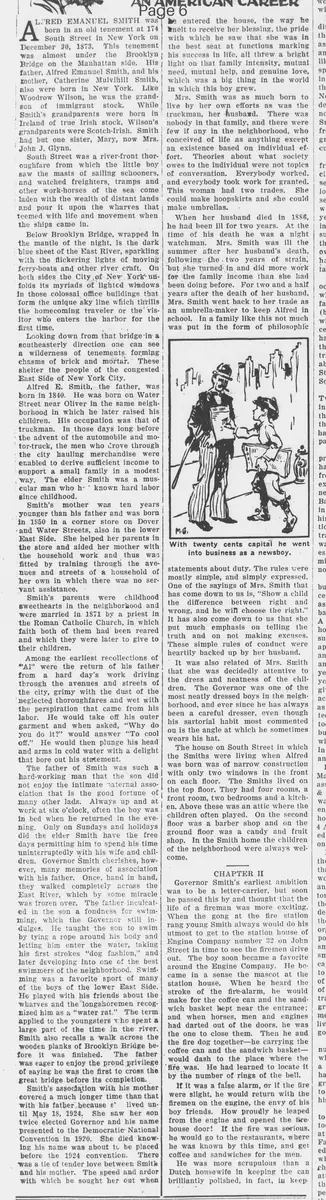
With twenty cents capital he went into business as a newsboy.
South Street was a river-front thoroughfare from which the little boy saw the masts of sailing schooners, and watched freighters, tramps and other work-horses of the sea come laden with the wealth of distant lands and pour it upon the wharves that teemed with life and movement when the ships came in.
Below Brooklyn Bridge, wrapped in the mantle of the night, is the dark blue sheet of the East River, sparkling with the flickering lights of moving ferry-boats and other river craft. On both sides the City of New York unfolds its myriads of lighted windows in those colossal office buildings that form the unique sky line which thrills the homecoming traveler or the visitor who enters the harbor for the first time.
Looking down from that bridge in a southeasterly direction one can see a wilderness of tenements, forming chasms of brick and mortar. These shelter the people of the congested East Side of New York City.
Alfred E. Smith, the father, was born in 1840. He was born on Water Street near Oliver in the same neighborhood in which he later raised his children. His occupation was that of truckman. In those days long before the advent of the automobile and motor-truck, the men who drove through the city hauling merchandise were enabled to derive sufficient income to support a small family in a modest way. The elder Smith was a muscular man who had known hard labor since childhood.
Smith's mother was ten years younger than his father and was born in 1850 in a corner store on Dover and Water Streets, also in the lower East Side. She helped her parents in the store and aided her mother with the household work and thus was fitted by training through the avenues and streets of a household of her own in which there was no servant assistance.
One of the sayings of Mrs. Smith that has come down to us is, "Show a child the difference between right and wrong, and he will choose the right."
It has also come down to us that she put much emphasis on telling the truth and on not making excuses.
These simple rules of conduct were heartily backed up by her husband.
Among the earliest recollections of "Al" were the return of his father from a hard day's work driving through the avenues and streets of the city, grimy with the dust of the neglected thoroughfares and wet with the perspiration that came from his labor. He would take off his outer garment and when asked, "Why do you do it?" would answer "To cool off." He would then plunge his head and arms in cold water with a delight that bore out his statement.
The house on South Street in which the Smiths were living when Alfred was born was of narrow construction with only two windows in the front on each floor. The Smiths lived on the top floor. They had four rooms, a front room, two bedrooms and a kitchen. Above these was an attic where the children often played. On the second floor was a barber shop and on the ground floor was a candy and fruit shop. In the Smith home the children of the neighborhood were always welcome.
Governor Smith cherishes, however, many memories of association with his father. Once, hand in hand, they walked completely across the East River, which by some miracle was frozen over. The father inculcated in the son a fondness for swimming, which the Governor still indulges. He taught the son to swim by tying a rope around his body and letting him enter the water, taking his first strokes "dog fashion," and later developing into one of the best swimmers of the neighborhood.
Swimming was a favorite sport of many of the boys of the lower East Side. He played with his friends about the wharves and the longshoremen recognized him as a "water rat." The term applied to the youngsters who spent a large part of the time in the river.
Smith also recalls a walk across the wooden planks of Brooklyn Bridge before it was finished. The father was eager to enjoy the proud privilege of saying he was the first to cross the great bridge before its completion.
Smith's association with his mother covered a much longer time than that with his father because she lived until May 18, 1924. She saw her son twice elected Governor and his name presented to the Democratic National Convention in 1920. She died knowing his name was about to be placed before the 1924 convention. There was a tie of tender love between Smith and his mother. The speed and ardor with which he sought her out when in New York, the pride with which he saw that she was in the best seat at functions marking his success in life, all threw a bright light on that family intensity, mutual need, mutual help, and genuine love, which was a big thing in the world in which this boy grew.
Mrs. Smith was as much born to live by her own efforts as was the truckman, her husband. There was nobody in that family, and there were few if any in the neighborhood, who conceived of life as anything except an existence based on individual effort.
Theories about what society owes to the individual were not topics of conversation. Everybody worked, and everybody took work for granted.
This woman had two trades. She could make hoopskirts and she could make umbrellas.
When her husband died in 1886, he had been ill for two years. At the time of his death he was a night watchman. Mrs. Smith was ill the summer after her husband's death, following the two years of strain, but she turned in and did more work for the family income than she had been doing before. For two and a half years after the death of her husband, Mrs. Smith went back to her trade as an umbrella-maker to keep Alfred in school. In a family like this not much was put in the form of philosophic statements about duty. The rules were mostly simple, and simply expressed.
With twenty cents capital he went into business as a newsboy.
What sub-type of article is it?
Essay
What themes does it cover?
Moral Virtue
Social Manners
What keywords are associated?
Alfred Smith
Early Life
New York
East Side
Family
Hard Work
Immigrant Stock
Self Reliance
Literary Details
Subject
Early Life And Family Background Of Alfred E. Smith
Form / Style
Biographical Narrative In Prose
Key Lines
"Show A Child The Difference Between Right And Wrong, And He Will Choose The Right."
It Has Also Come Down To Us That She Put Much Emphasis On Telling The Truth And On Not Making Excuses.