Thank you for visiting SNEWPapers!
Sign up free
Story
April 26, 1851
Sunbury American
Sunbury, Northumberland County, Pennsylvania
What is this article about?
A father recounts to his son his youthful disobedience and violence toward his mother, which triggered her fatal heart attack, leaving him with lifelong remorse as a cautionary tale against defying parental authority.
Clipping
OCR Quality
98%
Excellent
Full Text
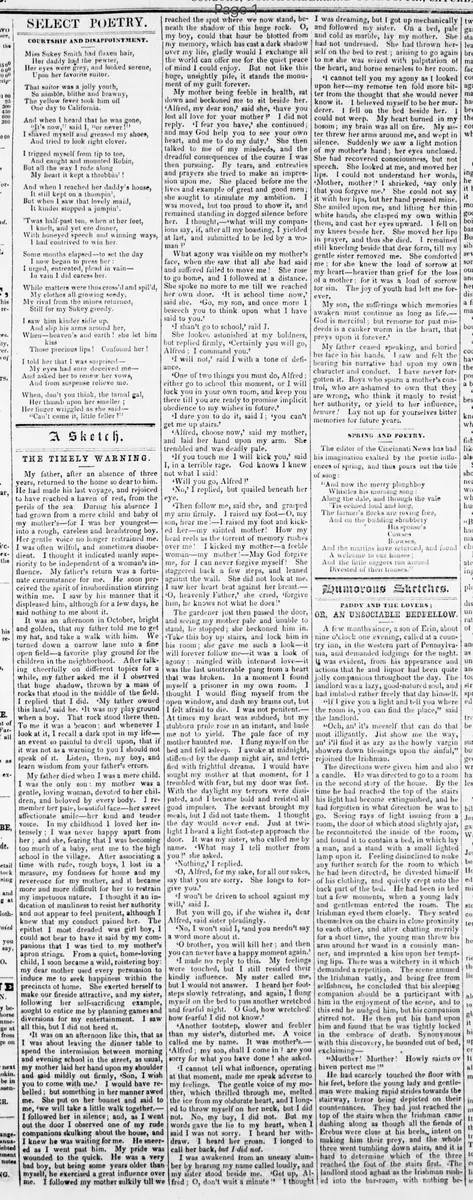
A Sketch.
THE TIMELY WARNING.
My father, after an absence of three years, returned to the home so dear to him. He had made his last voyage, and rejoiced to have reached a haven of rest, from the perils of the sea During his absence I had grown from a mere child and baby of my mother's-for I was her youngest-- into a rough, careless and headstrong boy.
Her gentle voice no longer restrained me. I was often wilful. and sometimes disobedient. I thought it indicated manly superiority to be independent of a woman's influence. My father's return was a fortunate circumstance for me. He soon perceived the spirit of insubordination stirring within me. I saw by his manner that it displeased him, although for a few days, he said nothing to me about it.
It was an afternoon in October, bright and golden, that my father told me to get my hat, and take a walk with him. We turned down a narrow lane into a fine open field-a favorite play ground for the children in the neighborhood. After talking cheerfully on different topics for a while, my father asked me if I observed that huge shadow, thrown by a mass of rocks that stood in the middle of the field.
I replied that I did. My father owned this land,' said he. It was my play ground when a boy. That rock stood there then. To me it was a beacon: and whenever I look at it, I recall a dark spot in my life- an event so painful to dwell upon, that if it was not as a warning to you I should not speak of it. Listen, then, my boy, and learn wisdom from your father's errors.
My father died when I was a mere child. I was the only son: my mother was a gentle, loving woman, devoted to her children, and beloved by every body. I remember her pale, beautiful face-her sweet affectionate smile-her kind and tender voice. In my childhood I loved her intensely: I was never happy apart from her ;and she,fearing that I was becoming too much of a baby, sent me to the high school in the village. After associating a time with rude, rough boys, I lost in a measure, my fondness for home and my reverence for my mother, and it became more and more difficult for her to restrain my impetuous nature. I thought it an indication of manliness to resist her authority and not appear to feel penitent, although I knew that my conduct pained her. The epithet I most dreaded was girl boy, I could not bear to have it said by my companions that I was tied to my mother's apron strings. From a quiet, home-loving child, I soon became a wild, roistering boy: my dear mother used every persuasion to induce me to seek happiness within the precincts of home. She exerted herself to make our fireside attractive, and my sister, following her self-sacrificing example, sought to entice me by planning games and diversions for my entertainment. I saw all this, but I did not heed it.
It was on an afternoon like this, that as I was about leaving the dinner table to spend the intermission between morning and evening school in the street, as usual, my mother laid her hand upon my shoulder and said mildly but firmly, 'Son, I wish you to come with me.' I would have rebelled;but something in her manner awed me. She put on her bonnet and said to me, 'we will take a little walk together.— I followed her in silence; and, as I went out the door I observed one of my rude companions skulking about the house, and I knew he was waiting for me. He sneered as I went past him. My pride was wounded to the quick. He was a very bad boy, but being some years older than myself, he exercised a great influence over me, I followed my mother sulkily till we reached the spot where we now stand, beneath the shadow of this huge rock. O, my boy, could that hour be blotted from my memory, which has cast a dark shadow over my life, gladly would I exchange all the world can offer me for the quiet peace of mind I could enjoy. But not like this huge, unsightly pile, it stands the monument of my guilt forever.
My mother being feeble in health, sat down and beckoned me to sit beside her. 'Alfred, my dear son,' said she, 'have you lost all love for your mother? I did not reply. I fear you have,' she continued: and may God help you to see your own heart, and me to do my duty.' She then talked to me of my misdeeds, and the dreadful consequences of the course I was then pursuing. By tears, and entreaties and prayers she tried to make an impression upon me. She placed before me the lives and example of great and good men; she sought to stimulate my ambition. I was moved, but too proud to show it, and remained standing in dogged silence before her. I thought,-'what will my companions say, if, after all my boasting, I yielded at last, and submitted to be led by a woman
What agony was visible on my mother's face, when she saw that all she had said and suffered failed to move me! She rose to go home, and I followed at a distance. She spoke no more to me till we reached her own door. 'It is school time now,' said she. Go, my son, and once more I beseech you to think upon what I have said to you.'
'I shan't go to school,' said I.
She looked astonished at my boldness, but replied firmly, 'Certainly you will go, Alfred : I command you.'
'I will not,' said I with a tone of defiance.
'One of two things you must do, Alfred: either go to school this moment, or I will lock you in your own room, and keep you there till you are ready to promise implicit obedience to my wishes in future.'
I dare you to do it, said I; 'you can't get me upstairs.'
'Alfred, choose now, said my mother, and laid her hand upon my arm. She trembled and was deadly pale.
'If you touch me I will kick you,' said I, in a terrible rage. God knows I knew not what I said!
Will you go, Alfred?
No, I replied, but quailed beneath her eye.
'Then follow me, said she, and grasped my arm firmly. I raised my foot-O, my son, hear me!--I raised my foot and kicked her-my sainted mother! How my head reels as the torrent of memory rushes over me! I kicked my mother-a feeble woman-my mother!-May God forgive me, for I can never forgive myself! She staggered back a few steps, and leaned against the wall. She did not look at me. I saw her heart beat against her breast.- O, heavenly Father,' she cried, 'forgive him. he knows not what he does!'
The gardener just then passed the door. and seeing my mother pale and unable to stand, he stopped; she beckoned him in. Take this boy up stairs, and lock him in his room; she gave me such a look-it will forever follow me--it was a look of agony; mingled with intensest love--it was the last unutterable pang from a heart that was broken. In a moment I found myself a prisoner in my own room. I thought I would fling myself from the open window, and dash my brains out, but I felt afraid to die. I was not penitent.— At times my heart was subdued, but my stubborn pride rose in an instant, and bade me not to yield. The pale face of my mother haunted me. I flung myself on the bed and fell asleep. I awoke at midnight, stiffened by the damp night air, and terrified with frightful dreams. I would have sought my mother at that moment, for I trembled with fear, but my door was fast. With the daylight my terrors were dissipated, and I became bold and resisted all good impulses. The servant brought my meals, but I did not taste them. I thought the day would never end. Just at twilight I heard a light foot-step approach the door. It was my sister, who called me by name. What may I tell mother from you? she asked.
Nothing, I replied.
O, Alfred, for my sake, for all our sakes, say that you are sorry. She longs to forgive you.'
'I won't be driven to school against my will,' said I.
But you will go, if she wishes it, dear Alfred, said sister pleadingly.
No, I won't said I, 'and you needn't say a word more
you can never have a happy moment again.'
'I made no reply to this. My feelings were touched, but I still resisted their kindly influence. My sister called me, but I would not answer. I heard her footsteps slowly retreating, and again, I flung myself on the bed to pass another wretched and fearful night. O God, how wretched! how fearful! I did not know.'
'Another footstep, slower and feebler than my sister's, disturbed me. A voice called me by name. It was mother's.- Alfred; my son, shall I come in? are you sorry for what you have done? she asked.
'I cannot tell what influence, operating at that moment, made me speak adverse to my feelings. The gentle voice of my mother, which thrilled through me, melted the ice from my obdurate heart, and I longed to throw myself on her neck, but I did not. No, my boy, I did not. But my words gave the lie to my heart, when I said I was not sorry. I heard her withdraw. I heard her groan. I longed to call her back, but I did not.
I was awakened from an uneasy slumber by hearing my name called loudly, and my sister stood beside me. 'Get up, Alfred; O, don't wait a minute!" I thought I was dreaming, but I got up mechanically and followed my sister. On a bed, pale and cold as marble, lay my mother. She had not undressed, She had thrown herself on the bed to rest ; arising to go again to me she was seized with palpitation of the heart, and borne senseless to her room.
'I cannot tell you my agony as I looked upon her-my remorse ten fold more bitter from the thought that she would never know it. I believed myself to be her murderer. I fell on the bed beside her. I could not weep. My heart burned in my bosom; my brain was all on fire. My sister threw her arms around me, and wept in silence. Suddenly we saw a light motion of my mother's hand: her eyes unclosed. She had recovered consciousness, but not speech. She looked at me, and moved her lips. I could not understand her words,
Mother, mother!' I shrieked, 'say only that you forgive me.' She could not say it with her lips, but her hand pressed mine. She smiled upon me, and lifting her thin white hands, she clasped my own within them, and cast her eyes upward. I fell on my knees beside her. She moved her lips in prayer, and thus she died. I remained still kneeling beside that dear form, till my gentle sister removed me, She comforted me; for she knew the load of sorrow at my heart—heavier than grief for the loss of a mother: for it was a load of sorrow for sin. The joy of youth had left me forever.
My son, the sufferings which memories awaken must continue as long as life.— God is merciful : but remorse for past misdeeds is a canker worm in the heart, that preys upon it forever.'
My father ceased speaking, and buried his face in his hands. I saw and felt the bearing his narrative had upon my own character and conduct. I have never forgotten it. Boys who spurn a mother's control, who are ashamed to own that they are wrong, who think it manly to resist her authority, or yield to her influence, beware! Lay not up for yourselves bitter memories for future years.
THE TIMELY WARNING.
My father, after an absence of three years, returned to the home so dear to him. He had made his last voyage, and rejoiced to have reached a haven of rest, from the perils of the sea During his absence I had grown from a mere child and baby of my mother's-for I was her youngest-- into a rough, careless and headstrong boy.
Her gentle voice no longer restrained me. I was often wilful. and sometimes disobedient. I thought it indicated manly superiority to be independent of a woman's influence. My father's return was a fortunate circumstance for me. He soon perceived the spirit of insubordination stirring within me. I saw by his manner that it displeased him, although for a few days, he said nothing to me about it.
It was an afternoon in October, bright and golden, that my father told me to get my hat, and take a walk with him. We turned down a narrow lane into a fine open field-a favorite play ground for the children in the neighborhood. After talking cheerfully on different topics for a while, my father asked me if I observed that huge shadow, thrown by a mass of rocks that stood in the middle of the field.
I replied that I did. My father owned this land,' said he. It was my play ground when a boy. That rock stood there then. To me it was a beacon: and whenever I look at it, I recall a dark spot in my life- an event so painful to dwell upon, that if it was not as a warning to you I should not speak of it. Listen, then, my boy, and learn wisdom from your father's errors.
My father died when I was a mere child. I was the only son: my mother was a gentle, loving woman, devoted to her children, and beloved by every body. I remember her pale, beautiful face-her sweet affectionate smile-her kind and tender voice. In my childhood I loved her intensely: I was never happy apart from her ;and she,fearing that I was becoming too much of a baby, sent me to the high school in the village. After associating a time with rude, rough boys, I lost in a measure, my fondness for home and my reverence for my mother, and it became more and more difficult for her to restrain my impetuous nature. I thought it an indication of manliness to resist her authority and not appear to feel penitent, although I knew that my conduct pained her. The epithet I most dreaded was girl boy, I could not bear to have it said by my companions that I was tied to my mother's apron strings. From a quiet, home-loving child, I soon became a wild, roistering boy: my dear mother used every persuasion to induce me to seek happiness within the precincts of home. She exerted herself to make our fireside attractive, and my sister, following her self-sacrificing example, sought to entice me by planning games and diversions for my entertainment. I saw all this, but I did not heed it.
It was on an afternoon like this, that as I was about leaving the dinner table to spend the intermission between morning and evening school in the street, as usual, my mother laid her hand upon my shoulder and said mildly but firmly, 'Son, I wish you to come with me.' I would have rebelled;but something in her manner awed me. She put on her bonnet and said to me, 'we will take a little walk together.— I followed her in silence; and, as I went out the door I observed one of my rude companions skulking about the house, and I knew he was waiting for me. He sneered as I went past him. My pride was wounded to the quick. He was a very bad boy, but being some years older than myself, he exercised a great influence over me, I followed my mother sulkily till we reached the spot where we now stand, beneath the shadow of this huge rock. O, my boy, could that hour be blotted from my memory, which has cast a dark shadow over my life, gladly would I exchange all the world can offer me for the quiet peace of mind I could enjoy. But not like this huge, unsightly pile, it stands the monument of my guilt forever.
My mother being feeble in health, sat down and beckoned me to sit beside her. 'Alfred, my dear son,' said she, 'have you lost all love for your mother? I did not reply. I fear you have,' she continued: and may God help you to see your own heart, and me to do my duty.' She then talked to me of my misdeeds, and the dreadful consequences of the course I was then pursuing. By tears, and entreaties and prayers she tried to make an impression upon me. She placed before me the lives and example of great and good men; she sought to stimulate my ambition. I was moved, but too proud to show it, and remained standing in dogged silence before her. I thought,-'what will my companions say, if, after all my boasting, I yielded at last, and submitted to be led by a woman
What agony was visible on my mother's face, when she saw that all she had said and suffered failed to move me! She rose to go home, and I followed at a distance. She spoke no more to me till we reached her own door. 'It is school time now,' said she. Go, my son, and once more I beseech you to think upon what I have said to you.'
'I shan't go to school,' said I.
She looked astonished at my boldness, but replied firmly, 'Certainly you will go, Alfred : I command you.'
'I will not,' said I with a tone of defiance.
'One of two things you must do, Alfred: either go to school this moment, or I will lock you in your own room, and keep you there till you are ready to promise implicit obedience to my wishes in future.'
I dare you to do it, said I; 'you can't get me upstairs.'
'Alfred, choose now, said my mother, and laid her hand upon my arm. She trembled and was deadly pale.
'If you touch me I will kick you,' said I, in a terrible rage. God knows I knew not what I said!
Will you go, Alfred?
No, I replied, but quailed beneath her eye.
'Then follow me, said she, and grasped my arm firmly. I raised my foot-O, my son, hear me!--I raised my foot and kicked her-my sainted mother! How my head reels as the torrent of memory rushes over me! I kicked my mother-a feeble woman-my mother!-May God forgive me, for I can never forgive myself! She staggered back a few steps, and leaned against the wall. She did not look at me. I saw her heart beat against her breast.- O, heavenly Father,' she cried, 'forgive him. he knows not what he does!'
The gardener just then passed the door. and seeing my mother pale and unable to stand, he stopped; she beckoned him in. Take this boy up stairs, and lock him in his room; she gave me such a look-it will forever follow me--it was a look of agony; mingled with intensest love--it was the last unutterable pang from a heart that was broken. In a moment I found myself a prisoner in my own room. I thought I would fling myself from the open window, and dash my brains out, but I felt afraid to die. I was not penitent.— At times my heart was subdued, but my stubborn pride rose in an instant, and bade me not to yield. The pale face of my mother haunted me. I flung myself on the bed and fell asleep. I awoke at midnight, stiffened by the damp night air, and terrified with frightful dreams. I would have sought my mother at that moment, for I trembled with fear, but my door was fast. With the daylight my terrors were dissipated, and I became bold and resisted all good impulses. The servant brought my meals, but I did not taste them. I thought the day would never end. Just at twilight I heard a light foot-step approach the door. It was my sister, who called me by name. What may I tell mother from you? she asked.
Nothing, I replied.
O, Alfred, for my sake, for all our sakes, say that you are sorry. She longs to forgive you.'
'I won't be driven to school against my will,' said I.
But you will go, if she wishes it, dear Alfred, said sister pleadingly.
No, I won't said I, 'and you needn't say a word more
you can never have a happy moment again.'
'I made no reply to this. My feelings were touched, but I still resisted their kindly influence. My sister called me, but I would not answer. I heard her footsteps slowly retreating, and again, I flung myself on the bed to pass another wretched and fearful night. O God, how wretched! how fearful! I did not know.'
'Another footstep, slower and feebler than my sister's, disturbed me. A voice called me by name. It was mother's.- Alfred; my son, shall I come in? are you sorry for what you have done? she asked.
'I cannot tell what influence, operating at that moment, made me speak adverse to my feelings. The gentle voice of my mother, which thrilled through me, melted the ice from my obdurate heart, and I longed to throw myself on her neck, but I did not. No, my boy, I did not. But my words gave the lie to my heart, when I said I was not sorry. I heard her withdraw. I heard her groan. I longed to call her back, but I did not.
I was awakened from an uneasy slumber by hearing my name called loudly, and my sister stood beside me. 'Get up, Alfred; O, don't wait a minute!" I thought I was dreaming, but I got up mechanically and followed my sister. On a bed, pale and cold as marble, lay my mother. She had not undressed, She had thrown herself on the bed to rest ; arising to go again to me she was seized with palpitation of the heart, and borne senseless to her room.
'I cannot tell you my agony as I looked upon her-my remorse ten fold more bitter from the thought that she would never know it. I believed myself to be her murderer. I fell on the bed beside her. I could not weep. My heart burned in my bosom; my brain was all on fire. My sister threw her arms around me, and wept in silence. Suddenly we saw a light motion of my mother's hand: her eyes unclosed. She had recovered consciousness, but not speech. She looked at me, and moved her lips. I could not understand her words,
Mother, mother!' I shrieked, 'say only that you forgive me.' She could not say it with her lips, but her hand pressed mine. She smiled upon me, and lifting her thin white hands, she clasped my own within them, and cast her eyes upward. I fell on my knees beside her. She moved her lips in prayer, and thus she died. I remained still kneeling beside that dear form, till my gentle sister removed me, She comforted me; for she knew the load of sorrow at my heart—heavier than grief for the loss of a mother: for it was a load of sorrow for sin. The joy of youth had left me forever.
My son, the sufferings which memories awaken must continue as long as life.— God is merciful : but remorse for past misdeeds is a canker worm in the heart, that preys upon it forever.'
My father ceased speaking, and buried his face in his hands. I saw and felt the bearing his narrative had upon my own character and conduct. I have never forgotten it. Boys who spurn a mother's control, who are ashamed to own that they are wrong, who think it manly to resist her authority, or yield to her influence, beware! Lay not up for yourselves bitter memories for future years.
What sub-type of article is it?
Biography
Family Drama
Tragedy
What themes does it cover?
Filial Piety
Family
Tragedy
What keywords are associated?
Filial Disobedience
Mother's Death
Remorse
Moral Warning
Family Authority
What entities or persons were involved?
Alfred
Mother
Sister
Father
Where did it happen?
Open Field With Rock Near Home Village
Story Details
Key Persons
Alfred
Mother
Sister
Father
Location
Open Field With Rock Near Home Village
Event Date
An Afternoon In October
Story Details
Youthful Alfred disobeys and kicks his frail mother after she tries to counsel him, leading to her fatal heart palpitation; he experiences profound remorse and later warns his own son against similar insubordination.