Thank you for visiting SNEWPapers!
Sign up free
Story
July 12, 1841
New York Tribune
New York, New York County, New York
What is this article about?
Editorial in the New-York Tribune on July 12, 1841, advocating for the General Bankrupt Law. It criticizes opposition letters from New York merchants for lacking substance, argues the law would boost labor and economy, and claims most solvent merchants support it to aid those ruined by prior policies.
Clipping
OCR Quality
98%
Excellent
Full Text
THE TRIBUNE.
NEW-YORK, MONDAY MORNING, JULY 12, 1841.
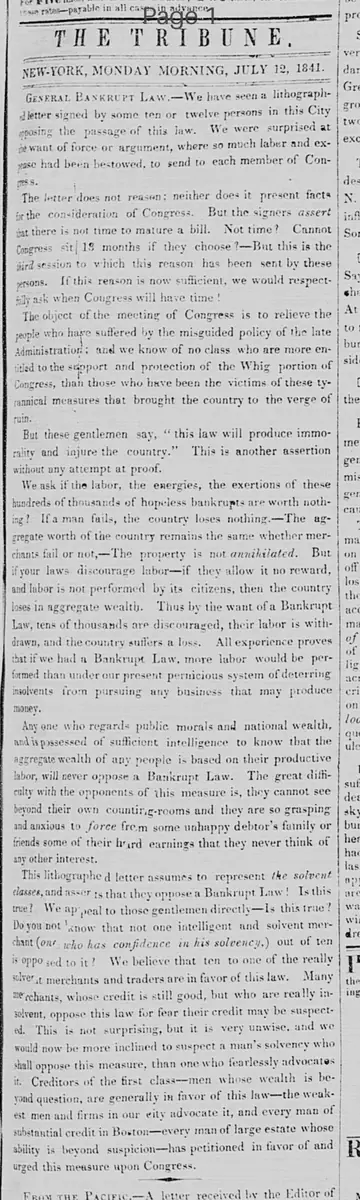
General Bankrupt Law.—We have seen a lithographed letter signed by some ten or twelve persons in this City opposing the passage of this law. We were surprised at the want of force or argument, where so much labor and expense had been bestowed, to send to each member of Congress.
The letter does not reason; neither does it present facts in the consideration of Congress. But the signers assert that there is not time to mature a bill. Not time? Cannot Congress sit 18 months if they choose?—But this is the third session to which this reason has been sent by these persons. If this reason is now sufficient, we would respectfully ask when Congress will have time!
The object of the meeting of Congress is to relieve the people who have suffered by the misguided policy of the late Administration: and we know of no class who are more entitled to the support and protection of the Whig portion of Congress, than those who have been the victims of these tyrannical measures that brought the country to the verge of ruin.
But these gentlemen say, 'this law will produce immorality and injure the country.' This is another assertion without any attempt at proof.
We ask if the labor, the energies, the exertions of these hundreds of thousands of hopeless bankrupts are worth nothing? If a man fails, the country loses nothing.—The aggregate worth of the country remains the same whether merchants fail or not,—The property is not annihilated. But if your laws discourage labor—if they allow it no reward, and labor is not performed by its citizens, then the country loses in aggregate wealth. Thus by the want of a Bankrupt Law, tens of thousands are discouraged, their labor is withdrawn, and the country suffers a loss. All experience proves that if we had a Bankrupt Law, more labor would be performed than under our present pernicious system of deterring insolvents from pursuing any business that may produce money.
Any one who regards public morals and national wealth, and is possessed of sufficient intelligence to know that the aggregate wealth of any people is based on their productive labor, will never oppose a Bankrupt Law. The great difficulty with the opponents of this measure is, they cannot see beyond their own counting-rooms and they are so grasping and anxious to force from some unhappy debtor's family or friends some of their hard earnings that they never think of any other interest.
This lithographed letter assumes to represent the solvent classes, and asserts that they oppose a Bankrupt Law! Is this true? We appeal to those gentlemen directly—Is this true? Do you not know that not one intelligent and solvent merchant (one who has confidence in his solvency) out of ten is opposed to it? We believe that ten to one of the really solvent merchants and traders are in favor of this law. Many merchants, whose credit is still good, but who are really insolvent, oppose this law for fear their credit may be suspected. This is not surprising, but it is very unwise, and we would now be more inclined to suspect a man's solvency who shall oppose this measure, than one who fearlessly advocates it. Creditors of the first class—men whose wealth is beyond question, are generally in favor of this law—the weakest men and firms in our city advocate it, and every man of substantial credit in Boston—every man of large estate whose ability is beyond suspicion—has petitioned in favor of and urged this measure upon Congress.
NEW-YORK, MONDAY MORNING, JULY 12, 1841.
General Bankrupt Law.—We have seen a lithographed letter signed by some ten or twelve persons in this City opposing the passage of this law. We were surprised at the want of force or argument, where so much labor and expense had been bestowed, to send to each member of Congress.
The letter does not reason; neither does it present facts in the consideration of Congress. But the signers assert that there is not time to mature a bill. Not time? Cannot Congress sit 18 months if they choose?—But this is the third session to which this reason has been sent by these persons. If this reason is now sufficient, we would respectfully ask when Congress will have time!
The object of the meeting of Congress is to relieve the people who have suffered by the misguided policy of the late Administration: and we know of no class who are more entitled to the support and protection of the Whig portion of Congress, than those who have been the victims of these tyrannical measures that brought the country to the verge of ruin.
But these gentlemen say, 'this law will produce immorality and injure the country.' This is another assertion without any attempt at proof.
We ask if the labor, the energies, the exertions of these hundreds of thousands of hopeless bankrupts are worth nothing? If a man fails, the country loses nothing.—The aggregate worth of the country remains the same whether merchants fail or not,—The property is not annihilated. But if your laws discourage labor—if they allow it no reward, and labor is not performed by its citizens, then the country loses in aggregate wealth. Thus by the want of a Bankrupt Law, tens of thousands are discouraged, their labor is withdrawn, and the country suffers a loss. All experience proves that if we had a Bankrupt Law, more labor would be performed than under our present pernicious system of deterring insolvents from pursuing any business that may produce money.
Any one who regards public morals and national wealth, and is possessed of sufficient intelligence to know that the aggregate wealth of any people is based on their productive labor, will never oppose a Bankrupt Law. The great difficulty with the opponents of this measure is, they cannot see beyond their own counting-rooms and they are so grasping and anxious to force from some unhappy debtor's family or friends some of their hard earnings that they never think of any other interest.
This lithographed letter assumes to represent the solvent classes, and asserts that they oppose a Bankrupt Law! Is this true? We appeal to those gentlemen directly—Is this true? Do you not know that not one intelligent and solvent merchant (one who has confidence in his solvency) out of ten is opposed to it? We believe that ten to one of the really solvent merchants and traders are in favor of this law. Many merchants, whose credit is still good, but who are really insolvent, oppose this law for fear their credit may be suspected. This is not surprising, but it is very unwise, and we would now be more inclined to suspect a man's solvency who shall oppose this measure, than one who fearlessly advocates it. Creditors of the first class—men whose wealth is beyond question, are generally in favor of this law—the weakest men and firms in our city advocate it, and every man of substantial credit in Boston—every man of large estate whose ability is beyond suspicion—has petitioned in favor of and urged this measure upon Congress.
What sub-type of article is it?
Historical Event
What themes does it cover?
Justice
Misfortune
Moral Virtue
What keywords are associated?
Bankrupt Law
Congress
Merchants
Economic Policy
Insolvency
Whig Party
Where did it happen?
New York
Story Details
Location
New York
Event Date
July 12, 1841
Story Details
The editorial argues in favor of the General Bankrupt Law, countering a lithographed opposition letter from New York merchants by highlighting its benefits for economic recovery, labor encouragement, and moral support for victims of past policies, while noting broad support among solvent merchants.