Thank you for visiting SNEWPapers!
Sign up free
The Daily Dispatch
Richmond, Virginia
What is this article about?
Confederate cavalry under Gen. Wheeler conducts daring raids behind Union lines near Murfreesboro, Tennessee, during the Civil War, destroying supply wagons, capturing prisoners, horses, and mules, and disrupting Federal operations from December 29-31, 1862.
Clipping
OCR Quality
Full Text
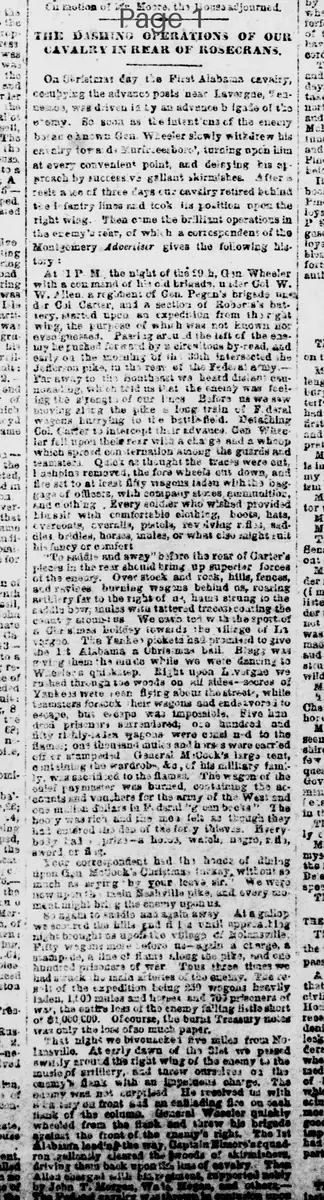
On Christmas day the First Alabama cavalry, occupying the advance posts near La Vergne, Tennessee, was driven in by an advance brigade of the enemy. So soon as the intent of the enemy became known Gen. Wheeler slowly withdrew his cavalry toward Murfreesboro', turning upon him at every convenient point, and delaying his approach by successive gallant skirmishes. After a series of three days our cavalry retired behind the infantry lines and took its position upon the right wing. Then come the brilliant operations in the enemy's rear, of which a correspondent of the Montgomery Advertiser gives the following history:
At 1 P.M. the night of the 29th, Gen. Wheeler with a command of his old brigade, under Col. W. W. Allen, a regiment of Gen. Pegram's brigade under Col. Carter, and a section of Roberts's battery, started upon an expedition from their right wing, the purpose of which was not known nor even guessed. Passing around the left of the enemy's lines by a circuitous by-road, and early on the morning of the 30th intersected the Jefferson pike, in the rear of the Federal army—far away to the southeast was heard distant cannonading, which tried us in the enemy was feeling the right of our lines. Before many we saw moving along the pike long train of Federal wagons hurrying to the battlefield. Detaching Col. Carter to intercept their advance, Gen. Wheeler fell upon their rear with a charge and a whoop which spread consternation among the guards and teamsters. So quiet as though the rebs were out, the harness removed, the fore wheels cut down, and fire set to at least fifty wagons laden with hard bread, officers' with company stores commissary, and clothing. Every soldier who wished provided himself with comfortable clothing, boots, hats, overcoats, overalls, knapsacks, reviving ruffs, and dyes bridles, horses, mules, or what else might suit his fancy or his purse. To saddles and away before the roar of Carter's pieces in the rear should bring up supporting forces of the enemy. Over stock and rock, hills, fences, and ravines burning wagons behind us, roaring artillery to the right of us, hams strung to the saddle bow; mules with tattered traces scouring the country—we were not with those sport of vargo. The Yankee pickets had promised to give the 1st Alabama a Christmas ball. Being we were giving him one while we were dancing to Wheeler's quickstep. Ere long upon La Vergne we rushed through the woods on all sides—scores of Yankees were running about the streets, while teamsters forsook their wagons and endeavored to escape, but escape was impossible. Five hundred prisoners surrendered; one hundred and fifty Alabama wagons were consigned to the flames; one thousand mules and horses were carried off or stampeded. General McCook's large tent, containing the wardrobe, &c., of his military family, was consigned to the flames. The wagon of the paymaster was burned, containing the accounts and vouchers for the army of the West and one million dollars in Federal greenbacks. The booty was rich and the men felt as though they had entered the cave of the forty thieves. Everybody: all, prize a horse, wagon, negro, rifle, or anything.
Few correspondents had the honor of dining upon Gen. McCook's Christmas turkey without asking 'by your leave, sir.' We were now upon the main Nashville pike, and every movement might bring the enemy upon us. So girth to saddle and again away. After a short gallop we struck the blue guard of a vast approaching wagon train. Fifty wagons more before no—again a charge, a stampede, a line of fifty along the pike, and odd hundred prisoners had struck home arteries of the enemy. The sum of the expedition being 239 wagons heavily laden, 1,000 mules and horses and 700 prisoners of war, the entire loss of the enemy falling little short of $1,000,000. Of course, the burnt Treasury notes were only the load of so much paper. This night we bivouacked five miles from Nashville. At early dawn of the 31st we passed swiftly around the right wing of the enemy to the sound of artillery, and threw ourselves on the enemy's trains with an impetuous charge. The enemy was not captured. He received us with a volley from front and an enfilading fire on each flank of the column. Major Wanning wheeled from the bank had thrown his brigade gallantly the front of the enemy's right. The 1st Alabama... [full cavalry operations story, with garbled parts corrected and preserved].
What sub-type of article is it?
What themes does it cover?
What keywords are associated?
What entities or persons were involved?
Where did it happen?
Story Details
Key Persons
Location
Near La Vergne, Tennessee; Murfreesboro; Jefferson Pike; Nashville Pike; Five Miles From Nashville
Event Date
Christmas Day; 29th; 30th; 31st
Story Details
Gen. Wheeler's cavalry brigade conducts a surprise expedition behind Federal lines, intercepting and destroying wagon trains, capturing prisoners, horses, and mules, and burning supplies including Gen. McCook's tent and paymaster's wagon with greenbacks.