Thank you for visiting SNEWPapers!
Sign up free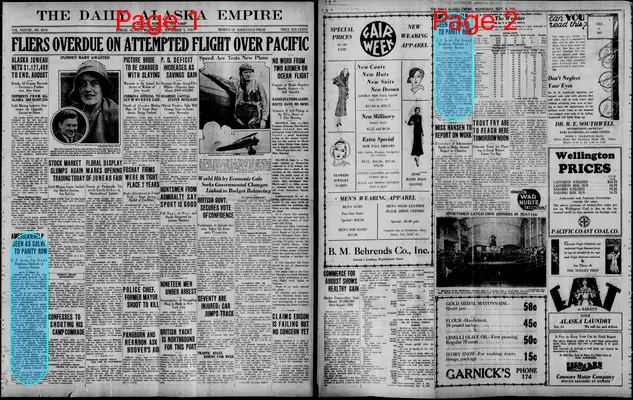
The Daily Alaska Empire
Juneau, Juneau County, Alaska
What is this article about?
US stance on arms cuts provides hope for resolving Franco-German parity dispute at upcoming Geneva disarmament conference, bolstered by Anglo-American cooperation involving Hoover, MacDonald, and Stimson.
Merged-components note: Continuation of American help in disarmament article from page 1 to page 2.
Clippings
1 of 2
OCR Quality
Full Text
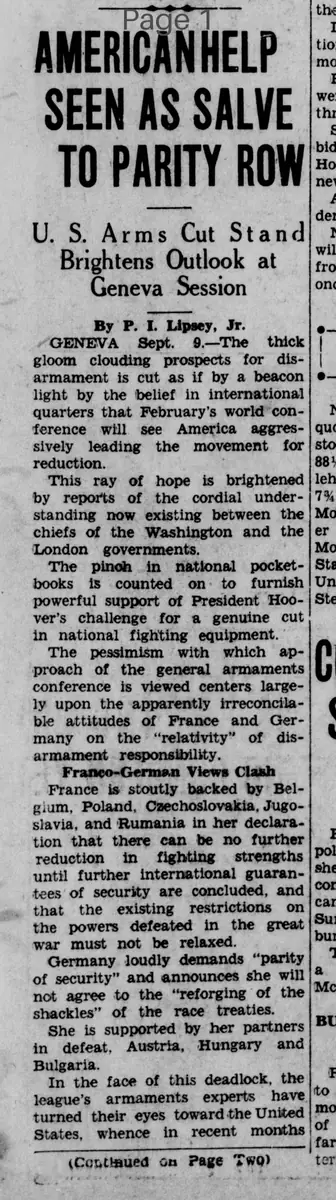
SEEN AS SALVE
TO PARITY ROW
U. S. Arms Cut Stand
Brightens Outlook at
Geneva Session
By P. L. Lipsey, Jr.
GENEVA Sept. 9.-The thick gloom clouding prospects for disarmament is cut as if by a beacon light by the belief in international quarters that February's world conference will see America aggressively leading the movement for reduction.
This ray of hope is brightened by reports of the cordial understanding now existing between the chiefs of the Washington and the London governments.
The pinch in national pocketbooks is counted on to furnish powerful support of President Hoover's challenge for a genuine cut in national fighting equipment.
The pessimism with which approach of the general armaments conference is viewed centers largely upon the apparently irreconcilable attitudes of France and Germany on the "relativity" of disarmament responsibility.
Franco-German Views Clash
France is stoutly backed by Belgium, Poland, Czechoslovakia, Jugoslavia, and Rumania in her declaration that there can be no further reduction in fighting strengths until further international guarantees of security are concluded, and that the existing restrictions on the powers defeated in the great war must not be relaxed.
Germany loudly demands parity of security and announces she will not agree to the "reforging of the shackles" of the race treaties.
She is supported by her partners in defeat, Austria, Hungary and Bulgaria.
In the face of this deadlock, the league's armaments experts have turned their eyes toward the United States, whence in recent months (Continued on Page Two)
AMERICAN HELP
SEEN AS SALVE
TO PARITY ROW
U. S. Arms Cut Stand
Brightens Outlook at
Geneva Session
(Continued from Page One)
have come many evidences of vital concerns over the arms problem.
Anglo-American Solution
Standing and working together, the United States and Great Britain-students of world affairs believe-may be able to solve the Franco-German puzzle.
Geneva observers remember the personal conversation of President Hoover and Ramsay MacDonald, British premier, and in recent weeks they remarked the chumming together of Premier MacDonald and Henry L. Stimson, American secretary of state.
The MacDonald-Stimson talks and rambles are seen here as another valuable contribution to British-American concord, so markedly advanced by the Rapidan parley two years ago.
Friends of world peace found great significance in the British leader's words when he said of himself and his American colleague: "We are friends."
What sub-type of article is it?
What keywords are associated?
What entities or persons were involved?
Where did it happen?
Foreign News Details
Primary Location
Geneva
Event Date
Sept. 9
Key Persons
Outcome
hopeful outlook for disarmament conference due to us leadership and anglo-american cooperation amid franco-german deadlock on parity and security guarantees.
Event Details
Belief that US will lead arms reduction at February's Geneva conference brightens prospects, supported by US-UK understanding. France, backed by Belgium, Poland, Czechoslovakia, Jugoslavia, Rumania, insists on security guarantees before reductions and maintains Versailles restrictions. Germany, supported by Austria, Hungary, Bulgaria, demands parity and rejects renewed treaty shackles. League experts look to US for solution, recalling Hoover-MacDonald and MacDonald-Stimson meetings.