Thank you for visiting SNEWPapers!
Sign up free
The National Intelligencer And Washington Advertiser
Washington, District Of Columbia
What is this article about?
Dispatch from Tripoli, July 17, describes the city's beauty amid palm forests, its history on ancient sites, fortifications, dusty streets causing health issues, a preserved Roman triumphal arch honoring Marcus Aurelius, consular privileges for Europeans, water shortages, ancient medals, and a formal audience with the Bey where visitors were honored but his son denied boarding their frigate.
Merged-components note: Continuation of the report on Tripoli from page 1 to page 2, connected by sequential reading order and matching text content
Clippings
1 of 2
OCR Quality
Full Text
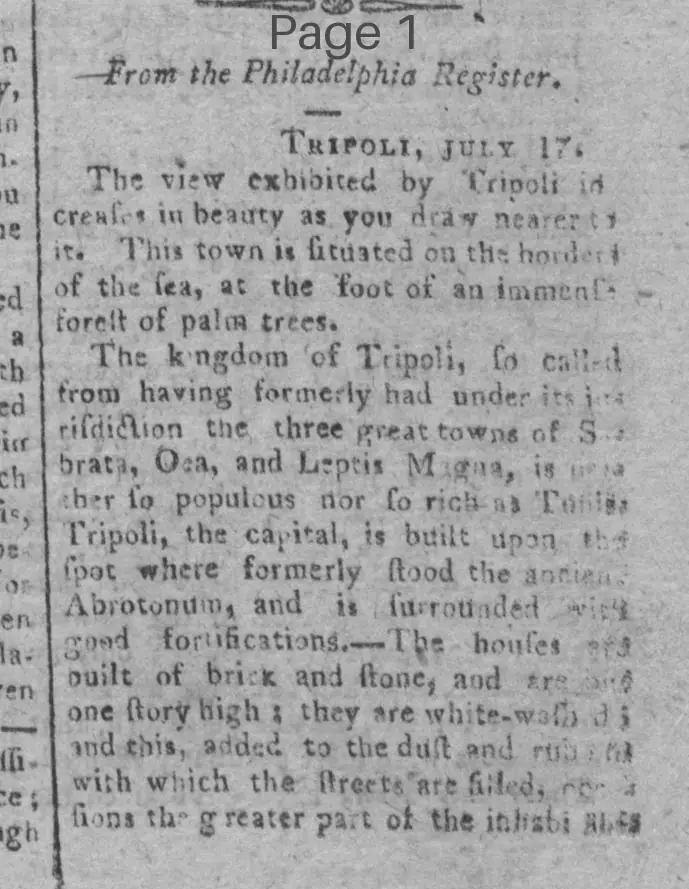
TRIPOLI, JULY 17.
The view exhibited by Tripoli increases in beauty as you draw nearer to it. This town is situated on the border of the sea, at the foot of an immense forest of palm trees.
The kingdom of Tripoli, so called from having formerly had under its jurisdiction the three great towns of Sabrata, Oea, and Leptis Magna, is neither so populous nor so rich as Tunis. Tripoli, the capital, is built upon the spot where formerly stood the ancient Abrotonum, and is surrounded with good fortifications.—The houses are built of brick and stone, and are one story high: they are white-washed; and this, added to the dust and rubbish with which the streets are filled, renders the greater part of the inhabitants
to have over even a complaint very prevalent among the Tunisians, owing to the same cause. The gates of this place are arched, and so small that it is necessary to stoop in order to get through them: a custom established to render the passage more difficult in the time of an insurrection.
At the entrance into the city is a triumphal monument of the Composite order, which, according to the inscription, seems to have been erected in honor of Marcus Aurelius, and his colleague, on account of the victory which the latter obtained over the Armenians. The arches, vine leaves, and trophies, are in good preservation: but the statues, which are in the niches, have been destroyed; and the rage of superstition has mutilated the four busts placed above them, as well as all the figures in bas-relief. On that side of the arch, however, which contains the inscription, is an upright figure by the side of a woman sitting, and surrounded by little children, the drapery of which is perfectly entire. Some of the pieces of marble, of which this monument is composed, are of an enormous size.
On account of the great heat, I was not able to copy what remains of the inscription.
Some of the Tripolitans, perceiving that we looked attentively at this monument, began to examine it also themselves -and one of them even extended his curiosity so far as to ask us, at what period the infidels had erected it.
The Franks enjoy privileges here, of very great importance, in a country where the populace are under so little subordination. For example, if one of them happen to have been insulted, he has the right of causing the offender to be arrested by one of the Janizaries belonging to the consul of his nation, and taken before a judge. There are consuls here from France, England, Holland, Denmark, Spain, Venice, and Naples.
There are neither wells nor fountains in this place; and notwithstanding every precaution that can be taken to preserve the rain water, it often happens, in dry seasons, that none of it is to be found.
Roman and African medals, both of silver and copper, are found in this country: we purchased some copper ones, which have a horse's head on one side, with a palm tree and dates on the other.
We yesterday paid a visit to the Bey, who did us the honor to give us a particular audience in a spacious saloon. A great number of persons, among whom the most conspicuous was his own son, were standing before him, while a slave with a large fan, made of swan's feathers, cooled the air, and drove the flies from him. He was armed with pistols and scimitars. You would naturally suppose that the first compliment was made by the consul. But this was not the case; a janizary, stepping before the company advanced towards the Bey, and, after kissing his hands, spoke a few words to him. The Bey at last desired us to be seated; and soon after our slaves spread large pieces of muslin fringed with gold upon our knees, and brought us coffee and various sorts of sherbet. One of the slaves then poured rose-water over us, whilst another perfumed us with myrrh and aloes—all the while making several inclinations of the head.
The son of the Bey having expressed a wish to see our frigate, a Council was held to determine whether this proceeding was consistent with his dignity; but it being observed, that neither his father nor grandfather had ever been on board a foreign ship of war, it was decided in the negative.
What sub-type of article is it?
What keywords are associated?
What entities or persons were involved?
Where did it happen?
Foreign News Details
Primary Location
Tripoli
Event Date
July 17
Key Persons
Event Details
Descriptive account of Tripoli's landscape, history, architecture including a Roman triumphal monument, local customs, consular privileges for European nations, water scarcity, ancient medals purchased, and a formal audience with the Bey where visitors received coffee, sherbet, and perfumes; the Bey's son was denied permission to board the visitors' frigate to preserve dignity.