Thank you for visiting SNEWPapers!
Sign up free
Literary
February 20, 1752
The Virginia Gazette
Richmond, Williamsburg, Richmond County, Virginia
What is this article about?
An essay arguing that the pursuit of literary fame is as precarious and uncertain as political or military ambition, challenging scholars' self-congratulatory views of their stable, superior condition. It uses historical examples and Latin quotes to illustrate the instability of reputation in both spheres.
Clipping
OCR Quality
95%
Excellent
Full Text
Terra salutiferas herbas, eademque nocentes,
Nutrit; Curicae proxima saepe rosa est.
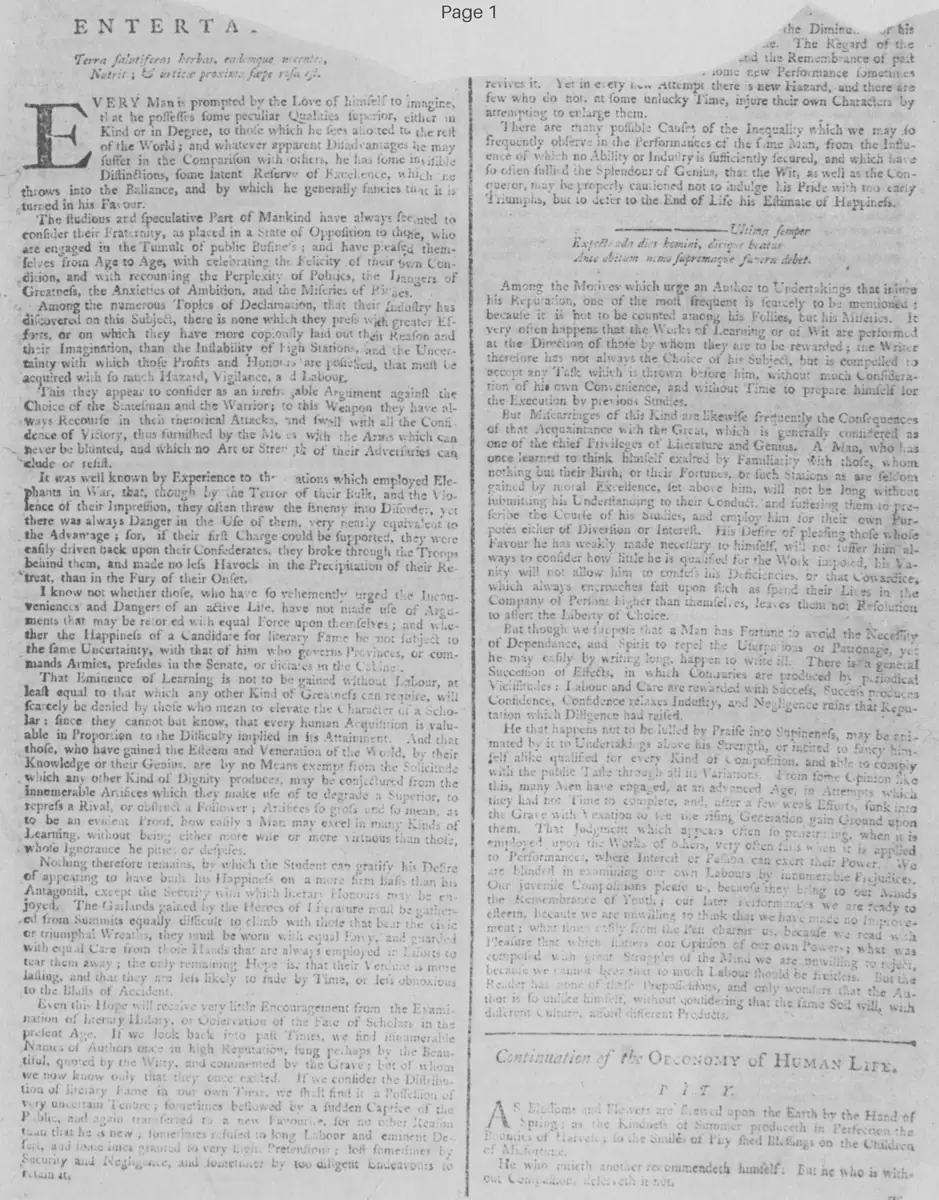
EVERY Man is prompted by the Love of himself to imagine,
that he possesses some peculiar Qualities superior,
either in
Kind or in Degree, to those which he sees allotted to the rest
of the World; and whatever apparent Disadvantages he may
suffer in the Comparison with others, he has some invisible
Distinctions, some latent Reserve of Excellence, which he
throws into the Balance, and by which he generally fancies that it is
turned in his Favour.
The studious and speculative Part of Mankind have always seemed to
consider their Fraternity, as placed in a State of Opposition to those, who
are engaged in the Tumult of public Business; and have pleased them-
themselves from Age to Age, with celebrating the Felicity of their own Con-
dition, and with recounting the Perplexity of Politics, the Dangers of
Greatness, the Anxieties of Ambition, and the Miseries of Riches.
Among the numerous Topics of Declamation, that their Industry has
discovered on this Subject, there is none which they press with greater Ef-
forts, or on which they have more copiously laid out their Reason and
their Imagination, than the Instability of high Stations, and the Uncer-
tainty with which those Profits and Honours, are purchased, that must be
acquired with so much Hazard, Vigilance, and Labour.
This they appear to consider as an irrefusable Argument against the
Choice of the Statesman and the Warrior; to this Weapon they have al-
ways Recourse in their rhetorical Attacks, and swell with all the Confi-
dence of Victory, thus furnished by the Muses with the Arms which can
never be blunted, and which no Art or Strength of their Adversaries can
elude or resist.
It was well known by Experience to those
Nations which employed Ele-
phants in War, that, though by the Tenor of their Bulk, and the Vio-
lence of their Impression, they often threw the Enemy into Disorder, yet
there was always Danger in the Use of them, very nearly equivalent to
the Advantage; or, if their first Charge could be supported, they were
easily driven back upon their Confederates. They broke through the Troops
behind them, and made no less Havoc in the Precipitation of their Re-
treat, than in the Fury of their Onset.
I know not whether those, who have so vehemently urged the Incon-
veniences and Dangers of an active Life, have not made use of Argu-
ments that may be retorted with equal Force upon themselves; and whe-
ther the Happiness of a Candidate for literary Fame be not subject to
the same Uncertainty, with that of him who governs Provinces, or com-
mands Armies, presides in the Senate, or dictates in the Cabinet.
That Eminence of Learning is not to be gained without Labour, at
least equal to that which any other Kind of Greatness can require, will
scarcely be denied by these who mean to elevate the Character of a Scho-
lar; since they cannot but know, that every human Acquisition is valu-
able in Proportion to the Difficulty implied in its Attainment. And that
those, who have gained the Esteem and Veneration of the World, by their
Knowledge or their Genius, are by no Means exempt from the Solicitude
which any other Kind of Dignity produces, may be conjectured from the
innumerable Artifices which they make use of to degrade a Superior, to
suppress a Rival, or obstruct a Follower; Artifices so gross and so mean, as
to be an evident Proof, how easily a Man may excel in many Kinds of
Learning, without being either more wise or more virtuous than those,
whose Ignorance he pities or derides.
Nothing therefore remains, by which the Student can gratify his Desire
of appearing to have built his Happiness on a more firm Basis than his
Antagonist, except the Security with which literary Honours may be en-
joyed. The Garlands gained by the Heroes of Literature must be gather-
ed from Summits equally difficult to climb with those that bear the civic
or triumphal Wreaths, they must be worn with equal Envy, and guarded
with equal Care from those Hands that are always employed in Efforts to
tear them away; the only remaining Hope is, that their Duration is more
lasting, and that they are less likely to fade by Time, or less obnoxious
to the Blasts of Accident.
Even this Hope will receive very little Encouragement from the Exami-
Nation of literary History, or Observation of the Fate of Scholars in the
present Age. If we look back into past Times, we find innumerable
Names of Authors once in high Reputation, sung perhaps by the Beau-
tiful, quoted by the Witty, and commented by the Grave; but of whom
we now know only that they once existed. If we consider the Distribu-
tion of literary Fame in our own Time, we shall find it a Possession of
very uncertain Tenure; sometimes bestowed by a sudden Caprice of the
Public, and again transferred to a new Favourite, for no other Reason
than that he is new, sometimes raised to long Labour and eminent De-
serving, and sometimes granted to very low Pretensions; lost sometimes by
Security and Negligence, and sometimes by too diligent Endeavours to
retain it. The diminution of his fame revives it. Yet in every Attempt there is new Hazard, and there are
few who do not, at some unlucky Time, injure their own Characters by
attempting to enlarge them.
There are many possible Causes of the Inequality which we may so
frequently observe in the Performances of the same Man, from the Influ-
ence of which no Ability or Industry is sufficiently secured, and which have
so often sullied the Splendour of Genius, that the Wit, as well as the Con-
queror, may be properly cautioned not to indulge his Pride with too early
Triumphs, but to defer to the End of Life his Estimate of Happiness.
Ultima
Expectanda dies homini, dicique beatus
Ante obitum nemo supremaque funera debet.
Among the Motives which urge an Author to Undertakings that injure
his Reputation, one of the most frequent is scarcely to be mentioned;
because it is not to be counted among his Follies, but his Miseries.
It
very often happens that the Works of Learning or of Wit are performed
at the Direction of those by whom they are to be rewarded; the Writer
therefore has not always the Choice of his Subject, but is compelled to
accept any Task which is thrown before him, without much Considera-
tion of his own Convenience, and without Time to prepare himself for
the Execution by previous Studies.
But Misearriages of this Kind are likewise frequently the Consequences
of that Acquaintance with the Great, which is generally considered as
one of the chief Privileges of Literature and Genius. A Man, who has
once learned to think himself exalted by Familiarity with those, whom
nothing but their Birth, or their Fortunes, or such Stations as are seldom
gained by moral Excellence, set above him, will not be long without
submitting his Understanding to their Conduct, and suffering them to pre-
scribe the Course of his Studies, and employ him for their own Pur-
poses either of Diversion or Interest. His Desire of pleasing those whose
Favour he has weakly made necessary to himself, will not suffer him al-
ways to consider how little he is qualified for the Work imposed, his Va-
nity will not allow him to confess his Deficiencies, or that Cowardice,
which always encroaches art upon such as spend their Lives in the
Company of Persons higher than themselves, leaves them not Resolution
to assert the Liberty of Choice.
But though we suppose that a Man has Fortune to avoid the Necessity
of Dependence, and Spirit to repel the Usurpations of Patronage, yet
he may easily by writing long, happen to write ill. There is a general
Succession of Effects, in which Consequences are produced by periodical
Vicissitudes: Labour and Care are rewarded with Success, Success produces
Confidence, Confidence relaxes Industry, and Negligence ruins that Repu-
tation which Diligence had raised.
He that happens not to be lulled by Praise into Supineness, may be ani-
mated by it to Undertakings above his Strength, or invited to fancy him-
self alike qualified for every Kind of Composition, and able to comply
with the public Taste through all its Variations. From some Opinion like
this, many Men have engaged, at an advanced Age, in Attempts which
they had not Time to complete, and, after a few weak Efforts, sunk into
the Grave with Vexation to see the rising Generation gain Ground upon
them. That Judgment which appears then so penetrating, when it is
employed upon the Works of others, very often fails when it is applied
to Performance, where Interest or Passion can exert their Power. We
are blinded in examining our own Labours by innumerable Prejudices.
Our juvenile Compositions please us, because they bring to our Minds
the Remembrance of Youth; our later Performances we are ready to
esteem, because we are unwilling to think that we have made no Improvement;
what flows easily from the Pen charms us, because we read it with the Pleasure that flatters our Opinion of our own Power; what was
composed with great Struggles of the Mind we are unwilling to reject,
because we cannot bear that so much Labour should be lost. But the
Reader has none of these Prepossessions, and only wonders that the Au-
thor is so unlike himself, without considering that the same Soil will, with
different Culture, afford different Products.
Nutrit; Curicae proxima saepe rosa est.
EVERY Man is prompted by the Love of himself to imagine,
that he possesses some peculiar Qualities superior,
either in
Kind or in Degree, to those which he sees allotted to the rest
of the World; and whatever apparent Disadvantages he may
suffer in the Comparison with others, he has some invisible
Distinctions, some latent Reserve of Excellence, which he
throws into the Balance, and by which he generally fancies that it is
turned in his Favour.
The studious and speculative Part of Mankind have always seemed to
consider their Fraternity, as placed in a State of Opposition to those, who
are engaged in the Tumult of public Business; and have pleased them-
themselves from Age to Age, with celebrating the Felicity of their own Con-
dition, and with recounting the Perplexity of Politics, the Dangers of
Greatness, the Anxieties of Ambition, and the Miseries of Riches.
Among the numerous Topics of Declamation, that their Industry has
discovered on this Subject, there is none which they press with greater Ef-
forts, or on which they have more copiously laid out their Reason and
their Imagination, than the Instability of high Stations, and the Uncer-
tainty with which those Profits and Honours, are purchased, that must be
acquired with so much Hazard, Vigilance, and Labour.
This they appear to consider as an irrefusable Argument against the
Choice of the Statesman and the Warrior; to this Weapon they have al-
ways Recourse in their rhetorical Attacks, and swell with all the Confi-
dence of Victory, thus furnished by the Muses with the Arms which can
never be blunted, and which no Art or Strength of their Adversaries can
elude or resist.
It was well known by Experience to those
Nations which employed Ele-
phants in War, that, though by the Tenor of their Bulk, and the Vio-
lence of their Impression, they often threw the Enemy into Disorder, yet
there was always Danger in the Use of them, very nearly equivalent to
the Advantage; or, if their first Charge could be supported, they were
easily driven back upon their Confederates. They broke through the Troops
behind them, and made no less Havoc in the Precipitation of their Re-
treat, than in the Fury of their Onset.
I know not whether those, who have so vehemently urged the Incon-
veniences and Dangers of an active Life, have not made use of Argu-
ments that may be retorted with equal Force upon themselves; and whe-
ther the Happiness of a Candidate for literary Fame be not subject to
the same Uncertainty, with that of him who governs Provinces, or com-
mands Armies, presides in the Senate, or dictates in the Cabinet.
That Eminence of Learning is not to be gained without Labour, at
least equal to that which any other Kind of Greatness can require, will
scarcely be denied by these who mean to elevate the Character of a Scho-
lar; since they cannot but know, that every human Acquisition is valu-
able in Proportion to the Difficulty implied in its Attainment. And that
those, who have gained the Esteem and Veneration of the World, by their
Knowledge or their Genius, are by no Means exempt from the Solicitude
which any other Kind of Dignity produces, may be conjectured from the
innumerable Artifices which they make use of to degrade a Superior, to
suppress a Rival, or obstruct a Follower; Artifices so gross and so mean, as
to be an evident Proof, how easily a Man may excel in many Kinds of
Learning, without being either more wise or more virtuous than those,
whose Ignorance he pities or derides.
Nothing therefore remains, by which the Student can gratify his Desire
of appearing to have built his Happiness on a more firm Basis than his
Antagonist, except the Security with which literary Honours may be en-
joyed. The Garlands gained by the Heroes of Literature must be gather-
ed from Summits equally difficult to climb with those that bear the civic
or triumphal Wreaths, they must be worn with equal Envy, and guarded
with equal Care from those Hands that are always employed in Efforts to
tear them away; the only remaining Hope is, that their Duration is more
lasting, and that they are less likely to fade by Time, or less obnoxious
to the Blasts of Accident.
Even this Hope will receive very little Encouragement from the Exami-
Nation of literary History, or Observation of the Fate of Scholars in the
present Age. If we look back into past Times, we find innumerable
Names of Authors once in high Reputation, sung perhaps by the Beau-
tiful, quoted by the Witty, and commented by the Grave; but of whom
we now know only that they once existed. If we consider the Distribu-
tion of literary Fame in our own Time, we shall find it a Possession of
very uncertain Tenure; sometimes bestowed by a sudden Caprice of the
Public, and again transferred to a new Favourite, for no other Reason
than that he is new, sometimes raised to long Labour and eminent De-
serving, and sometimes granted to very low Pretensions; lost sometimes by
Security and Negligence, and sometimes by too diligent Endeavours to
retain it. The diminution of his fame revives it. Yet in every Attempt there is new Hazard, and there are
few who do not, at some unlucky Time, injure their own Characters by
attempting to enlarge them.
There are many possible Causes of the Inequality which we may so
frequently observe in the Performances of the same Man, from the Influ-
ence of which no Ability or Industry is sufficiently secured, and which have
so often sullied the Splendour of Genius, that the Wit, as well as the Con-
queror, may be properly cautioned not to indulge his Pride with too early
Triumphs, but to defer to the End of Life his Estimate of Happiness.
Ultima
Expectanda dies homini, dicique beatus
Ante obitum nemo supremaque funera debet.
Among the Motives which urge an Author to Undertakings that injure
his Reputation, one of the most frequent is scarcely to be mentioned;
because it is not to be counted among his Follies, but his Miseries.
It
very often happens that the Works of Learning or of Wit are performed
at the Direction of those by whom they are to be rewarded; the Writer
therefore has not always the Choice of his Subject, but is compelled to
accept any Task which is thrown before him, without much Considera-
tion of his own Convenience, and without Time to prepare himself for
the Execution by previous Studies.
But Misearriages of this Kind are likewise frequently the Consequences
of that Acquaintance with the Great, which is generally considered as
one of the chief Privileges of Literature and Genius. A Man, who has
once learned to think himself exalted by Familiarity with those, whom
nothing but their Birth, or their Fortunes, or such Stations as are seldom
gained by moral Excellence, set above him, will not be long without
submitting his Understanding to their Conduct, and suffering them to pre-
scribe the Course of his Studies, and employ him for their own Pur-
poses either of Diversion or Interest. His Desire of pleasing those whose
Favour he has weakly made necessary to himself, will not suffer him al-
ways to consider how little he is qualified for the Work imposed, his Va-
nity will not allow him to confess his Deficiencies, or that Cowardice,
which always encroaches art upon such as spend their Lives in the
Company of Persons higher than themselves, leaves them not Resolution
to assert the Liberty of Choice.
But though we suppose that a Man has Fortune to avoid the Necessity
of Dependence, and Spirit to repel the Usurpations of Patronage, yet
he may easily by writing long, happen to write ill. There is a general
Succession of Effects, in which Consequences are produced by periodical
Vicissitudes: Labour and Care are rewarded with Success, Success produces
Confidence, Confidence relaxes Industry, and Negligence ruins that Repu-
tation which Diligence had raised.
He that happens not to be lulled by Praise into Supineness, may be ani-
mated by it to Undertakings above his Strength, or invited to fancy him-
self alike qualified for every Kind of Composition, and able to comply
with the public Taste through all its Variations. From some Opinion like
this, many Men have engaged, at an advanced Age, in Attempts which
they had not Time to complete, and, after a few weak Efforts, sunk into
the Grave with Vexation to see the rising Generation gain Ground upon
them. That Judgment which appears then so penetrating, when it is
employed upon the Works of others, very often fails when it is applied
to Performance, where Interest or Passion can exert their Power. We
are blinded in examining our own Labours by innumerable Prejudices.
Our juvenile Compositions please us, because they bring to our Minds
the Remembrance of Youth; our later Performances we are ready to
esteem, because we are unwilling to think that we have made no Improvement;
what flows easily from the Pen charms us, because we read it with the Pleasure that flatters our Opinion of our own Power; what was
composed with great Struggles of the Mind we are unwilling to reject,
because we cannot bear that so much Labour should be lost. But the
Reader has none of these Prepossessions, and only wonders that the Au-
thor is so unlike himself, without considering that the same Soil will, with
different Culture, afford different Products.
What sub-type of article is it?
Essay
What themes does it cover?
Political
Moral Virtue
What keywords are associated?
Literary Fame
Political Ambition
Instability Of Reputation
Scholarly Life
Moral Excellence
Public Business
Authorial Miseries
Literary Details
Key Lines
Terra Salutiferas Herbas, Eademque Nocentes,
Nutrit; Curicae Proxima Saepe Rosa Est.
Ultima
Expectanda Dies Homini, Dicique Beatus
Ante Obitum Nemo Supremaque Funera Debet.
I Know Not Whether Those, Who Have So Vehemently Urged The Incon
Veniences And Dangers Of An Active Life, Have Not Made Use Of Argu
Ments That May Be Retorted With Equal Force Upon Themselves;