Thank you for visiting SNEWPapers!
Sign up free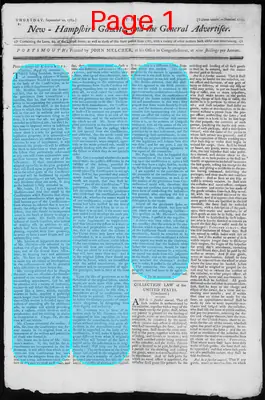
Story
September 10, 1789
The New Hampshire Gazette And General Advertiser
Portsmouth, Rockingham County, New Hampshire
What is this article about?
Debate in the U.S. Congress on August 13 regarding whether proposed amendments to the Constitution should be incorporated directly into the document or added as a separate supplementary act. Speakers including Madison, Smith, and others argue for and against, with the motion to add as supplement failing.
Clipping
OCR Quality
95%
Excellent
Full Text
Proceedings of Congress.
Thursday, August 13, continued.
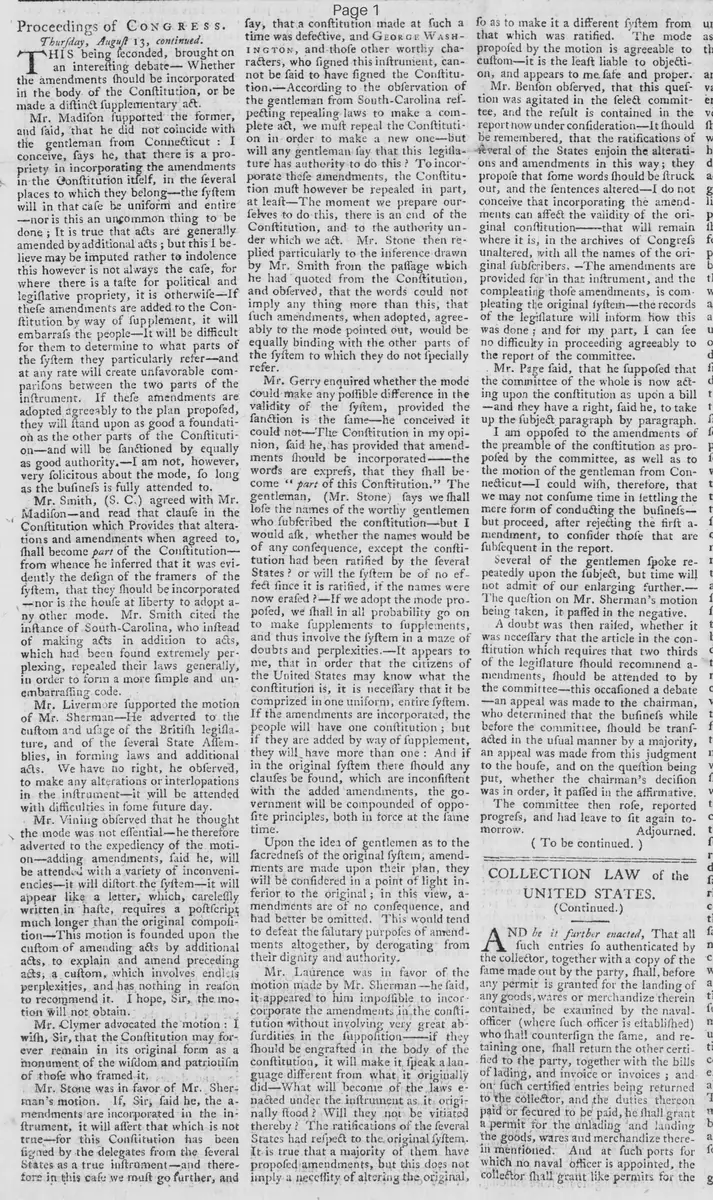
HIS being seconded, brought on an interesting debate-- Whether the amendments should be incorporated in the body of the Constitution, or be made a distinct supplementary act.
Mr. Madison supported the former, and said, that he did not coincide with the gentleman from Connecticut: I conceive, says he, that there is a propriety in incorporating the amendments in the Constitution itself, in the several places to which they belong--the system will in that case be uniform and entire --nor is this an uncommon thing to be done; It is true that acts are generally amended by additional acts ; but this I believe may be imputed rather to indolence this however is not always the case. for where there is a taste for political and legislative propriety, it is otherwise--If these amendments are added to the Constitution by way of supplement, it will embarrass the people--It will be difficult for them to determine to what parts of the system they particularly refer--and at any rate will create unfavorable comparisons between the two parts of the instrument. If these amendments are adopted agreeably to the plan proposed, they will stand upon as good a foundation as the other parts of the Constitution-and will be sanctioned by equally as good authority.-I am not, however, very solicitous about the mode, so long as the business is fully attended to.
Mr. Smith, (S. C.) agreed with Mr. Madison--and read that clause in the Constitution which Provides that alterations and amendments when agreed to. shall become part of the Constitution-- from whence he inferred that it was evidently the design of the framers of the system, that they should be incorporated -nor is the house at liberty to adopt any other mode. Mr. Smith cited the instance of South-Carolina, who instead of making acts in addition to acts, which had been found extremely perplexing, repealed their laws generally, in order to form a more simple and unembarrassing code.
Mr. Livermore supported the motion of Mr. Sherman--He adverted to the custom and usage of the British legislature, and of the several State Assemblies, in forming laws and additional acts. We have no right, he observed, to make any alterations or interpolations in the instrument--it will be attended with difficulties in some future day.
Mr. Vining observed that he thought the mode was not essential--he therefore adverted to the expediency of the motion--adding amendments, said he, will be attended with a variety of inconveniences--it will distort the system--it will appear like a letter, which, carelessly written in haste, requires a postscript much longer than the original composition--This motion is founded upon the custom of amending acts by additional acts, to explain and amend preceding acts, a custom, which involves endless perplexities, and has nothing in reason to recommend it. I hope, Sir, the motion will not obtain.
Mr. Clymer advocated the motion : I wish, Sir, that the Constitution may forever remain in its original form as a monument of the wisdom and patriotism of those who framed it.
Mr. Stone was in favor of Mr. Sherman's motion. If, Sir, said he, the amendments are incorporated in the instrument. it will assert that which is not true--for this Constitution has been signed by the delegates from the several States as a true instrument and therefore in this case we must go further, and say. that a constitution made at such a time was defective. and George Washington, and those other worthy characters, who signed this instrument, cannot be said to have signed the Constitution.--According to the observation of the gentleman from South-Carolina respecting repealing laws to make a complete act, we must repeal the Constitution in-order to make a new one--but will any gentleman say that this legislature has authority to do this ? To incorporate these amendments, the Constitution must however be repealed in part, at least--The moment we prepare ourselves to do this, there is an end of the Constitution, and to the authority under which we act. Mr. Stone then replied particularly to the inference drawn by Mr. Smith from the passage which he had quoted from the Constitution, and observed, that the words could not imply any thing more than this, that such amendments, when adopted, agreeably to the mode pointed out, would be equally binding with the other parts of the system to which they do not specially refer.
Mr. Gerry enquired whether the mode could make any possible difference in the validity of the system, provided the sanction is the same--he conceived it could not--The Constitution in my opinion, said he, has provided that amendments should be incorporated--the words are express, that they shall become " part of this Constitution." The gentleman, (Mr. Stone) says we shall lose the names of the worthy gentlemen who subscribed the constitution--but I would ask, whether the names would be of any consequence, except the constitution had been ratified by the several States ? or will the system be of no effect since it is ratified, if the names were now erased ?-If we adopt the mode proposed, we shall in all probability go on to make supplements to supplements, and thus involve the system in a maze of doubts and perplexities.--It appears to me. that in order that the citizens of the United States may know what the constitution is, it is necessary that it be comprised in one uniform, entire system. If the amendments are incorporated, the people will have one constitution ; but if they are added by way of supplement, they will have more than one: And if in the original system there should any clauses be found. which are inconsistent with the added amendments, the government will be compounded of opposite principles, both in force at the same time. Upon the idea of gentlemen as to the sacredness of the original system, amendments are made upon their plan, they will be considered in a point of light inferior to the original: in this view, amendments are of no consequence, and had better be omitted. This would tend to defeat the salutary purposes of amendments altogether, by derogating from their dignity and authority.
Mr. Laurence was in favor of the motion made by Mr. Sherman--he said. it appeared to him impossible to incorporate the amendments in the constitution without involving very great absurdities in the supposition--if they should be engrafted in the body of the constitution. it will make it speak a language different from what, it originally did -What will become of the laws enacted under the instrument as..it originally stood ? Will they not be vitiated thereby ? The ratifications of the several States had respect to the, original system. It is true that a majority of them have proposed amendments, but this does not imply a necessity of altering the original, so as to make it a different system from that which was ratified. The mode proposed by the motion is agreeable to custom-it is the least liable to objection, and appears to me safe and proper.
Mr. Benson observed, that this question was agitated in the select committee, and the result is contained in the report now under consideration--It should be remembered, that the ratifications of several of the States enjoin the alterations and amendments in this way; they propose that some words should be struck out, and the sentences altered-I do not conceive that incorporating the amendments can affect the validity of the original constitution-e--that will remain where it is, in the archives of Congress unaltered, with all the names of the original subscribers. -The amendments are provided for in that instrument, and the completing those amendments, is completing the original system-the records of the legislature will inform how this was done; and for my part, I can see no difficulty in proceeding agreeably to the report of the committee.
Mr. Page said, that he supposed that the committee of the whole is now acting upon the constitution as upon a bill --and they have a right, said he, to take up the subject paragraph by paragraph. I am opposed to the amendments of the preamble of the constitution as proposed by the committee, as well as to the motion of the gentleman from Connecticut--I could wish, therefore, that we may not consume time in settling the mere form of conducting the business- but proceed, after rejecting the first amendment, to consider those that are subsequent in the report.
Several of the gentlemen spoke repeatedly upon the subject, but time will not admit of our enlarging further.-- The question on Mr. Sherman's motion being taken, it passed in the negative. A doubt was then raised, whether it was necessary that the article in the constitution which requires that two thirds of the legislature should recommend amendments, should be attended to by the committee--this occasioned a debate --an appeal was made to the chairman, who determined that the business while before the committee, should be transacted in the usual manner by a majority, an appeal was made from this judgment to the house, and on the question being put, whether the chairman's decision was in order, it passed in the affirmative. The committee then rose, reported progress, and had leave to sit again to- morrow.
Adjourned.
( To be continued. )
Thursday, August 13, continued.
HIS being seconded, brought on an interesting debate-- Whether the amendments should be incorporated in the body of the Constitution, or be made a distinct supplementary act.
Mr. Madison supported the former, and said, that he did not coincide with the gentleman from Connecticut: I conceive, says he, that there is a propriety in incorporating the amendments in the Constitution itself, in the several places to which they belong--the system will in that case be uniform and entire --nor is this an uncommon thing to be done; It is true that acts are generally amended by additional acts ; but this I believe may be imputed rather to indolence this however is not always the case. for where there is a taste for political and legislative propriety, it is otherwise--If these amendments are added to the Constitution by way of supplement, it will embarrass the people--It will be difficult for them to determine to what parts of the system they particularly refer--and at any rate will create unfavorable comparisons between the two parts of the instrument. If these amendments are adopted agreeably to the plan proposed, they will stand upon as good a foundation as the other parts of the Constitution-and will be sanctioned by equally as good authority.-I am not, however, very solicitous about the mode, so long as the business is fully attended to.
Mr. Smith, (S. C.) agreed with Mr. Madison--and read that clause in the Constitution which Provides that alterations and amendments when agreed to. shall become part of the Constitution-- from whence he inferred that it was evidently the design of the framers of the system, that they should be incorporated -nor is the house at liberty to adopt any other mode. Mr. Smith cited the instance of South-Carolina, who instead of making acts in addition to acts, which had been found extremely perplexing, repealed their laws generally, in order to form a more simple and unembarrassing code.
Mr. Livermore supported the motion of Mr. Sherman--He adverted to the custom and usage of the British legislature, and of the several State Assemblies, in forming laws and additional acts. We have no right, he observed, to make any alterations or interpolations in the instrument--it will be attended with difficulties in some future day.
Mr. Vining observed that he thought the mode was not essential--he therefore adverted to the expediency of the motion--adding amendments, said he, will be attended with a variety of inconveniences--it will distort the system--it will appear like a letter, which, carelessly written in haste, requires a postscript much longer than the original composition--This motion is founded upon the custom of amending acts by additional acts, to explain and amend preceding acts, a custom, which involves endless perplexities, and has nothing in reason to recommend it. I hope, Sir, the motion will not obtain.
Mr. Clymer advocated the motion : I wish, Sir, that the Constitution may forever remain in its original form as a monument of the wisdom and patriotism of those who framed it.
Mr. Stone was in favor of Mr. Sherman's motion. If, Sir, said he, the amendments are incorporated in the instrument. it will assert that which is not true--for this Constitution has been signed by the delegates from the several States as a true instrument and therefore in this case we must go further, and say. that a constitution made at such a time was defective. and George Washington, and those other worthy characters, who signed this instrument, cannot be said to have signed the Constitution.--According to the observation of the gentleman from South-Carolina respecting repealing laws to make a complete act, we must repeal the Constitution in-order to make a new one--but will any gentleman say that this legislature has authority to do this ? To incorporate these amendments, the Constitution must however be repealed in part, at least--The moment we prepare ourselves to do this, there is an end of the Constitution, and to the authority under which we act. Mr. Stone then replied particularly to the inference drawn by Mr. Smith from the passage which he had quoted from the Constitution, and observed, that the words could not imply any thing more than this, that such amendments, when adopted, agreeably to the mode pointed out, would be equally binding with the other parts of the system to which they do not specially refer.
Mr. Gerry enquired whether the mode could make any possible difference in the validity of the system, provided the sanction is the same--he conceived it could not--The Constitution in my opinion, said he, has provided that amendments should be incorporated--the words are express, that they shall become " part of this Constitution." The gentleman, (Mr. Stone) says we shall lose the names of the worthy gentlemen who subscribed the constitution--but I would ask, whether the names would be of any consequence, except the constitution had been ratified by the several States ? or will the system be of no effect since it is ratified, if the names were now erased ?-If we adopt the mode proposed, we shall in all probability go on to make supplements to supplements, and thus involve the system in a maze of doubts and perplexities.--It appears to me. that in order that the citizens of the United States may know what the constitution is, it is necessary that it be comprised in one uniform, entire system. If the amendments are incorporated, the people will have one constitution ; but if they are added by way of supplement, they will have more than one: And if in the original system there should any clauses be found. which are inconsistent with the added amendments, the government will be compounded of opposite principles, both in force at the same time. Upon the idea of gentlemen as to the sacredness of the original system, amendments are made upon their plan, they will be considered in a point of light inferior to the original: in this view, amendments are of no consequence, and had better be omitted. This would tend to defeat the salutary purposes of amendments altogether, by derogating from their dignity and authority.
Mr. Laurence was in favor of the motion made by Mr. Sherman--he said. it appeared to him impossible to incorporate the amendments in the constitution without involving very great absurdities in the supposition--if they should be engrafted in the body of the constitution. it will make it speak a language different from what, it originally did -What will become of the laws enacted under the instrument as..it originally stood ? Will they not be vitiated thereby ? The ratifications of the several States had respect to the, original system. It is true that a majority of them have proposed amendments, but this does not imply a necessity of altering the original, so as to make it a different system from that which was ratified. The mode proposed by the motion is agreeable to custom-it is the least liable to objection, and appears to me safe and proper.
Mr. Benson observed, that this question was agitated in the select committee, and the result is contained in the report now under consideration--It should be remembered, that the ratifications of several of the States enjoin the alterations and amendments in this way; they propose that some words should be struck out, and the sentences altered-I do not conceive that incorporating the amendments can affect the validity of the original constitution-e--that will remain where it is, in the archives of Congress unaltered, with all the names of the original subscribers. -The amendments are provided for in that instrument, and the completing those amendments, is completing the original system-the records of the legislature will inform how this was done; and for my part, I can see no difficulty in proceeding agreeably to the report of the committee.
Mr. Page said, that he supposed that the committee of the whole is now acting upon the constitution as upon a bill --and they have a right, said he, to take up the subject paragraph by paragraph. I am opposed to the amendments of the preamble of the constitution as proposed by the committee, as well as to the motion of the gentleman from Connecticut--I could wish, therefore, that we may not consume time in settling the mere form of conducting the business- but proceed, after rejecting the first amendment, to consider those that are subsequent in the report.
Several of the gentlemen spoke repeatedly upon the subject, but time will not admit of our enlarging further.-- The question on Mr. Sherman's motion being taken, it passed in the negative. A doubt was then raised, whether it was necessary that the article in the constitution which requires that two thirds of the legislature should recommend amendments, should be attended to by the committee--this occasioned a debate --an appeal was made to the chairman, who determined that the business while before the committee, should be transacted in the usual manner by a majority, an appeal was made from this judgment to the house, and on the question being put, whether the chairman's decision was in order, it passed in the affirmative. The committee then rose, reported progress, and had leave to sit again to- morrow.
Adjourned.
( To be continued. )
What sub-type of article is it?
Historical Event
What themes does it cover?
Justice
What keywords are associated?
Constitutional Amendments
Congress Debate
Incorporation Method
Sherman Motion
Bill Of Rights
What entities or persons were involved?
Mr. Madison
Mr. Smith (S. C.)
Mr. Livermore
Mr. Vining
Mr. Clymer
Mr. Stone
Mr. Gerry
Mr. Laurence
Mr. Benson
Mr. Page
Mr. Sherman
George Washington
Where did it happen?
United States Congress
Story Details
Key Persons
Mr. Madison
Mr. Smith (S. C.)
Mr. Livermore
Mr. Vining
Mr. Clymer
Mr. Stone
Mr. Gerry
Mr. Laurence
Mr. Benson
Mr. Page
Mr. Sherman
George Washington
Location
United States Congress
Event Date
Thursday, August 13
Story Details
Debate on incorporating constitutional amendments directly or as a supplement, with arguments on propriety, validity, and custom; Sherman's motion for supplement fails; procedural question on majority vote resolved in favor of chairman.