Thank you for visiting SNEWPapers!
Sign up free
Story
May 29, 1892
The Indianapolis Journal
Indianapolis, Marion County, Indiana
What is this article about?
Historical account of the trotting and pacing horse industry gaining respectability, with Indianapolis positioning itself as a major breeding and racing center in Indiana, rivaling Kentucky; details local developments, horse notes, and sales.
Clipping
OCR Quality
98%
Excellent
Full Text
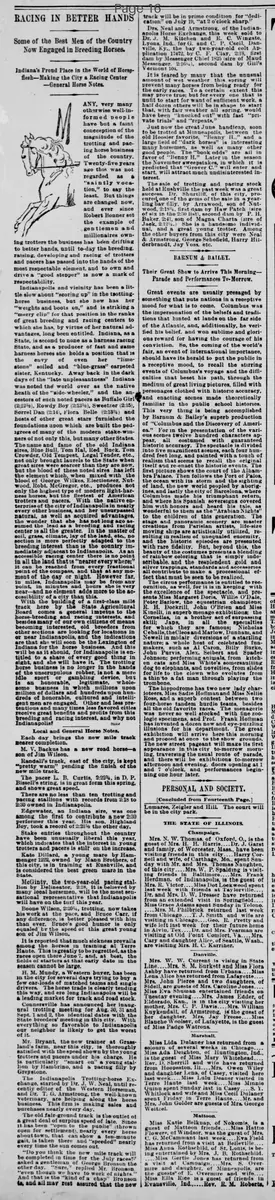
RACING IN BETTER HANDS
Some of the Best Men of the Country Now Engaged in Breeding Horses.
Indiana's Proud Place in the World of Horseflesh-Making the City a Racing Center
-General Horse Notes.
Many, very many otherwise well-informed people have but a faint conception of the magnitude of the trotting and pacing horse business of the country. Twenty-five years ago this was not regarded as a "saintly vocation," to say the least. But things are changed now, and ever since Robert Bonner set the example of gentlemen and millionaires owning trotters the business has been drifting to better hands, until to-day the breeding, raising, developing and racing of trotters and pacers has passed into the hands of the most respectable element, and to own and drive a "good stepper" is now a mark of respectability.
Indianapolis and vicinity has been a little slow about "scoring up" in the trotting-horse business, but she now has her "weights and boots on," and is striking a "merry clip" for that position in the ranks of great breeding and racing centers to which she has, by virtue of her natural advantages, long been entitled. Indiana, as a State, is second to none as a harness racing State, and as a producer of fast and game harness horses she holds a position that is the envy of even her "lime-stone" soiled and "blue-grass" carpeted sister, Kentucky. Away back in the dark days of the "late unpleasantness" Indiana was noted the world over as the native heath of the "side-wheeler," and the ancestors of such noted pacers as Buffalo Girl (2:12½), Rowdy Boy (2:13½), Sweetzer (2:15), Sorrel Dan (2:14), Flora Belle (2:13¼) and hosts of other great stars furnished the foundations upon which are built the pedigrees of many of the modern stake-winners of not only this, but many other States. The name and fame of the old Indiana sires, Blue Bull, Tom Hal, Red Buck, Tom Crowder, Old Tempest, Legal Tender, etc., not only brought laurels to the State when great sires were scarcer than they are now, but the blood of these noted sires has left the element which, when mixed with the blood of George Wilkes, Electioneer, Nutwood, Robt. McGregor, etc., produces not only the highest type of modern light-harness horses, but the fleetest of American trotters and pacers. With the native enterprise of the city of Indianapolis in nearly every other business, and her unsurpassed natural, as well as acquired advantages, the wonder that she has not long ago assumed the lead as a breeding and racing center is all the greater. In the matter of soil, grass, climate, lay of the land, etc., no section is more perfectly adapted to the breeding interest than is the country immediately adjacent to Indianapolis. As an accessible racing center there is no point in all the land that is "nearer everywhere;" it can be reached from every fractional point of the compass, and that at any moment of the day or night. However far, in miles, Indianapolis may be from any point, in minutes and hours she is very near-and no element adds more to the accessibility of a city than this. With the building of a first-class mile track here by the State Agricultural Board comes general impetus to the horse-breeding and racing interests, and besides many of our own citizens of means becoming interested, old breeders from other sections are looking for locations in or near Indianapolis, and the indications are that she will soon be the Lexington of Indiana for the horse business. And this will be as it should, for Indianapolis is entitled to a share of every good thing in sight, and she will have it. The trotting horse business is no longer in the hands of the unscrupulous robber, is not a mere idle sport or gambling device, but is an honorable, legitimate, wholesome business in which millions upon million of dollars and hundreds upon hundreds of honorable, cultured and intelligent men are engaged. Other and less pretentious and many times less favored cities receive great benefits and profits from this breeding and racing interest, and why not Indianapolis?
Local and General Horse Notes.
Each day brings the new mile track nearer completion. M. V. Backus has a new road horse-son of Jim Wilson. Randall's track, east of the city, is kept "pretty warm" pending the finish of the new mile track. The pacer L. B. Curtis, 2:22¾, in D. P. Bissell's string, is in great form this spring, and shows great speed. There are no less than ten trotting and pacing stallions with records from 2:15 to 2:30 owned in Indianapolis. Edgewater, an Indiana sire, was one among the first to contribute a new 2:30 performer this year. His son, Highland Boy, took a record of 2:23½ the other day. Stake entries throughout the country have been unusually liberal this year, which indicates that the interest in young trotters and pacers is still on the increase. Kate Dillard, a young mare by Hammenger 2:22, owned by Mann Brothers, of this city, is in training at Rushville, and is considered the best green mare in the State. McGinty, the two-year-old pacing stallion by Delineator, 2:18, it is believed by many local horsemen, will be the most sensational representative that Indianapolis will have on the turf this year. Boone Wilson, 2:20½, trotting, now takes his work at the pace, and Bruce Carr, if any difference, is better pleased with him than ever. Bruce's good humor is only equaled by the speed of this great young son of Jim Wilson. It is reported that much sickness prevails among the horses in training at Terre Haute. This is greatly to be regretted, as the races open there June 7, and, at best, the fields of starters at that early date in the season cannot be large. H. M. Mundy, a Western buyer, has been in the city for several days trying to buy a few car-loads of matched teams and single drivers. The horse trade is clearly tending this way, and ere long Indianapolis will be a leading market for track and road stock. Connersville has announced her inaugural trotting meeting for Aug. 30, 31 and Sept. 1 and 2, the identical dates with the State breeders' meeting in this city. With everything so favorable to Indianapolis our neighbor is likely to get the worst of it. Mr. Bryant, the new trainer at Grassland's farm, near this city, is thoroughly satisfied with the speed shown by the young trotters and pacers under his charge. He is particularly smart on a young stallion by Hambrino, and a pacing filly by Greystone. The Indianapolis Trotting-horse Exchange, started by Dr. J. W. Neal, until recently editor of the Western Horseman, and Dr. T. G. Armstrong, the well-known veterinary, are helping along the horse business. This firm is making sales and purchases nearly every day. The old fair-ground track is the outlet of a great deal of surplus speed of late. Since it has been "open to the public" (thrown open for settlement), nearly every horse about town, that can show a ten-minute gait, is taken there and "speeded" nearly every time the sun comes out. "Do you think the new mile track will be completed in time for the July races?" asked a gentleman of George Bronson the other day. "Sure," replied Mr. Bronson, even though we have to work off nights. And that is the "kind of a chap" Bronson is, and all may rest assured that the new track will be in prime condition for "dedication" on July 19, "at 2 o'clock sharp."
Drs. Neal and Armstrong, of the Indianapolis Horse Exchange, this week sold to Dr. J. M. Kitchen and R. C. Wingate, Lyons, Ind., for G. and C. P. Cecil, Danville, Ky., the bay two-year-old colt Application 17472, by C. F. Clay, 2:18, first dam by Messenger Chief 1825 (sire of Maud Messenger, 2:16¼) second dam by Gil's Vermont 104. It is feared by many that the unusual amount of wet weather this spring will prevent many horses from being ready for the early races. To a certain extent this may prove true; but for every one that is unfit to start for want of sufficient work, a half dozen others will be in shape to start that, with fair weather all spring, would have been "knocked out" with fast "private trials" and "repeats." Just now the great June handicap, soon to be trotted at Minneapolis, between the old Hoosier favorite, "Benny H.," and a large field of "dark horses" is interesting many horsemen, as well as many other good people. The "book odds" are all in favor of "Benny H." Later in the season the November sweepstakes, in which it is predicted that "Grover C." will enter and start, will attract much un-disinterested interest. The sale of trotting and pacing stock held at Rushville the past week was a great success. Dr. Shurtliff, of this city, procured one of the gems of the sale in a yearling bay filly, by Arrawood, son of Nutwood, 2:18½, first dam by Haw Patch (sire of six in the 2:30 list), second dam by P. H. Baker, 2:41, son of Magna Charta (sire of Jack, 2:12¼.) She is a handsome individual, and a great young trotter. Among the other buyers from this city were Neal & Armstrong, George Schofield, Harry Hilderbrandt, Jay Voss, etc.
Some of the Best Men of the Country Now Engaged in Breeding Horses.
Indiana's Proud Place in the World of Horseflesh-Making the City a Racing Center
-General Horse Notes.
Many, very many otherwise well-informed people have but a faint conception of the magnitude of the trotting and pacing horse business of the country. Twenty-five years ago this was not regarded as a "saintly vocation," to say the least. But things are changed now, and ever since Robert Bonner set the example of gentlemen and millionaires owning trotters the business has been drifting to better hands, until to-day the breeding, raising, developing and racing of trotters and pacers has passed into the hands of the most respectable element, and to own and drive a "good stepper" is now a mark of respectability.
Indianapolis and vicinity has been a little slow about "scoring up" in the trotting-horse business, but she now has her "weights and boots on," and is striking a "merry clip" for that position in the ranks of great breeding and racing centers to which she has, by virtue of her natural advantages, long been entitled. Indiana, as a State, is second to none as a harness racing State, and as a producer of fast and game harness horses she holds a position that is the envy of even her "lime-stone" soiled and "blue-grass" carpeted sister, Kentucky. Away back in the dark days of the "late unpleasantness" Indiana was noted the world over as the native heath of the "side-wheeler," and the ancestors of such noted pacers as Buffalo Girl (2:12½), Rowdy Boy (2:13½), Sweetzer (2:15), Sorrel Dan (2:14), Flora Belle (2:13¼) and hosts of other great stars furnished the foundations upon which are built the pedigrees of many of the modern stake-winners of not only this, but many other States. The name and fame of the old Indiana sires, Blue Bull, Tom Hal, Red Buck, Tom Crowder, Old Tempest, Legal Tender, etc., not only brought laurels to the State when great sires were scarcer than they are now, but the blood of these noted sires has left the element which, when mixed with the blood of George Wilkes, Electioneer, Nutwood, Robt. McGregor, etc., produces not only the highest type of modern light-harness horses, but the fleetest of American trotters and pacers. With the native enterprise of the city of Indianapolis in nearly every other business, and her unsurpassed natural, as well as acquired advantages, the wonder that she has not long ago assumed the lead as a breeding and racing center is all the greater. In the matter of soil, grass, climate, lay of the land, etc., no section is more perfectly adapted to the breeding interest than is the country immediately adjacent to Indianapolis. As an accessible racing center there is no point in all the land that is "nearer everywhere;" it can be reached from every fractional point of the compass, and that at any moment of the day or night. However far, in miles, Indianapolis may be from any point, in minutes and hours she is very near-and no element adds more to the accessibility of a city than this. With the building of a first-class mile track here by the State Agricultural Board comes general impetus to the horse-breeding and racing interests, and besides many of our own citizens of means becoming interested, old breeders from other sections are looking for locations in or near Indianapolis, and the indications are that she will soon be the Lexington of Indiana for the horse business. And this will be as it should, for Indianapolis is entitled to a share of every good thing in sight, and she will have it. The trotting horse business is no longer in the hands of the unscrupulous robber, is not a mere idle sport or gambling device, but is an honorable, legitimate, wholesome business in which millions upon million of dollars and hundreds upon hundreds of honorable, cultured and intelligent men are engaged. Other and less pretentious and many times less favored cities receive great benefits and profits from this breeding and racing interest, and why not Indianapolis?
Local and General Horse Notes.
Each day brings the new mile track nearer completion. M. V. Backus has a new road horse-son of Jim Wilson. Randall's track, east of the city, is kept "pretty warm" pending the finish of the new mile track. The pacer L. B. Curtis, 2:22¾, in D. P. Bissell's string, is in great form this spring, and shows great speed. There are no less than ten trotting and pacing stallions with records from 2:15 to 2:30 owned in Indianapolis. Edgewater, an Indiana sire, was one among the first to contribute a new 2:30 performer this year. His son, Highland Boy, took a record of 2:23½ the other day. Stake entries throughout the country have been unusually liberal this year, which indicates that the interest in young trotters and pacers is still on the increase. Kate Dillard, a young mare by Hammenger 2:22, owned by Mann Brothers, of this city, is in training at Rushville, and is considered the best green mare in the State. McGinty, the two-year-old pacing stallion by Delineator, 2:18, it is believed by many local horsemen, will be the most sensational representative that Indianapolis will have on the turf this year. Boone Wilson, 2:20½, trotting, now takes his work at the pace, and Bruce Carr, if any difference, is better pleased with him than ever. Bruce's good humor is only equaled by the speed of this great young son of Jim Wilson. It is reported that much sickness prevails among the horses in training at Terre Haute. This is greatly to be regretted, as the races open there June 7, and, at best, the fields of starters at that early date in the season cannot be large. H. M. Mundy, a Western buyer, has been in the city for several days trying to buy a few car-loads of matched teams and single drivers. The horse trade is clearly tending this way, and ere long Indianapolis will be a leading market for track and road stock. Connersville has announced her inaugural trotting meeting for Aug. 30, 31 and Sept. 1 and 2, the identical dates with the State breeders' meeting in this city. With everything so favorable to Indianapolis our neighbor is likely to get the worst of it. Mr. Bryant, the new trainer at Grassland's farm, near this city, is thoroughly satisfied with the speed shown by the young trotters and pacers under his charge. He is particularly smart on a young stallion by Hambrino, and a pacing filly by Greystone. The Indianapolis Trotting-horse Exchange, started by Dr. J. W. Neal, until recently editor of the Western Horseman, and Dr. T. G. Armstrong, the well-known veterinary, are helping along the horse business. This firm is making sales and purchases nearly every day. The old fair-ground track is the outlet of a great deal of surplus speed of late. Since it has been "open to the public" (thrown open for settlement), nearly every horse about town, that can show a ten-minute gait, is taken there and "speeded" nearly every time the sun comes out. "Do you think the new mile track will be completed in time for the July races?" asked a gentleman of George Bronson the other day. "Sure," replied Mr. Bronson, even though we have to work off nights. And that is the "kind of a chap" Bronson is, and all may rest assured that the new track will be in prime condition for "dedication" on July 19, "at 2 o'clock sharp."
Drs. Neal and Armstrong, of the Indianapolis Horse Exchange, this week sold to Dr. J. M. Kitchen and R. C. Wingate, Lyons, Ind., for G. and C. P. Cecil, Danville, Ky., the bay two-year-old colt Application 17472, by C. F. Clay, 2:18, first dam by Messenger Chief 1825 (sire of Maud Messenger, 2:16¼) second dam by Gil's Vermont 104. It is feared by many that the unusual amount of wet weather this spring will prevent many horses from being ready for the early races. To a certain extent this may prove true; but for every one that is unfit to start for want of sufficient work, a half dozen others will be in shape to start that, with fair weather all spring, would have been "knocked out" with fast "private trials" and "repeats." Just now the great June handicap, soon to be trotted at Minneapolis, between the old Hoosier favorite, "Benny H.," and a large field of "dark horses" is interesting many horsemen, as well as many other good people. The "book odds" are all in favor of "Benny H." Later in the season the November sweepstakes, in which it is predicted that "Grover C." will enter and start, will attract much un-disinterested interest. The sale of trotting and pacing stock held at Rushville the past week was a great success. Dr. Shurtliff, of this city, procured one of the gems of the sale in a yearling bay filly, by Arrawood, son of Nutwood, 2:18½, first dam by Haw Patch (sire of six in the 2:30 list), second dam by P. H. Baker, 2:41, son of Magna Charta (sire of Jack, 2:12¼.) She is a handsome individual, and a great young trotter. Among the other buyers from this city were Neal & Armstrong, George Schofield, Harry Hilderbrandt, Jay Voss, etc.
What sub-type of article is it?
Historical Event
What themes does it cover?
Triumph
What keywords are associated?
Horse Breeding
Trotting Horses
Pacing Horses
Indianapolis Track
Harness Racing
What entities or persons were involved?
Robert Bonner
Where did it happen?
Indianapolis, Indiana
Story Details
Key Persons
Robert Bonner
Location
Indianapolis, Indiana
Story Details
Overview of the trotting and pacing horse breeding and racing industry shifting to respectable hands, with Indiana and Indianapolis emerging as key centers due to natural advantages and new track construction; includes local notes on horses, sales, and upcoming races.