Thank you for visiting SNEWPapers!
Sign up free
Commercial
May 29, 1848
The Daily Crescent
New Orleans, Orleans County, Louisiana
What is this article about?
A London paper reports on Mr. C. F. Bakewell's Copying Telegraph, a new invention that transmits handwriting and print via wires at 500 letters per minute, enabling rapid, secure facsimile communication for business and news, far faster than postal service.
Clipping
OCR Quality
95%
Excellent
Full Text
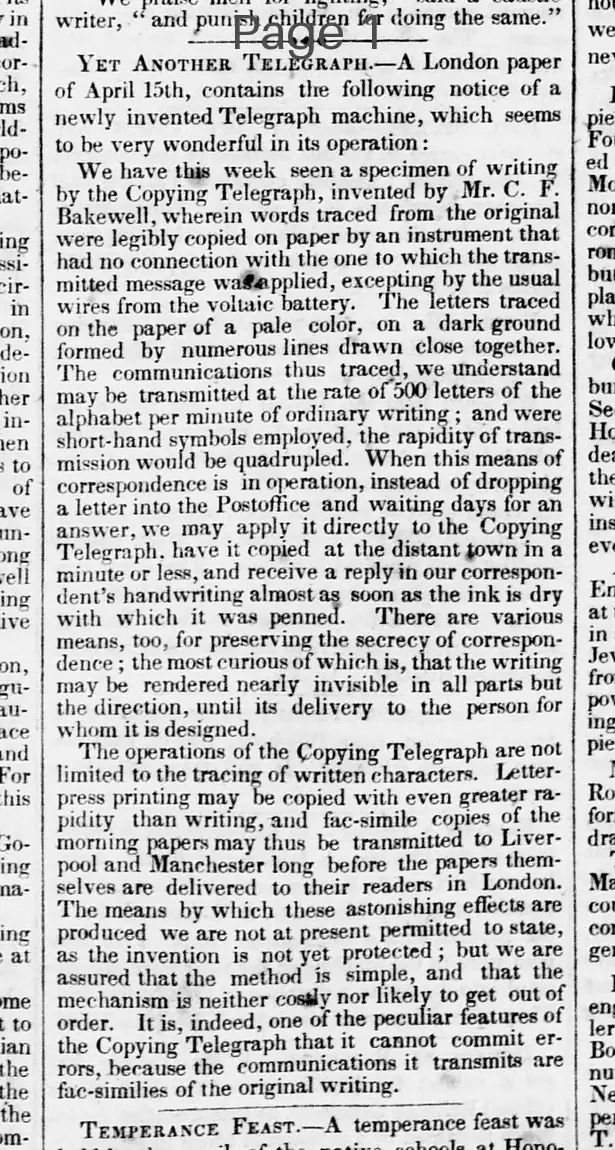
YET Another TELEGRAPH.—A London paper of April 15th, contains the following notice of a newly invented Telegraph machine, which seems to be very wonderful in its operation:
We have this week seen a specimen of writing by the Copying Telegraph, invented by Mr. C. F. Bakewell, wherein words traced from the original were legibly copied on paper by an instrument that had no connection with the one to which the transmitted message was applied, excepting by the usual wires from the voltaic battery. The letters traced on the paper of a pale color, on a dark ground formed by numerous lines drawn close together.
The communications thus traced, we understand may be transmitted at the rate of 500 letters of the alphabet per minute of ordinary writing: and were short-hand symbols employed, the rapidity of transmission would be quadrupled. When this means of correspondence is in operation, instead of dropping a letter into the Postoffice and waiting days for an answer, we may apply it directly to the Copying Telegraph, have it copied at the distant town in a minute or less, and receive a reply in our correspondent's handwriting almost as soon as the ink is dry with which it was penned. There are various means, too, for preserving the secrecy of correspondence; the most curious of which is, that the writing may be rendered nearly invisible in all parts but the direction, until its delivery to the person for whom it is designed.
The operations of the Copying Telegraph are not limited to the tracing of written characters. Letter-press printing may be copied with even greater rapidity than writing, and fac-simile copies of the morning papers may thus be transmitted to Liverpool and Manchester long before the papers themselves are delivered to their readers in London.
The means by which these astonishing effects are produced we are not at present permitted to state, as the invention is not yet protected; but we are assured that the method is simple, and that the mechanism is neither costly nor likely to get out of order. It is, indeed, one of the peculiar features of the Copying Telegraph that it cannot commit errors, because the communications it transmits are fac-similes of the original writing.
We have this week seen a specimen of writing by the Copying Telegraph, invented by Mr. C. F. Bakewell, wherein words traced from the original were legibly copied on paper by an instrument that had no connection with the one to which the transmitted message was applied, excepting by the usual wires from the voltaic battery. The letters traced on the paper of a pale color, on a dark ground formed by numerous lines drawn close together.
The communications thus traced, we understand may be transmitted at the rate of 500 letters of the alphabet per minute of ordinary writing: and were short-hand symbols employed, the rapidity of transmission would be quadrupled. When this means of correspondence is in operation, instead of dropping a letter into the Postoffice and waiting days for an answer, we may apply it directly to the Copying Telegraph, have it copied at the distant town in a minute or less, and receive a reply in our correspondent's handwriting almost as soon as the ink is dry with which it was penned. There are various means, too, for preserving the secrecy of correspondence; the most curious of which is, that the writing may be rendered nearly invisible in all parts but the direction, until its delivery to the person for whom it is designed.
The operations of the Copying Telegraph are not limited to the tracing of written characters. Letter-press printing may be copied with even greater rapidity than writing, and fac-simile copies of the morning papers may thus be transmitted to Liverpool and Manchester long before the papers themselves are delivered to their readers in London.
The means by which these astonishing effects are produced we are not at present permitted to state, as the invention is not yet protected; but we are assured that the method is simple, and that the mechanism is neither costly nor likely to get out of order. It is, indeed, one of the peculiar features of the Copying Telegraph that it cannot commit errors, because the communications it transmits are fac-similes of the original writing.
What sub-type of article is it?
Telegraph Invention
Communication Technology
What keywords are associated?
Copying Telegraph
Bakewell Invention
Facsimile Transmission
Rapid Correspondence
Secure Communication
Print Copying
What entities or persons were involved?
Mr. C. F. Bakewell
Where did it happen?
London
Commercial Details
Location
London
Event Date
April 15th
Key Figures
Mr. C. F. Bakewell
Notable Details
Transmits 500 Letters Per Minute
Uses Short Hand For Quadrupled Speed
Facsimile Copies Of Handwriting And Print
Secrecy Features Including Nearly Invisible Writing
Simple And Reliable Mechanism
No Errors As It Copies Originals