Thank you for visiting SNEWPapers!
Sign up free
Editorial
September 18, 1914
Clinch Valley News
Tazewell, Jeffersonville, Tazewell County, Virginia
What is this article about?
This editorial criticizes 'local option' for regulating alcohol sales in Virginia, arguing it fails to protect dry areas from saloons in wet zones like Pocahontas. It advocates for statewide prohibition, highlighting the harms of the liquor trade, saloon keepers' profits, and moral injustices, urging voters to support it on September 22.
Clipping
OCR Quality
98%
Excellent
Full Text
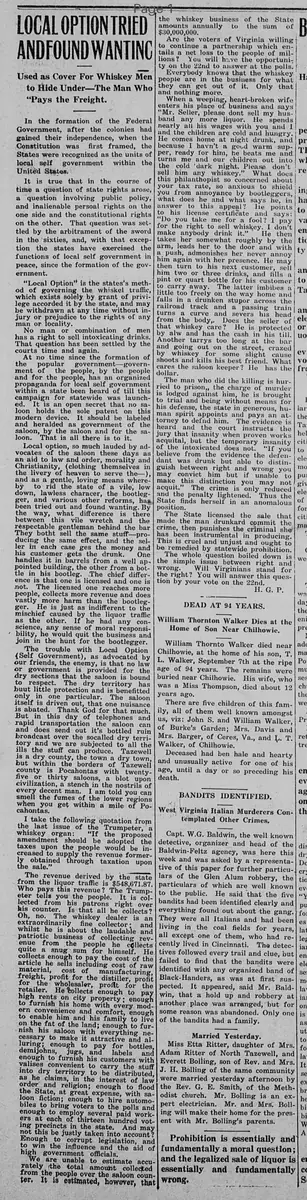
LOCAL OPTION TRIED AND FOUND WANTING
Used as Cover For Whiskey Men to Hide Under—The Man Who "Pays the Freight."
In the formation of the Federal Government, after the colonies had gained their independence, when the Constitution was first framed, the States were recognized as the units of local self government within the United States.
It is true that in the course of time a question of state rights arose, a question involving public policy, and inalienable personal rights on the one side and the constitutional rights on the other. That question was settled by the arbitrament of the sword in the sixties, and, with that exception, the states have exercised the functions of local self government in peace, since the formation of the government.
"Local Option" is the state's method of governing the whiskey traffic which exists solely by grant of privilege accorded it by the state, and may be withdrawn at any time without injury or prejudice to the rights of any man or locality.
No man or combination of men has a right to sell intoxicating drinks. That question has been settled by the courts time and again.
At no time since the formation of the popular government—government of the people, by the people and for the people—has an organized propaganda for local self government within a state been heard of till this campaign for statewide was launched. It is an open secret that no saloon holds the sole patent on this modern device. It should be labeled and heralded as government of the saloon, by the saloon and for the saloon. That is all there is to it.
Local option, so much lauded by advocates of the saloon these days as an aid to law and order, morality and Christianity, (clothing themselves in the livery of heaven to serve the—), and as a gentle, loving means whereby to rid the state of a vile, low down, lawless character, the bootlegger, and various other reforms, has been tried out and found wanting. By the way, what difference is there between this vile wretch and the respectable gentleman behind the bar? They both sell the same stuff producing the same effect, and the seller in each case gets the money and his customer gets the drunk. One handles it in barrels from a well appointed building, the other from a bottle in his bootleg. The chief difference is that one is licensed and one is not. The licensed one reaches more people, collects more revenue and does vastly more harm than the bootlegger. He is just as indifferent to the mischief caused by the liquor traffic as the other. If he had any conscience, any sense of moral responsibility, he would quit the business and join in the hunt for the bootlegger.
The trouble with Local Option (Self Government), as advocated by our friends, the enemy, is that no law or government is provided for the dry sections that the saloon is bound to respect. The dry territory has but little protection and is benefitted only in one particular. The saloon itself is driven out. That one nuisance is abated. Thank God for that much.
But in this day of telephones and rapid transportation the saloon can and does send out its bottled ruin broadcast over the so-called dry territory and we are subjected to all the ills the stuff can produce. Tazewell is a dry county, the town a dry town, but within the borders of Tazewell county is Pocahontas with twenty-five or thirty saloons, a blot upon civilization, a stench in the nostrils of every decent man. I am told you can smell the fumes of the lower regions when you get within a mile of Pocahontas.
I take the following quotation from the last issue of the Trumpeter, a whiskey organ:
"If passed amendment should be adopted the taxes upon the people would be increased to supply the revenue formerly obtained through taxation upon the sale."
The revenue derived by the state from the liquor traffic is $548,671.87. Who pays this revenue? The Trumpeter tells you the people. It is collected from his patrons right over his counter. Is that all he collects? Oh, no. The whiskey dealer is an extraordinarily fine collector: and whilst he is about the laudable and patriotic business of collecting revenue from the people he collects quite a snug sum for himself. He collects enough to pay the cost of the article he sells including cost of raw material, cost of manufacturing, freight, profit for the distiller, profit for the wholesaler, profit for the retailer. He collects enough to pay high rents on city property: enough to furnish his home with every modern convenience and comfort, enough to enable him and his family to live on the fat of the land: enough to furnish his saloon with everything necessary to make it attractive and alluring; enough to pay for bottles, demijohns, jugs, and labels and enough to furnish his customers with valises convenient to carry the stuff into dry territory to be distributed as he claims, in the interest of law order and religion; enough to flood the State, at great expense, with saloon fiction; enough to hire automobiles to bring voters to the polls and enough to employ several paid workers at each of thirteen hundred voting precincts in the state. And may not this be justly taken into account? Enough to corrupt legislation, and to win the influence and the aid of high government officials.
We are unable to estimate accurately the total amount collected from the people over the saloon counter. It is estimated, however, that the whiskey business of the State amounts annually to the sum of $30,000,000.
Are the voters of Virginia willing to continue a partnership which entails a net loss to the people of millions? You will have the opportunity on the 22nd to answer at the polls.
Everybody knows that the whiskey people are in the business for what they can get out of it. Only that and nothing more.
When a weeping, heart-broken wife enters his place of business and says "Mr. Seller, please dont sell my husband any more liquor. He spends nearly all his wages with you and I and the children are cold and hungry. He comes home at night drunk, and because I havn't a good warm supper, ready for him, he beats me and turns me and our children out into the cold dark night. Please don't sell him any whiskey." What does this philanthropist so concerned about your tax rate, so anxious to shield you from annoyance by bootleggers, what does he and what says he, in answer to this appeal? He points to his license certificate and says: "Do you take me for a fool? I pay for the right to sell whiskey. I don't make anybody drink it." He then takes her somewhat roughly by the arm, leads her to the door and with a push, admonishes her never annoy him again with her presence. He may then turn to his next customer, sell him two or three drinks, and fills a pint or quart bottle for his customer to carry away. The latter imbibes a little too freely on the way home and falls in a drunken stupor across the railroad track and a passing train turns a curve and severs his head from the body. Does the seller of that whiskey care? He is protected by law and has the cash in his till.
Another tarrys too long at the bar and going out on the street, crazed by whiskey for some slight cause shoots and kills his best friend. What cares the saloon keeper? He has the dollar.
The man who did the killing is hurried to prison, the charge of murder is lodged against him, he is brought to trial and being without means for his defense, the state in generous, human spirit appoints and pays an attorney to defend him. The evidence is heard and the court instructs the jury that insanity when proven works acquittal, but the temporary insanity of the intoxicated does not. "If you believe from the evidence the defendant was drunk but able to distinguish between right and wrong you may convict him but if unable to make this distinction you may not acquit." The crime is only reduced and the penalty lightened. Thus the State finds herself in an anomalous position.
The State licensed the sale that made the man drunkard commit the crime, then punishes the criminal she has been instrumental in producing. This is cruel and unjust and ought to be remedied by statewide prohibition.
The whole question boiled down is the simple issue between right and wrong.
Will Virginians stand for the right? You will answer this question by your vote on the 22nd.
H. G. P.
Used as Cover For Whiskey Men to Hide Under—The Man Who "Pays the Freight."
In the formation of the Federal Government, after the colonies had gained their independence, when the Constitution was first framed, the States were recognized as the units of local self government within the United States.
It is true that in the course of time a question of state rights arose, a question involving public policy, and inalienable personal rights on the one side and the constitutional rights on the other. That question was settled by the arbitrament of the sword in the sixties, and, with that exception, the states have exercised the functions of local self government in peace, since the formation of the government.
"Local Option" is the state's method of governing the whiskey traffic which exists solely by grant of privilege accorded it by the state, and may be withdrawn at any time without injury or prejudice to the rights of any man or locality.
No man or combination of men has a right to sell intoxicating drinks. That question has been settled by the courts time and again.
At no time since the formation of the popular government—government of the people, by the people and for the people—has an organized propaganda for local self government within a state been heard of till this campaign for statewide was launched. It is an open secret that no saloon holds the sole patent on this modern device. It should be labeled and heralded as government of the saloon, by the saloon and for the saloon. That is all there is to it.
Local option, so much lauded by advocates of the saloon these days as an aid to law and order, morality and Christianity, (clothing themselves in the livery of heaven to serve the—), and as a gentle, loving means whereby to rid the state of a vile, low down, lawless character, the bootlegger, and various other reforms, has been tried out and found wanting. By the way, what difference is there between this vile wretch and the respectable gentleman behind the bar? They both sell the same stuff producing the same effect, and the seller in each case gets the money and his customer gets the drunk. One handles it in barrels from a well appointed building, the other from a bottle in his bootleg. The chief difference is that one is licensed and one is not. The licensed one reaches more people, collects more revenue and does vastly more harm than the bootlegger. He is just as indifferent to the mischief caused by the liquor traffic as the other. If he had any conscience, any sense of moral responsibility, he would quit the business and join in the hunt for the bootlegger.
The trouble with Local Option (Self Government), as advocated by our friends, the enemy, is that no law or government is provided for the dry sections that the saloon is bound to respect. The dry territory has but little protection and is benefitted only in one particular. The saloon itself is driven out. That one nuisance is abated. Thank God for that much.
But in this day of telephones and rapid transportation the saloon can and does send out its bottled ruin broadcast over the so-called dry territory and we are subjected to all the ills the stuff can produce. Tazewell is a dry county, the town a dry town, but within the borders of Tazewell county is Pocahontas with twenty-five or thirty saloons, a blot upon civilization, a stench in the nostrils of every decent man. I am told you can smell the fumes of the lower regions when you get within a mile of Pocahontas.
I take the following quotation from the last issue of the Trumpeter, a whiskey organ:
"If passed amendment should be adopted the taxes upon the people would be increased to supply the revenue formerly obtained through taxation upon the sale."
The revenue derived by the state from the liquor traffic is $548,671.87. Who pays this revenue? The Trumpeter tells you the people. It is collected from his patrons right over his counter. Is that all he collects? Oh, no. The whiskey dealer is an extraordinarily fine collector: and whilst he is about the laudable and patriotic business of collecting revenue from the people he collects quite a snug sum for himself. He collects enough to pay the cost of the article he sells including cost of raw material, cost of manufacturing, freight, profit for the distiller, profit for the wholesaler, profit for the retailer. He collects enough to pay high rents on city property: enough to furnish his home with every modern convenience and comfort, enough to enable him and his family to live on the fat of the land: enough to furnish his saloon with everything necessary to make it attractive and alluring; enough to pay for bottles, demijohns, jugs, and labels and enough to furnish his customers with valises convenient to carry the stuff into dry territory to be distributed as he claims, in the interest of law order and religion; enough to flood the State, at great expense, with saloon fiction; enough to hire automobiles to bring voters to the polls and enough to employ several paid workers at each of thirteen hundred voting precincts in the state. And may not this be justly taken into account? Enough to corrupt legislation, and to win the influence and the aid of high government officials.
We are unable to estimate accurately the total amount collected from the people over the saloon counter. It is estimated, however, that the whiskey business of the State amounts annually to the sum of $30,000,000.
Are the voters of Virginia willing to continue a partnership which entails a net loss to the people of millions? You will have the opportunity on the 22nd to answer at the polls.
Everybody knows that the whiskey people are in the business for what they can get out of it. Only that and nothing more.
When a weeping, heart-broken wife enters his place of business and says "Mr. Seller, please dont sell my husband any more liquor. He spends nearly all his wages with you and I and the children are cold and hungry. He comes home at night drunk, and because I havn't a good warm supper, ready for him, he beats me and turns me and our children out into the cold dark night. Please don't sell him any whiskey." What does this philanthropist so concerned about your tax rate, so anxious to shield you from annoyance by bootleggers, what does he and what says he, in answer to this appeal? He points to his license certificate and says: "Do you take me for a fool? I pay for the right to sell whiskey. I don't make anybody drink it." He then takes her somewhat roughly by the arm, leads her to the door and with a push, admonishes her never annoy him again with her presence. He may then turn to his next customer, sell him two or three drinks, and fills a pint or quart bottle for his customer to carry away. The latter imbibes a little too freely on the way home and falls in a drunken stupor across the railroad track and a passing train turns a curve and severs his head from the body. Does the seller of that whiskey care? He is protected by law and has the cash in his till.
Another tarrys too long at the bar and going out on the street, crazed by whiskey for some slight cause shoots and kills his best friend. What cares the saloon keeper? He has the dollar.
The man who did the killing is hurried to prison, the charge of murder is lodged against him, he is brought to trial and being without means for his defense, the state in generous, human spirit appoints and pays an attorney to defend him. The evidence is heard and the court instructs the jury that insanity when proven works acquittal, but the temporary insanity of the intoxicated does not. "If you believe from the evidence the defendant was drunk but able to distinguish between right and wrong you may convict him but if unable to make this distinction you may not acquit." The crime is only reduced and the penalty lightened. Thus the State finds herself in an anomalous position.
The State licensed the sale that made the man drunkard commit the crime, then punishes the criminal she has been instrumental in producing. This is cruel and unjust and ought to be remedied by statewide prohibition.
The whole question boiled down is the simple issue between right and wrong.
Will Virginians stand for the right? You will answer this question by your vote on the 22nd.
H. G. P.
What sub-type of article is it?
Temperance
Moral Or Religious
Social Reform
What keywords are associated?
Local Option
Statewide Prohibition
Liquor Traffic
Saloon Keepers
Bootleggers
Temperance Movement
Virginia Election
What entities or persons were involved?
Saloon Keepers
Whiskey Men
Bootleggers
State Of Virginia
Pocahontas
Trumpeter
Editorial Details
Primary Topic
Opposition To Local Option And Advocacy For Statewide Prohibition In Virginia
Stance / Tone
Strongly Pro Prohibition, Anti Saloon, Moral Exhortation
Key Figures
Saloon Keepers
Whiskey Men
Bootleggers
State Of Virginia
Pocahontas
Trumpeter
Key Arguments
Local Option Fails To Protect Dry Areas From Wet Zones Like Pocahontas
Saloon Keepers Profit Immensely While Causing Societal Harm
No Inherent Right To Sell Intoxicating Drinks
Statewide Prohibition Needed To End Liquor Traffic Injustices
Liquor Trade Leads To Family Suffering, Crime, And Moral Decay
Revenue From Liquor Is Collected From Consumers, Not Benefiting The Public
Saloon Advocates Hypocritically Claim To Support Law And Order
State Licenses Crimes By Allowing Alcohol Sales Then Punishes Victims