Thank you for visiting SNEWPapers!
Sign up free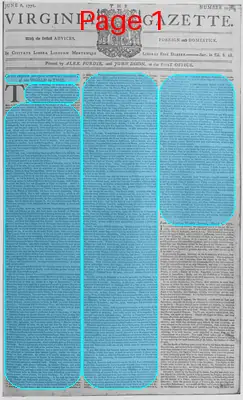
Literary
June 6, 1771
The Virginia Gazette
Richmond, Williamsburg, Richmond County, Virginia
What is this article about?
This philosophical essay argues that time, age, and reflection drive continual improvement in the world, enhancing moral virtue, arts, sciences, and happiness through endless progression, as intended by the Deity. It refutes claims of societal decline, emphasizing historical progress and the role of Christianity.
Clipping
OCR Quality
98%
Excellent
Full Text
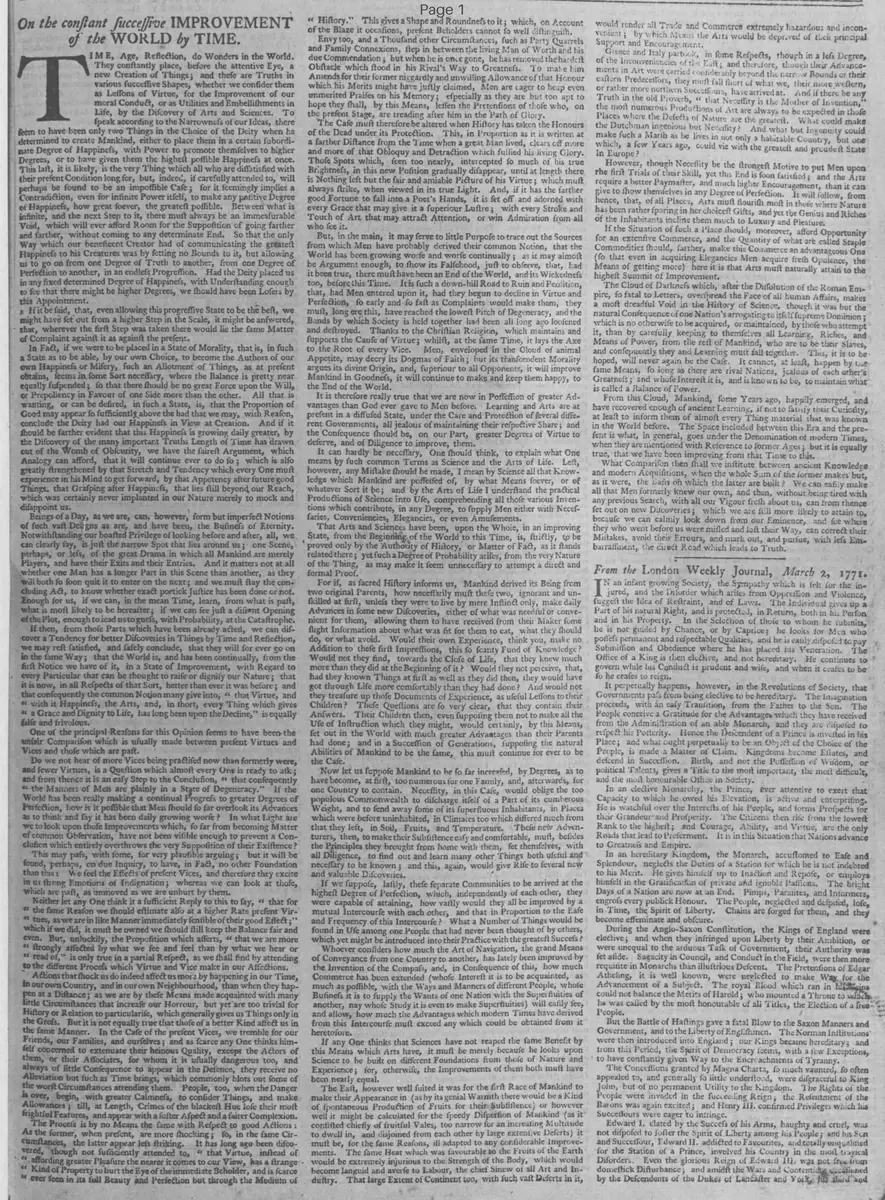
On the constant successive IMPROVEMENT of the WORLD by TIME.
TIME, Age, Reflection, do Wonders in the World.
They constantly place, before the attentive Eye, a new Creation of Things; and these are Truths in various successive Shapes, whether we consider them as Lessons of Virtue, for the Improvement of our moral Conduct, or as Utilities and Embellishments in Life, by the Discovery of Arts and Sciences. To speak according to the Narrowness of our Ideas, there seem to have been only two Things in the Choice of the Deity when he determined to create Mankind, either to place them in a certain subordinate Degree of Happiness, with Power to promote themselves to higher Degrees, or to have given them the highest possible Happiness at once.
This last, it is likely, is the very Thing which all who are dissatisfied with their present Condition long for, but, indeed, if carefully attended to, will perhaps be found to be an impossible Case; for it seemingly implies a Contradiction, even for infinite Power itself, to make any positive Degree of Happiness, how great soever, the greatest possible. Between what is infinite, and the next Step to it, there must always be an immeasurable Void, which will ever afford Room for the Supposition of going farther and farther, without coming to any determinate End. So that the only Way which our beneficent Creator had of communicating the greatest Happiness to his Creatures was by setting no Bounds to it, but allowing us to go on from one Degree of Truth to another, from one Degree of Perfection to another, in an endless Progression. Had the Deity placed us in any fixed determined Degree of Happiness, with Understanding enough to see that there might be higher Degrees, we should have been Losers by this Appointment.
If it be said, that, even allowing this progressive State to be the best, we might have set out from a higher Step in the Scale, it might be answered, that, wherever the first Step was taken there would lie the same Matter of Complaint against it as against the present.
In Fact, if we were to be placed in a State of Morality, that is, in such a State as to be able, by our own Choice, to become the Authors of our own Happiness or Misery, such an Allotment of Things, as at present obtains, seems in some Sort necessary, where the Balance is pretty near equally suspended; so that there should be no great Force upon the Will, or Preponderancy in Favour of one Side more than the other. All that is wanting, or can be desired, in such a State, is, that the Proportion of Good may appear so sufficiently above the bad that we may, with Reason, conclude the Deity had our Happiness in View at Creation. And if it should be farther evident that this Happiness is growing daily greater, by the Discovery of the many important Truths Length of Time has drawn out of the Womb of Obscurity, we have the fairest Argument, which Analogy can afford, that it will continue ever to do so; which is also greatly strengthened by that Stretch and Tendency which every One must experience in his Mind to get forward, by that Appetency after future good Things, that Grasping after Happiness, that lies still beyond our Reach, which was certainly never implanted in our Nature merely to mock and disappoint us.
Beings of a Day, as we are, can, however, form but imperfect Notions of such vast Designs as are, and have been, the Business of Eternity.
Notwithstanding our boasted Privilege of looking before and after, all we can clearly say, is just the narrow Spot that lies around us; one Scene, perhaps, or less, of the great Drama in which all Mankind are merely Players, and have their Exits and their Entries. And it matters not at all whether one Man has a longer Part in this Scene than another, as they will both so soon quit it to enter on the next; and we must stay the concluding Act, to know whether exact poetick Justice has been done or not.
Enough for us, if we can, in the mean Time, learn, from what is past, what is most likely to be hereafter; if we can see just a distant Opening of the Plot, enough to lead us to guess, with Probability, at the Catastrophe.
If then, from those Parts which have been already acted, we can discover a Tendency for better Discoveries in Things by Time and Reflection, we may rest satisfied, and safely conclude, that they will for ever go on in the same Way; that the World is, and has been continually, from the first Notice we have of it, in a State of Improvement, with Regard to every Particular that can be thought to raise or dignify our Nature; that it is now, in all Respects of that Sort, better than ever it was before; and that consequently the common Notion many give into, "that Virtue, and with it Happiness, the Arts, and, in short, every Thing which gives a Grace and Dignity to Life, has long been upon the Decline," is equally false and frivolous.
One of the principal Reasons for this Opinion seems to have been the unfair Comparison which is usually made between present Virtues and Vices and those which are past.
Do we not hear of more Vices being practised now than formerly were, and fewer Virtues, is a Question which almost every One is ready to ask; and from thence it is an easy Step to the Conclusion, "that consequently the Manners of Men are plainly in a State of Degeneracy." If the World has been really making a continual Progress to greater Degrees of Perfection, how is it possible that Men should so far overlook its Advances as to think and say it has been daily growing worse? In what Light are we to look upon those Improvements which, so far from becoming Matter of common Observation, have not been visible enough to prevent a Conclusion which entirely overthrows the very Supposition of their Existence?
This may pass, with some, for very plausible arguing; but it will be found, perhaps, on due Inquiry, to have, in Fact, no other Foundation than this: We feel the Effects of present Vices, and therefore they excite in us strong Emotions of Indignation; whereas we can look at those, which are past, as unmoved as we are unhurt by them.
Neither let any One think it a sufficient Reply to this to say, "that for the same Reason we should estimate also at a higher Rate present Virtues, as we are in like Manner immediately sensible of their good Effect;" which if we did, it must be owned we should still keep the Balance fair and even. But, unluckily, the Proposition which asserts, "that we are more strongly affected by what we see and feel than by what we hear or read of," is only true in a partial Respect, as we shall find by attending to the different Process which Virtue and Vice make in our Affections.
Actions that shock us do indeed affect us more by happening in our Time, in our own Country, and in our own Neighbourhood, than when they happen at a Distance; as we are by these Means made acquainted with many little Circumstances that increase our Horror, but yet are too trivial for History or Relation to particularize, which generally gives us Things only in the Gross. But it is not equally true that those of a better Kind affect us in the same Manner. In the Case of the present Vices, we tremble for our Friends, our Families, and ourselves; and as scarce any One thinks himself concerned to extenuate their heinous Quality, except the Actors of them, or their Associates, for whom it is usually dangerous too, and always of little Consequence to appear in the Defence, they receive no Alleviation but such as Time brings, which commonly blots out some of the worst Circumstances attending them. People, too, when the Danger is over, begin, with greater Calmness, to consider Things, and make Allowances; till, at Length, Crimes of the blackest Hue lose their most frightful Features, and appear with a softer Aspect and a fairer Complexion.
The Process is by no Means the same with Respect to good Actions:
As the former, when present, are more shocking; so, in the same Circumstances, the latter appear less striking. It has long ago been discovered, though not sufficiently attended to, "that Virtue, instead of affording greater Pleasure the nearer it comes to our View, has a strange Kind of Property to hurt the Eye of the immediate Beholder, and is scarce ever seen in its full Beauty and Perfection but through the Medium of "History." This gives a Shape and Roundness to it; which, on Account of the Blaze it occasions, present Beholders cannot so well distinguish.
Envy too, and a Thousand other Circumstances, such as Party Quarrels and Family Connexions, step in between the living Man of Worth and his due Commendation; but when he is once gone, he has removed the hardest Obstacle which stood in his Rival's Way to Greatness. To make Amends for their former niggardly and unwilling Allowance of that Honour which his Merits might have justly claimed, Men are eager to heap even unmerited Praises on his Memory; especially as they are but too apt to hope they shall, by this Means, lessen the Pretensions of those who, on the present Stage, are treading after him in the Path of Glory.
The Case must therefore be altered when History has taken the Honours of the Dead under its Protection. This, in Proportion as it is written at a farther Distance from the Time when a great Man lived, clears off more and more of that Obloquy and Detraction which sullied his living Glory.
Those Spots which, seen too nearly, intercepted so much of his true Brightness, in this new Position gradually disappear, until at length there is Nothing left but the fair and amiable Picture of his Virtue; which must always strike, when viewed in its true Light. And, if it has the farther good Fortune to fall into a Poet's Hands, it is set off and adorned with every Grace that may give it a superior Lustre; with every Stroke and Touch of Art that may attract Attention, or win Admiration from all who see it.
But, in the main, it may serve to little Purpose to trace out the Sources from which Men have probably derived their common Notion, that the World has been growing worse and worse continually; as it may almost be Argument enough, to show its Falsehood, just to observe, that, had it been true, there must have been an End of the World, and its Wickedness too, before this Time. It is such a down-hill Road to Ruin and Perdition, that, had Men entered upon it, had they begun to decline in Virtue and Perfection, so early and so fast as Complaints would make them, they must, long ere this, have reached the lowest Pitch of Degeneracy, and the Bands by which Society is held together had been all long ago loosened and destroyed. Thanks to the Christian Religion, which maintains and supports the Cause of Virtue; whilst, at the same Time, it lays the Axe to the Root of every Vice. Men, enveloped in the Cloud of animal Appetite, may decry its Dogmas of Faith; but its transcendent Morality argues its divine Origin, and, superior to all Opponents, it will improve Mankind in Goodness, it will continue to make and keep them happy, to the End of the World.
It is therefore really true that we are now in Possession of greater Advantages than God ever gave to Men before. Learning and Arts are at present in a diffused State, under the Care and Protection of several different Governments, all jealous of maintaining their respective Share; and the Consequence should be, on our Part, greater Degrees of Virtue to deserve, and of Diligence to improve, them.
It can hardly be necessary, One should think, to explain what One means by such common Terms as Science and the Arts of Life. Lest, however, any Mistake should be made, I mean by Science all that Knowledge which Mankind are possessed of, by what Means soever, or of whatever Sort it be; and by the Arts of Life I understand the practical Productions of Science into Use, comprehending all those various Inventions which contribute, in any Degree, to supply Men either with Necessaries, Conveniences, Elegancies, or even Amusements.
That Arts and Sciences have been, upon the Whole, in an improving State, from the Beginning of the World to this Time, is, strictly, to be proved only by the Authority of History, or Matter of Fact, as it stands related there; yet such a Degree of Probability arises, from the very Nature of the Thing, as may make it seem unnecessary to attempt a direct and formal Proof.
For if, as sacred History informs us, Mankind derived its Being from two original Parents, how necessarily must these two, ignorant and un-skilled at first, unless they were to live by mere Instinct only, make daily Advances in some new Discoveries, either of what was needful or convenient for them, allowing them to have received from their Maker some slight Information about what was fit for them to eat, what they should do, or what avoid. Would their own Experience, think you, make no Addition to these first Impressions, this so scanty Fund of Knowledge?
Would not they find, towards the Close of Life, that they knew much more than they did at the Beginning of it? Would they not perceive, that, had they known Things at first as well as they did then, they would have got through Life more comfortably than they had done? And would not they treasure up those Documents of Experience, as useful Lessons to their Children? These Questions are so very clear, that they contain their Answers. Their Children then, even supposing them not to make all the Use of Instruction which they might, would certainly, by this Means, set out in the World with much greater Advantages than their Parents had done; and in a Succession of Generations, supposing the natural Abilities of Mankind to be the same, this must continue for ever to be the Case.
Now let us suppose Mankind to be so far increased, by Degrees, as to have become, at first, too numerous for one Family, and, afterwards, for one Country to contain. Necessity, in this Case, would oblige the too populous Commonwealth to discharge itself of a Part of its cumbrous Weight, and to send away some of its superfluous Inhabitants, in Places which were before uninhabited, in Climates too which differed much from that they left, in Soil, Fruits, and Temperature. These new Adventurers, then, to make their Subsistence easy and comfortable, must, besides the Principles they brought from home with them, set themselves, with all Diligence, to find out and learn many other Things both useful and necessary to be known; and this, again, would give Rise to several new and valuable Discoveries.
If we suppose, lastly, these separate Communities to be arrived at the highest Degree of Perfection, which, independently of each other, they were capable of attaining, how vastly would they all be improved by a mutual Intercourse with each other, and that in Proportion to the Ease and Frequency of this Intercourse? What a Number of Things would be found in Use among one People that had never been thought of by others, which yet might be introduced into their Practice with the greatest Success?
Whoever considers how much the Art of Navigation, the grand Means of Conveyance from one Country to another, has lately been improved by the Invention of the Compass, and, in Consequence of this, how much Commerce has been extended (whose Interest it is to be acquainted, as much as possible, with the Ways and Manners of different People, whose Business it is to supply the Wants of one Nation with the Superfluities of another, nay whose Study it is even to make Superfluities) will easily see, and allow, how much the Advantages which modern Times have derived from this Intercourse must exceed any which could be obtained from it heretofore.
If any One thinks that Sciences have not reaped the same Benefit by this Means which Arts have, it must be merely because he looks upon Science to be built on different Foundations from those of Nature and Experience; for, otherwise, the Improvements of them both must have been nearly equal.
The East, however well suited it was for the first Race of Mankind to make their Appearance in (as by its genial Warmth there would be a Kind of spontaneous Production of Fruits for their Subsistence) or however well it might be calculated for the speedy Dispersion of Mankind (as it consisted chiefly of fruitful Vales, too narrow for an increasing Multitude to dwell in, and disjoined from each other by large extensive Deserts) it must be, for the same Reasons, ill adapted to any considerable Improvements. The same Heat which was favourable to the Fruits of the Earth would be extremely injurious to the Strength of the Body, which would become languid and averse to Labour, the chief Sinew of all Art and Industry. That large Extent of Continent too, with such vast Deserts in it, would render all Trade and Commerce extremely hazardous and inconvenient; by which Means the Arts would be deprived of their principal Support and Encouragement.
Greece and Italy partook, in some Respects, though in a less Degree, of the Inconveniencies of the East; and therefore, though their Advancements in Art were carried considerably beyond the narrow Bounds of their eastern Predecessors, they must fall short of what we, their more western, or rather more northern Successors, have arrived at. And if there be any Truth in the old Proverb, "that Necessity is the Mother of Invention," the most numerous Productions of Art are always to be expected in those Places where the Defects of Nature are the greatest. What could make the Dutchman ingenious but Necessity? And what but Ingenuity could make such a Marsh as he lives in not only a habitable Country, but one which, a few Years ago, could vie with the greatest and proudest State in Europe?
However, though Necessity be the strongest Motive to put Men upon the first Trials of their Skill, yet this End is soon satisfied; and the Arts require a better Paymaster, and much higher Encouragement, than it can give to show themselves in any Degree of Perfection. It will follow, from hence, that, of all Places, Arts must flourish most in those where Nature has been rather sparing in her choicest Gifts, and yet the Genius and Riches of the Inhabitants incline them much to Luxury and Pleasure.
If the Situation of such a Place should, moreover, afford Opportunity for an extensive Commerce, and the Quantity of what are called Staple Commodities should, farther, make this Commerce an advantageous One (so that even in acquiring Elegancies Men acquire fresh Opulence, the Means of getting more) here it is that Arts must naturally attain to the highest Summit of Improvement.
The Cloud of Darkness which, after the Dissolution of the Roman Empire, so fatal to Letters, overspread the Face of all human Affairs, makes a most dreadful Void in the History of Science, though it was but the natural Consequence of one Nation's arrogating to itself supreme Dominion; which is no otherwise to be acquired, or maintained, by those who attempt it, than by carefully keeping to themselves all Learning, Riches, and Means of Power, from the rest of Mankind, who are to be their Slaves, and consequently they and Learning must fall together. This, it is to be hoped, will never again be the Case. It cannot, at least, happen by the same Means, so long as there are rival Nations, jealous of each other's Greatness; and whose Interest it is, and is known to be, to maintain what is called a Balance of Power.
From this Cloud, Mankind, some Years ago, happily emerged, and have recovered enough of ancient Learning, if not to satisfy their Curiosity, at least to inform them of almost every Thing material that was known in the World before. The Space included between this Era and the present is what, in general, goes under the Denomination of modern Times, when they are mentioned with Reference to former Ages; but it is equally true, that we have been improving from that Time to this.
What Comparison then shall we institute between ancient Knowledge and modern Acquisitions, when the whole Sum of the former makes but, as it were, the Basis on which the latter are built? We can easily make all that Men formerly knew our own, and then, without being tired with any previous Search, with all our Vigour fresh about us, can from thence set out on new Discoveries; which we are still more likely to attain to, because we can calmly look down from our Eminence, and see where they who went before us were misled and lost their Way, can correct their Mistakes, avoid their Errors, and mark out, and pursue, with less Embarrassment, the direct Road which leads to Truth.
From the London Weekly Journal, March 2, 1771.
TIME, Age, Reflection, do Wonders in the World.
They constantly place, before the attentive Eye, a new Creation of Things; and these are Truths in various successive Shapes, whether we consider them as Lessons of Virtue, for the Improvement of our moral Conduct, or as Utilities and Embellishments in Life, by the Discovery of Arts and Sciences. To speak according to the Narrowness of our Ideas, there seem to have been only two Things in the Choice of the Deity when he determined to create Mankind, either to place them in a certain subordinate Degree of Happiness, with Power to promote themselves to higher Degrees, or to have given them the highest possible Happiness at once.
This last, it is likely, is the very Thing which all who are dissatisfied with their present Condition long for, but, indeed, if carefully attended to, will perhaps be found to be an impossible Case; for it seemingly implies a Contradiction, even for infinite Power itself, to make any positive Degree of Happiness, how great soever, the greatest possible. Between what is infinite, and the next Step to it, there must always be an immeasurable Void, which will ever afford Room for the Supposition of going farther and farther, without coming to any determinate End. So that the only Way which our beneficent Creator had of communicating the greatest Happiness to his Creatures was by setting no Bounds to it, but allowing us to go on from one Degree of Truth to another, from one Degree of Perfection to another, in an endless Progression. Had the Deity placed us in any fixed determined Degree of Happiness, with Understanding enough to see that there might be higher Degrees, we should have been Losers by this Appointment.
If it be said, that, even allowing this progressive State to be the best, we might have set out from a higher Step in the Scale, it might be answered, that, wherever the first Step was taken there would lie the same Matter of Complaint against it as against the present.
In Fact, if we were to be placed in a State of Morality, that is, in such a State as to be able, by our own Choice, to become the Authors of our own Happiness or Misery, such an Allotment of Things, as at present obtains, seems in some Sort necessary, where the Balance is pretty near equally suspended; so that there should be no great Force upon the Will, or Preponderancy in Favour of one Side more than the other. All that is wanting, or can be desired, in such a State, is, that the Proportion of Good may appear so sufficiently above the bad that we may, with Reason, conclude the Deity had our Happiness in View at Creation. And if it should be farther evident that this Happiness is growing daily greater, by the Discovery of the many important Truths Length of Time has drawn out of the Womb of Obscurity, we have the fairest Argument, which Analogy can afford, that it will continue ever to do so; which is also greatly strengthened by that Stretch and Tendency which every One must experience in his Mind to get forward, by that Appetency after future good Things, that Grasping after Happiness, that lies still beyond our Reach, which was certainly never implanted in our Nature merely to mock and disappoint us.
Beings of a Day, as we are, can, however, form but imperfect Notions of such vast Designs as are, and have been, the Business of Eternity.
Notwithstanding our boasted Privilege of looking before and after, all we can clearly say, is just the narrow Spot that lies around us; one Scene, perhaps, or less, of the great Drama in which all Mankind are merely Players, and have their Exits and their Entries. And it matters not at all whether one Man has a longer Part in this Scene than another, as they will both so soon quit it to enter on the next; and we must stay the concluding Act, to know whether exact poetick Justice has been done or not.
Enough for us, if we can, in the mean Time, learn, from what is past, what is most likely to be hereafter; if we can see just a distant Opening of the Plot, enough to lead us to guess, with Probability, at the Catastrophe.
If then, from those Parts which have been already acted, we can discover a Tendency for better Discoveries in Things by Time and Reflection, we may rest satisfied, and safely conclude, that they will for ever go on in the same Way; that the World is, and has been continually, from the first Notice we have of it, in a State of Improvement, with Regard to every Particular that can be thought to raise or dignify our Nature; that it is now, in all Respects of that Sort, better than ever it was before; and that consequently the common Notion many give into, "that Virtue, and with it Happiness, the Arts, and, in short, every Thing which gives a Grace and Dignity to Life, has long been upon the Decline," is equally false and frivolous.
One of the principal Reasons for this Opinion seems to have been the unfair Comparison which is usually made between present Virtues and Vices and those which are past.
Do we not hear of more Vices being practised now than formerly were, and fewer Virtues, is a Question which almost every One is ready to ask; and from thence it is an easy Step to the Conclusion, "that consequently the Manners of Men are plainly in a State of Degeneracy." If the World has been really making a continual Progress to greater Degrees of Perfection, how is it possible that Men should so far overlook its Advances as to think and say it has been daily growing worse? In what Light are we to look upon those Improvements which, so far from becoming Matter of common Observation, have not been visible enough to prevent a Conclusion which entirely overthrows the very Supposition of their Existence?
This may pass, with some, for very plausible arguing; but it will be found, perhaps, on due Inquiry, to have, in Fact, no other Foundation than this: We feel the Effects of present Vices, and therefore they excite in us strong Emotions of Indignation; whereas we can look at those, which are past, as unmoved as we are unhurt by them.
Neither let any One think it a sufficient Reply to this to say, "that for the same Reason we should estimate also at a higher Rate present Virtues, as we are in like Manner immediately sensible of their good Effect;" which if we did, it must be owned we should still keep the Balance fair and even. But, unluckily, the Proposition which asserts, "that we are more strongly affected by what we see and feel than by what we hear or read of," is only true in a partial Respect, as we shall find by attending to the different Process which Virtue and Vice make in our Affections.
Actions that shock us do indeed affect us more by happening in our Time, in our own Country, and in our own Neighbourhood, than when they happen at a Distance; as we are by these Means made acquainted with many little Circumstances that increase our Horror, but yet are too trivial for History or Relation to particularize, which generally gives us Things only in the Gross. But it is not equally true that those of a better Kind affect us in the same Manner. In the Case of the present Vices, we tremble for our Friends, our Families, and ourselves; and as scarce any One thinks himself concerned to extenuate their heinous Quality, except the Actors of them, or their Associates, for whom it is usually dangerous too, and always of little Consequence to appear in the Defence, they receive no Alleviation but such as Time brings, which commonly blots out some of the worst Circumstances attending them. People, too, when the Danger is over, begin, with greater Calmness, to consider Things, and make Allowances; till, at Length, Crimes of the blackest Hue lose their most frightful Features, and appear with a softer Aspect and a fairer Complexion.
The Process is by no Means the same with Respect to good Actions:
As the former, when present, are more shocking; so, in the same Circumstances, the latter appear less striking. It has long ago been discovered, though not sufficiently attended to, "that Virtue, instead of affording greater Pleasure the nearer it comes to our View, has a strange Kind of Property to hurt the Eye of the immediate Beholder, and is scarce ever seen in its full Beauty and Perfection but through the Medium of "History." This gives a Shape and Roundness to it; which, on Account of the Blaze it occasions, present Beholders cannot so well distinguish.
Envy too, and a Thousand other Circumstances, such as Party Quarrels and Family Connexions, step in between the living Man of Worth and his due Commendation; but when he is once gone, he has removed the hardest Obstacle which stood in his Rival's Way to Greatness. To make Amends for their former niggardly and unwilling Allowance of that Honour which his Merits might have justly claimed, Men are eager to heap even unmerited Praises on his Memory; especially as they are but too apt to hope they shall, by this Means, lessen the Pretensions of those who, on the present Stage, are treading after him in the Path of Glory.
The Case must therefore be altered when History has taken the Honours of the Dead under its Protection. This, in Proportion as it is written at a farther Distance from the Time when a great Man lived, clears off more and more of that Obloquy and Detraction which sullied his living Glory.
Those Spots which, seen too nearly, intercepted so much of his true Brightness, in this new Position gradually disappear, until at length there is Nothing left but the fair and amiable Picture of his Virtue; which must always strike, when viewed in its true Light. And, if it has the farther good Fortune to fall into a Poet's Hands, it is set off and adorned with every Grace that may give it a superior Lustre; with every Stroke and Touch of Art that may attract Attention, or win Admiration from all who see it.
But, in the main, it may serve to little Purpose to trace out the Sources from which Men have probably derived their common Notion, that the World has been growing worse and worse continually; as it may almost be Argument enough, to show its Falsehood, just to observe, that, had it been true, there must have been an End of the World, and its Wickedness too, before this Time. It is such a down-hill Road to Ruin and Perdition, that, had Men entered upon it, had they begun to decline in Virtue and Perfection, so early and so fast as Complaints would make them, they must, long ere this, have reached the lowest Pitch of Degeneracy, and the Bands by which Society is held together had been all long ago loosened and destroyed. Thanks to the Christian Religion, which maintains and supports the Cause of Virtue; whilst, at the same Time, it lays the Axe to the Root of every Vice. Men, enveloped in the Cloud of animal Appetite, may decry its Dogmas of Faith; but its transcendent Morality argues its divine Origin, and, superior to all Opponents, it will improve Mankind in Goodness, it will continue to make and keep them happy, to the End of the World.
It is therefore really true that we are now in Possession of greater Advantages than God ever gave to Men before. Learning and Arts are at present in a diffused State, under the Care and Protection of several different Governments, all jealous of maintaining their respective Share; and the Consequence should be, on our Part, greater Degrees of Virtue to deserve, and of Diligence to improve, them.
It can hardly be necessary, One should think, to explain what One means by such common Terms as Science and the Arts of Life. Lest, however, any Mistake should be made, I mean by Science all that Knowledge which Mankind are possessed of, by what Means soever, or of whatever Sort it be; and by the Arts of Life I understand the practical Productions of Science into Use, comprehending all those various Inventions which contribute, in any Degree, to supply Men either with Necessaries, Conveniences, Elegancies, or even Amusements.
That Arts and Sciences have been, upon the Whole, in an improving State, from the Beginning of the World to this Time, is, strictly, to be proved only by the Authority of History, or Matter of Fact, as it stands related there; yet such a Degree of Probability arises, from the very Nature of the Thing, as may make it seem unnecessary to attempt a direct and formal Proof.
For if, as sacred History informs us, Mankind derived its Being from two original Parents, how necessarily must these two, ignorant and un-skilled at first, unless they were to live by mere Instinct only, make daily Advances in some new Discoveries, either of what was needful or convenient for them, allowing them to have received from their Maker some slight Information about what was fit for them to eat, what they should do, or what avoid. Would their own Experience, think you, make no Addition to these first Impressions, this so scanty Fund of Knowledge?
Would not they find, towards the Close of Life, that they knew much more than they did at the Beginning of it? Would they not perceive, that, had they known Things at first as well as they did then, they would have got through Life more comfortably than they had done? And would not they treasure up those Documents of Experience, as useful Lessons to their Children? These Questions are so very clear, that they contain their Answers. Their Children then, even supposing them not to make all the Use of Instruction which they might, would certainly, by this Means, set out in the World with much greater Advantages than their Parents had done; and in a Succession of Generations, supposing the natural Abilities of Mankind to be the same, this must continue for ever to be the Case.
Now let us suppose Mankind to be so far increased, by Degrees, as to have become, at first, too numerous for one Family, and, afterwards, for one Country to contain. Necessity, in this Case, would oblige the too populous Commonwealth to discharge itself of a Part of its cumbrous Weight, and to send away some of its superfluous Inhabitants, in Places which were before uninhabited, in Climates too which differed much from that they left, in Soil, Fruits, and Temperature. These new Adventurers, then, to make their Subsistence easy and comfortable, must, besides the Principles they brought from home with them, set themselves, with all Diligence, to find out and learn many other Things both useful and necessary to be known; and this, again, would give Rise to several new and valuable Discoveries.
If we suppose, lastly, these separate Communities to be arrived at the highest Degree of Perfection, which, independently of each other, they were capable of attaining, how vastly would they all be improved by a mutual Intercourse with each other, and that in Proportion to the Ease and Frequency of this Intercourse? What a Number of Things would be found in Use among one People that had never been thought of by others, which yet might be introduced into their Practice with the greatest Success?
Whoever considers how much the Art of Navigation, the grand Means of Conveyance from one Country to another, has lately been improved by the Invention of the Compass, and, in Consequence of this, how much Commerce has been extended (whose Interest it is to be acquainted, as much as possible, with the Ways and Manners of different People, whose Business it is to supply the Wants of one Nation with the Superfluities of another, nay whose Study it is even to make Superfluities) will easily see, and allow, how much the Advantages which modern Times have derived from this Intercourse must exceed any which could be obtained from it heretofore.
If any One thinks that Sciences have not reaped the same Benefit by this Means which Arts have, it must be merely because he looks upon Science to be built on different Foundations from those of Nature and Experience; for, otherwise, the Improvements of them both must have been nearly equal.
The East, however well suited it was for the first Race of Mankind to make their Appearance in (as by its genial Warmth there would be a Kind of spontaneous Production of Fruits for their Subsistence) or however well it might be calculated for the speedy Dispersion of Mankind (as it consisted chiefly of fruitful Vales, too narrow for an increasing Multitude to dwell in, and disjoined from each other by large extensive Deserts) it must be, for the same Reasons, ill adapted to any considerable Improvements. The same Heat which was favourable to the Fruits of the Earth would be extremely injurious to the Strength of the Body, which would become languid and averse to Labour, the chief Sinew of all Art and Industry. That large Extent of Continent too, with such vast Deserts in it, would render all Trade and Commerce extremely hazardous and inconvenient; by which Means the Arts would be deprived of their principal Support and Encouragement.
Greece and Italy partook, in some Respects, though in a less Degree, of the Inconveniencies of the East; and therefore, though their Advancements in Art were carried considerably beyond the narrow Bounds of their eastern Predecessors, they must fall short of what we, their more western, or rather more northern Successors, have arrived at. And if there be any Truth in the old Proverb, "that Necessity is the Mother of Invention," the most numerous Productions of Art are always to be expected in those Places where the Defects of Nature are the greatest. What could make the Dutchman ingenious but Necessity? And what but Ingenuity could make such a Marsh as he lives in not only a habitable Country, but one which, a few Years ago, could vie with the greatest and proudest State in Europe?
However, though Necessity be the strongest Motive to put Men upon the first Trials of their Skill, yet this End is soon satisfied; and the Arts require a better Paymaster, and much higher Encouragement, than it can give to show themselves in any Degree of Perfection. It will follow, from hence, that, of all Places, Arts must flourish most in those where Nature has been rather sparing in her choicest Gifts, and yet the Genius and Riches of the Inhabitants incline them much to Luxury and Pleasure.
If the Situation of such a Place should, moreover, afford Opportunity for an extensive Commerce, and the Quantity of what are called Staple Commodities should, farther, make this Commerce an advantageous One (so that even in acquiring Elegancies Men acquire fresh Opulence, the Means of getting more) here it is that Arts must naturally attain to the highest Summit of Improvement.
The Cloud of Darkness which, after the Dissolution of the Roman Empire, so fatal to Letters, overspread the Face of all human Affairs, makes a most dreadful Void in the History of Science, though it was but the natural Consequence of one Nation's arrogating to itself supreme Dominion; which is no otherwise to be acquired, or maintained, by those who attempt it, than by carefully keeping to themselves all Learning, Riches, and Means of Power, from the rest of Mankind, who are to be their Slaves, and consequently they and Learning must fall together. This, it is to be hoped, will never again be the Case. It cannot, at least, happen by the same Means, so long as there are rival Nations, jealous of each other's Greatness; and whose Interest it is, and is known to be, to maintain what is called a Balance of Power.
From this Cloud, Mankind, some Years ago, happily emerged, and have recovered enough of ancient Learning, if not to satisfy their Curiosity, at least to inform them of almost every Thing material that was known in the World before. The Space included between this Era and the present is what, in general, goes under the Denomination of modern Times, when they are mentioned with Reference to former Ages; but it is equally true, that we have been improving from that Time to this.
What Comparison then shall we institute between ancient Knowledge and modern Acquisitions, when the whole Sum of the former makes but, as it were, the Basis on which the latter are built? We can easily make all that Men formerly knew our own, and then, without being tired with any previous Search, with all our Vigour fresh about us, can from thence set out on new Discoveries; which we are still more likely to attain to, because we can calmly look down from our Eminence, and see where they who went before us were misled and lost their Way, can correct their Mistakes, avoid their Errors, and mark out, and pursue, with less Embarrassment, the direct Road which leads to Truth.
From the London Weekly Journal, March 2, 1771.
What sub-type of article is it?
Essay
What themes does it cover?
Moral Virtue
Religious
Commerce Trade
What keywords are associated?
World Improvement
Time Progress
Moral Virtue
Arts Sciences
Divine Happiness
Societal Decline
Christian Morality
Historical Progress
Literary Details
Title
On The Constant Successive Improvement Of The World By Time.
Subject
Philosophical Reflection On The Progressive Improvement Of Mankind Through Time, Virtue, And Discovery
Form / Style
Philosophical Essay In Prose
Key Lines
Time, Age, Reflection, Do Wonders In The World.
So That The Only Way Which Our Beneficent Creator Had Of Communicating The Greatest Happiness To His Creatures Was By Setting No Bounds To It, But Allowing Us To Go On From One Degree Of Truth To Another, From One Degree Of Perfection To Another, In An Endless Progression.
Thanks To The Christian Religion, Which Maintains And Supports The Cause Of Virtue; Whilst, At The Same Time, It Lays The Axe To The Root Of Every Vice.
That Arts And Sciences Have Been, Upon The Whole, In An Improving State, From The Beginning Of The World To This Time, Is, Strictly, To Be Proved Only By The Authority Of History, Or Matter Of Fact, As It Stands Related There;
We Can Easily Make All That Men Formerly Knew Our Own, And Then, Without Being Tired With Any Previous Search, With All Our Vigour Fresh About Us, Can From Thence Set Out On New Discoveries;