Thank you for visiting SNEWPapers!
Sign up free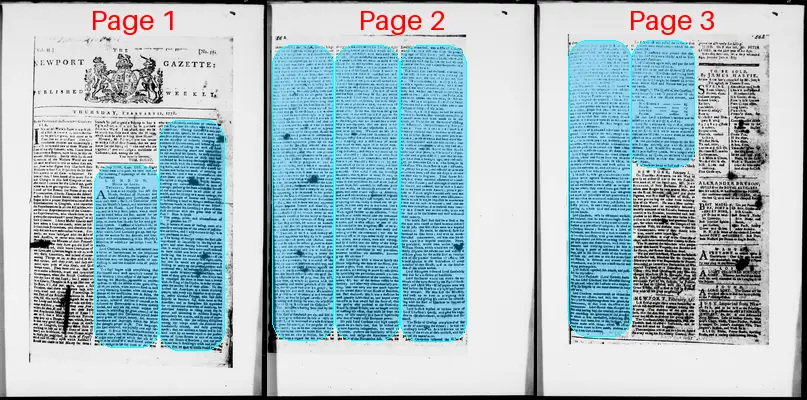
The Newport Gazette
Newport, Newport County, Rhode Island
What is this article about?
In the British House of Lords on November 20, debate on the King's speech focused on the American war. Lord Chatham criticized the ministry's conduct, use of Indian allies, and foreign troops, proposing an amendment for peace negotiations. The amendment was rejected 97-24, and the Address was agreed to.
Merged-components note: These components form a single continuous report on the proceedings of the British Parliament regarding the American war, spanning pages 1 to 3 with sequential reading order and flowing text content.
Clippings
1 of 3
OCR Quality
Full Text
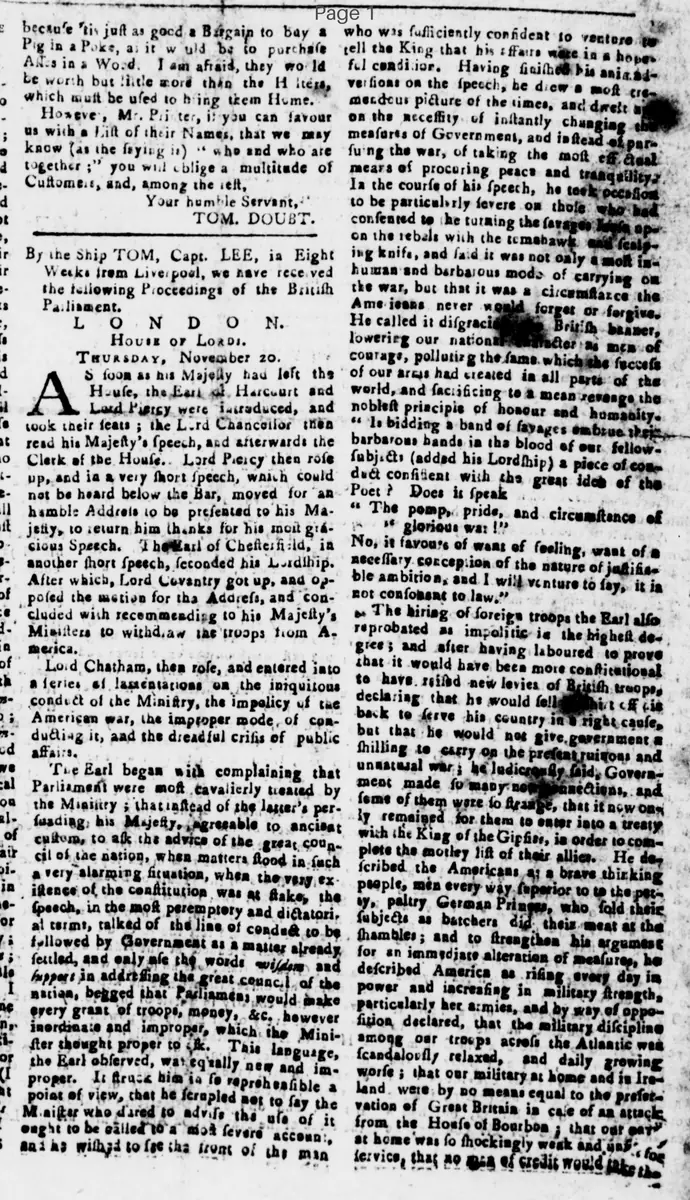
LONDON.
House of Lords.
Thursday, November 20.
As soon as his Majesty had left the House, the Earl of Harcourt and Lord Percy were introduced, and took their Seats; the Lord Chancellor then read his Majesty's speech, and afterward the Clerk of the House. Lord Percy then rose up, and in a very short speech, which could not be heard below the Bar, moved for an humble Address to be presented to his Majesty, to return him thanks for his most gracious Speech. The Earl of Chesterfield, in another short speech, seconded his Lordship.
After which, Lord Coventry got up, and opposed the motion for the Address, and concluded with recommending to his Majesty's Ministers to withdraw the troops from America.
Lord Chatham, then rose, and entered into a series of declamations on the iniquitous conduct of the Ministry, the impolicy of the American war, the improper mode of conducting it, and the dreadful crisis of public affairs.
The Earl began with complaining that Parliament were most cavalierly treated by the Ministry; that instead of the King's persuading his Majesty, agreeable to ancient custom, to ask the advice of the great council of the nation, when matters stood in such a very alarming situation, when the very existence of the constitution, was at stake, the Speech, in the most peremptory and dictatorial tone, talked of the line of conduct to be followed by Government as a matter already settled, and only made use of a few smooth words with them and support in addressing the great council of the nation, begged that Parliament would make every grant of troops, money; &c.; however inordinate and improper, which the Minister thought proper to ask. This language, the Earl observed, was equally new and improper. It struck him in so reprehensible a point of view, that he scrupled not to say the Minister who dared to advise the use of it ought to be called to a most Severe account, and he wished to get the front of the man who was sufficiently confident to venture to tell the King that his affairs were in hopeful condition.
Having finished his animadversions on the speech, he drew a most credulous picture of the situation, and dwelt a good deal on the necessity of instantly changing the measures of Government, and instead of prosecuting the war, of taking the most effectual means of procuring peace and tranquility.
In the course of his speech, he took occasion to be particularly severe on those who had consented to the turning the savage loose upon the rebels with the tomahawk and scalping knife, and said it was not only a most inhuman and barbarous mode of carrying on the war, but that it was a circumstance the Americans never would forget or forgive.
He called it disgraceful to the British banner, lowering our national character as men of courage, polluting the same, which the success of our arms had created in all parts of the world, and sacrificing to a mean revenge the noblest principles of honour and humanity.
In bidding a band of savages imbue their barbarous hands in the blood of our fellow-Subjects, (added his Lordship) a piece of conduct consistent with the great idea of the Poet? Does it speak
The pomp, pride, and circumstance of glorious war!?
No, it savours of want of feeling, want of necessary conception of the nature of justifiable ambition: and I will venture to say, it is not consonant to law.
The hiring of foreign troops the Earl also reprobated as impolitic in the highest degree; and after having laboured to prove that it would have been more constitutional to have raised new levies of British troops, declaring that he would sell the coat off his back to serve his country in a right cause, but that he would not give government a shilling to carry on the present ruinous and unnatural war: he ludicrously said: Government made so many new engagements, and (some of them were so strange), that it now only remained for them to enter into a treaty with the King of the Gypsies, in order to complete the motley list of their allies. He described the Americans as a brave thinking people, men every way superior to the petty, paltry German Princes, who sold their Subjects as butchers did their meat at the shambles; and to strengthen his argument for an immediate alteration of measures, he described America as rising every day in power and increasing in military strength, particularly her armies, and by way of opposition declared, that the military discipline among our troops across the Atlantic was scandalously relaxed, and daily growing worse; that our military at home and in Ireland were by no means equal to the preservation of Great Britain in case of an attack from the House of Bourbon; that our navy at home was so shockingly weak and unfit for service, that no man of credit would take the command of it; and, in fact, that the kingdom, now, in consequence of the present ruinous war, was altogether in a defenceless state.
saying our proof of our daily decreasing a power ready advantage, he balanced, that our kernel was carried with privateer, which annoyed our commerce much no more than usual cover hewn in these sort of war, on added, that our main, shut out of asbn river was not take the like inconvenience we felt. And having uttered innumerable griefs of America, this Lordship thought even a jar at the; had enlisted for the sake of wreaking, he would justify their conduct but that he was altogether so entirely of opinion with them as to undertake to demand support every thing they have done; America, his Lordship declared, was not to be justified in throwing off her dependency on Great-Britain; the mother country had an undoubted right to a Succession, between the two. They enjoy and use it usually for her own interest and that of her Colonies, and not with a view to derive great advantage to herself, and to oppress America. The act of navigation should be allowed, every pretence to independency retorted on the one hand, every desire of unconstitutional subjection given up on the other; this his Lordship asserted was the only rational idea of accommodation that could be adopted; and that it was at once honourable way, and promised to be permanently. This present moment his Lordship pointed out as the propitious point of time to bring an attempt, such a mode of accommodation; because, by the later declarations of not aiding America, seemed not to be ox the right terms with the Congress, and probably hit the reason was some treaty was on the carpet between her and the Congress Deputies, the terms of which he meant to terrify the latter into a compliance with, by appearing abs in carne in her professions to the Court of Great-Britain; that we ought to take advantage of this fluctuation affairs, and while there was any apparent opening, between France and America, to settle matters with the latter; and restore our distracted affairs to such order as was absolutely necessary for the safety of the empire. As a first step towards effecting what his Lordship advised, he moved an amendment to the Address proposed to be presented: which amendment was as follows:
" That this House does most humbly address and supplicate his Majesty to be pleased cautiously speedy and effectual measures to be taken for restoring peace in America; and that no time may be lost in proceeding an immediate cessation of hostilities are, in order to opening a treaty for a final settlement of the tranquility of these countries be provided by a removal of the shreddy causes of this joint us civil war, and by a just and adequate security against the return of the like calamities in time to come. And this House desires to offer the most du-assurance to his Majesty, that they will, in due time, cheerfully so operate with the magnanimity and tender goodness of his Majesty, for the preservation of his people; by such explicit and most solemn declarations deprecations of fundamental and irrevocable laws, as may be judged necessary for as-fraining and fixing, for ever, the respective right of Great Britain and her Colonies."
This amendment having been read by the clerk.
The Earl of Sandwich got up, and said it was with great diffidence he rose to reply to the noble Lord so reasoned as a wise statesman in powerful orator, as the proposer of the amendment: but as he was convinced from what had fallen from the noble Earl, that he only was an able politician, but had a real and sincere regard for his country; he thought it his duty to set his Lordship right in picturing favourable partialities which he had advanced, and which were absolutely false in fact. He promised that he was well aware the noble Earl did not mean to mislead the House or to misrepresent any one's character which he had taken upon him to mention in the course of his speech: just however it was evident that the noble Earl had been mis-formed. he would undeceive him in re-spect to each of the points alleged as e-very under his cognizance, and which he could prove to be very differently situated from he noble Earl's description. The first of these was the state of the navy in Europe, which the noble Earl had declared not any to be weak, and unfit for service, but in o despicable and deplorable a state. That no man of credit in his profession would take the com-mand of it. So far was this from being the case, that he was most deadly happy to be able to say, in the hearing of the House, and of the strangers, and not so care how uni-versally it was reported, that our navy never was in so powerful and respectable a condi-tion as at present. We have no less than forty two ships of the line in commission in Europe, thirty-five of which were fully man-ned, excepting very a deficiency of about thousand odd men upon their entire com-plements, which was an uncommonly tri-fling deficiency, and very easily made up in case of necessity: that the seven other ships were lately put into commission, and there-fore not yet manned; but that all the ma-terials necessary for them were ready, and that no doubt their complements would soon be procured. This naval force, his Lordship remarked, was superior to what France, or any of the continental powers had; and that when it was considered we had more line of battle ships, fully manned, in different parts of the world, an increase in number of fri-gates, and other armed vessels on America, and a most extraordinary addition of sloops and small vessels built and bought, and now preparing for sea, surely it could not be ar-gued, that our navy was in any such like a weak state, or an unserviceable condition.
With regard further to the assertion, "that no officer of credit would take the command of the fleet in Europe," it was equally false; a noble, and an able officer, of one of the first families in the kingdom; and of an ir-reproachable character, was both ready and willing to take the command; nor was he the only officer of reputation ready to accept it; others; many others, were all willing. and God forbid that the safety of the king-dom should rest solely on the experience and valour of an individual in any profession, however excellent his character, however great his abilities!
His Lordship,-with a view to satisfy the House respecting the state of the Navy, pro-duced papers, from which he read a variety of matters, all tending to prove his assertions, by specifying the particulars necessary to con-vey an exact information of the numbers, size, crews, &c. &c. of the various vessels in the service; and after very circumstantially pro-ving, that our navy was now much superior to the combined fleets of the House of Bourbon, the Earl declared; 'that it was a doctrine he most heartily subscribed to; and hoped every successor to him would feel the force of, that the person who presided at the Admiralty Board in Great Britain, was no longer worthy of holding his office; this he kept the navy of this country in a state of superiority over that of every other European power.
He paid Lord Chatham very high compli-ment on his declaration. that he wished not to have America independent, but would at all events, preserve the Superiority of Great-Britain, and oblige the Americans to allow the force of the Navigation Act. This, his Lord Suffolk.
Lord Camden took pains to show that the Americans had been treated in the most savage manner, and that the British had recourse to the tomahawk and scalping knife upon them. His Lordship referred to the conduct of Great Britain's expecting unconditional submission, and this Americans having no intention to declare their lives independent. Their conduct reduced them to the necessity of making such a declaration.
He Lordship defended his speech with affairs that they had ruined their America interests padded, this declaration over.
Lord Weymouth detailed Lord Camden on the change this language from last session, reflecting his conduct of France.
In both houses Parliament, in a short speech, arraigned the conduct to Great Britain, lament the ill consequences already the French present war having been so long, prophesied that the expense would increase in proportion to the continuance. Since, and advised that this country should make this an overture towards an accommodation, as a proof that she had forgot her past ill treatment.
The Duke of Richmond went over the old ground in the origin of the war, recapitulated its various events, and endeavoured to show, that in three years we had only aimed to subdue a few towns, and that the ablest mathematician could not possibly calculate the time it would take to be able to conquer all America.
Lord Effingham pointed out some contradictions, which had fallen from the mouths of this Ministry and the Lords in office, in the course of the debate, and took pains to justify the amendment, and the advice given by the noble Earl who proposed it.
Lord Suffolk, referring again to the objections made against Government for employing the Indians, and showed, that as it would not embodied them to assist us in repulsing the rebels, they would have got them to attack us; that our motive was the great and only principle of self-preservation; and that when an unnatural rebellion was begun, it surely was not only justifiable, but highly politic, to exert every instrument in quelling it, which God and nature had put into our hands.
Lord Chatham rose in vehement wrath, and declared, that he was exceedingly shocked at what the Secretary of State had avowed; shocked as a professor of religion; shocked as a Christian Senator; shocked as a Lord of Parliament, and shocked as a man of humanity! -- His Lordship, with great loudness of tone, reprobated the idea of turning the savages loose upon the Americans, with their tomahawks and scalping-knives; he said it was setting a pack of hell-hounds to hunt them; and in the literal sense of the words to eat them up. And that to use the former God and Nature, in defence and avowal of the circumstance, was in his eye a most horrid and daring presumption.
Lord Suffolk repelled this attack, and justified the expression.
The Lord President (Lord Gower) declared, that Lord Chatham was Minister during the last war, when the Indians were employed by the English in the same manner as they now were.
Lord Chatham endeavoured to show the blame on the officers, and said, that no authority for so employing them was given by Government, or sent from the office to the commanders. Lord Gower then charged him with having had the conduct, or at least the ignorance of the manner in which it was conducted, justifying. Presents had been sent to the Indians, and treaties made with them, which no officer would have dared to have made, without authority from Government. It was sick James.
Lord Amherst was called on to prove that the Indians were employed, -- which he acknowledged.
Lord Townshend also proved that they were chiefly used as Calmucks and Pandours.
Lord Chatham again rose, and put the best face he could on his assertion.
Lord Shelburne and the Duke of Grafton supported him. The Duke said letting loose the savages was as bad as poisoning rivers, and yet the latter might be deemed an instrument which God and Nature had put into our hands.
At length, "The Question, the Question." being called for from all parts of the House, it was put, when the House divided, and the numbers were,
Non Contents 84
Proxies 13
Contents 24
So that Lord Chatham's motion was rejected on a division of 97 against 24.
Lord Percy afterwards reported an Address to the House, which was read and agreed to, and the Lords with white staves ordered to wait on his Majesty, to know when he would please to be attended therewith.
At the conclusion of the debate on this motion for the Address, and after the division thereon; Lord Winchilsea moved, either in that introductory speech, for a congratulatory Address to the Queen, on the birth of a son to her Royal Highness, which motion was seconded by Lord Powis.
The House broke up at half past ten o'clock.
What sub-type of article is it?
What keywords are associated?
What entities or persons were involved?
Where did it happen?
Foreign News Details
Primary Location
London
Event Date
Thursday, November 20
Key Persons
Outcome
lord chatham's amendment for peace in america rejected 97-24; address to the king agreed to.
Event Details
Debate in the House of Lords on the King's speech regarding the American war. Lord Percy moved for an Address of thanks. Lord Coventry opposed and recommended withdrawing troops from America. Lord Chatham criticized the ministry's conduct, the war's impolicy, use of Indian allies and foreign troops, and proposed an amendment for immediate cessation of hostilities and peace negotiations. Earl of Sandwich defended the navy's strength. Other lords debated the savagery of employing Indians, the war's origins, and accommodations with America. The amendment was rejected, and the Address agreed to. A motion for a congratulatory Address to the Queen on a royal birth was also made.