Thank you for visiting SNEWPapers!
Sign up free
The National Intelligencer And Washington Advertiser
Washington, District Of Columbia
What is this article about?
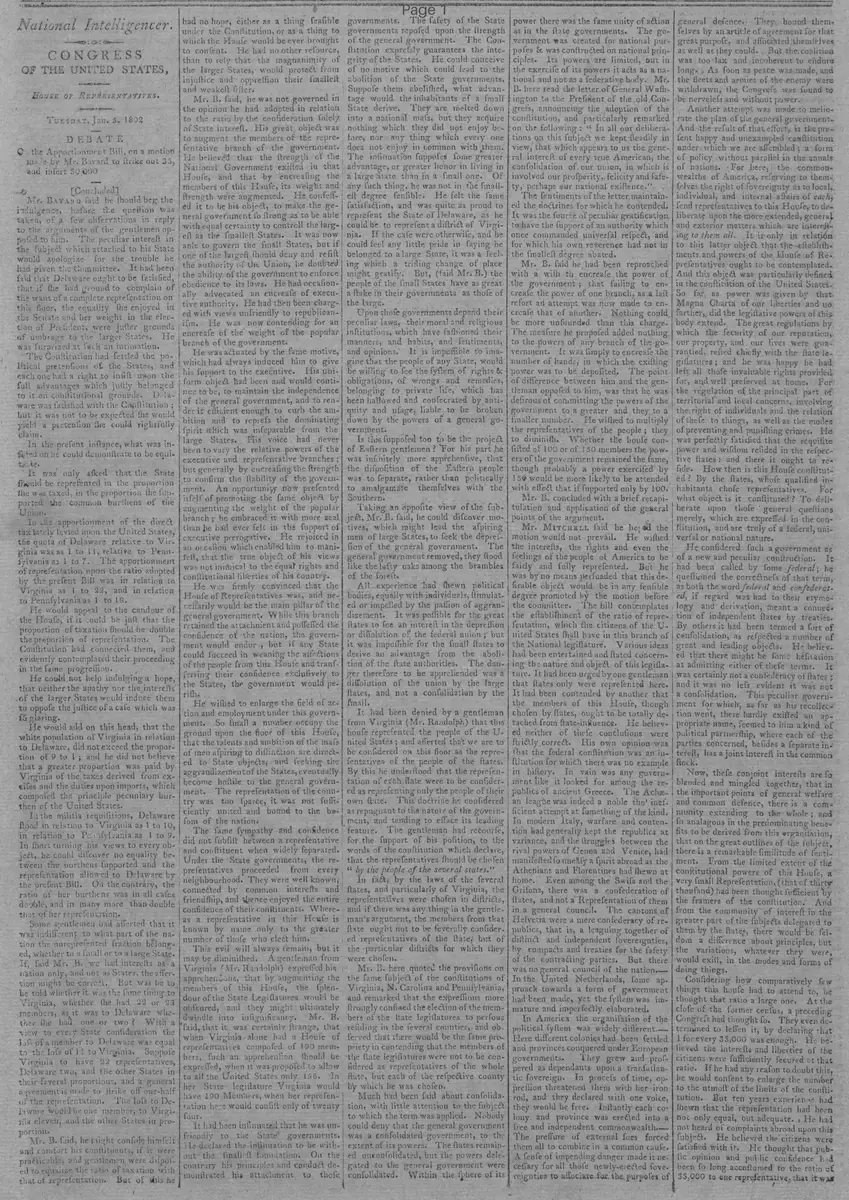
On January 5, 1802, the U.S. House of Representatives debated the Apportionment Bill. Mr. Bayard of Delaware argued for increasing the representation ratio to 50,000 to ensure fairer representation for smaller states relative to taxation and burdens, emphasizing national government strength. Opponents like Mr. Mitchell and Mr. Van Ness favored 33,000 for efficiency and balance. The motion failed 42-48.
Merged-components note: Continuation of the congressional debate on the Apportionment Bill across pages 1 and 2; original label of first component changed from 'story' to 'domestic_news' as it fits national legislative news.
Clippings
1 of 2
OCR Quality
Full Text
CONGRESS
OF THE UNITED STATES,
HOUSE OF REPRESENTATIVES.
TUESDAY, Jan. 5, 1802.
DEBATE
On the Apportionment Bill, on a motion
made by Mr. Bayard to strike out 33,
and insert 50,000.
[Concluded.]
Mr. Bayard said he should beg the
indulgence, before the question was
taken, of a few observations in reply
to the arguments of the gentlemen op-
posed to him. The peculiar interest in
the subject which attached to his State
would apologize for the trouble he
had given the committee. It had been
said that Delaware ought to be satisfied,
that if she had ground to complain of
the want of a complete representation on
this floor, the equality she enjoyed in
the Senate and her weight in the elec-
tion of President, were juster grounds
of umbrage to the larger States. He
was surprised at such an intimation.
The Constitution had settled the po-
litical pretensions of the States, and
each one had a right to insist upon the
full advantages which justly belonged
to it on constitutional grounds. Dela-
ware was satisfied with the Constitution;
but it was not to be expected she would
yield a pretension she could rightfully
claim.
In the present instance, what was in-
tended he could demonstrate to be equi-
table.
It was only asked that the State
should be represented in the proportion
she was taxed, in the proportion she sup-
ported the common burdens of the
Union.
In the apportionment of the direct
tax lately levied upon the United States.
the quota of Delaware relative to Vir-
ginia was as 1 to 11, relative to Penn-
sylvania as 1 to 7. The apportionment
of representation upon the ratio adopted
by the present Bill was in relation to
Virginia as 1 to 22, and in relation
to Pennsylvania as 1 to 18.
He would appeal to the candour of
the House, if it could be just that the
proportion of taxation should be double
the proportion of representation. The
Constitution had connected them, and
evidently contemplated their proceeding
in the same progression.
He could not help indulging a hope.
that neither the apathy nor the interests
of the larger States would induce them
to oppose the justice of a case which was
so glaring.
He would add on this head, that the
white population of Virginia in relation
to Delaware, did not exceed the propor-
tion of 9 to 1; and he did not believe
that a greater proportion was paid by
Virginia of the taxes derived from ex-
cises and the duties upon imports, which
composed the principal pecuniary bur-
den of the United States.
In the militia requisitions, Delaware
stood in relation to Virginia as 1 to 10,
in relation to Pennsylvania as 1 to 9.
In short turning his views to every ob-
ject, he could discover no equality be-
tween the burdens supported and the
representation allowed to Delaware by
the present Bill. On the contrary, the
ratio of her burdens was in all cases
double, and in many more than double
that of her representation.
Some gentlemen had asserted that it
was indifferent to what part of the na-
tion the unrepresented fraction belong-
ed, whether to a small or to a large State.
If, said Mr. B. we had interests as a
nation only, and not as States, the asser-
tion might be correct. But was he to
be told whether it was the same thing to
Virginia, whether she had 22 or 23
members, as it was to Delaware whe-
ther she had one or two? With a
view to every State consideration the
loss of a member to Delaware was equal
to the loss of 11 to Virginia. Suppose
Virginia to have 22 representatives,
Delaware two, and the other States in
their several proportions, and a general
agreement is made to strike off one-half
of the representation. The loss to De-
aware would be one member, to Virgi-
nia eleven, and the other States in pro-
portion.
Mr. B. said, he might console himself
and comfort his constituents, if it were
practicable, and gentlemen were disposed
to equalize the ratio of taxation with
that of representation. But of this he
had no hope, either as a thing feasible
under the Constitution, or as a thing to
which the House would be ever brought
to consent. He had no other resource,
than to rely that the magnanimity of
the larger States, would protect from
injustice and oppression their smallest
and weakest sister.
Mr. B. said, he was not governed in
the opinion he had adopted in relation
to the ratio by the consideration solely
of State interest. His great object was
to augment the members of the repre-
sentative branch of the government.
He believed that the strength of the
National Government existed in that
House, and that by increasing the
members of this House, its weight and
strength were augmented. He confessed
it to be his object, to make the ge-
neral government so strong as to be able
with equal certainty to control the larg-
est as the smallest States. It was now
able to govern the small States, but if
one of the largest should deny and resist
the authority of the Union, he doubted
the ability of the government to enforce
obedience to its laws. He had occasion-
ally advocated an increase of execu-
tive authority. He had then been charg-
ed with views unfriendly to republican-
ism. He was now contending for an
increase of the weight of the popular
branch of the government.
He was actuated by the same motive.
which had always induced him to give
his support to the executive. His uni-
form object had been and would conti-
nue to be, to maintain the independence
of the general government, and to ren-
der it efficient enough to curb the am-
bition and to repress the dominating
spirit which was inseparable from the
large States. His voice had never
been to vary the relative powers of the
executive and representative branches;
but generally by increasing the strength
to confirm the stability of the govern-
ment. An opportunity now presented
itself of promoting the same object by
augmenting the weight of the popular
branch; he embraced it with more zeal
than he had ever felt in the support of
executive prerogative. He rejoiced in
an occasion which enabled him to mani-
fest, that the true object of his views
was not inimical to the equal rights and
constitutional liberties of his country.
He was firmly convinced that the
House of Representatives was, and ne-
cessarily would be the main pillar of the
general government. While this branch
retained the attachment and possessed the
confidence of the nation, the govern-
ment would endure , but if any State
could succeed in weaning the affections
of the people from this House and tranf-
ferring their confidence exclusively to
the States, the government would pe-
rish.
He wished to enlarge the field of ac-
tion and employment under this govern-
ment. So small a number occupy the
ground upon the floor of this House,
that the talents and ambition of the mass
of men aspiring to distinction are direct-
ed to State objects, and seeking there
the aggrandizement of the States, eventually
become hostile to the general govérn-
ment. The representation of the coun-
try was too sparse, it was not ui-
sufficiently united and bound to the bo-
om of the nation.
The same sympathy and confidence
did not subsist between a representative
and constituent when widely separated.
Under the State governments, the re-
representatives proceeded from every
neighbourhood. They were well known,
connected by common interests and
friendship, and thence enjoyed the entire
Confidence of their constituents. Where-
as a representative in this House is
known by name only to the greater
number of those who elect him.
This evil will always remain, but it
may be diminished. A gentleman from
Virginia (Mr. Randolph) expressed his
apprehensions, that by augmenting the
members of this House, the splen-
dour of the State Legislatures would be
absorbed, and they might ultimately
dwindle into insignificancy. Mr. B.
said, that it was certainly strange, that
when Virginia alone had a House of
representatives composed of 190 mem-
bers, such an apprehension should be
expressed, when it was proposed to allow
to all the United States only 156. In
her State legislature Virginia would
have 190 Members, when her representa-
*tion here would consist only of twenty
four.
It had been insinuated that he was un-
friendly to the State' governments.
He declared the insinuation to be with-
out the slightest foundation. On the
contrary his principles and conduct de-
monstrated his attachment to those
governments. The safety of the State
governments reposed upon the strength
of the general government. The Con-
stitution expressly guarantees the inte-
grity of the States. He could conceive
of no motive which could lead to the
abolition of the State governments.
Suppose them abolished, what advan-
tage would the inhabitants of a small
State derive. They are melted down
into a national mass, but they acquire
nothing which they did not enjoy be-
fore, nor any thing which every one
does not enjoy in common with them.
The insinuation supposes some greater
advantage, or greater honor in living in
a large State than in a small one. Of
any such thing, he was not in the small-
est degree sensible. He felt the same
satisfaction, and was quite as proud to
represent the State of Delaware, as he
could be. to represent a district of Virgi-
nia. If the case were otherwise, and he
could feel any little pride in saying he
belonged to a large State, it was a feel-
ing which a trifling change of place
might gratify. But, (said Mr. B.) the
people of the small States have as great
a stake in their governments as those of
the large.
Upon those governments depend their
peculiar laws, their moral and religious
institutions, which have fashioned their
manners, and habits, and sentiments,
and opinions. It is impossible to ima-
gine that the people of any State, would
be willing to see the system of rights &
obligations, of wrongs.and remedies.
belonging to private life, which has
been hallowed and consecrated by anti-
guity and usage, liable to be broken
down by the powers of a general go-
vernment.
Is this supposed too to be the project
of Eastern gentlemen? For his part he
was infinitely more apprehensive, that
the disposition of the Eastern people
was to separate, rather than politically
to amalgamate themselves with the
Southern.
Taking an opposite view ofthe sub-
ject, Mr. B. said, he could discover mo-
tives, which might lead the aspiring
men of large States, to seek the depres-
sion of the general government. The
general government removed, they stood
like the lofty oaks among the brambles
of the forest.
All experience had shown political
bodies, equally with individuals, stimulat-
ed or impelled by the passion of aggran-
dizement. It was possible for the great
States to see an interest in the depression
or dissolution of the federal union; but
it was impossible for the small states to
derive an advantage from the aboli-
tion of the state authorities. The dan-
ger therefore to be apprehended was a
dissolution of the union by the large
states, and not a consolidation by the
small.
It had been denied by a gentleman
from Virginia (Mr. Randolph) that this
House represented the people of the U-
nited States; and asserted that we are to
be considered on this floor as the repre-
sentatives of the people of the States.
By this he understood that the representa-
tion of each State were to be consider-
ed as representing only the people of their
own state. This doctrine he considered
as repugnant to the nature of the govern-
ment, and tending to efface its leading
feature. The gentleman had recourse,
for the support of his position, to the
words of the constitution which declare,
that the representatives should be chosen
" by the people of the several states."
In fact, by the laws of the several
states, and particularly of Virginia, the
representatives were chosen in districts,
and if there was any thing in the gentle-
man's argument, the members from that
state ought not to be severally consider-
ed representatives of the state, but of
the particular districts for which they
were chosen,
Mr. B. here quoted the provisions on
the same subject of the constitutions of
Virginia, N. Carolina and Pennsylvania,
and remarked that the expressions more
strongly confirmed the election of the mem-
bers of the state legislatures to persons
residing in the several counties, and ob-
served that there would be the same pro-
priety in contending that the members of
the state legislatures were not to be con-
sidered as representatives of the whole
state, but each of the respective county
by which he was chosen.
Much had been said about consolida-
tion, with little attention to the subject
to which the term was applied. Nobody
could deny that the general government
was a consolidated government, to the
extent of its powers. The states remain-
ed unconsolidated, but the powers dele-
gated to the general government were
consolidated. Within the sphere of its
power there was the same unity of action
as in the state governments. The go-
vernment was created for national pur-
poses & was constructed on national prin-
ciples. Its powers are limited, but in
the exercise of its powers it acts as a na-
tional and not as a federative body. Mr.
B. here read the letter of General Wash-
ington to the President of the old Con-
gress, announcing the adoption of the
constitution, and particularly remarked
on the following : " In all our delibera-
tions on this subject we kept steadily in
view, that which appears to us the gene-
ral interest of every true American, the
consolidation of.our union, in which is
involved our prosperity, felicity and safe-
ty, perhaps our national existence."
The sentiments of the letter maintain-
ed the doctrines for which he contended.
It was the source of peculiar gratification
to have the support of an authority which
once commanded universal respect, and
for which his own reverence had not in
the smallest degree abated.
Mr. B. said he had been reproached
with a wish to increase the power of
the government ; that failing to en-
crease the power of one branch, as a last
resort an attempt was now made to en-
crease that of another. Nothing could
be more unfounded than this charge.
The measure he proposed added nothing
to the powers of any branch of the go-
vernment. It was simply to increase the
number of hands, in which the existing
power was to be deposited. The point
of difference between him and the gen-
tleman opposed to him, was that he was
desirous of committing the powers of the
government to a greater and they to a
smaller number. He wished to multiply
the representatives of the people; they
to diminish. Whether the house con-
sisted of 100 or of 150 members the pow-
ers of the government remained the same,
though probably a power exercised by
150 would be more likely to be attended
with effect that if supported only by 100.
Mr. B. concluded with a brief recapi-
tulation and application of the general
points of the argument.
Mr. MITCHELL said he hoped the
motion would not prevail. He wished
the interests, the rights and even the
feelings of the people of America to be
fairly and fully represented. But he
was by no means persuaded that this de-
sirable object would be in any sensible
degree promoted by the motion before
the committee. The bill contemplates
the establishment of the ratio of repre-
sentation, which the citizens of the U.
nited States shall have in this branch of
the National legislature. Various ideas
had been entertained and stated concern-
ing the nature and object of this legisla-
ture. It had been urged by one gentleman
that states only were represented here.
It had been contended by another that
the members of this House, though
chosen by states, ought to be totally de-
tached from state-influence. He believ-
ed neither of these conclusions were
strictly correct. His own opinion was
that the federal constitution was an in-
stitution for which there was no example
in history. In vain was any govern-
ment like it looked for among the re-
publics of ancient Greece. The Acha-
ian league was indeed a noble tho' inef-
ficient attempt at something of the kind.
In modern Italy, warfare and conten-
tion had generally kept the republics at
variance, and the struggles between the
rival powers of Genoa and Venice, had
manifested so uneasy a spirit abroad as the
Athenians and Florentines had shown at
home. Even among the Swiss and the
Grisons, there was a confederation of
States, and not a Representation of them
in a general council. The cantons of
Helvetia were a mere confederacy of re-
publics, that is, a leaguing together of
distinct and independent sovereignties,
by compacts and treaties for the safety
of the contracting parties. But there
was no general council of the nation.
In the United Netherlands, some ap-
proach towards a form of government
had been made, yet the system was im-
perfect and imperfectly elaborated.
In America the organization of the
political system was widely different.—
Here different colonies had been settled
and provinces conquered under European
governments. They grew and pro-
pered as dependants upon a transatlan-
tic sovereign. In process of time, op-
pression threatened them with her iron
rod, and they declared with one voice,
they would be free. Instantly each co-
lony and province was erected into a
free and independent commonwealth.—
The pressure of external foes forced
them all to combine in a common cause.
A sense of impending danger made it ne-
cessary or all those newly-erected ove-
reignties to associate for the purposes of
general defence. They bound them-
themselves by an article of agreement or that
great purpose, and associated themselves
as well as they could. But the. coalition
was too lax and incoherent to endure
long: , As soon as peace was made, and
the fleets and armies of the enemy were
withdrawn, the Congress. was found to
be nerveless and without power.
Another attempt was made to melio-
rate the plan of the general government.
And the result of that effort, is the pre-
sent happy and unexampled constitution
under which we are assembled; a form
of policy. without parallel in the annals
of nations. -For here,the common-
wealths of America, reserving to them-
themselves the right of sovereignty as to local,
individual, and internal affairs of each,
end representatives to this House, to de-
liberate upon the more extended, general.
and exterior matters which are interest-
ing to them all. It is only in relation
to this latter object that theestablish-
ments and powers of the House of Re-
representatives ought to be contemplated.
And this object was particularly defined
in the constitution of the United States.
So far as power was given by that.
Magna Charta of our liberties and no
farther, did the legislative powers of this
body extend. The great regulations by
which the security of our reputation,
our property, and our lives were gua-
rantied, rested chiefly with the state le-
gislatures; and be was happy be had
left all those invaluable rights provided
for, and well preserved at home. For
the regulation of the principal part of
territorial and local concerns, involving
the right of individuals and the relation
of these to things, as well as the modes
of preventing and punishing crimes. He
was perfectly satisfied that the requisite
power and wisdom resided in the respec-
tive states: and there it ought to re-
side. How then is this House consti-
tuted ? By the states, whose qualified in-
habitants choose representatives. For
what object is it constituted? To deli-
berate upon those general questions
merely, which are expressed in the con-
stitution, and are truly of a federal, uni-
versal or national nature.
He considered such a government as
of a new and peculiar construction. It
had been called by some federal; he
questioned the correctness of that term,
as both the word federal and confederat-
ed. if regard was had to their etymo-
logy and derivation, meant a connec-
tion of independent states by treaties.
By others it had been termed a sort of
consolidation, as respected a number of
great and leading objects. He believ-
ed that there might be some hesitation
at admitting either of these terms. It
was certainly not a confederacy of states ;
and it was no less evident it was not
a consolidation. This peculiar govern-
ment for which, as far as his recollec-
tion went, there hardly existed an ap-
propriate name, seemed to him a kind of
political partnership, where each of the
parties concerned, besides a separate in-
terest, has a joint interest in the common
stock.
Now, these conjoint interests are so
blended and mingled together, that in
the important points of general welfare
and common defence, there is a com-
munity extending to the whole; and
so analogous in the predominating bene-
fits to be derived from this organization,
that on the great outlines of the subject,
there is a remarkable similitude of senti-
ment. From the limited extent of the
constitutional powers of this House, a
very small Representation, (that of thirty
thousand) had been thought sufficient by
the framers of the constitution. And
from the community of interest in the
greater part of the subjects delegated to
them by the states, there would be sel-
dom a difference about principles, but
the variations, whatever they were,
would exist, in the modes and forms of
doing things.
Considering how comparatively few
things this house had to attend to, he
thought that ratio a large one. At the
close of the former census, a preceding
Congress had thought so. They even de-
termined to lessen it, by declaring that
1 for every 33,000 was enough. He be-
lieved the interests and liberties of the
citizens were sufficiently secured at that
ratio. If he had any reason to doubt this,
he would consent to enlarge the number
to the utmost of the limits of the consti-
tution. But ten years experience had
shown that the representation had been
not only equal, but adequate. He had
not heard of complaints abroad upon this
subject. He believed the citizens were
satisfied with it. He thought that pub-
lic opinion and public confidence had
been so long accustomed to the ratio of
33,000 to one representative, that it was
at least sales it possibly might be injurious to change it.
Judging upon the matter on principle, he considered 30,000 for 1 as a large allowance; and now aided by experience, he was convinced 1 to 33,000 was not too small. He had stated to the house, in a former debate, his opinion on a too numerous legislative body. He should not repeat what he then had advanced; but only observe that in an excessive representation there certainly would be more expense and less dispatch in business. As to the state of New-York, whence he had the honor to come, there had been lately a strong expression of the sense of the citizens on this subject. In a convention lately held for the purpose, it was ordained that the ratio of representation should be lessened in the branches of the legislature.
Much had been said concerning the large fraction in the state of Delaware. This was to him a matter of secondary importance. This fraction and all other fractions would be virtually represented in the proposed ratio, as well as in any other that could be proposed. The peculiar and exquisite manner in which that house was constituted, gave every one of its members an interest in the whole of the national concerns before them. And it was the privilege and the duty of a member from New-York, to consult the welfare of Maine and Tennessee; and of the members from those states to consult for the good of all the other states. This community of interest he contended went so far, that even in the case of laying a direct tax, that house could not without violating the constitution, cause Delaware to pay more of it than her rateable proportion. The census gave the number of her inhabitants, and beyond the amount of her population, it was not in the power of Congress to make her pay. And this rule would be inviolably regarded, even if her representative should by sickness or any unavoidable accident be prevented from attending in his place.
Great apprehensions had been expressed of the overbearing disposition of the larger states. He believed nothing had been advanced during the session of chimera. The fears about rapacity, selfishness and dominion were visionary. When New-York, a strong and powerful state, surrendered her impost, and poured her wealth into the national treasury, was that rapacity? In this magnanimous act was there any thing that looked like selfishness? Was the delivery of the key into the hand of the nation, a grasping for dominion? No. There was nothing like it; nor was there any probability that such proceedings would ever happen. The smaller states were the most benefitted by the ratification of the present constitution. They were accordingly the first to adopt it. And they had uniformly found it a system, not of oppression, but of protection, and that protection would never, with his consent, be withdrawn from them.
In the course of his remarks, Mr. Mitchell animadverted on the proposition made some time since in the state of Delaware, to abolish the sovereignty of that state, and to merge in that of an adjoining state.
Mr. Bayard said that he would furnish the house with some information respecting the proposition alluded to by the gentleman from New-York. The proposition had been made. He would inform the house by whom it had been made, and what were the motives of those who made it. It had been made by a set of men once called jacobins, then democrats, and who now called themselves republicans. It had been opposed by the federalists, who, having most strength, frustrated it. It had been the desire and effort of the former description of men to get all the offices of the state into their hands, in which having failed, they wished to be annexed to Pennsylvania, where democratic principles held sway.
Mr. Van Ness. After the great display of talents and abilities which we have had upon this subject, it is not to be expected that I shall rise to detain you more than a moment or two. I have attended, Sir, with great deference and respect to all the gentlemen who have been up before me. I have heard an eloquent discussion, extremely entertaining and improving, but which being rather too much confined to abstract principles, I think has not been in all its parts immediately applicable to the question before us.
Gentlemen, Sir, surely deserve credit for their candor at least, who avow their motives to be local prepossessions or partialities. Considerations of this kind, particular attachments appear indeed too operative in the present case; but, Sir, I think, and I believe the sentiment is common to a majority of my Colleagues, that we ought not to be wholly actuated by such motives. We have heard much upon the question, whether we are the representatives of the states (or of the people of the different states) or whether we are the representatives of the whole people of the United States? I must confess, Sir, that the moment I enter this house I consider myself as bound by general obligations towards the whole nation. My obligations and duties extend to all the United States, and in an act of national legislation, I do not feel myself justified in consulting the particular and more immediate interest of any individual state as contradistinguished from those of the others. No arrangement, tending in its result to general benefit or advantage, ought to be varied or rejected merely upon the ground of partial inconvenience to any particular state. This doctrine savors too much of that narrowness, of that contracted illiberality which ought never to govern the mind of the legislature. He should take extensive views of his subject, and be influenced only by a liberal policy.
Our government is, after all, but a government of experiment. We have opened a new road to ourselves, and are travelling on in it without knowing to a certainty what dangers may await us by the way. We should therefore, Sir, proceed,
"With cautious steps and slow."
We have been in number as low as 65. We have increased to 106. We now propose to rise to 141 (at 33,000) that is to considerably more than a duplication in about 13 or 14 years. Is not this, Sir, advancing with pretty rapid strides? We all acknowledge we must stop somewhere.
There is a certain point, Sir, that point where security and convenience for the transaction of public business meet, which we must not pass; if we do we may find it difficult and embarrassing to recede. The constitution of human nature is such that we are all gratified with the enjoyment and exercise of power. Tell the people you shall choose a certain number of representatives; and if, upon experiment, it is found too large, you will find it difficult to diminish. We may hesitate ourselves: we may not be disposed to lessen our chances of re-election. The people will hesitate to relinquish or abridge their right. And, Sir, if once we have plunged ourselves into the dilemma of too numerous a representation, all the dreadful evils incident to such a state, and which in a particular instance, excites the sensibility of some gentlemen, may be produced before a preventative can be adopted.
I confess, Sir, I am one of those who, though differing in this particular from some gentlemen on this side of the house, whose opinions I highly respect, believe that an increase of members in a public body to a certain extent, will increase the confidence of the community in that body. I do not mean, Sir, such an increase as would exceed the line that I have before marked out, and which would expose the body alternately to ridicule and contempt, and to the dangerous operation of those licentious and ungovernable passions which frequently rage in society; but a moderate, reasonable augmentation, such an one as is calculated and adapted to secure the advantages incident to a wholesome deliberative assembly. I say, Sir, in this case an increase of members will generally increase confidence: and that confidence will be attended with a correspondent augmentation of powers, since the representative body will have a greater influence over the physical force of the community.
It certainly, Sir, appears to me that we ought to be extremely careful how we increase this power in the general government. I believe, Sir, with many others, that the influence of that government has been bearing very hard upon the state governments. I believe, Sir, whatever was the theory, that the practice for sometime last tended to the substantial reduction of the state governments. I believe this, Sir, has been the policy (and perhaps consistently with their principles) of some who have borne a conspicuous part in the administration of our government; but, Sir, I flatter myself the doctrine is exploded. In this view, Sir, that is with respect to the state governments, I do not wish to see our own powers too much increased in the augmented numbers of this house.
I do not wish to see the state governments, which I regard indeed as the pillars on which the fabric of our liberty rests, drawn within and swallowed up by the vortex of federal power and influence. In another view, Sir, I do not wish to see the powers of this house imprudently enlarged by too rapid an increase of members. The established theory of our constitution I admire—I adore it. I believe the arrangement and distribution of power among the several branches of the government is in the main salutary and correct. The equilibrium is well established, and may continue whilst we are careful not to add too great a weight to either branch.
But, Sir, give this house too decided a preponderance, by means of its numbers, increased public confidence, and its consequent increased strength—and you hazard all. We have seen melancholy instances, Sir, of public evils resulting from struggles for power between different branches of the same political establishment. When by accident, intrigue, or other circumstances, the physical power of a people has been more peculiarly and completely attached or devoted to one of those branches, we have frequently beheld it, conscious of this advantage, and under the influence of the most dangerous passions, sweep every thing before it that opposed the gratification of those passions. I need not particularize. The history of every country that has ever enjoyed even a semblance of liberty: where there has been even a pretended division or distribution of power, will furnish us with cases.
I do therefore, Sir, feel a strong regard, a strong solicitude for the preservation and permanent firmness of the other branches of the present government, whilst I am augmenting the numbers, confidence and power of this house. We are at present, and by a moderate progression will continue, a sufficient counterbalance to the other branches. If we practice upon the pure principles of the constitution, I am persuaded it is so.
But, Sir, it is said by some gentlemen that the difference for which we contend is trifling; neither on the score of economy or any other, can it be material, &c. I confess, Sir, the number of fifteen abstracted, is not very large—but is not the addition of thirty-five members (which will be the increase according to the ratio of 33,000) a considerable one. It is not large when compared to the whole number of members. Will not this satisfy the country? When our population was three millions our representation on this floor consisted of 65 members. When our population was near four millions, our number of representatives here was 106, and so continued until the present day. When our population, Sir, appears to be five millions, shall we call for 156, in direct violation of the principle heretofore established, instead of 141, which will be the number afforded by the divisor of 33,000, and which is the number we ask for.
I repeat, Sir, we must rest somewhere. We cannot long proceed at this rapid rate of increase in direct proportion to our population. And it appears more reasonable, more politic, gradually to lessen our proportional increase, until we arrive by a moderate progression, at an ultimatum, than to proceed in full career, and with an intemperate zeal for increase; and thus presently do violence to the habits and expectations of the country, by a sudden, an abrupt discontinuance.
I would therefore, Sir, prefer even a larger ratio than 33,000: to 30,000, but this not appearing desirable to any part of the house, I shall adhere to that number, which appears to me most proper and consistent, of any that has been under consideration. As I have before said, Sir, I respect the feelings and sentiments of the public upon every occasion, particularly upon the present, when we are upon a subject more interesting to them than any other object of legislation. They are generally right, Sir, taking necessarily a strong interest in public affairs, after having bestowed due deliberation and reflection upon a subject, they arrive at the truth. This remark applies Sir, to an enlightened country, a country like our own. I consider their opinions as unequivocally expressed in the first instance by our constitution, which directs that the number of representatives shall not exceed one for every 30,000, even at the period of its formation, when our population was so much inferior to the present, clearly implying that even in that state of our population this ratio was full low enough, and of course that as the population advanced the ratio or divisor ought to be increased: By the Law of Congress passed very soon afterwards, and after the taking of the first census, which pursuing this principle raised the ratio to 33,000, by the recommendation of Congress (two thirds of both houses concurring) of an article, by way of amendment to the constitution, regulating, in effect, the ratio by the population. Here indeed some gentlemen triumphantly exclaim, "but that recommended article was rejected. It was not adopted by three fourths of the states." Those gentlemen, however, Sir, should recollect that it was not rejected on account of its principle. It contained, probably through the inadvertence of its framers, a proposition which was inconsistent and contradictory in itself. By the terms of it, after the number of representatives should have amounted to two hundred the proportion was to have been so regulated that there were not to be less than two hundred members, nor more than 1 for every 30,000; whereas it might have happened from the state of population, that taking the ratio (the least possible according to the proposed article) the number of members would have fallen short of 200. Here then, Sir, in the same breath it was proposed that the number of members should not be less, and that it might be less than 200. To this intrinsic defect in the form, and not to the radical principle out of which it had grown, the proposed amendment owed its rejection.
Notwithstanding all this imperfection of form, and perhaps substance, in which it was submitted, a number of states, though not indeed three-fourths assented to it; and the concurrent evidence of the public sentiment in favor of the principle which I contend for, is the satisfaction of the country with the practice under that principle. I would indeed prefer a moderate increase of the ratio, as the most reasonable arrangement: but since that seems not to be desirable by any part of this house, I shall adhere to 33,000; for to descend from that, appeared upon the ground of general principle, to be reversing the order of things, and to be in direct hostility to every idea of propriety.
The examples of particular states, Sir, have been cited in favor of the more numerous representation; but, I presume it will be recollected that from the difference between the objects of state and those of federal legislation, a correspondent difference may be proper in the relative proportion of representation. The one embraces the minute and particular interests of the different districts and parts of the individual states; the other objects of a more general nature. In the one case, therefore, a more intimate local knowledge is requisite than in the other; and this is to be obtained only by a more numerous representation. In the state, however, Sir, which I have the honor to represent, after an experience of 24 years, and upon the most mature deliberation they have lately reduced their limitation to 150 members, in the popular branch, their present number consisting of a few more than 100. In the most important eastern state, indeed one of the most important in the union, although they have a right to elect a number considerably larger than here contended for, still I believe that right, from political inconveniences, has frequently remained unexercised. And here, Sir, permit me to add, if I am mistaken the gentleman from that state will correct me, that the internal arrangement or apportionment of the representatives from the different towns in that state, is observed the very principle for which we now contend, that is all increase of ratio in some proportion to the increase of population or electors; and, Sir, I think 60 members, whatever may be the whole eligible number which particular emergencies may draw forth, is a quorum to proceed to business. The same principle, that is, a proportionate increase of ratio is adopted, I think, in New-Hampshire. All the other states, Sir, perhaps one or two excepted, are below even our present number, in this popular branch; many of them very inferior indeed.
It has been strenuously urged and insisted upon, Sir, that every precaution ought to be taken to prevent a combination of the larger states against the smaller. That the former would always feel a strong disposition to oppress, and finally to crush the other. But, Sir, are not those fears chimerical? How are they warranted by experience in similar cases? Why most of the small states or nations in the world, are brought into existence, and afterwards supported and reared by the jealousies and enmities of the large ones, towards each other. They are not jealous of the weak, but of the strong; and neither of them will voluntarily suffer a powerful rival, to accumulate a degree of strength dangerous to herself. Hence, Sir, has for a long time proceeded the safety of most of the small states in the world. I might instance among others Holland and Switzerland in Europe. I might call the attention of this house to our own political history. And has not even the State of Delaware discovered in her sister states the most friendly, the most conceding disposition, on all important occasions? They will acknowledge the fact. Now and then, indeed, a solitary instance of a foolish division occurs: but Sir, they are rare. Ambition. Rapacity, those very passions that move the plunderers to the measure, generally produce a difference about a division of the spoil.
The gentleman from Delaware, Sir, contends that he is the representative of all the United States; and still the moment he views the fraction likely to remain to that State, his feelings seem to whisper to him "you are the representative only of Delaware;" for, if that gentleman will for a moment examine the general result to all the small states in case of the division of 30,000, he will find that the aggregate fraction is larger than in the case of 33,000, and not smaller as some gentlemen have erroneously stated. Gentlemen are very fearful indeed, Sir, that the four larger States will obtain a majority of votes on this floor. What, Sir, are the gentlemen republicans? Do they pretend that the people ought to be represented, and a majority of them so represented ought not to govern; & are they not willing to allow, if a majority of the constitutional Electors of the country are found within any particular states or parts of the Union, that they should also have a majority on this floor? This Sir, is proceeding upon the true principles of representation which I presume they are not ready to contest. The majority of population is unquestionably contained in those states: but, Sir, the danger is idle. Among other reasons we need not now repeat the disproportionate weight which the small states have in the choice of the other branch of the Legislature and of the Executive.
Something, Sir, has been said about economy. That the difference in expense would be trifling &c. This opinion comes, in one instance particularly, from a respectable quarter: But, Sir, when I reflect that, besides the additional consumption of time which must necessarily result, there will be a saving in the course of ten years of between two and three hundred thousand dollars in the immediate pay of the members, I cannot think so lightly of it. I think, Sir, would make a respectable item in a list of retrenchments. I would not, indeed, sacrifice to this object any important advantages of a representative government; but there is no danger of such a consequence.
The gentleman from Delaware, in adverting to a struggle which some time since took place in his state respecting a surrender of their sovereignty, acknowledged the fact, but very unnecessarily went on to tell us that the attempt was made by those who were formerly called Jacobins, afterwards Democrats, and who now call themselves Republicans.
It is a little extraordinary, Sir, I confess, and only to be accounted for by local circumstances unknown to us, that they should have had to contend in a struggle of this kind with a set of people formerly called Federalists; afterwards Aristocrats; and now called Royalists. The opposition of this latter class cannot have been consistent with their usual principles—principles which after full experience have met with the public reprobation.
General S. Smith, Mr. Lowndes, and Mr. Van Rensselaer followed Mr. Bayard, in favor of the ratio of 33,000.
The question was then taken on striking out "33,000," and lost—Ayes 42, Noes 48.
What sub-type of article is it?
What keywords are associated?
What entities or persons were involved?
Where did it happen?
Domestic News Details
Primary Location
Washington
Event Date
Tuesday, Jan. 5, 1802
Key Persons
Outcome
the motion to strike out 33,000 and insert 50,000 was lost—ayes 42, noes 48.
Event Details
Debate on the Apportionment Bill in the House of Representatives, where Mr. Bayard argued for a higher ratio of representation to benefit smaller states like Delaware by aligning it with taxation proportions and strengthening the national government, while opponents argued for maintaining 33,000 for efficiency, balance between federal and state powers, and historical precedent.