Thank you for visiting SNEWPapers!
Sign up free
Letter to Editor
March 5, 1799
Gazette Of The United States, & Philadelphia Daily Advertiser
Philadelphia, Philadelphia County, Pennsylvania
What is this article about?
A letter to the editor debates the end of the 18th century, arguing it closes on December 31, 1800, not 1799. The writer uses almanac dating from Christ's birth and milestone analogies from Philadelphia to Lancaster to support that 1800 years elapse only at the end of 1800.
Clipping
OCR Quality
92%
Excellent
Full Text
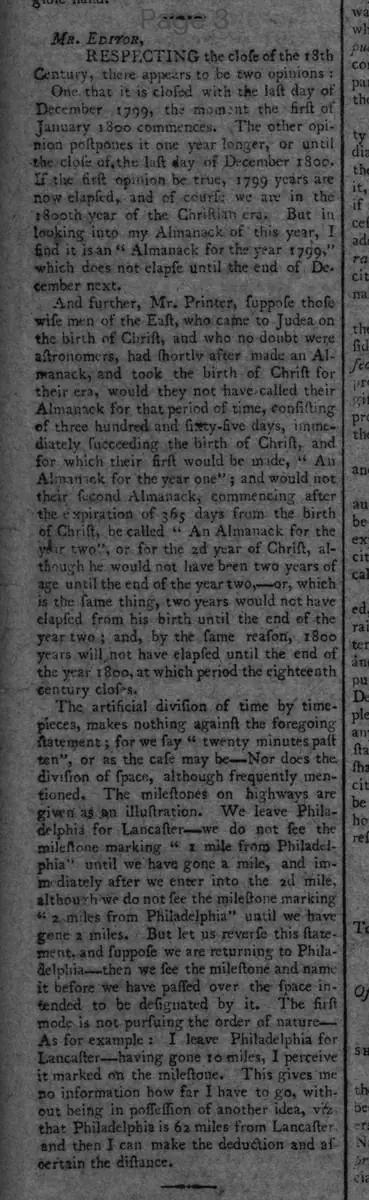
MR. EDITOR,
RESPECTING the close of the 18th
Century, there appears to be two opinions:
One that it is closed with the last day of
December 1799, the moment the first of
January 1800 commences. The other opi-
nion postpones it one year longer, or until
the close of the last day of December 1800.
If the first opinion be true, 1799 years are
now elapsed, and of course we are in the
1800th year of the Christian era. But in
looking into my Almanack of this year, I
find it is an "Almanack for the year 1799,"
which does not elapse until the end of De-
cember next.
And further, Mr. Printer, suppose those
wise men of the East, who came to Judea on
the birth of Christ, and who no doubt were
astronomers, had shortly after made an Al-
manack, and took the birth of Christ for
their era, would they not have called their
Almanack for that period of time, consisting
of three hundred and sixty-five days, imme-
diately succeeding the birth of Christ, and
for which their first would be made, "An
Almanack for the year one"; and would not
their second Almanack, commencing after
the expiration of 365 days from the birth
of Christ, be called "An Almanack for the
year two", or for the 2d year of Christ, al-
though he would not have been two years of
age until the end of the year two, -or, which
is the same thing, two years would not have
elapsed from his birth until the end of the
year two; and, by the same reason, 1800
years will not have elapsed until the end of
the year 1800, at which period the eighteenth
century closes.
The artificial division of time by time-
pieces, makes nothing against the foregoing
statement; for we say "twenty minutes past
ten", or as the case may be. Nor does the
division of space, although frequently men-
tioned. The milestones on highways are
given as an illustration. We leave Phila-
delphia for Lancaster-we do not see the
milestone marking "1 mile from Philadel-
phia" until we have gone a mile, and im-
mediately after we enter into the 2d mile,
although we do not see the milestone marking
"2 miles from Philadelphia" until we have
gone 2 miles. But let us reverse this state-
ment, and suppose we are returning to Phila-
delphia-then we see the milestone and name
it before we have passed over the space in-
tended to be designated by it. The first
mode is not pursuing the order of nature
As for example: I leave Philadelphia for
Lancaster-having gone 10 miles, I perceive
it marked on the milestone. This gives me
no information how far I have to go, with-
out being in possession of another idea, viz
that Philadelphia is 62 miles from Lancaster
and then I can make the deduction and as-
certain the distance.
RESPECTING the close of the 18th
Century, there appears to be two opinions:
One that it is closed with the last day of
December 1799, the moment the first of
January 1800 commences. The other opi-
nion postpones it one year longer, or until
the close of the last day of December 1800.
If the first opinion be true, 1799 years are
now elapsed, and of course we are in the
1800th year of the Christian era. But in
looking into my Almanack of this year, I
find it is an "Almanack for the year 1799,"
which does not elapse until the end of De-
cember next.
And further, Mr. Printer, suppose those
wise men of the East, who came to Judea on
the birth of Christ, and who no doubt were
astronomers, had shortly after made an Al-
manack, and took the birth of Christ for
their era, would they not have called their
Almanack for that period of time, consisting
of three hundred and sixty-five days, imme-
diately succeeding the birth of Christ, and
for which their first would be made, "An
Almanack for the year one"; and would not
their second Almanack, commencing after
the expiration of 365 days from the birth
of Christ, be called "An Almanack for the
year two", or for the 2d year of Christ, al-
though he would not have been two years of
age until the end of the year two, -or, which
is the same thing, two years would not have
elapsed from his birth until the end of the
year two; and, by the same reason, 1800
years will not have elapsed until the end of
the year 1800, at which period the eighteenth
century closes.
The artificial division of time by time-
pieces, makes nothing against the foregoing
statement; for we say "twenty minutes past
ten", or as the case may be. Nor does the
division of space, although frequently men-
tioned. The milestones on highways are
given as an illustration. We leave Phila-
delphia for Lancaster-we do not see the
milestone marking "1 mile from Philadel-
phia" until we have gone a mile, and im-
mediately after we enter into the 2d mile,
although we do not see the milestone marking
"2 miles from Philadelphia" until we have
gone 2 miles. But let us reverse this state-
ment, and suppose we are returning to Phila-
delphia-then we see the milestone and name
it before we have passed over the space in-
tended to be designated by it. The first
mode is not pursuing the order of nature
As for example: I leave Philadelphia for
Lancaster-having gone 10 miles, I perceive
it marked on the milestone. This gives me
no information how far I have to go, with-
out being in possession of another idea, viz
that Philadelphia is 62 miles from Lancaster
and then I can make the deduction and as-
certain the distance.
What sub-type of article is it?
Philosophical
Reflective
Informative
What themes does it cover?
Science Nature
Religion
Social Issues
What keywords are associated?
18th Century Close
Christian Era
Almanack Dating
Milestones Analogy
Time Reckoning
Philosophical Debate
What entities or persons were involved?
Mr. Editor
Letter to Editor Details
Recipient
Mr. Editor
Main Argument
the 18th century closes at the end of december 1800, not 1799, as 1800 years from christ's birth elapse only then, supported by almanac dating and milestone analogies.
Notable Details
References Wise Men Of The East As Astronomers
Almanack For The Year One Starting At Christ's Birth
Milestone Illustration From Philadelphia To Lancaster (62 Miles)