Thank you for visiting SNEWPapers!
Sign up free
Story
March 14, 1827
Phenix Gazette
Alexandria, Virginia
What is this article about?
Editorial from Lynchburg Virginian on a failed duel challenge between Hon. George McDuffie and Gen. Metcalfe, stemming from political committee disputes over Mr. Calhoun and the Rip Rap contract. McDuffie challenged but refused rifles, leading to harmless ink-spilling instead of blood.
Clipping
OCR Quality
92%
Excellent
Full Text
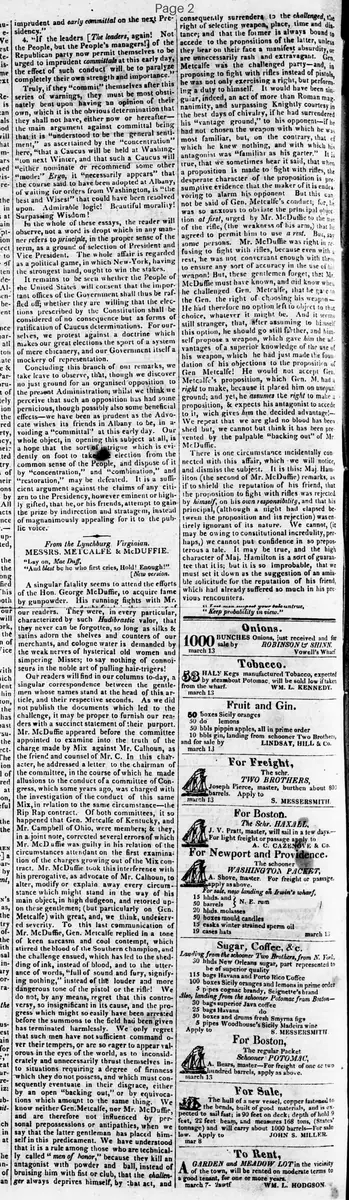
From the Lynchburg Virginian.
MESSRS. METCALFE & McDUFFIE.
"Lay on, Mac Duff,
"And blest be he who first cries, Hold! Enough!"
[New version.]
A singular fatality seems to attend the efforts of the Hon. George McDuffie, to acquire fame by gunpowder. His running fights with Mr. our readers. They were, in every particular, characterized by such Hudibrastic valor, that they never can be forgotten, so long as silks & satins adorn the shelves and counters of our merchants, and cologne water is demanded by the weak nerves of hysterical old women and simpering Misses; to say nothing of connoisseurs in the noble art of pulling hair-triggers!
Our readers will find in our columns to-day, a singular correspondence between the gentlemen whose names stand at the head of this article, and their respective seconds. As we did not publish the documents which led to the challenge, it may be proper to furnish our readers with a succinct statement of their purport.
Mr. McDuffie appeared before the committee appointed to examine into the truth of the charge made by Mix against Mr. Calhoun, as the friend and counsel of Mr. C. In this character, he addressed a letter to the chairman of the committee, in the course of which he made allusions to the conduct of a committee of Congress, which some years ago, was charged with the investigation of the conduct of this same Mix, in relation to the same circumstance-the Rip Rap contract. Of both committees, it so happened that Gen. Metcalfe of Kentucky, and Mr. Campbell of Ohio, were members; & they, in a joint note, corrected several errors of which Mr. McDuffie was guilty in his relation of the circumstances attendant on the first examination of the charges growing out of the Mix contract. Mr. McDuffie took this interference with his prerogative, as advocate of Mr. Calhoun, to alter, modify or explain away every circumstance which might stand in the way of his main object, in high dudgeon, and retorted upon these gentlemen; (but particularly on Gen. Metcalfe) with great, and, we think, undeserved severity. To this last communication of Mr. McDuffie, Gen. Metcalfe replied in a tone of keen sarcasm and cool contempt, which stirred the blood of the Southern champion, and the challenge ensued, which has led to the shedding of ink, instead of blood, and to the utterance of words, "full of sound and fury, signifying nothing," instead of the louder and more dangerous tone of the pistol or the rifle! We do not, by any means, regret that this controversy, so insignificant in its cause, and the progress which might so easily have been arrested before the summons to the field had been given has terminated harmlessly. We only regret that such men have not sufficient command over their tempers, or are so eager to appear valorous in the eyes of the world, as to inconsiderately and unnecessarily thrust themselves into situations requiring a degree of firmness which they do not possess, and which must consequently eventuate in their disgrace, either by an open "backing out," or by equivocations which amount to the same thing. We know neither Gen. Metcalfe, nor Mr. McDuffie, and are therefore not influenced by personal prepossessions or antipathies, when we say that the latter gentleman has placed himself in this predicament. We have understood that it is a rule among those who are technically called "men of honor," because they kill an antagonist with powder and ball, instead of bruising him with fist or club, that the challenger always deprives himself, by that act, and consequently surrenders to the challenged, the right of selecting weapon, place, time and distance; and that the former is always bound to accede to the propositions of the latter, unless they bear on their face a manifest absurdity, or are unnecessarily rash and extravagant.
Gen. Metcalfe was the challenged party-and, in proposing to fight with rifles instead of pistols, he was not only exercising a right, but performing a duty to himself. It would have been singular, indeed, an act of more than Roman magnanimity, and surpassing Knightly courtesy in the best days of chivalry, if he had surrendered his "vantage ground," to his opponent-if he had not chosen the weapon with which he was most familiar, but, on the contrary, that of which he knew nothing, and with which his antagonist was "familiar as his garter."
It is true, that we sometimes hear it said, that when a proposition is made to fight with rifles, the desperate character of the proposition is presumptive evidence that the maker of it is endeavoring to alarm his opponent But this can not be said of Gen. Metcalfe's conduct; for, he was so anxious to obviate the principal objection at first, urged by Mr. McDuffie to the use of the rifle, (the weakness of his arm,) that he agreed to permit him to use a rest. But, say some persons. Mr. McDuffie was right in refusing to fight with rifles, because even with a rest, he was not conversant enough with them to ensure any sort of accuracy in the use of his weapon! But, these gentlemen forget, that Mr. McDuffie must have known, and did know when he challenged Gen. Metcalfe, that he gave to the Gen. the right of choosing his weapon- He had therefore no option left to object to that choice, whatever it might be. And it seems still stranger, that, after assuming to himself this option, he should go still farther, and himself propose a weapon, which gave him the advantages of a superior knowledge of the use of his weapon, which he had just made the foundation of his objections to the proposition of Gen Metcalfe! He would not accept Gen Metcalfe's proposition, which Gen. M. had a right to make, because it placed him on unequal ground; and yet, he assumes the right to make a proposition, & expects his antagonist to accede to it, which gives him the decided advantage!-
We repeat that we are glad no blood has been shed but, we cannot but think it has been prevented by the palpable "backing out" of Mr McDuffie.
There is one circumstance incidentally connected with this affair, which we will notice, and dismiss the subject. It is this: Maj. Hamilton (the second of Mr. McDuffie) remarks, as if to shield the reputation of his friend, that the proposition to fight with rifles was rejected by himself, on his own responsibility, and that his principal, (although a night had elapsed between the proposition and its rejection) was entirely ignorant of its nature. We cannot, (it may be owing to constitutional incredulity, perhaps,) we cannot put confidence in so preposterous a tale. It may be true, and the high character of Maj. Hamilton is a sort of guarantee that it is; but it is so improbable, that we must set it down as the suggestion of an amiable solicitude for the reputation of his friend which had already suffered so much in his previous rencounters.
Keep probability in view.
MESSRS. METCALFE & McDUFFIE.
"Lay on, Mac Duff,
"And blest be he who first cries, Hold! Enough!"
[New version.]
A singular fatality seems to attend the efforts of the Hon. George McDuffie, to acquire fame by gunpowder. His running fights with Mr. our readers. They were, in every particular, characterized by such Hudibrastic valor, that they never can be forgotten, so long as silks & satins adorn the shelves and counters of our merchants, and cologne water is demanded by the weak nerves of hysterical old women and simpering Misses; to say nothing of connoisseurs in the noble art of pulling hair-triggers!
Our readers will find in our columns to-day, a singular correspondence between the gentlemen whose names stand at the head of this article, and their respective seconds. As we did not publish the documents which led to the challenge, it may be proper to furnish our readers with a succinct statement of their purport.
Mr. McDuffie appeared before the committee appointed to examine into the truth of the charge made by Mix against Mr. Calhoun, as the friend and counsel of Mr. C. In this character, he addressed a letter to the chairman of the committee, in the course of which he made allusions to the conduct of a committee of Congress, which some years ago, was charged with the investigation of the conduct of this same Mix, in relation to the same circumstance-the Rip Rap contract. Of both committees, it so happened that Gen. Metcalfe of Kentucky, and Mr. Campbell of Ohio, were members; & they, in a joint note, corrected several errors of which Mr. McDuffie was guilty in his relation of the circumstances attendant on the first examination of the charges growing out of the Mix contract. Mr. McDuffie took this interference with his prerogative, as advocate of Mr. Calhoun, to alter, modify or explain away every circumstance which might stand in the way of his main object, in high dudgeon, and retorted upon these gentlemen; (but particularly on Gen. Metcalfe) with great, and, we think, undeserved severity. To this last communication of Mr. McDuffie, Gen. Metcalfe replied in a tone of keen sarcasm and cool contempt, which stirred the blood of the Southern champion, and the challenge ensued, which has led to the shedding of ink, instead of blood, and to the utterance of words, "full of sound and fury, signifying nothing," instead of the louder and more dangerous tone of the pistol or the rifle! We do not, by any means, regret that this controversy, so insignificant in its cause, and the progress which might so easily have been arrested before the summons to the field had been given has terminated harmlessly. We only regret that such men have not sufficient command over their tempers, or are so eager to appear valorous in the eyes of the world, as to inconsiderately and unnecessarily thrust themselves into situations requiring a degree of firmness which they do not possess, and which must consequently eventuate in their disgrace, either by an open "backing out," or by equivocations which amount to the same thing. We know neither Gen. Metcalfe, nor Mr. McDuffie, and are therefore not influenced by personal prepossessions or antipathies, when we say that the latter gentleman has placed himself in this predicament. We have understood that it is a rule among those who are technically called "men of honor," because they kill an antagonist with powder and ball, instead of bruising him with fist or club, that the challenger always deprives himself, by that act, and consequently surrenders to the challenged, the right of selecting weapon, place, time and distance; and that the former is always bound to accede to the propositions of the latter, unless they bear on their face a manifest absurdity, or are unnecessarily rash and extravagant.
Gen. Metcalfe was the challenged party-and, in proposing to fight with rifles instead of pistols, he was not only exercising a right, but performing a duty to himself. It would have been singular, indeed, an act of more than Roman magnanimity, and surpassing Knightly courtesy in the best days of chivalry, if he had surrendered his "vantage ground," to his opponent-if he had not chosen the weapon with which he was most familiar, but, on the contrary, that of which he knew nothing, and with which his antagonist was "familiar as his garter."
It is true, that we sometimes hear it said, that when a proposition is made to fight with rifles, the desperate character of the proposition is presumptive evidence that the maker of it is endeavoring to alarm his opponent But this can not be said of Gen. Metcalfe's conduct; for, he was so anxious to obviate the principal objection at first, urged by Mr. McDuffie to the use of the rifle, (the weakness of his arm,) that he agreed to permit him to use a rest. But, say some persons. Mr. McDuffie was right in refusing to fight with rifles, because even with a rest, he was not conversant enough with them to ensure any sort of accuracy in the use of his weapon! But, these gentlemen forget, that Mr. McDuffie must have known, and did know when he challenged Gen. Metcalfe, that he gave to the Gen. the right of choosing his weapon- He had therefore no option left to object to that choice, whatever it might be. And it seems still stranger, that, after assuming to himself this option, he should go still farther, and himself propose a weapon, which gave him the advantages of a superior knowledge of the use of his weapon, which he had just made the foundation of his objections to the proposition of Gen Metcalfe! He would not accept Gen Metcalfe's proposition, which Gen. M. had a right to make, because it placed him on unequal ground; and yet, he assumes the right to make a proposition, & expects his antagonist to accede to it, which gives him the decided advantage!-
We repeat that we are glad no blood has been shed but, we cannot but think it has been prevented by the palpable "backing out" of Mr McDuffie.
There is one circumstance incidentally connected with this affair, which we will notice, and dismiss the subject. It is this: Maj. Hamilton (the second of Mr. McDuffie) remarks, as if to shield the reputation of his friend, that the proposition to fight with rifles was rejected by himself, on his own responsibility, and that his principal, (although a night had elapsed between the proposition and its rejection) was entirely ignorant of its nature. We cannot, (it may be owing to constitutional incredulity, perhaps,) we cannot put confidence in so preposterous a tale. It may be true, and the high character of Maj. Hamilton is a sort of guarantee that it is; but it is so improbable, that we must set it down as the suggestion of an amiable solicitude for the reputation of his friend which had already suffered so much in his previous rencounters.
Keep probability in view.
What sub-type of article is it?
Historical Event
Biography
What themes does it cover?
Deception
Social Manners
Justice
What keywords are associated?
Duel Challenge
Political Dispute
Honor Code
Rifles Vs Pistols
Backing Out
Rip Rap Contract
What entities or persons were involved?
George Mcduffie
Gen. Metcalfe
Mr. Calhoun
Mix
Maj. Hamilton
Mr. Campbell
Story Details
Key Persons
George Mcduffie
Gen. Metcalfe
Mr. Calhoun
Mix
Maj. Hamilton
Mr. Campbell
Story Details
Political dispute in congressional committees over Rip Rap contract leads McDuffie to challenge Metcalfe to a duel; Metcalfe chooses rifles, McDuffie refuses citing unfamiliarity, resulting in no duel and editorial criticism of McDuffie's backing out.