Thank you for visiting SNEWPapers!
Sign up free
The Somerset Herald And Farmers' And Mechanics' Register
Somerset, Somerset County, Pennsylvania
What is this article about?
US Senate debate on Mexican-American War causes: Sen. Turney (TN) admits Texas annexation made war inevitable; Sen. Calhoun (SC) blames Pres. Polk's order for Gen. Taylor's march from Corpus Christi to Rio Grande, not annexation, and explains his silence to prioritize Oregon negotiations.
Clipping
OCR Quality
Full Text
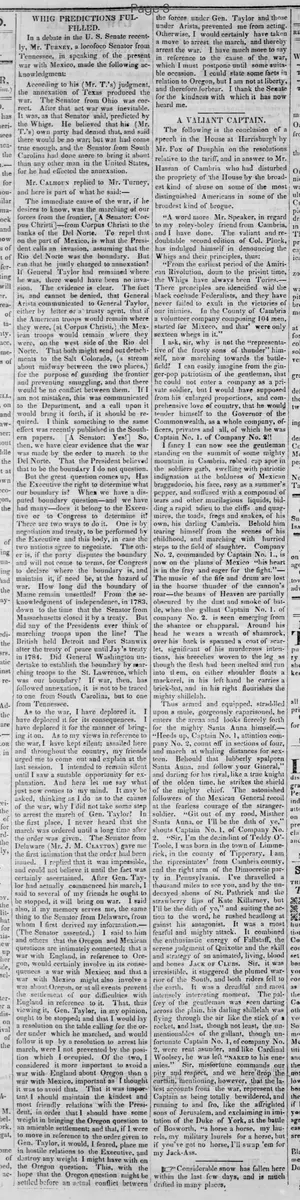
In a debate in the U. S. Senate recently, Mr. Turney, a locofoco Senator from Tennessee, in speaking of the present war with Mexico, made the following acknowledgment:
"According to his (Mr. T.'s) judgment, the annexation of Texas produced the war. The Senator from Ohio was correct. After that act war was inevitable. It was, as that Senator said, predicted by the Whigs. He believed that his (Mr. T.'s) own party had denied that, and said there would be no war; but war had come true enough, and the Senator from South Carolina had done more to bring it about than any other man in the United States, for he had effected the annexation."
Mr. Calhoun replied to Mr. Turney, and here is part of what he said:
"The immediate cause of the war, if he desires to know, was the marching of our forces from the frontier. A Senator: From Corpus Christi—from Corpus Christi to the banks of the Del Norte. To repel that on the part of Mexico, is what the President calls an invasion, assuming that the Rio del Norte was the boundary. But can that be justly charged to annexation? If General Taylor had remained where he was, there would have been no invasion. The evidence is clear. The fact is, and cannot be denied, that General Arista communicated to General Taylor, either by letter or a trusty agent, that if the American troops would remain where they were, (at Corpus Christi,) the Mexican troops would remain where they were, on the west side of the Rio del Norte. That both might send out detachments to the Salt Colorado, (a stream about midway between the two places,) for the purpose of guarding the frontier and preventing smuggling, and that there would be no conflict between them. If I am not mistaken, this was communicated to the Department, and a call upon it would bring it forth, if it should be required. I think something to the same effect was recently published in the Southern papers. [A Senator: Yes!] So, then, we have clear evidence that the war was made by the order to march to the Del Norte. That the President believed that to be the boundary I do not question. But the great question comes up, Has the Executive the right to determine what our boundary is? When we have a disputed boundary question—and we have had many—does it belong to the Executive or to Congress to determine it? There are two ways to do it. One is by negotiation and treaty, to be performed by the Executive and this body, in case the two nations agree to negotiate. The other is, if the party disputes the boundary and will not come to terms, for Congress to declare where the boundary is, and maintain it, if need be, at the hazard of war. How long did the boundary of Maine remain unsettled? From the acknowledgment of independence, in 1783, down to the time that the Senator from Massachusetts closed it by a treaty. But did any of the Presidents ever think of marching troops upon the line? The British held Detroit and Fort Stanwix after the treaty of peace until Jay's treaty in 1794. Did General Washington undertake to establish the boundary by marching troops to the St. Lawrence, which was our boundary? If war, then, has followed annexation, it is not to be traced to one from South Carolina, but to one from Tennessee.
As to the war, I have deplored it. I have deplored it for its consequences. I have deplored it for the manner of bringing it on. As to my views in reference to the war, I have kept silent; assailed here and throughout the country, my friends urged me to come out and explain at the last session. I intended to remain silent until I saw a suitable opportunity for explanation. And here let me say what just now comes to my mind. It may be asked, thinking as I do as to the causes of the war, why I did not take some step to arrest the march of Gen. Taylor? In the first place, I never heard that the march was ordered until a long time after the order was given. The Senator from Delaware (Mr. J. M. Clayton) gave me the first intimation that the order had been issued. I replied that it was impossible, and could not believe it until the fact was certainly ascertained. After Gen. Taylor had actually commenced his march, I said to several of my friends he ought to be stopped, it will bring on war. I said also, if my memory serves me, the same thing to the Senator from Delaware, from whom I first derived my information. (The Senator assented.) I said to him and others that the Oregon and Mexican questions are intimately connected; that a war with England, in reference to Oregon, would certainly involve in its consequences a war with Mexico; and that a war with Mexico might also involve a war about Oregon, or at all events prevent the settlement of our difficulties with England in reference to it. That, thus viewing it, Gen. Taylor, in my opinion, ought to be stopped; and that I would lay a resolution on the table calling for the order under which he marched, and would follow it up by a resolution to arrest his march, were I not prevented by the position which I occupied. Of the two, I considered it more important to avoid a war with England about Oregon than a war with Mexico, important as I thought it was to avoid that. That it was important I should maintain the kindest and most friendly relations with the President, in order that I should have some weight in bringing the Oregon question to an amicable settlement; and that, if I were to move in reference to the order given to Gen. Taylor, it would, I feared, place me in hostile relations to the Executive, and destroy any weight I might have with him on the Oregon question. This, with the hope that the Oregon question might be settled before an actual conflict between the forces under Gen. Taylor and those under Arista, prevented me from acting. Otherwise, I would certainly have taken a move to arrest the march, and thereby arrest the war. I have much more to say in reference to the cause of the war, which I must postpone until some suitable occasion. I could state some facts in relation to Oregon, but I am not at liberty and therefore forbear. I thank the Senate for the kindness with which it has now heard me."
What sub-type of article is it?
What keywords are associated?
What entities or persons were involved?
Where did it happen?
Foreign News Details
Primary Location
Mexico
Event Date
Recently
Key Persons
Outcome
war with mexico ensued due to the march of us troops to the rio del norte, which provoked mexican response; annexation of texas seen as underlying cause by some.
Event Details
In a recent US Senate debate on the Mexican War, Sen. Turney acknowledged that Texas annexation made war inevitable, contrary to his party's predictions, and blamed Sen. Calhoun for it. Calhoun countered that the immediate cause was Pres. Polk's order for Gen. Taylor to march from Corpus Christi to the Rio Grande, violating an understanding with Mexican Gen. Arista to avoid conflict. Calhoun argued boundaries should be settled by Congress or treaty, not executive action, and explained his silence on the march to preserve influence on Oregon negotiations with England.