Thank you for visiting SNEWPapers!
Sign up free
Editorial
December 14, 1807
Norfolk Gazette And Publick Ledger
Norfolk, Virginia
What is this article about?
An opposition editorial criticizes British ministers for conceding to American demands on searching neutral ships, arguing it avoids unnecessary war and upholds international law, while mocking supporters' disappointment.
Clipping
OCR Quality
98%
Excellent
Full Text
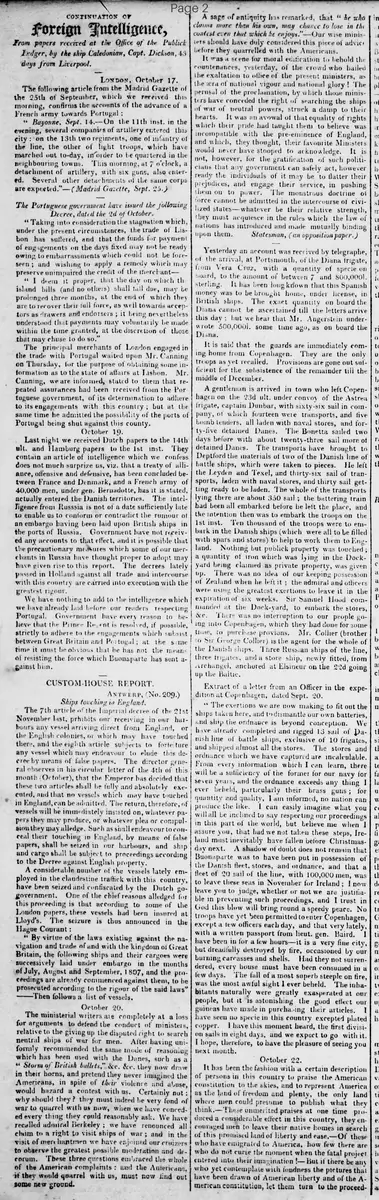
October 20.
The ministerial writers are completely at a loss for arguments to defend the conduct of ministers, relative to the giving up the disputed right to search neutral ships of war for men. After having uniformly recommended the same mode of reasoning which has been used with the Danes, such as a "Storm of British bullets," &c. &c. they now draw in their horns, and pretend they never imagined the Americans, in spite of their violence and abuse, would hazard a contest with us. Certainly not: why should they? they must indeed be very fond of war to quarrel with us now, when we have conceded every thing they could reasonably ask. We have recalled admiral Berkeley; we have renounced all claim to a right to visit ships of war; and in the visit of merchantmen we have enjoined our cruisers to observe the greatest possible moderation and decorum. These three questions embraced the whole of the American complaints: and the Americans, if they would quarrel with us, must now find out some new ground.
A sage of antiquity has remarked, that "he who claims more than his own, may chance to lose in the contest even that which he enjoys."--Our wise ministers should have duly considered this piece of advice before they quarrelled with the Americans.
It was a scene for moral edification to behold the countenances, yesterday, of the crowd who hailed the exaltation to office of the present ministers, as the aera of national vigour and national glory! The perusal of the proclamation, by which those ministers have conceded the right of searching the ships of war of neutral powers, struck a damp to their hearts. It was an avowal of that equality of rights which their pride had taught them to believe was incompatible with the pre-eminence of England. and which, they thought, their favourite Ministers would never have stooped to acknowledge. It is not, however, for the gratification of such politicians that any government can safely act, however ready the individuals of it may be to flatter their prejudices, and engage their service, in pushing them on to power. The monstrous doctrine of force cannot be admitted in the intercourse of civilized states--whatever be their relative strength, they must acquiesce in the rules which the law of nations has introduced and made mutually binding upon them.
Statesman, (an opposition paper.)
The ministerial writers are completely at a loss for arguments to defend the conduct of ministers, relative to the giving up the disputed right to search neutral ships of war for men. After having uniformly recommended the same mode of reasoning which has been used with the Danes, such as a "Storm of British bullets," &c. &c. they now draw in their horns, and pretend they never imagined the Americans, in spite of their violence and abuse, would hazard a contest with us. Certainly not: why should they? they must indeed be very fond of war to quarrel with us now, when we have conceded every thing they could reasonably ask. We have recalled admiral Berkeley; we have renounced all claim to a right to visit ships of war; and in the visit of merchantmen we have enjoined our cruisers to observe the greatest possible moderation and decorum. These three questions embraced the whole of the American complaints: and the Americans, if they would quarrel with us, must now find out some new ground.
A sage of antiquity has remarked, that "he who claims more than his own, may chance to lose in the contest even that which he enjoys."--Our wise ministers should have duly considered this piece of advice before they quarrelled with the Americans.
It was a scene for moral edification to behold the countenances, yesterday, of the crowd who hailed the exaltation to office of the present ministers, as the aera of national vigour and national glory! The perusal of the proclamation, by which those ministers have conceded the right of searching the ships of war of neutral powers, struck a damp to their hearts. It was an avowal of that equality of rights which their pride had taught them to believe was incompatible with the pre-eminence of England. and which, they thought, their favourite Ministers would never have stooped to acknowledge. It is not, however, for the gratification of such politicians that any government can safely act, however ready the individuals of it may be to flatter their prejudices, and engage their service, in pushing them on to power. The monstrous doctrine of force cannot be admitted in the intercourse of civilized states--whatever be their relative strength, they must acquiesce in the rules which the law of nations has introduced and made mutually binding upon them.
Statesman, (an opposition paper.)
What sub-type of article is it?
Foreign Affairs
Partisan Politics
War Or Peace
What keywords are associated?
Neutral Ships
Search Rights
British Concessions
American Complaints
International Law
Diplomatic Moderation
What entities or persons were involved?
British Ministers
Admiral Berkeley
Americans
Danes
Editorial Details
Primary Topic
British Concessions On Searching Neutral Ships To Avoid War With America
Stance / Tone
Critical Of Ministers But Supportive Of Diplomatic Concessions
Key Figures
British Ministers
Admiral Berkeley
Americans
Danes
Key Arguments
Ministers Have Conceded All Reasonable American Demands On Ship Searches
Recalling Admiral Berkeley And Renouncing Right To Visit Ships Of War Resolves Complaints
Pursuing Excessive Claims Risks Losing Existing Rights
Concessions Affirm Equality Of Nations Under International Law
Governing For Popular Prejudices Based On Force Is Unsafe