Thank you for visiting SNEWPapers!
Sign up free
The Charlotte Journal
Charlotte, Mecklenburg County, North Carolina
What is this article about?
In March 1846, Mexico's government under Paredes faces criticism for lacking energy; Almonte resigns from ministry. US Minister Slidell demands passports after refusal to negotiate Texas annexation, causing panic in Vera Cruz. Military reinforcements sent; Ampudia's troops mutiny. Press suppressed amid monarchy vs. republican debates. Yucatan eyes independence.
Merged-components note: Both components cover ongoing news from Mexico; sequential reading order and same subject matter.
Clipping
OCR Quality
Full Text
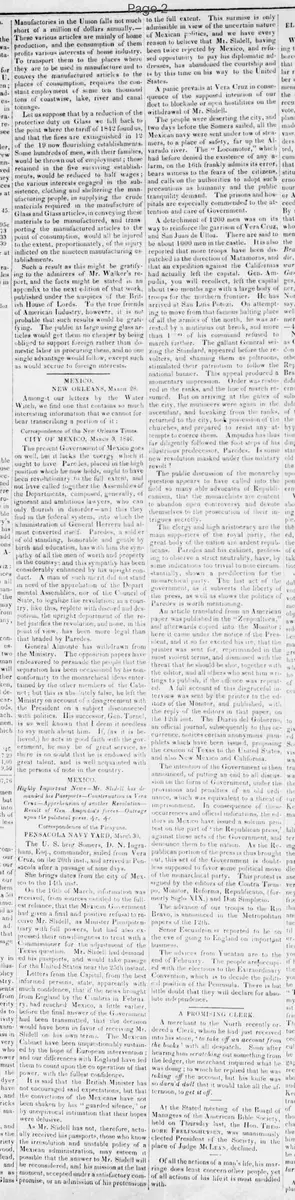
NEW ORLEANS, MARCH 28.
Among our letters by the Water Witch, we find one that contains so much interesting information that we cannot forbear transcribing a portion of it:
Correspondence of the New Orleans Times.
CITY OF MEXICO, MARCH 3, 1846.
The present Government of Mexico goes on well, but it lacks the energy which it ought to have. Paredes, placed in the high position which he now holds, ought to have been revolutionary to the full extent, and not have called together the Assemblies of the Departments, composed, generally, of ignorant and ambitious lawyers, who can only flourish in disorder—and thus they find in the federal system, into which the administration of General Herrera had almost converted itself. Paredes, a soldier of old standing, honorable and gentle by birth and education, has with him the sympathy of all the men of worth and property in the country: and this sympathy has been considerably enhanced by his upright conduct. A man of such merit did not stand in need of the approbation of the Departmental Assemblies, nor of the Council of State, to legalize the revolution; in a country, like this, replete with discord and despotism, the upright deportment of the rebel justifies the revolution, and none, in this point of view, has been more legal than that headed by Paredes.
General Almonte has withdrawn from the Ministry. The opposition papers have endeavored to persuade the people that the separation has been occasioned by his non-conformity to the monarchical ideas entertained by the other members of the Cabinet; but this is absolutely false, he left the Ministry on account of a disagreement with the President on a subject disconnected with politics. His successor, Gen. Tornel, is so well known that I deem it needless to say much about him. If, (as it is believed,) he acts in good faith with the government, he may be of great service, as there is no doubt that he is endowed with great talent, and is well acquainted with the persons of note in the country.
MEXICO.
Highly Important News—Mr. Slidell has demanded his Passports—Consternation in Vera Cruz—Apprehension of another Revolution—Revolt of Gen. Ampudia's forces—Outrage upon the political press, &c.
The U. S. brig Somers, D. N. Ingraham, Esq., commander, sailed from Vera Cruz, on the 20th inst., and arrived at Pensacola after a passage of nine days. She brings dates from the city of Mexico to the 14th inst.
On the 10th of March, information was received, from sources entitled to the fullest reliance, that the Mexican Government had given a final and positive refusal to receive Mr. Slidell, as Minister Plenipotentiary with full powers, but had also expressed their unwillingness to treat with a Commissioner for the adjustment of the Texas question. Mr. Slidell had demanded his passports, and would take passage for the United States near the 25th instant.
Letters from the Capital, from the best informed persons, state, apparently with much confidence, that if the news brought from England by the Cimbria in February, had reached Mexico, a little earlier, before the final answer of the Government had been transmitted, that the decision would have been in favor of receiving Mr. Slidell on his own terms. The Mexican Cabinet have been unquestionably sustained by the hope of European intervention; and our differences with England have led them to count upon the co-operation of that power, with the fullest confidence.
It is said that the British Minister has not encouraged said expectations, but that the convictions of the Mexicans have not been shaken by his "guarded silence," or by unequivocal intimation that their hopes were delusive.
As Mr. Slidell has not, therefore, actually received his passports, those who know the irresolution and unstable policy of a Mexican administration, may esteem it possible that the answer to Mr. Slidell will be reconsidered, and his mission at the last moment, accepted under a satisfactory compromise, or an admission of his pretensions to the full extent. This surmise is only admissible in view of the uncertain nature of Mexican politics, and we have every reason to believe that Mr. Slidell, having been twice rejected by Mexico, and refused opportunity to pay his diplomatic addresses, has abandoned the courtship and is by this time on his way to the United States.
A panic prevails at Vera Cruz in consequence of the supposed intention of our fleet to blockade or open hostilities on the withdrawal of Mr. Slidell. The people were deserting the city, and two days before the Somers sailed, all the Mexican navy were sent under tow of steamers, to a place of safety, far up the Alvarado river. The "Locomotor," which had before denied the existence of any alarm, on the 16th frankly admits its error, bears witness to the fears of the citizens, and calls on the authorities to adopt such precautions as humanity and the public tranquility demand. The prisons and hospitals are especially commended to the attention and care of Government.
A detachment of 1200 men was on its way to reinforce the garrison of Vera Cruz and San Juan de Ulloa. There are said to be about 1000 men in the castle. It is also reported that more troops have been dispatched in the direction of Matamoras, and that an expedition against the Californias had actually left the capital. Gen. Ampudia, you will recollect, left the capital about two months ago with a large body of troops for the northern frontier. He has arrived at San Luis Potosi. On attempting to move from that famous halting place of all the armies of the north, he was arrested by a mutinous outbreak, and more than 1/3 of his command refused to march further. The gallant General seizing the Standard, appeared before the revolters, and shaming them as poltroons, stimulated their patriotism to follow the national banner. This appeal produced a momentary impression. Order was restored in the ranks, and the line of march resumed. But on arriving at the gates of the city, the mutineers were again in the ascendant, and breaking from the ranks, returned to the city, took possession of the churches, and prepared to resist any attempts to coerce them. Ampudia has thus far diligently followed the footsteps of his illustrious predecessor, Paredes. Is some new revolution masked under this military revolt?
The public discussion of the monarchy question appears to have called into the field so many able advocates of Republicanism, that the monarchists are content to abandon open controversy and devote themselves to the prosecution of their intrigues secretly.
The clergy and high aristocracy are the main supporters of the royal party, the great body of the nation are ardent republicans. Paredes and his cabinet, professing to observe a strict neutrality, have, by some indications too trivial to note circumstantially, shown a predilection for the monarchical party. The last act of the government, as it subverts the liberty of the press, as well as shows the politics of Paredes is worth mentioning.
An article translated from an American paper was published in the "Zenpoalteca," and afterwards copied into the Monitor; here it came under the notice of the President, and it so far excited his ire, that the printer was sent for, reprimanded in the most violent terms, and dismissed with the threat that he should be shot, together with the editor, and all others who sent him writings to publish, if the offence was repeated. A full account of this disgraceful interview was sent by the printer to the editors of the Monitor, and published, with the reply of the editors in that paper, on the 12th inst. The Diario del Gobierno, an official journal, subsequently to this occurrence, notices certain anonymous pamphlets which have been issued, proposing the cession of Texas to the United States, and also New Mexico and California. The intention of the Government is then announced, of putting an end to all discussion on the form of Government, under the provisions and penalties of an old ordinance, which was equivalent to a threat of imprisonment. In consequence of these occurrences and official indications, the editors in Mexico have issued a solemn protest on the part of "the Republican press," against these acts of the Government, and denounce them to the nation. As the Republican portion of the press is thus brought out, this act of the Government is doubtless supposed to favor some political move of the monarchial party. This protest is signed by the editors of the Contra Tiempo, Monitor, Reforma, Republicano, (formerly Siglo XIX,) and Don Sumplicio.
The advance of our troops to the Rio Bravo, is announced in the Metropolitan papers of the 12th.
Senor Escuadron is reported to be on the eve of going to England on important business.
The advices from Yucatan are to the end of February. The people are occupied with the elections to the Extraordinary Convention, which is to decide the political position of the Peninsula. There is but little doubt that they will declare for absolute independence.
What sub-type of article is it?
What keywords are associated?
What entities or persons were involved?
Where did it happen?
Foreign News Details
Primary Location
Mexico
Event Date
March 1846
Key Persons
Outcome
mexico refuses to receive us minister slidell, who demands passports; panic and evacuations in vera cruz; ampudia's troops mutiny with over 1/3 refusing to march; government suppresses press and threatens imprisonment for discussions on government form.
Event Details
Mexican government under Paredes criticized for lacking energy and consulting departmental assemblies; Almonte resigns due to non-political disagreement, replaced by Tornel. Mexico rejects Slidell as minister for Texas negotiations, leading to his departure; hopes for British intervention dashed. Panic in Vera Cruz over potential US blockade; navy relocated, reinforcements sent. Ampudia's forces mutiny at San Luis Potosi. Debate on monarchy vs. republic intensifies; government outrages press by threatening printers and editors, prompting republican press protest. Yucatan prepares for independence declaration.