Thank you for visiting SNEWPapers!
Sign up free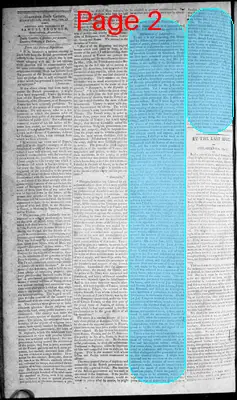
Domestic News
May 5, 1809
Alexandria Daily Gazette, Commercial & Political
Alexandria, Virginia
What is this article about?
An opinion piece in the Frederick-Town Herald disputes Thomas Jefferson's authorship of the Declaration of Independence, attributing the initial resolution to Richard Henry Lee and describing the 1776 congressional committee process involving Adams, Franklin, and others.
Clipping
OCR Quality
80%
Good
Full Text
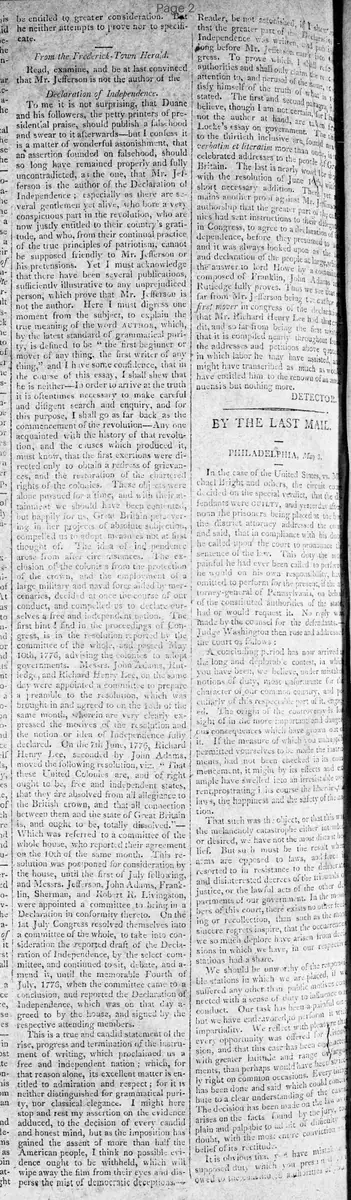
From the Frederick-Town Herald.
Read, examine, and be at last convinced that Mr. Jefferson is not the author of the Declaration of Independence.
To me it is not surprising, that Duane and his followers, the petty printers of presidential praise, should publish a falsehood and swear to it afterwards--but I confess it is a matter of wonderful astonishment, that an assertion founded on falsehood, should so long have remained properly and fully uncontradicted, as the one, that Mr. Jefferson is the author of the Declaration of Independence; especially as there are several gentlemen yet alive, who bore a very conspicuous part in the revolution, who are now justly entitled to their country's gratitude, and who, from their continual practice of the true principles of patriotism, cannot be supposed friendly to Mr. Jefferson or his pretensions. Yet I must acknowledge that there have been several publications, sufficiently illustrative to any unprejudiced person, which prove that Mr. Jefferson is not the author. Here I must digress one moment from the subject, to explain the true meaning of the word AUTHOR, which, by the latest standard of grammatical purity, is defined to be "the first beginner or mover of any thing, the first writer of any thing," and I have some confidence, that in the course of this essay, I shall shew that he is neither--In order to arrive at the truth it is oftentimes necessary to make careful and diligent search and enquiry, and for this purpose, I shall go as far back as the commencement of the revolution--Any one acquainted with the history of that revolution, and the causes which produced it must know, that the first exertions were directed only to obtain a redress of grievances, and the restoration of the chartered rights of the colonies. Those objects were alone pursued for a time, and with their attainment we should have been contented, but happily for us, Great Britain persevering in her projects of absolute subjection, compelled us to adopt measures not at first thought of. The idea of independence arose from after circumstances. The exclusion of the colonies from the protection of the crown, and the employment of a large military and naval force aided by mercenaries, decided at once the course of our conduct, and compelled us to declare ourselves a free and independent nation. The first hint I find in the proceedings of Congress, is in the resolution reported by the committee of the whole, and passed May 10th, 1776, advising the colonies to adopt governments. Messrs. John Adams, Rutledge, and Richard Henry Lee, on the same day were appointed a committee to prepare a preamble to the resolution, which was brought in and agreed to on the 15th of the same month, wherein are very clearly expressed the motives of the resolution and the notion or idea of Independence fully declared. On the 7th June, 1776. Richard Henry Lee, seconded by John Adams, moved the following resolution, viz. "That these United Colonies are, and of right ought to be, free and independent states, that they are absolved from all allegiance to the British crown, and that all connection between them and the state of Great Britain is, and ought to be, totally dissolved."--Which was referred to a committee of the whole house, who reported their agreement on the 10th of the same month. This resolution was postponed for consideration by the house, until the first of July following, and Messrs. Jefferson, John Adams, Franklin, Sherman, and Robert R. Livingston, were appointed a committee to bring in a Declaration in conformity thereto. On the 1st July Congress resolved themselves into a committee of the whole, to take into consideration the reported draft of the Declaration of Independence by the select committee, and continued to sit, debate and amend it, until the memorable Fourth of July, 1776, when the committee came to a conclusion, and reported the Declaration of Independence, which was on that day agreed to by the house, and signed by the respective attending members.
This is a true and candid statement of the rise, progress and termination of the instrument of writing, which proclaimed us a free and independent nation; which, for that reason alone, its excellent matter is entitled to admiration and respect; for it is neither distinguished for grammatical purity, nor classical elegance. I might here stop and rest my assertion on the evidence adduced, to the decision of every candid and honest mind, but as the imposition has gained the assent of more than half the American people, I think no possible evidence ought to be withheld, which will wipe away the film from their eyes and disperse the mist of democratic deceptions.--
that the Reader be not astonished at part of the Declaration of Independence which I shall shew was written before authorities and to prove was only which shali only written I uhd shal publi refe effe son cant into to and perusal of the same stated tisfy himself of the truth of what is i believe, though I am not certain, for I have not the author at hand, are taken from Locke's essay on government. The third to the thirtieth inclusive are found nearly verbatim et literatim more than once, in celebrated addresses to the people of Great Britain.
The last is nearly word for word with the resolution of June 7th with a short necessary addition.
Theryet with mains another proof against Mr. Jefferson's authorship that the greater part of the colonies had sent instructions to their delegates in Congress, to agree to a declaration of independence, before they presumed to act and it was always looked upon as the act and declaration of the people at large, which the answer to lord Howe by a committee composed of Franklin, John Adams and Rutledge fully proves. Thus we see that far from Mr. Jefferson being the author or first mover in congress of the declaration that Mr. Richard Henry Lee had that credit, and so far from being the first writer that it is compiled nearly throughout from the addresses and petitions above quoted in which labor he may have assisted, and might have transcribed as much as would have entitled him to the renown of an amanuensis but nothing more.
DETECTOR
Read, examine, and be at last convinced that Mr. Jefferson is not the author of the Declaration of Independence.
To me it is not surprising, that Duane and his followers, the petty printers of presidential praise, should publish a falsehood and swear to it afterwards--but I confess it is a matter of wonderful astonishment, that an assertion founded on falsehood, should so long have remained properly and fully uncontradicted, as the one, that Mr. Jefferson is the author of the Declaration of Independence; especially as there are several gentlemen yet alive, who bore a very conspicuous part in the revolution, who are now justly entitled to their country's gratitude, and who, from their continual practice of the true principles of patriotism, cannot be supposed friendly to Mr. Jefferson or his pretensions. Yet I must acknowledge that there have been several publications, sufficiently illustrative to any unprejudiced person, which prove that Mr. Jefferson is not the author. Here I must digress one moment from the subject, to explain the true meaning of the word AUTHOR, which, by the latest standard of grammatical purity, is defined to be "the first beginner or mover of any thing, the first writer of any thing," and I have some confidence, that in the course of this essay, I shall shew that he is neither--In order to arrive at the truth it is oftentimes necessary to make careful and diligent search and enquiry, and for this purpose, I shall go as far back as the commencement of the revolution--Any one acquainted with the history of that revolution, and the causes which produced it must know, that the first exertions were directed only to obtain a redress of grievances, and the restoration of the chartered rights of the colonies. Those objects were alone pursued for a time, and with their attainment we should have been contented, but happily for us, Great Britain persevering in her projects of absolute subjection, compelled us to adopt measures not at first thought of. The idea of independence arose from after circumstances. The exclusion of the colonies from the protection of the crown, and the employment of a large military and naval force aided by mercenaries, decided at once the course of our conduct, and compelled us to declare ourselves a free and independent nation. The first hint I find in the proceedings of Congress, is in the resolution reported by the committee of the whole, and passed May 10th, 1776, advising the colonies to adopt governments. Messrs. John Adams, Rutledge, and Richard Henry Lee, on the same day were appointed a committee to prepare a preamble to the resolution, which was brought in and agreed to on the 15th of the same month, wherein are very clearly expressed the motives of the resolution and the notion or idea of Independence fully declared. On the 7th June, 1776. Richard Henry Lee, seconded by John Adams, moved the following resolution, viz. "That these United Colonies are, and of right ought to be, free and independent states, that they are absolved from all allegiance to the British crown, and that all connection between them and the state of Great Britain is, and ought to be, totally dissolved."--Which was referred to a committee of the whole house, who reported their agreement on the 10th of the same month. This resolution was postponed for consideration by the house, until the first of July following, and Messrs. Jefferson, John Adams, Franklin, Sherman, and Robert R. Livingston, were appointed a committee to bring in a Declaration in conformity thereto. On the 1st July Congress resolved themselves into a committee of the whole, to take into consideration the reported draft of the Declaration of Independence by the select committee, and continued to sit, debate and amend it, until the memorable Fourth of July, 1776, when the committee came to a conclusion, and reported the Declaration of Independence, which was on that day agreed to by the house, and signed by the respective attending members.
This is a true and candid statement of the rise, progress and termination of the instrument of writing, which proclaimed us a free and independent nation; which, for that reason alone, its excellent matter is entitled to admiration and respect; for it is neither distinguished for grammatical purity, nor classical elegance. I might here stop and rest my assertion on the evidence adduced, to the decision of every candid and honest mind, but as the imposition has gained the assent of more than half the American people, I think no possible evidence ought to be withheld, which will wipe away the film from their eyes and disperse the mist of democratic deceptions.--
that the Reader be not astonished at part of the Declaration of Independence which I shall shew was written before authorities and to prove was only which shali only written I uhd shal publi refe effe son cant into to and perusal of the same stated tisfy himself of the truth of what is i believe, though I am not certain, for I have not the author at hand, are taken from Locke's essay on government. The third to the thirtieth inclusive are found nearly verbatim et literatim more than once, in celebrated addresses to the people of Great Britain.
The last is nearly word for word with the resolution of June 7th with a short necessary addition.
Theryet with mains another proof against Mr. Jefferson's authorship that the greater part of the colonies had sent instructions to their delegates in Congress, to agree to a declaration of independence, before they presumed to act and it was always looked upon as the act and declaration of the people at large, which the answer to lord Howe by a committee composed of Franklin, John Adams and Rutledge fully proves. Thus we see that far from Mr. Jefferson being the author or first mover in congress of the declaration that Mr. Richard Henry Lee had that credit, and so far from being the first writer that it is compiled nearly throughout from the addresses and petitions above quoted in which labor he may have assisted, and might have transcribed as much as would have entitled him to the renown of an amanuensis but nothing more.
DETECTOR
What sub-type of article is it?
Politics
What keywords are associated?
Declaration Of Independence
Jefferson Authorship
Richard Henry Lee
Congressional Committee
American Revolution
What entities or persons were involved?
Thomas Jefferson
Duane
John Adams
Rutledge
Richard Henry Lee
Franklin
Sherman
Robert R. Livingston
Locke
Lord Howe
Where did it happen?
Frederick Town
Domestic News Details
Primary Location
Frederick Town
Key Persons
Thomas Jefferson
Duane
John Adams
Rutledge
Richard Henry Lee
Franklin
Sherman
Robert R. Livingston
Locke
Lord Howe
Event Details
The article argues that Jefferson is not the author of the Declaration of Independence, detailing the historical process: Lee's resolution on June 7, 1776, committee appointment including Jefferson, debates from July 1 to 4, 1776, and claims parts derived from Locke and prior addresses.