Thank you for visiting SNEWPapers!
Sign up free
Editorial
March 23, 1803
The Recorder
Richmond, Virginia
What is this article about?
Editorial in Richmond Recorder critiques Rep. Matthew Clay's letter praising Republican administration's finances and policy on New Orleans crisis, warning of potential French war's economic devastation and partisan divisions.
Merged-components note: Long editorial on politics, including Mr. Clay's letter and export tables; merges text, tables, and continuation across pages 2 and 3.
Clippings
1 of 2
OCR Quality
75%
Good
Full Text
The RECORDER.
RICHMOND.
MARCH 19th 1803.
THE HONORABLE
MATTHEW CLAY
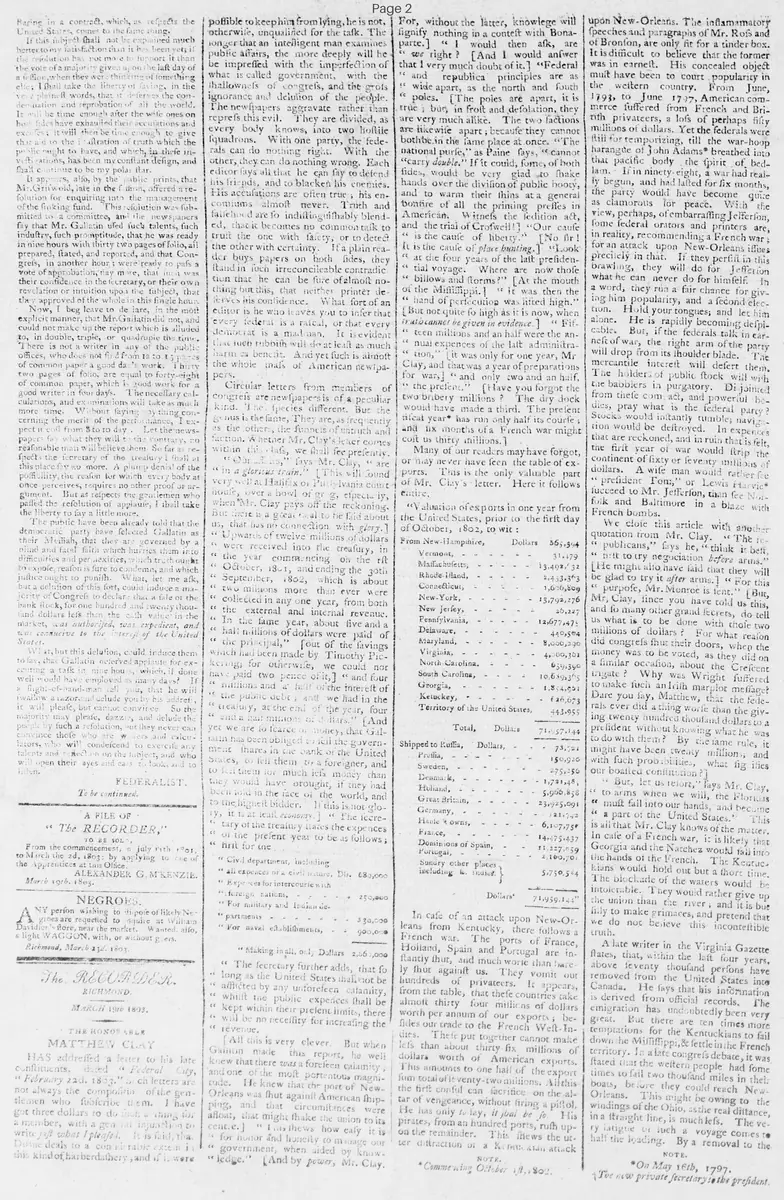
HAS addressed a letter to his late constituents, dated "Federal City, February 22d. 1803." such letters are not always the composition of the gentlemen who subscribe them. I have got three dollars to do such a thing too, a member, with a general injunction to write just what I please, it is said, that Dumourier deals to a considerable extent in this kind of barbarism, and if it were possible to keep him from lying, he is not, otherwise, unqualified for the task. The longer that an intelligent man examines public affairs, the more deeply will he be impressed with the imperfection of what is called government. with the shallowness of congress, and the gross ignorance and delusion of the people.
The newspapers aggravate rather than repress this evil. They are divided, as every body knows, into two hostile squadrons. With one party, the federals can do nothing right. With the other, they can do nothing wrong. Each editor says all that he can say to defend his friends, and to blacken his enemies. His accusations are often true; his encomiums almost never. Truth and falsehood are so indistinguishably blended, that it becomes no common task to trust the one with safety, or to detect the other with certainty. If a plain reader buys papers on both sides, they stand in such irreconcileable contradiction that he can be sure of almost nothing but this, that neither printer deserves his confidence. What sort of an editor is he who leaves you to infer that every federal is a radical, or that every democrat is a madman. It is evident that such rubbish will do at least as much harm as benefit. And yet such is almost the whole mass of American newspapers.
Circular letters from members of congress are newspapers is of a peculiar kind. The species different. But the genus is the same, They are, as frequently as the other, the founts of untruth and faction. Whether Mr. Clay's letter comes within this class, we shall see presently.
"Our S.s," says Mr. Clay, "are in a glorious train." This will sound very well at Halifax or Pennsylvania county house, over a bowl of grog, especially, when Mr. Clay pays off the reckoning. But there is a great deal to be said about us, that has no connection with glory.
"Upwards of twelve millions of dollars were received into the treasury, in the year commencing on the 1st October, 1801, and ending the 30th September, 1802, which is about two millions more than ever were collected in any one year, from both the external and internal revenue.
In the same year, about five and a half millions of dollars were paid off the principal, [out of the savings which had been made by Timothy Pickering; for otherwise, we could not have paid two pence of it,] and four millions and a half of the interest of the public debt; and we had in the treasury, at the end of the year, four and a half millions of dollars." (And yet we are so scarce of money, that Gallatin has been obliged to steal the government shares in the bank of the United States, to sell them to a foreigner, and to lay them for much less money than they would have brought, if they had been sold in the face of the world, and to the highest bidder. If this is not glory, it is at least economy.) "The secretary of the treasury states the expenses of the present year to be as follows;
first for the Civil department, including all expenses of civil nature, Dls. 2,560,000
Expenses for intercourse with foreign nations, 250,000
For military and Indian departments - - 330,000
For naval establishments, - - 900,000
Making in all, or. 2,560,000 Dollars
The secretary further adds, that so long as the United States shall not be afflicted by any unforeseen calamity, whilst the public expenses shall be kept within their present limits, there will be no necessity for increasing the revenue.
[All this is very clever But when Gallatin made this report, he well knew that there was a foreseen calamity; and one of the most portentous magnitude. He knew that the port of New-Orleans was shut against American shipping, and that circumstances were afloat, that might shake the union to its center. "This shows how easy it is for honor and honesty to manage our government, when aided by knowledge." [And by power, Mr. Clay. For, without the latter, knowledge will signify nothing in a contest with Bonaparte.] I would then ask, are we right ? [And I would answer that I very much doubt of it.] "Federal and republican principles are as wide apart, as the north and South poles." [The poles are apart, it is true; but, in frost and desolation, they are very much alike. The two factions are likewise apart: because they cannot both be in the same place at once. "The national purse," as Paine says, "cannot carry double." If it could, some of both sides, would be very glad to shake hands over the division of public booty, and to warm their shins at a general bonfire of all the printing presses in American. Witness the sedition act, and the trial of Callender!? "Our cause is the cause of liberty." No sir! It is the cause of place hunting.] "Look at the four years of the last presidential voyage.
Where are now those billows and storms?" [At the mouth of the Mississippi.! "It was then the hand of persecution was lifted high." [But not quite so high as it is now, when truth cannot be given in evidence.] "Fifteen millions and an half were the annual expenses of the last administration," [it was only for one year, Mr Clay, and that was a year of preparations for war,] "and only two and an half, the present." [Have you forgot the two bribery millions ? The dry dock would have made a third. The present fiscal year* has run only half its course; and six months of a French war might cost us thirty millions.]
Many of our readers may have forgot, or may never have seen the table of exports.
This is the only valuable part of Mr. Clay's letter. Here it follows entire.
"Valuation of exports in one year from the United States, prior to the first day of October, 1802, to wit :
Dollars 71,959,144"
In case of an attack upon New-Orleans from Kentucky, there follows a French war. The ports of France, Holland, Spain and Portugal are instantly shut, and much worse than barely shut against us. They vomit out hundreds of privateers.
It appears, from the table, that these countries take almost thirty four millions of dollars worth per annum of our exports; besides our trade to the French West-Indies. These put together cannot make less than about thirty six millions of dollars worth of American exports.
This amounts to one half of the export sum total of seventy-two millions. All this the first consul can sacrifice on the altar of vengeance, without firing a pistol. He has only to say, it shall be so." His pirates, from an hundred ports, rush upon the remainder. This shows the utter distraction of a Kentuckian at such a time.*
NOTE. *Commencing October 1st, 1802.
upon New-Orleans. The inflammatory speeches and paragraphs of Mr. Ross and of Bronson, are only fit for a tinder box. It is difficult to believe that the former was in earnest. His concealed object must have been to court popularity in the western country. From June, 1793, to June 1797, American commerce suffered from French and British privateers, a loss of perhaps fifty millions of dollars. Yet the federals were still for temporizing, till the war-whoop harangue of John Adams* breathed into that pacific body the spirit of Bellona. - If in ninety-eight, a war had really begun, and had lasted for six months, the party would have become quite as clamorous for peace. With the view, perhaps, of embarrassing Jefferson, some federal orators and printers are, in reality, recommending a French war: for an attack upon New-Orleans issues precisely in that. If they persist in this brawling, they will do for Jefferson what he can never do for himself. In a word, they run a fair chance for giving him popularity, and a second election. Hold your tongues; and let him alone. He is rapidly becoming despicable. But, if the federals talk in earnest of war, the right arm of the party will drop from its shoulder blade. The mercantile interest will desert them. The holders of public stock will wish the babblers in purgatory. Disjoined from these compact, and powerful bodies, pray what is the federal party ?
Stocks would instantly tumble; navigation would be destroyed. In expenses that are reckoned, and in ruin that is felt, the first year of war would strip the continent of sixty or seventy millions of dollars. A wise man would rather see "president Tom," or Lewis Fitzgarvie* succeed to Mr. Jefferson, than see Norfolk and Baltimore in a blaze with French bombs.
We close this article with another quotation from Mr. Clay. "The republicans," says he, "think it best not to try negotiation before arms." He might also have said that they will be glad to try it after arms.] "For this purpose, Mr. Monroe is sent." [But. Mr. Clay, since you have told us this, and so many other grand secrets, do tell us what is to be done with those two millions of dollars ? For what reason did congress shut their doors, when the money was to be voted, as they did on a similar occasion, about the Crescent frigate ? Why was Wright suffered to make such an Irish marplot message? Dare you say, Matthew, that the federals ever did a thing worse than the giving twenty hundred thousand dollars to a president without knowing what he was to do with them? By the same rule, it might have been twenty millions; and with such probabilities, what signifies our boasted constitution?]
"But, let us resort," says Mr. Clay. "to arms when we will, the Floridas must fall into our hands, and become a part of the United States.' This is all that Mr. Clay knows of the matter. In case of a French war, it is likely that Georgia and the Natchez would fall into the hands of the French. The Kentuckians would hold out but a short time. The blockade of the waters would be intolerable. They would rather give up the union than the river; and it is but folly to make grimaces, and pretend that we do not believe this incontestable truth.
A late writer in the Virginia Gazette states, that, within the last four years, above seventy thousand persons have removed from the United States into Canada. He says that his information is derived from official records. The emigration has undoubtedly been very great. But there are ten times more temptations for the Kentuckians to sail down the Mississippi, & settle in the French territory. In a late congress debate, it was stated that the western people had some times to sail two thousand miles in their boats, before they could reach New-Orleans. This might be owing to the windings of the Ohio, as the real distance, in a straight line, is much less. The very fatigue of such a voyage comes to half the loading. By a removal to the
NOTE. *On May 16th, 1797.
The new private secretary to the president.
In the vicinity of New-Orleans, all this labour is saved. The farmer is much nearer the market. As a French citizen, he is always sure of a free passage. The result is, that the western people will throng, by thousands, down the river, and join the French. It is needless to strive against nature, personal interest, and common sense. The federal government cannot hinder this event; and that it will soon take place cannot be doubted.
As for Mr. Clay's infallible conquest of the Floridas, it only shows that he is very unfit for a seat in congress; that he is ignorant of the first rudiments of geography, and of political knowledge. But at the same time, it is barely doing him justice to say, that one half or two thirds of every congress, are not better informed than himself. In Virginia, an election to the assembly, or to congress, is by no means a certain mark that the successful candidate is more respectable than his neighbors. His promotion can often be traced up to the dexterity of cunning, or the blackness of treachery. He prevails by the firmness of a face that never blushes, or, the loquacity of a tongue that never tires, by a prompt invention of popular falsehoods, and a plentiful distribution of grog.
Wit, that can creep, and pride that licks the dust.*
As the first Consul has completely beat the British, they are venting their gall in scurrilous newspaper paragraphs. They complain that Bonaparte oppresses Switzerland. They may look, if they please, at their own government of Ireland; or, on the banks of the Ganges, where they have starved or destroyed fifteen times as many people as the Swiss cantons contain. Where the British have it in their power, there is not a more ravenous, a more insolent, or a more barbarous people upon earth.
RICHMOND.
MARCH 19th 1803.
THE HONORABLE
MATTHEW CLAY
HAS addressed a letter to his late constituents, dated "Federal City, February 22d. 1803." such letters are not always the composition of the gentlemen who subscribe them. I have got three dollars to do such a thing too, a member, with a general injunction to write just what I please, it is said, that Dumourier deals to a considerable extent in this kind of barbarism, and if it were possible to keep him from lying, he is not, otherwise, unqualified for the task. The longer that an intelligent man examines public affairs, the more deeply will he be impressed with the imperfection of what is called government. with the shallowness of congress, and the gross ignorance and delusion of the people.
The newspapers aggravate rather than repress this evil. They are divided, as every body knows, into two hostile squadrons. With one party, the federals can do nothing right. With the other, they can do nothing wrong. Each editor says all that he can say to defend his friends, and to blacken his enemies. His accusations are often true; his encomiums almost never. Truth and falsehood are so indistinguishably blended, that it becomes no common task to trust the one with safety, or to detect the other with certainty. If a plain reader buys papers on both sides, they stand in such irreconcileable contradiction that he can be sure of almost nothing but this, that neither printer deserves his confidence. What sort of an editor is he who leaves you to infer that every federal is a radical, or that every democrat is a madman. It is evident that such rubbish will do at least as much harm as benefit. And yet such is almost the whole mass of American newspapers.
Circular letters from members of congress are newspapers is of a peculiar kind. The species different. But the genus is the same, They are, as frequently as the other, the founts of untruth and faction. Whether Mr. Clay's letter comes within this class, we shall see presently.
"Our S.s," says Mr. Clay, "are in a glorious train." This will sound very well at Halifax or Pennsylvania county house, over a bowl of grog, especially, when Mr. Clay pays off the reckoning. But there is a great deal to be said about us, that has no connection with glory.
"Upwards of twelve millions of dollars were received into the treasury, in the year commencing on the 1st October, 1801, and ending the 30th September, 1802, which is about two millions more than ever were collected in any one year, from both the external and internal revenue.
In the same year, about five and a half millions of dollars were paid off the principal, [out of the savings which had been made by Timothy Pickering; for otherwise, we could not have paid two pence of it,] and four millions and a half of the interest of the public debt; and we had in the treasury, at the end of the year, four and a half millions of dollars." (And yet we are so scarce of money, that Gallatin has been obliged to steal the government shares in the bank of the United States, to sell them to a foreigner, and to lay them for much less money than they would have brought, if they had been sold in the face of the world, and to the highest bidder. If this is not glory, it is at least economy.) "The secretary of the treasury states the expenses of the present year to be as follows;
first for the Civil department, including all expenses of civil nature, Dls. 2,560,000
Expenses for intercourse with foreign nations, 250,000
For military and Indian departments - - 330,000
For naval establishments, - - 900,000
Making in all, or. 2,560,000 Dollars
The secretary further adds, that so long as the United States shall not be afflicted by any unforeseen calamity, whilst the public expenses shall be kept within their present limits, there will be no necessity for increasing the revenue.
[All this is very clever But when Gallatin made this report, he well knew that there was a foreseen calamity; and one of the most portentous magnitude. He knew that the port of New-Orleans was shut against American shipping, and that circumstances were afloat, that might shake the union to its center. "This shows how easy it is for honor and honesty to manage our government, when aided by knowledge." [And by power, Mr. Clay. For, without the latter, knowledge will signify nothing in a contest with Bonaparte.] I would then ask, are we right ? [And I would answer that I very much doubt of it.] "Federal and republican principles are as wide apart, as the north and South poles." [The poles are apart, it is true; but, in frost and desolation, they are very much alike. The two factions are likewise apart: because they cannot both be in the same place at once. "The national purse," as Paine says, "cannot carry double." If it could, some of both sides, would be very glad to shake hands over the division of public booty, and to warm their shins at a general bonfire of all the printing presses in American. Witness the sedition act, and the trial of Callender!? "Our cause is the cause of liberty." No sir! It is the cause of place hunting.] "Look at the four years of the last presidential voyage.
Where are now those billows and storms?" [At the mouth of the Mississippi.! "It was then the hand of persecution was lifted high." [But not quite so high as it is now, when truth cannot be given in evidence.] "Fifteen millions and an half were the annual expenses of the last administration," [it was only for one year, Mr Clay, and that was a year of preparations for war,] "and only two and an half, the present." [Have you forgot the two bribery millions ? The dry dock would have made a third. The present fiscal year* has run only half its course; and six months of a French war might cost us thirty millions.]
Many of our readers may have forgot, or may never have seen the table of exports.
This is the only valuable part of Mr. Clay's letter. Here it follows entire.
"Valuation of exports in one year from the United States, prior to the first day of October, 1802, to wit :
Dollars 71,959,144"
In case of an attack upon New-Orleans from Kentucky, there follows a French war. The ports of France, Holland, Spain and Portugal are instantly shut, and much worse than barely shut against us. They vomit out hundreds of privateers.
It appears, from the table, that these countries take almost thirty four millions of dollars worth per annum of our exports; besides our trade to the French West-Indies. These put together cannot make less than about thirty six millions of dollars worth of American exports.
This amounts to one half of the export sum total of seventy-two millions. All this the first consul can sacrifice on the altar of vengeance, without firing a pistol. He has only to say, it shall be so." His pirates, from an hundred ports, rush upon the remainder. This shows the utter distraction of a Kentuckian at such a time.*
NOTE. *Commencing October 1st, 1802.
upon New-Orleans. The inflammatory speeches and paragraphs of Mr. Ross and of Bronson, are only fit for a tinder box. It is difficult to believe that the former was in earnest. His concealed object must have been to court popularity in the western country. From June, 1793, to June 1797, American commerce suffered from French and British privateers, a loss of perhaps fifty millions of dollars. Yet the federals were still for temporizing, till the war-whoop harangue of John Adams* breathed into that pacific body the spirit of Bellona. - If in ninety-eight, a war had really begun, and had lasted for six months, the party would have become quite as clamorous for peace. With the view, perhaps, of embarrassing Jefferson, some federal orators and printers are, in reality, recommending a French war: for an attack upon New-Orleans issues precisely in that. If they persist in this brawling, they will do for Jefferson what he can never do for himself. In a word, they run a fair chance for giving him popularity, and a second election. Hold your tongues; and let him alone. He is rapidly becoming despicable. But, if the federals talk in earnest of war, the right arm of the party will drop from its shoulder blade. The mercantile interest will desert them. The holders of public stock will wish the babblers in purgatory. Disjoined from these compact, and powerful bodies, pray what is the federal party ?
Stocks would instantly tumble; navigation would be destroyed. In expenses that are reckoned, and in ruin that is felt, the first year of war would strip the continent of sixty or seventy millions of dollars. A wise man would rather see "president Tom," or Lewis Fitzgarvie* succeed to Mr. Jefferson, than see Norfolk and Baltimore in a blaze with French bombs.
We close this article with another quotation from Mr. Clay. "The republicans," says he, "think it best not to try negotiation before arms." He might also have said that they will be glad to try it after arms.] "For this purpose, Mr. Monroe is sent." [But. Mr. Clay, since you have told us this, and so many other grand secrets, do tell us what is to be done with those two millions of dollars ? For what reason did congress shut their doors, when the money was to be voted, as they did on a similar occasion, about the Crescent frigate ? Why was Wright suffered to make such an Irish marplot message? Dare you say, Matthew, that the federals ever did a thing worse than the giving twenty hundred thousand dollars to a president without knowing what he was to do with them? By the same rule, it might have been twenty millions; and with such probabilities, what signifies our boasted constitution?]
"But, let us resort," says Mr. Clay. "to arms when we will, the Floridas must fall into our hands, and become a part of the United States.' This is all that Mr. Clay knows of the matter. In case of a French war, it is likely that Georgia and the Natchez would fall into the hands of the French. The Kentuckians would hold out but a short time. The blockade of the waters would be intolerable. They would rather give up the union than the river; and it is but folly to make grimaces, and pretend that we do not believe this incontestable truth.
A late writer in the Virginia Gazette states, that, within the last four years, above seventy thousand persons have removed from the United States into Canada. He says that his information is derived from official records. The emigration has undoubtedly been very great. But there are ten times more temptations for the Kentuckians to sail down the Mississippi, & settle in the French territory. In a late congress debate, it was stated that the western people had some times to sail two thousand miles in their boats, before they could reach New-Orleans. This might be owing to the windings of the Ohio, as the real distance, in a straight line, is much less. The very fatigue of such a voyage comes to half the loading. By a removal to the
NOTE. *On May 16th, 1797.
The new private secretary to the president.
| From New-Hampshire, | Dollars | 565,394 |
| Vermont, | 31,479 | |
| Maffachufets, | 13,492,32 | |
| Rhode Island, | 2,433,363 | |
| Connecticut, | 1,606,809 | |
| New-York, | 13,792,276 | |
| New Jersey, | 26,227 | |
| Pennsylvania, | 12,677,475 | |
| Delaware, | 440,504 | |
| Maryland, | 8,000,290 | |
| Virginia, | 4,060,361 | |
| North Carolina, | 659,390 | |
| South Carolina, | 10,639,365 | |
| Georgia, | 1,854,951 | |
| Ketuckey, | 626,673 | |
| Territory of the United States, | 443,955 |
| Total, | Dollars | 71,957,144 | |
| Shipped to Ruffa, | Dollars, | - | 73,721 |
| Profitia, | - | - | 150,920 |
| Sweden, | - | - | 275,256 |
| Denmark, | - | - | 1,731,481 |
| Holland, | - | - | 5,966,858 |
| Great Britain, | - | - | 23,925,091 |
| Germany, | - | - | 121,742 |
| Hanfe \& owns, | - | - | 6,107,758 |
| France, | - | - | 14,475,437 |
| Dominions of Spain, | - | - | 11,227,059 |
| Portugal, | - | - | 2,100,701 |
| Sundry other places including \& inakes. | - | - | 5,750,524 |
In the vicinity of New-Orleans, all this labour is saved. The farmer is much nearer the market. As a French citizen, he is always sure of a free passage. The result is, that the western people will throng, by thousands, down the river, and join the French. It is needless to strive against nature, personal interest, and common sense. The federal government cannot hinder this event; and that it will soon take place cannot be doubted.
As for Mr. Clay's infallible conquest of the Floridas, it only shows that he is very unfit for a seat in congress; that he is ignorant of the first rudiments of geography, and of political knowledge. But at the same time, it is barely doing him justice to say, that one half or two thirds of every congress, are not better informed than himself. In Virginia, an election to the assembly, or to congress, is by no means a certain mark that the successful candidate is more respectable than his neighbors. His promotion can often be traced up to the dexterity of cunning, or the blackness of treachery. He prevails by the firmness of a face that never blushes, or, the loquacity of a tongue that never tires, by a prompt invention of popular falsehoods, and a plentiful distribution of grog.
Wit, that can creep, and pride that licks the dust.*
As the first Consul has completely beat the British, they are venting their gall in scurrilous newspaper paragraphs. They complain that Bonaparte oppresses Switzerland. They may look, if they please, at their own government of Ireland; or, on the banks of the Ganges, where they have starved or destroyed fifteen times as many people as the Swiss cantons contain. Where the British have it in their power, there is not a more ravenous, a more insolent, or a more barbarous people upon earth.
What sub-type of article is it?
Partisan Politics
Foreign Affairs
Economic Policy
What keywords are associated?
Matthew Clay Letter
New Orleans Crisis
French War Threat
American Exports
Partisan Politics
Government Finances
Republican Administration
What entities or persons were involved?
Matthew Clay
Jefferson
Gallatin
Bonaparte
Federalists
Republicans
Congress
Editorial Details
Primary Topic
Critique Of Matthew Clay's Letter On Republican Finances And New Orleans Policy
Stance / Tone
Skeptical And Critical Of Partisan Claims, Anti War Caution
Key Figures
Matthew Clay
Jefferson
Gallatin
Bonaparte
Federalists
Republicans
Congress
Key Arguments
Newspapers And Circular Letters Spread Untruth And Faction
Republican Finances Appear Strong But Ignore New Orleans Crisis
Potential French War Would Devastate American Exports And Economy
Federal Warmongering Risks Boosting Jefferson's Popularity
Westerners May Emigrate To French Territory Rather Than Fight
Conquest Of Floridas Unlikely In War Scenario