Thank you for visiting SNEWPapers!
Sign up free
Story
March 21, 1835
The Liberator
Boston, Suffolk County, Massachusetts
What is this article about?
Editorial argues against U.S. war with France for failing to pay 25 million francs indemnity under unratified treaty by Mr. Rives; emphasizes war only for hostilities, not debts; cites Jay Treaty rejection and France-Haiti precedent. (Source: New York Star.)
Clipping
OCR Quality
95%
Excellent
Full Text
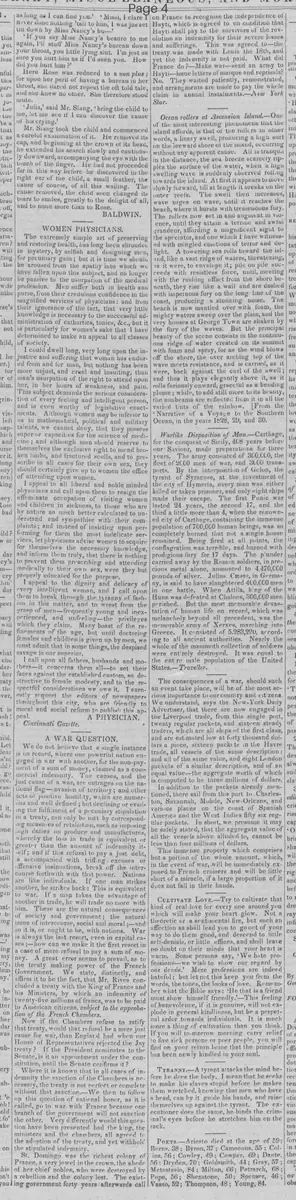
A WAR QUESTION.
We do not believe that a single instance is on record, where one powerful nation engaged in war with another, for the non-payment of a sum of money, claimed as a commercial indemnity. The causes, and the just cause of a war, are outrages on the national flag— invasion of territory; and other acts of positive hostility, which are numerous and well defined; but declining or evading the fulfilment of a pecuniary stipulation in a treaty, can only be met by corresponding measures of retaliation, such as imposing high duties on produce and manufactures, whereby the loss in trade is equivalent or greater than the amount of indemnity itself; and if this refusal to pay a just debt, is accompanied with trifling excuses or offensive insinuations, break off the intercourse forthwith with that power. Nations are like individuals. If one man strikes another, he strikes back: This is equivalent to war. If a man takes the advantage of another in trade, he will trade no more with him. These are the natural consequences of society and government; the natural issue of intercourse, social and moral;—and so it is, or ought to be, with nations. War is always the last resort, even in capital cases;—how can we make it the first resort in a case of mere refusal to pay a sum of money. A great error seems to prevail, as to the treaty making power of the French Government. We state, distinctly, and affirm it to be the fact, that Mr. Rives concluded a treaty with the King of France and his Ministers, by which an indemnity of twenty-five millions of francs, was to be paid to American citizens, subject to the approbation of the French Chambers.
Now if the Chambers refuse to ratify that treaty, would that refusal be a more just cause for war, than England had when our House of Representatives rejected the Jay treaty? If the President nominates to the Senate, is it an appointment under the constitution, until the Senate confirms it? Where it is known that in all cases of indemnity the sanction of the Chambers is necessary, the treaty is not perfect or complete without that sanction.—We then to follow up this question of national honor, as it is called, go to war with France because one branch of the government will not sanction the other. Very differently would this question have been presented had the king, the ministers and the chambers, all agreed to the adoption of the treaty, and yet withhold the stipulated indemnity.
St. Domingo was the richest colony of France, a very jewel in the crown, the abode of her chief nobles, who were destroyed by a rebellion and the colony lost. The existing government forty years afterwards call on France to recognise the independence of Hayti, which is agreed to on condition that Hayti shall pay to the survivors of the revolution an indemnity for their severe losses and sufferings. This was agreed to—the treaty was made with Louis the 18th, and yet the indemnity is not paid. What did France do?—Make war—send an army to Hayti—issue letters of marque and reprisals? No. They waited patiently, remonstrated, and arrangements are made to pay the whole claim in annual instalments.—New York Star.
We do not believe that a single instance is on record, where one powerful nation engaged in war with another, for the non-payment of a sum of money, claimed as a commercial indemnity. The causes, and the just cause of a war, are outrages on the national flag— invasion of territory; and other acts of positive hostility, which are numerous and well defined; but declining or evading the fulfilment of a pecuniary stipulation in a treaty, can only be met by corresponding measures of retaliation, such as imposing high duties on produce and manufactures, whereby the loss in trade is equivalent or greater than the amount of indemnity itself; and if this refusal to pay a just debt, is accompanied with trifling excuses or offensive insinuations, break off the intercourse forthwith with that power. Nations are like individuals. If one man strikes another, he strikes back: This is equivalent to war. If a man takes the advantage of another in trade, he will trade no more with him. These are the natural consequences of society and government; the natural issue of intercourse, social and moral;—and so it is, or ought to be, with nations. War is always the last resort, even in capital cases;—how can we make it the first resort in a case of mere refusal to pay a sum of money. A great error seems to prevail, as to the treaty making power of the French Government. We state, distinctly, and affirm it to be the fact, that Mr. Rives concluded a treaty with the King of France and his Ministers, by which an indemnity of twenty-five millions of francs, was to be paid to American citizens, subject to the approbation of the French Chambers.
Now if the Chambers refuse to ratify that treaty, would that refusal be a more just cause for war, than England had when our House of Representatives rejected the Jay treaty? If the President nominates to the Senate, is it an appointment under the constitution, until the Senate confirms it? Where it is known that in all cases of indemnity the sanction of the Chambers is necessary, the treaty is not perfect or complete without that sanction.—We then to follow up this question of national honor, as it is called, go to war with France because one branch of the government will not sanction the other. Very differently would this question have been presented had the king, the ministers and the chambers, all agreed to the adoption of the treaty, and yet withhold the stipulated indemnity.
St. Domingo was the richest colony of France, a very jewel in the crown, the abode of her chief nobles, who were destroyed by a rebellion and the colony lost. The existing government forty years afterwards call on France to recognise the independence of Hayti, which is agreed to on condition that Hayti shall pay to the survivors of the revolution an indemnity for their severe losses and sufferings. This was agreed to—the treaty was made with Louis the 18th, and yet the indemnity is not paid. What did France do?—Make war—send an army to Hayti—issue letters of marque and reprisals? No. They waited patiently, remonstrated, and arrangements are made to pay the whole claim in annual instalments.—New York Star.
What sub-type of article is it?
Historical Event
What themes does it cover?
Justice
Moral Virtue
What keywords are associated?
War Question
French Treaty
Indemnity
Jay Treaty
Haiti Independence
National Honor
What entities or persons were involved?
Mr. Rives
King Of France
Louis The 18th
Where did it happen?
France, St. Domingo, Hayti
Story Details
Key Persons
Mr. Rives
King Of France
Louis The 18th
Location
France, St. Domingo, Hayti
Story Details
Opinion arguing that war is unjustified over France's non-payment of treaty indemnity to American citizens, as the treaty requires Chambers' approval; compares to U.S. rejection of Jay Treaty and France's patient handling of Haiti's indemnity.