Thank you for visiting SNEWPapers!
Sign up free
Editorial
January 17, 1861
Port Tobacco Times, And Charles County Advertiser
Port Tobacco, Charles County, Maryland
What is this article about?
Rev. Henry J. Van Dyke preaches a sermon in Brooklyn, NY, arguing that abolitionism lacks biblical foundation, defends slavery as sanctioned by Scripture in Old and New Testaments, criticizes abolitionists for misrepresenting doctrine, and warns of its divisive effects on church and nation.
Clipping
OCR Quality
95%
Excellent
Full Text
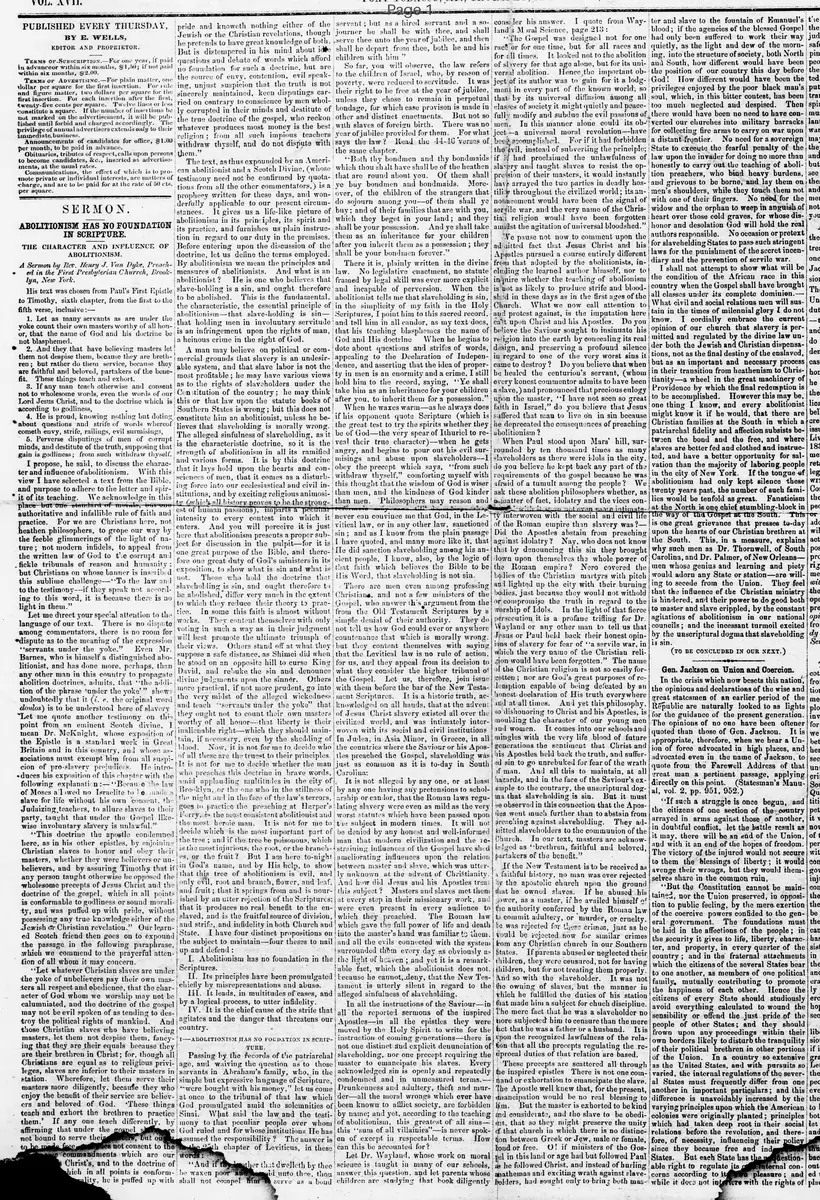
SERMON.
ABOLITIONISM HAS NO FOUNDATION
IN SCRIPTURE.
THE CHARACTER AND INFLUENCE OF
ABOLITIONISM,
A Sermon by Rev. Henry J. Van Dyke, Preached in the First Presbyterian Church, Brooklyn, New York.
His text was chosen from Paul's First Epistle to Timothy, sixth chapter, from the first to the fifth verse, inclusive:-
1. Let as many servants as are under the yoke count their own masters worthy of all honor, that the name of God and his doctrine be not blasphemed.
2. And they that have believing masters let them not despise them, because they are brethren; but rather do them service, because they are faithful and beloved, partakers of the benefit. These things teach and exhort.
3. If any man teach otherwise and consent not to wholesome words, even the words of our Lord Jesus Christ, and to the doctrine which is according to godliness,
4. He is proud, knowing nothing but doting about questions and strife of words whereof cometh envy, strife, railings, evil surmisings,
5. Perverse disputings of men of corrupt minds, and destitute of the truth, supposing that gain is godliness; from such withdraw thyself.
I propose, he said, to discuss the character and influence of abolitionism. With this view I have selected a text from the Bible, and purpose to adhere to the letter and spirit of its teaching. We acknowledge in this place the Bible as the only standard authoritative and infallible rule of faith and practice. For we are Christians here, not heathen philosophers, to grope our way by the feeble glimmerings of the light of nature; not modern infidels, to appeal from the written law of God to the corrupt and fickle tribunals of reason and humanity; but Christians on whose banner is inscribed this sublime challenge—"To the law and to the testimony—if they speak not according to this word, it is because there is no light in them."
Let me direct your special attention to the language of our text. There is no dispute among commentators, there is no room for dispute as to the meaning of the expression "servants, under the yoke." Even Mr. Barnes, who is himself a distinguished abolitionist, and has done more, perhaps, than any other man in this country to propagate abolition doctrines, admits, that "the addition of the phrase 'under the yoke'" shows undoubtedly that it (i. e. the original word doulos) is to be understood here of slavery.
Let me quote another testimony on this point from an eminent Scotch divine, I mean Dr. McKnight, whose exposition of the Epistle is a standard work in Great Britain and in this country, and whose associations must exempt him from all suspicion of pro-slavery prejudices. He introduces his exposition of this chapter with the following explanation :—"Because the law of Moses allowed no Israelite to be made a slave for life without his own consent, the Judaizing teachers, to allure slaves to their party, taught that under the Gospel likewise involuntary slavery is unlawful."
"This doctrine the apostle condemned here, as in his other epistles, by enjoining Christian slaves to honor and obey their masters, whether they were believers or unbelievers, and by assuring Timothy that if any person taught otherwise he opposed the wholesome precepts of Jesus Christ and the doctrine of the gospel, which in all points is conformable to godliness or sound morality, and was puffed up with pride, without possessing any true knowledge either of the Jewish or Christian revelation." Our learned Scotch friend then goes on to expound the passage in the following paraphrase, which we commend to the prayerful attention of all whom it may concern.
"'Let whatever Christian slaves are under the yoke of unbelievers pay their own masters all respect and obedience, that the character of God whom we worship may not be calumniated, and the doctrine of the gospel may not be evil spoken of as tending to destroy the political rights of mankind. And those Christian slaves who have believing masters, let them not despise them, fancying that they are their equals because they are their brethren in Christ; for, though all Christians are equal as to religious privileges, slaves are inferior to their masters in station. Wherefore, let them serve their masters more diligently, because they who enjoy the benefit of their service are believers and beloved of God. These things teach and exhort the brethren to practice them.' If any one teach differently, by affirming that under the gospel slaves are not bound to serve their masters, but ought to be made free, he does not consent to the pride and knoweth nothing either of the Jewish or the Christian revelations, though he pretends to have great knowledge of both. But is distempered in his mind about idle questions and debate of words which afford no foundation for such a doctrine, but are the source of envy, contention, evil speaking, unjust suspicion that the truth is not sincerely maintained, keen disputings carried on contrary to conscience by men wholly corrupted in their minds and destitute of the true doctrine of the gospel, who reckon whatever produces most money is the best religion; from all such impious teachers withdraw thyself, and do not dispute with them."
The text, as thus expounded by an American abolitionist and a Scotch Divine, (whose testimony need not be confirmed by quotations from all the other commentators,) is a prophecy written for these days, and wonderfully applicable to our present circumstances. It gives us a life-like picture of abolitionism in its principles, its spirit and its practice, and furnishes us plain instruction in regard to our duty in the premises.
Before entering upon the discussion of the doctrine, let us define the terms employed. By abolitionism we mean the principles and measures of abolitionists. And what is an abolitionist? He is one who believes that slave-holding is a sin, and ought therefore to be abolished. This is the fundamental, the characteristic, the essential principle of abolitionism—that slave-holding is sin—that holding men in involuntary servitude is an infringement upon the rights of man, a heinous crime in the sight of God.
A man may believe on political or commercial grounds that slavery is an undesirable system, and that slave labor is not the most profitable; he may have various views as to the rights of slaveholders under the Constitution of the country: he may think this or that law upon the statute books of Southern States is wrong; but this does not constitute him an abolitionist, unless he believes that slaveholding is morally wrong.
The alleged sinfulness of slaveholding, as it is the characteristic doctrine, so it is the strength of abolitionism in all its ramified and various forms. It is by this doctrine that it lays hold upon the hearts and consciences of men, that it comes as a disturbing force into our ecclesiastical and civil institutions, and by exciting religious animosity (which all history proves to be the strongest of human passions), imparts a peculiar intensity to every contest into which it enters. And you will perceive it is just here that abolitionism presents a proper subject for discussion in the pulpit—for it is one great purpose of the Bible, and therefore one great duty of God's ministers in its exposition, to show what is sin and what is not. Those who hold the doctrine that slaveholding is sin, and ought therefore to be abolished, differ very much in the extent to which they reduce their theory to practice. In some this faith is almost without works. They content themselves with only voting in such a way as in their judgment will best promote the ultimate triumph of their views. Others stand off at what they suppose a safe distance, as Shimei did when he stood on an opposite hill to curse King David, and rebuke the sin and denounce divine judgments upon the sinner. Others more practical, if not more prudent, go into the very midst of the alleged wickedness and teach "servants under the yoke" that they ought not to count their own masters worthy of all honor—that liberty is their inalienable right—which they should maintain, if necessary, even by the shedding of blood. Now, it is not for me to decide who of all these are the truest to their principles. It is not for me to decide whether the man who preaches this doctrine in brave words, amid applauding multitudes in the city of Brooklyn, or the one who in the stillness of the night and in the face of the law's terrors, goes to practice the preaching at Harper's Ferry, is the most consistent abolitionist and the most heroic man. It is not for me to decide which is the most important part of the tree; and if the tree be poisonous, which is the most injurious, the root, or the branches, or the fruit? But I am here to-night in God's name, and by His help, to show that this tree of abolitionism is evil, and only evil, root and branch, flower, and leaf and fruit; that it springs from and is nourished by an utter rejection of the Scriptures; that it produces no real benefit to the enslaved, and is the fruitful source of division, and strife, and infidelity in both Church and State. I have four distinct propositions on the subject to maintain—four theses to nail up and defend:
I. Abolitionism has no foundation in the Scriptures.
II. Its principles have been promulgated chiefly by misrepresentations and abuse.
III. It leads, in multitudes of cases, and by a logical process, to utter infidelity.
IV. It is the chief cause of the strife that agitates and the danger that threatens our country.
I.—ABOLITIONISM HAS NO FOUNDATION IN SCRIPTURE.
Passing by the records of the patriarchal age, and waiving the question as to those servants in Abraham's family, who, in the simple but expressive language of Scripture, "were bought with his money," let us come at once to the tribunal of that law which God promulgated amid the solemnities of Sinai. What said the law and the testimony to that peculiar people over whom God ruled and for whose institutions He has assumed the responsibility? The answer is the 25th chapter of Leviticus, in these words:
"And if thy brother that dwelleth by thee be waxen poor, and be sold unto thee; thou shalt not compel him to serve as a slave: but as an hired servant, and as a sojourner, he shall be with thee, and shall serve thee unto the year of jubilee: and then shall he depart from thee, both he and his children with him."
So far, you will observe, the law refers to the children of Israel, who, by reason of poverty, were reduced to servitude. It was their right to be free at the year of jubilee, unless they chose to remain in perpetual bondage, for which case provision is made in other and distinct enactments. But not so with slaves of foreign birth. There was no year of jubilee provided for them. For what says the law? Read the 44-46 verses of the same chapter.
"Both thy bondmen and thy bondmaids, which thou shalt have, shall be of the heathen that are round about you. Of them shall ye buy bondmen and bondmaids. Moreover, of the children of the strangers that do sojourn among you—of them shall ye buy; and of their families that are with you, which they beget in your land: and they shall be your possession. And ye shall take them as an inheritance for your children after you, to inherit them for a possession; they shall be your bondmen forever."
There it is, plainly written in the divine law. No legislative enactment, no statute framed by legal skill was ever more explicit and incapable of perversion. When the abolitionist tells me that slaveholding is sin, in the simplicity of my faith in the Holy Scriptures, I point him to this sacred record, and tell him in all candor, as my text does, that his teaching blasphemes the name of God and His doctrine. When he begins to dote about questions and strifes of words, appealing to the Declaration of Independence, and asserting that the idea of property in men is an enormity and a crime, I still hold him to the record, saying, "Ye shall take him as an inheritance for your children after you, to inherit them for a possession." When he waxes warm—as he always does if his opponent quote Scripture (which is the great test to try the spirits whether they be of God—the very spear of Ithuriel to reveal their true character)—when he gets angry, and begins to pour out his evil surmisings and abuse upon slaveholders—I obey the precept which says, from such withdraw thyself," comforting myself with this thought that the wisdom of God is wiser than men, and the kindness of God kinder than men. Philosophers may reason and never can convince me that God, in the Levitical law, or in any other law, sanctioned sin; and as I know from the plain passage I have quoted, and many more like it, that He did sanction slaveholding among his ancient people, I know, also, by the logic of that faith which believes the Bible to be His Word, that slaveholding is not sin.
There are men even among professing Christians, and not a few ministers of the Gospel, who answer this argument from the Old Testament Scriptures by a simple denial of their authority. They do not tell us how God could ever or anywhere countenance that which is morally wrong, but they content themselves with saying that the Levitical law is no rule of action for us, and they appeal from its decision to what they consider the higher tribunal of the Gospel. Let us, therefore, join issue with them before the bar of the New Testament Scriptures. It is a historic truth, acknowledged on all hands, that at the advent of Jesus Christ slavery existed all over the civilized world, and was intimately interwoven with its social and civil institutions. In Judea, in Asia Minor, in Greece, in all the countries where the Saviour or his Apostles preached the Gospel, slaveholding was just as common as it is to-day in South Carolina:
It is not alleged by any one, or at least by any one having any pretensions to scholarship or candor, that the Roman laws regulating slavery were even as mild as the very worst statutes which have been passed upon the subject in modern times. It will not be denied by any honest and well-informed man that modern civilization and the restraining influences of the Gospel have shed ameliorating influences upon the relation between master and slave, which was utterly unknown at the advent of Christianity.
And how did Jesus and his Apostles treat this subject? Masters and slaves met them at every step in their missionary work, and were even present in every audience to which they preached. The Roman law which gave the full power of life and death into the master's hand was familiar to them, and all the evils connected with the system surrounded them every day as obviously as the light of heaven; and yet it is a remarkable fact, which the abolitionist does not, because he cannot, deny, that the New Testament is utterly silent in regard to the alleged sinfulness of slaveholding.
In all the instructions of the Saviour—in all the reported sermons of the inspired Apostles—in all the epistles they were moved by the Holy Spirit to write for the instruction of coming generations—there is not one distinct and explicit denunciation of slaveholding, nor one precept requiring the master to emancipate his slaves. Every acknowledged sin is openly and repeatedly condemned and in unmeasured terms.—Drunkenness and adultery, theft and murder—all the moral wrongs which ever have been known to afflict society, are forbidden by name; and yet, according to the teaching of abolitionism, this greatest of all sins—this "sum of all villainies"—is never spoken of except in respectable terms. How can this be accounted for?
Let Dr. Wayland, whose work on moral science is taught in many of our schools, answer this question, and let parents whose children are studying that book diligently consider his answer. I quote from Wayland's Moral Science, page 213:
"the Gospel was designed not for one race or for one time, but for all races and for all times. It looked not to the abolition of slavery for that age alone, but for its universal abolition. Hence the important object of its author was to gain for it a lodgment in every part of the known world, so that by its universal diffusion among all classes of society it might quietly and peacefully modify and subdue the evil passions of men. In this manner alone could its object—a universal moral revolution—have been accomplished. For if it had forbidden the evil, instead of subverting the principle; if it had proclaimed the unlawfulness of slavery and taught slaves to resist the oppression of their masters, it would instantly have arrayed the two parties in deadly hostility throughout the civilized world; its announcement would have been the signal of servile war, and the very name of the Christian religion would have been forgotten amidst the agitation of universal bloodshed."
We pause not now to comment upon the admitted fact that Jesus Christ and his Apostles pursued a course entirely different from that adopted by the abolitionists, including the learned author himself, nor to inquire whether the teaching of abolitionism is not as likely to produce strife and bloodshed in these days as in the first ages of the Church. What we now call attention to and protest against, is the imputation here cast upon Christ and his Apostles. Do you believe the Saviour sought to insinuate his religion into the earth by concealing its real design, and preserving a profound silence in regard to one of the very worst sins it came to destroy? Do you believe that when he healed the centurion's servant, (whom every honest commentator admits to have been a slave,) and pronounced that precious eulogy upon the master, "I have not seen so great faith in Israel," do you believe that Jesus suffered that man to live on in sin because he deprecated the consequences of preaching abolitionism?
When Paul stood upon Mars' hill, surrounded by ten thousand times as many slaveholders as there were idols in the city, do you believe he kept back any part of the requirements of the gospel because he was afraid of a tumult among the people? We ask these abolition philosophers whether, as a matter of fact, idolatry and the vices connected with it were not even more intimately interwoven with the social and civil life of the Roman empire than slavery was?—Did the Apostles abstain from preaching against idolatry? Nay, who does not know that by denouncing this sin they brought down upon themselves the whole power of the Roman empire? Nero covered the bodies of the Christian martyrs with pitch and lighted up the city with their burning bodies, just because they would not withhold or compromise the truth in regard to the worship of Idols. In the light of that fierce persecution it is a profane trifling for Dr. Wayland or any other man to tell us that Jesus or Paul held back their honest opinions of slavery for fear of a servile war, in which the very name of the Christian religion would have been forgotten." The name of the Christian religion is not so easily forgotten; nor are God's great purposes of redemption capable of being defeated by an honest declaration of His truth everywhere and at all times. And yet this philosophy, so dishonoring to Christ and his Apostles, is moulding the character of our young men and women. It comes into our schools and mingles with the very life blood of future generations the sentiment that Christ and his Apostles held back the truth, and suffered sin to go unrebuked for fear of the wrath of man. And all this to maintain, at all hazards, and in the face of the Saviour's example to the contrary, the unscriptural dogma that slaveholding is sin. But it must be observed in this connection that the Apostles went much further than to abstain from preaching against slaveholding. They admitted slaveholders to the communion of the Church. In our text, masters are acknowledged as "brethren, faithful and beloved, partakers of the benefit."
If the New Testament is to be received as a faithful history, no man was ever rejected by the apostolic church upon the ground that he owned slaves. If he abused his power, as a master, if he availed himself of the authority conferred by the Roman law to commit adultery, or murder, or cruelty, he was rejected for those crimes, just as he would be rejected now for similar crimes from any Christian church in our Southern States. If parents abused or neglected their children, they were censured, not for having children, but for not treating them properly. And so with the slaveholder. It was not the owning of slaves, but the manner in which he fulfilled the duties of his station that made him a subject for church discipline. The mere fact that he was a slaveholder no more subjected him to censure than the mere fact that he was a father or a husband. It is upon the recognized lawfulness of the relation that all the precepts regulating the reciprocal duties of that relation are based.
These precepts are scattered all through the inspired epistles. There is not one command or exhortation to emancipate the slave. The Apostle well knew that, for the present, emancipation would be no real blessing to him. But the master is exhorted to be kind and considerate, and the slave to be obedient, that so they might preserve the unity of that church in which there is no distinction between Greek or Jew, male or female, bond or free. O! if ministers of the Gospel in this land or age had but followed Paul as he followed Christ, and instead of hurling anathemas and exciting wrath against slaveholders, had sought only to bring both master and slave to the fountain of Emanuel's blood; if the agencies of the blessed Gospel had only been suffered to work their way quietly, as the light and dew of the morning, into the structure of society, both North and South, how different would have been the position of our country this day before God! How different would have been the privileges enjoyed by the poor black man's soul, which, in this bitter contest, has been too much neglected and despised. Then there would have been no need to have converted our churches into military barracks for collecting fire arms to carry on war upon a distant frontier. No need for a sovereign State to execute the fearful penalty of the law upon the invader for doing no more than honestly to carry out the teaching of abolition preachers, who bind heavy burdens, and grievous to be borne, and lay them on men's shoulders, while they touch them not with one of their fingers. No need for the widow and the orphan to weep in anguish of heart over those cold graves, for whose dishonor and desolation God will hold the real authors responsible. No occasion or pretext for slaveholding States to pass such stringent laws for the punishment of the secret incendiary and the prevention of servile war.
I shall not attempt to show what will be the condition of the African race in this country when the Gospel shall have brought all classes under its complete dominion.—What civil and social relations men will sustain in the times of millennial glory I do not know. I cordially embrace the current opinion of our church that slavery is permitted and regulated by the divine law under both the Jewish and Christian dispensations, not as the final destiny of the enslaved, but as an important and necessary process in their transition from heathenism to Christianity—a wheel in the great machinery of Providence by which the final redemption is to be accomplished. However this may be, one thing I know, and every abolitionist might know it if he would, that there are Christian families at the South, in which a patriarchal fidelity and affection subsists between the bond and the free, and where slaves are better fed and clothed and instructed, and have a better opportunity for salvation than the majority of laboring people in the city of New York. If the tongue of abolitionism had only kept silence these twenty years past, the number of such families would be tenfold as great. Fanaticism at the North is one chief stumbling-block in the way of the Gospel at the South.—This is one great grievance that presses to-day upon the hearts of our Christian brethren at the South. This, in a measure, explains why such men as Dr. Thornwell, of South Carolina, and Dr. Palmer, of New Orleans—men whose genius and learning and piety would adorn any State or station—are willing to secede from the Union. They feel that the influence of the Christian ministry is hindered, and their power to do good both to master and slave crippled, by the constant agitations of abolitionism in our national councils: and the incessant turmoil excited by the unscriptural dogma that slaveholding is sin.
(TO BE CONCLUDED IN OUR NEXT.)
ABOLITIONISM HAS NO FOUNDATION
IN SCRIPTURE.
THE CHARACTER AND INFLUENCE OF
ABOLITIONISM,
A Sermon by Rev. Henry J. Van Dyke, Preached in the First Presbyterian Church, Brooklyn, New York.
His text was chosen from Paul's First Epistle to Timothy, sixth chapter, from the first to the fifth verse, inclusive:-
1. Let as many servants as are under the yoke count their own masters worthy of all honor, that the name of God and his doctrine be not blasphemed.
2. And they that have believing masters let them not despise them, because they are brethren; but rather do them service, because they are faithful and beloved, partakers of the benefit. These things teach and exhort.
3. If any man teach otherwise and consent not to wholesome words, even the words of our Lord Jesus Christ, and to the doctrine which is according to godliness,
4. He is proud, knowing nothing but doting about questions and strife of words whereof cometh envy, strife, railings, evil surmisings,
5. Perverse disputings of men of corrupt minds, and destitute of the truth, supposing that gain is godliness; from such withdraw thyself.
I propose, he said, to discuss the character and influence of abolitionism. With this view I have selected a text from the Bible, and purpose to adhere to the letter and spirit of its teaching. We acknowledge in this place the Bible as the only standard authoritative and infallible rule of faith and practice. For we are Christians here, not heathen philosophers, to grope our way by the feeble glimmerings of the light of nature; not modern infidels, to appeal from the written law of God to the corrupt and fickle tribunals of reason and humanity; but Christians on whose banner is inscribed this sublime challenge—"To the law and to the testimony—if they speak not according to this word, it is because there is no light in them."
Let me direct your special attention to the language of our text. There is no dispute among commentators, there is no room for dispute as to the meaning of the expression "servants, under the yoke." Even Mr. Barnes, who is himself a distinguished abolitionist, and has done more, perhaps, than any other man in this country to propagate abolition doctrines, admits, that "the addition of the phrase 'under the yoke'" shows undoubtedly that it (i. e. the original word doulos) is to be understood here of slavery.
Let me quote another testimony on this point from an eminent Scotch divine, I mean Dr. McKnight, whose exposition of the Epistle is a standard work in Great Britain and in this country, and whose associations must exempt him from all suspicion of pro-slavery prejudices. He introduces his exposition of this chapter with the following explanation :—"Because the law of Moses allowed no Israelite to be made a slave for life without his own consent, the Judaizing teachers, to allure slaves to their party, taught that under the Gospel likewise involuntary slavery is unlawful."
"This doctrine the apostle condemned here, as in his other epistles, by enjoining Christian slaves to honor and obey their masters, whether they were believers or unbelievers, and by assuring Timothy that if any person taught otherwise he opposed the wholesome precepts of Jesus Christ and the doctrine of the gospel, which in all points is conformable to godliness or sound morality, and was puffed up with pride, without possessing any true knowledge either of the Jewish or Christian revelation." Our learned Scotch friend then goes on to expound the passage in the following paraphrase, which we commend to the prayerful attention of all whom it may concern.
"'Let whatever Christian slaves are under the yoke of unbelievers pay their own masters all respect and obedience, that the character of God whom we worship may not be calumniated, and the doctrine of the gospel may not be evil spoken of as tending to destroy the political rights of mankind. And those Christian slaves who have believing masters, let them not despise them, fancying that they are their equals because they are their brethren in Christ; for, though all Christians are equal as to religious privileges, slaves are inferior to their masters in station. Wherefore, let them serve their masters more diligently, because they who enjoy the benefit of their service are believers and beloved of God. These things teach and exhort the brethren to practice them.' If any one teach differently, by affirming that under the gospel slaves are not bound to serve their masters, but ought to be made free, he does not consent to the pride and knoweth nothing either of the Jewish or the Christian revelations, though he pretends to have great knowledge of both. But is distempered in his mind about idle questions and debate of words which afford no foundation for such a doctrine, but are the source of envy, contention, evil speaking, unjust suspicion that the truth is not sincerely maintained, keen disputings carried on contrary to conscience by men wholly corrupted in their minds and destitute of the true doctrine of the gospel, who reckon whatever produces most money is the best religion; from all such impious teachers withdraw thyself, and do not dispute with them."
The text, as thus expounded by an American abolitionist and a Scotch Divine, (whose testimony need not be confirmed by quotations from all the other commentators,) is a prophecy written for these days, and wonderfully applicable to our present circumstances. It gives us a life-like picture of abolitionism in its principles, its spirit and its practice, and furnishes us plain instruction in regard to our duty in the premises.
Before entering upon the discussion of the doctrine, let us define the terms employed. By abolitionism we mean the principles and measures of abolitionists. And what is an abolitionist? He is one who believes that slave-holding is a sin, and ought therefore to be abolished. This is the fundamental, the characteristic, the essential principle of abolitionism—that slave-holding is sin—that holding men in involuntary servitude is an infringement upon the rights of man, a heinous crime in the sight of God.
A man may believe on political or commercial grounds that slavery is an undesirable system, and that slave labor is not the most profitable; he may have various views as to the rights of slaveholders under the Constitution of the country: he may think this or that law upon the statute books of Southern States is wrong; but this does not constitute him an abolitionist, unless he believes that slaveholding is morally wrong.
The alleged sinfulness of slaveholding, as it is the characteristic doctrine, so it is the strength of abolitionism in all its ramified and various forms. It is by this doctrine that it lays hold upon the hearts and consciences of men, that it comes as a disturbing force into our ecclesiastical and civil institutions, and by exciting religious animosity (which all history proves to be the strongest of human passions), imparts a peculiar intensity to every contest into which it enters. And you will perceive it is just here that abolitionism presents a proper subject for discussion in the pulpit—for it is one great purpose of the Bible, and therefore one great duty of God's ministers in its exposition, to show what is sin and what is not. Those who hold the doctrine that slaveholding is sin, and ought therefore to be abolished, differ very much in the extent to which they reduce their theory to practice. In some this faith is almost without works. They content themselves with only voting in such a way as in their judgment will best promote the ultimate triumph of their views. Others stand off at what they suppose a safe distance, as Shimei did when he stood on an opposite hill to curse King David, and rebuke the sin and denounce divine judgments upon the sinner. Others more practical, if not more prudent, go into the very midst of the alleged wickedness and teach "servants under the yoke" that they ought not to count their own masters worthy of all honor—that liberty is their inalienable right—which they should maintain, if necessary, even by the shedding of blood. Now, it is not for me to decide who of all these are the truest to their principles. It is not for me to decide whether the man who preaches this doctrine in brave words, amid applauding multitudes in the city of Brooklyn, or the one who in the stillness of the night and in the face of the law's terrors, goes to practice the preaching at Harper's Ferry, is the most consistent abolitionist and the most heroic man. It is not for me to decide which is the most important part of the tree; and if the tree be poisonous, which is the most injurious, the root, or the branches, or the fruit? But I am here to-night in God's name, and by His help, to show that this tree of abolitionism is evil, and only evil, root and branch, flower, and leaf and fruit; that it springs from and is nourished by an utter rejection of the Scriptures; that it produces no real benefit to the enslaved, and is the fruitful source of division, and strife, and infidelity in both Church and State. I have four distinct propositions on the subject to maintain—four theses to nail up and defend:
I. Abolitionism has no foundation in the Scriptures.
II. Its principles have been promulgated chiefly by misrepresentations and abuse.
III. It leads, in multitudes of cases, and by a logical process, to utter infidelity.
IV. It is the chief cause of the strife that agitates and the danger that threatens our country.
I.—ABOLITIONISM HAS NO FOUNDATION IN SCRIPTURE.
Passing by the records of the patriarchal age, and waiving the question as to those servants in Abraham's family, who, in the simple but expressive language of Scripture, "were bought with his money," let us come at once to the tribunal of that law which God promulgated amid the solemnities of Sinai. What said the law and the testimony to that peculiar people over whom God ruled and for whose institutions He has assumed the responsibility? The answer is the 25th chapter of Leviticus, in these words:
"And if thy brother that dwelleth by thee be waxen poor, and be sold unto thee; thou shalt not compel him to serve as a slave: but as an hired servant, and as a sojourner, he shall be with thee, and shall serve thee unto the year of jubilee: and then shall he depart from thee, both he and his children with him."
So far, you will observe, the law refers to the children of Israel, who, by reason of poverty, were reduced to servitude. It was their right to be free at the year of jubilee, unless they chose to remain in perpetual bondage, for which case provision is made in other and distinct enactments. But not so with slaves of foreign birth. There was no year of jubilee provided for them. For what says the law? Read the 44-46 verses of the same chapter.
"Both thy bondmen and thy bondmaids, which thou shalt have, shall be of the heathen that are round about you. Of them shall ye buy bondmen and bondmaids. Moreover, of the children of the strangers that do sojourn among you—of them shall ye buy; and of their families that are with you, which they beget in your land: and they shall be your possession. And ye shall take them as an inheritance for your children after you, to inherit them for a possession; they shall be your bondmen forever."
There it is, plainly written in the divine law. No legislative enactment, no statute framed by legal skill was ever more explicit and incapable of perversion. When the abolitionist tells me that slaveholding is sin, in the simplicity of my faith in the Holy Scriptures, I point him to this sacred record, and tell him in all candor, as my text does, that his teaching blasphemes the name of God and His doctrine. When he begins to dote about questions and strifes of words, appealing to the Declaration of Independence, and asserting that the idea of property in men is an enormity and a crime, I still hold him to the record, saying, "Ye shall take him as an inheritance for your children after you, to inherit them for a possession." When he waxes warm—as he always does if his opponent quote Scripture (which is the great test to try the spirits whether they be of God—the very spear of Ithuriel to reveal their true character)—when he gets angry, and begins to pour out his evil surmisings and abuse upon slaveholders—I obey the precept which says, from such withdraw thyself," comforting myself with this thought that the wisdom of God is wiser than men, and the kindness of God kinder than men. Philosophers may reason and never can convince me that God, in the Levitical law, or in any other law, sanctioned sin; and as I know from the plain passage I have quoted, and many more like it, that He did sanction slaveholding among his ancient people, I know, also, by the logic of that faith which believes the Bible to be His Word, that slaveholding is not sin.
There are men even among professing Christians, and not a few ministers of the Gospel, who answer this argument from the Old Testament Scriptures by a simple denial of their authority. They do not tell us how God could ever or anywhere countenance that which is morally wrong, but they content themselves with saying that the Levitical law is no rule of action for us, and they appeal from its decision to what they consider the higher tribunal of the Gospel. Let us, therefore, join issue with them before the bar of the New Testament Scriptures. It is a historic truth, acknowledged on all hands, that at the advent of Jesus Christ slavery existed all over the civilized world, and was intimately interwoven with its social and civil institutions. In Judea, in Asia Minor, in Greece, in all the countries where the Saviour or his Apostles preached the Gospel, slaveholding was just as common as it is to-day in South Carolina:
It is not alleged by any one, or at least by any one having any pretensions to scholarship or candor, that the Roman laws regulating slavery were even as mild as the very worst statutes which have been passed upon the subject in modern times. It will not be denied by any honest and well-informed man that modern civilization and the restraining influences of the Gospel have shed ameliorating influences upon the relation between master and slave, which was utterly unknown at the advent of Christianity.
And how did Jesus and his Apostles treat this subject? Masters and slaves met them at every step in their missionary work, and were even present in every audience to which they preached. The Roman law which gave the full power of life and death into the master's hand was familiar to them, and all the evils connected with the system surrounded them every day as obviously as the light of heaven; and yet it is a remarkable fact, which the abolitionist does not, because he cannot, deny, that the New Testament is utterly silent in regard to the alleged sinfulness of slaveholding.
In all the instructions of the Saviour—in all the reported sermons of the inspired Apostles—in all the epistles they were moved by the Holy Spirit to write for the instruction of coming generations—there is not one distinct and explicit denunciation of slaveholding, nor one precept requiring the master to emancipate his slaves. Every acknowledged sin is openly and repeatedly condemned and in unmeasured terms.—Drunkenness and adultery, theft and murder—all the moral wrongs which ever have been known to afflict society, are forbidden by name; and yet, according to the teaching of abolitionism, this greatest of all sins—this "sum of all villainies"—is never spoken of except in respectable terms. How can this be accounted for?
Let Dr. Wayland, whose work on moral science is taught in many of our schools, answer this question, and let parents whose children are studying that book diligently consider his answer. I quote from Wayland's Moral Science, page 213:
"the Gospel was designed not for one race or for one time, but for all races and for all times. It looked not to the abolition of slavery for that age alone, but for its universal abolition. Hence the important object of its author was to gain for it a lodgment in every part of the known world, so that by its universal diffusion among all classes of society it might quietly and peacefully modify and subdue the evil passions of men. In this manner alone could its object—a universal moral revolution—have been accomplished. For if it had forbidden the evil, instead of subverting the principle; if it had proclaimed the unlawfulness of slavery and taught slaves to resist the oppression of their masters, it would instantly have arrayed the two parties in deadly hostility throughout the civilized world; its announcement would have been the signal of servile war, and the very name of the Christian religion would have been forgotten amidst the agitation of universal bloodshed."
We pause not now to comment upon the admitted fact that Jesus Christ and his Apostles pursued a course entirely different from that adopted by the abolitionists, including the learned author himself, nor to inquire whether the teaching of abolitionism is not as likely to produce strife and bloodshed in these days as in the first ages of the Church. What we now call attention to and protest against, is the imputation here cast upon Christ and his Apostles. Do you believe the Saviour sought to insinuate his religion into the earth by concealing its real design, and preserving a profound silence in regard to one of the very worst sins it came to destroy? Do you believe that when he healed the centurion's servant, (whom every honest commentator admits to have been a slave,) and pronounced that precious eulogy upon the master, "I have not seen so great faith in Israel," do you believe that Jesus suffered that man to live on in sin because he deprecated the consequences of preaching abolitionism?
When Paul stood upon Mars' hill, surrounded by ten thousand times as many slaveholders as there were idols in the city, do you believe he kept back any part of the requirements of the gospel because he was afraid of a tumult among the people? We ask these abolition philosophers whether, as a matter of fact, idolatry and the vices connected with it were not even more intimately interwoven with the social and civil life of the Roman empire than slavery was?—Did the Apostles abstain from preaching against idolatry? Nay, who does not know that by denouncing this sin they brought down upon themselves the whole power of the Roman empire? Nero covered the bodies of the Christian martyrs with pitch and lighted up the city with their burning bodies, just because they would not withhold or compromise the truth in regard to the worship of Idols. In the light of that fierce persecution it is a profane trifling for Dr. Wayland or any other man to tell us that Jesus or Paul held back their honest opinions of slavery for fear of a servile war, in which the very name of the Christian religion would have been forgotten." The name of the Christian religion is not so easily forgotten; nor are God's great purposes of redemption capable of being defeated by an honest declaration of His truth everywhere and at all times. And yet this philosophy, so dishonoring to Christ and his Apostles, is moulding the character of our young men and women. It comes into our schools and mingles with the very life blood of future generations the sentiment that Christ and his Apostles held back the truth, and suffered sin to go unrebuked for fear of the wrath of man. And all this to maintain, at all hazards, and in the face of the Saviour's example to the contrary, the unscriptural dogma that slaveholding is sin. But it must be observed in this connection that the Apostles went much further than to abstain from preaching against slaveholding. They admitted slaveholders to the communion of the Church. In our text, masters are acknowledged as "brethren, faithful and beloved, partakers of the benefit."
If the New Testament is to be received as a faithful history, no man was ever rejected by the apostolic church upon the ground that he owned slaves. If he abused his power, as a master, if he availed himself of the authority conferred by the Roman law to commit adultery, or murder, or cruelty, he was rejected for those crimes, just as he would be rejected now for similar crimes from any Christian church in our Southern States. If parents abused or neglected their children, they were censured, not for having children, but for not treating them properly. And so with the slaveholder. It was not the owning of slaves, but the manner in which he fulfilled the duties of his station that made him a subject for church discipline. The mere fact that he was a slaveholder no more subjected him to censure than the mere fact that he was a father or a husband. It is upon the recognized lawfulness of the relation that all the precepts regulating the reciprocal duties of that relation are based.
These precepts are scattered all through the inspired epistles. There is not one command or exhortation to emancipate the slave. The Apostle well knew that, for the present, emancipation would be no real blessing to him. But the master is exhorted to be kind and considerate, and the slave to be obedient, that so they might preserve the unity of that church in which there is no distinction between Greek or Jew, male or female, bond or free. O! if ministers of the Gospel in this land or age had but followed Paul as he followed Christ, and instead of hurling anathemas and exciting wrath against slaveholders, had sought only to bring both master and slave to the fountain of Emanuel's blood; if the agencies of the blessed Gospel had only been suffered to work their way quietly, as the light and dew of the morning, into the structure of society, both North and South, how different would have been the position of our country this day before God! How different would have been the privileges enjoyed by the poor black man's soul, which, in this bitter contest, has been too much neglected and despised. Then there would have been no need to have converted our churches into military barracks for collecting fire arms to carry on war upon a distant frontier. No need for a sovereign State to execute the fearful penalty of the law upon the invader for doing no more than honestly to carry out the teaching of abolition preachers, who bind heavy burdens, and grievous to be borne, and lay them on men's shoulders, while they touch them not with one of their fingers. No need for the widow and the orphan to weep in anguish of heart over those cold graves, for whose dishonor and desolation God will hold the real authors responsible. No occasion or pretext for slaveholding States to pass such stringent laws for the punishment of the secret incendiary and the prevention of servile war.
I shall not attempt to show what will be the condition of the African race in this country when the Gospel shall have brought all classes under its complete dominion.—What civil and social relations men will sustain in the times of millennial glory I do not know. I cordially embrace the current opinion of our church that slavery is permitted and regulated by the divine law under both the Jewish and Christian dispensations, not as the final destiny of the enslaved, but as an important and necessary process in their transition from heathenism to Christianity—a wheel in the great machinery of Providence by which the final redemption is to be accomplished. However this may be, one thing I know, and every abolitionist might know it if he would, that there are Christian families at the South, in which a patriarchal fidelity and affection subsists between the bond and the free, and where slaves are better fed and clothed and instructed, and have a better opportunity for salvation than the majority of laboring people in the city of New York. If the tongue of abolitionism had only kept silence these twenty years past, the number of such families would be tenfold as great. Fanaticism at the North is one chief stumbling-block in the way of the Gospel at the South.—This is one great grievance that presses to-day upon the hearts of our Christian brethren at the South. This, in a measure, explains why such men as Dr. Thornwell, of South Carolina, and Dr. Palmer, of New Orleans—men whose genius and learning and piety would adorn any State or station—are willing to secede from the Union. They feel that the influence of the Christian ministry is hindered, and their power to do good both to master and slave crippled, by the constant agitations of abolitionism in our national councils: and the incessant turmoil excited by the unscriptural dogma that slaveholding is sin.
(TO BE CONCLUDED IN OUR NEXT.)
What sub-type of article is it?
Slavery Abolition
Moral Or Religious
What keywords are associated?
Abolitionism
Scripture
Slavery
Bible
Leviticus
New Testament
Slaveholding
Gospel
What entities or persons were involved?
Rev. Henry J. Van Dyke
Paul
Jesus Christ
Mr. Barnes
Dr. Mcknight
Dr. Wayland
Dr. Thornwell
Dr. Palmer
Abolitionists
Slaveholders
First Presbyterian Church Brooklyn
Editorial Details
Primary Topic
Abolitionism Has No Foundation In Scripture
Stance / Tone
Strongly Anti Abolitionist, Defending Slavery As Biblically Sanctioned
Key Figures
Rev. Henry J. Van Dyke
Paul
Jesus Christ
Mr. Barnes
Dr. Mcknight
Dr. Wayland
Dr. Thornwell
Dr. Palmer
Abolitionists
Slaveholders
First Presbyterian Church Brooklyn
Key Arguments
Abolitionism Contradicts Biblical Teachings On Slavery In Old And New Testaments
Leviticus Sanctions Perpetual Slavery For Foreigners
New Testament Silent On Sinfulness Of Slaveholding And Admits Slaveholders To Church
Abolitionists Misrepresent Scripture And Promote Infidelity
Abolitionism Causes Division In Church And State
Gospel Regulates Rather Than Abolishes Slavery