Thank you for visiting SNEWPapers!
Sign up free
Editorial
June 22, 1803
Alexandria Advertiser And Commercial Intelligencer
Alexandria, Virginia
What is this article about?
This continued editorial defends Judge Chase's charge that liberty is not defined by government form, using historical examples from Venice, Genoa, Athens, Rome, and England to argue governments must adapt to people's habits. It criticizes uninformed democratic advocates and praises the U.S. Constitution's success. (248 characters)
Clipping
OCR Quality
95%
Excellent
Full Text
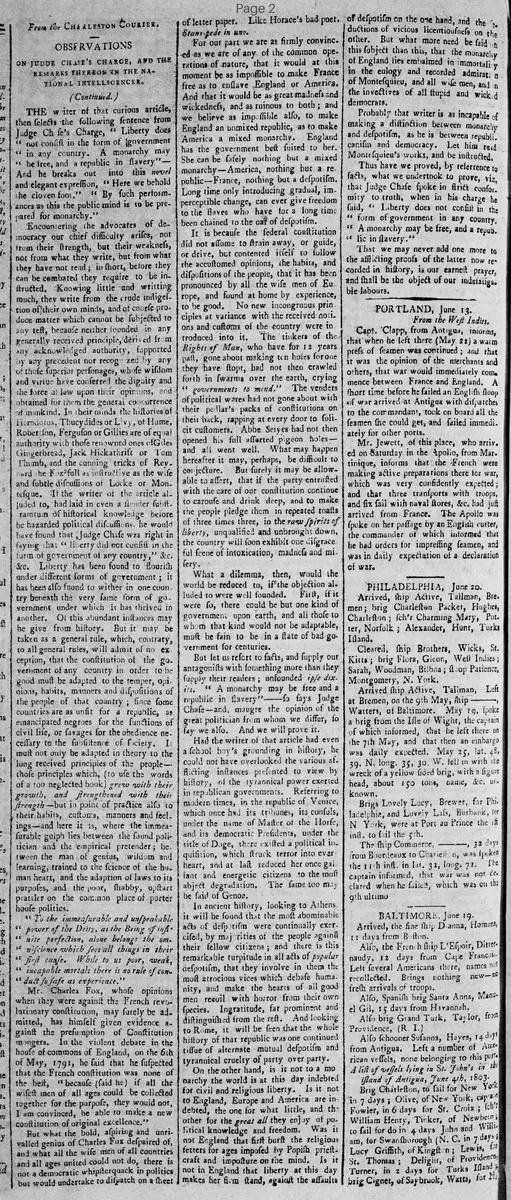
CHARLESTON COURIER
OBSERVATIONS
ON JUDGE CHASE'S CHARGE, AND THE REMARKS THEREON IN THE NATIONAL INTELLIGENCER.
(Continued.)
THE writer of that curious article, then selects the following sentence from Judge Chase's Charge, "Liberty does not consist in the form of government in any country. A monarchy may be free, and a republic in slavery"
And he breaks out into this novel and elegant expression, "Here we behold the cloven foot." "By such performances as this the public mind is to be prepared for monarchy."
Encountering the advocates of democracy our chief difficulty arises, not from their strength, but their weakness, not from what they write, but from what they have not read; in short, before they can be combated they require to be instructed. Knowing little and writing much, they write from the crude indigestion of their own minds, and of course produce matter which cannot be subjected to any test, because neither founded in any generally received principle, derived from any acknowledged authority, supported by any precedent nor recognized by any of those superior personages, whose wisdom and virtue have conferred the dignity and the force of law upon their opinions, and obtained for them the general concurrence of mankind. In their minds the histories of Herodotus, Thucydides or Livy, or Hume, Robertson, Ferguson or Gillies are of equal authority with those renowned ones of Giles Gingerbread, Jack Hickathrift or Tom Thumb, and the cunning tricks of Reynard the Fox full as instructive as the wise and subtle discussions of Locke or Montesquieu. If the writer of the article alluded to, had laid in even a slender stock of historical knowledge before he hazarded political discussions, he would have found that Judge Chase was right in saying that "liberty did not consist in the form of government of any country." &c. &c. Liberty has been found to flourish under different forms of government; it has been also found to wither in one country beneath the very same form of government under which it has thrived in another. Of this abundant instances may be given from history. But it may be taken as a general rule, which, contrary to all general rules, will admit of no exception, that the constitution of the government of any country in order to be good must be adapted to the temper, opinions, habits, manners and dispositions of the people of that country; since some countries are as unfit for a republic, as emancipated negroes for the functions of civil life, or savages for the obedience necessary to the subsistence of Society. It must not only be adapted in theory to the long received principles of the people-- those principles which, (to use the words of a too neglected book) grew with their growth, and strengthened with their strength--but in point of practice also to their habits, customs, manners and feelings--and here it is, where the immeasurable gulph lies between the sound politician and the empirical pretender; between the man of genius, wisdom and learning, trained to the science of the human heart, and the adaption of laws to its purposes, and the poor, shabby, upstart prattler on the common place of porter house politics.
"To the immeasurable and unspeakable power of the Deity, as the Being of infinite perfection, alone belongs the omniscience which sees all things in their first cause. While to us poor, weak, incapable mortals there is no rule of conduct so safe as experience."
Mr. Charles Fox, whose opinions when they were against the French revolutionary constitution, may surely be admitted, has himself given evidence against the presumption of Constitution mongers. In the violent debate in the house of commons of England, on the 6th of May, 1791, he said that he suspected that the French constitution was none of the best, "because (said he) if all the wisest men of all ages could be collected together for the purpose, they would not, I am convinced, be able to make a new constitution of original excellence."
But what the bold, aspiring and unrivalled genius of Charles Fox despaired of, and what all the wise men of all countries and all ages united could not do, there is not a democratic whipster-quack in politics but would undertake to dispatch on a sheet of letter paper. Like Horace's bad poet. Stans pede in uno.
For our part we are as firmly convinced as we are of any of the common operations of nature, that it would at this moment be as impossible to make France free as to enslave England or America. And that it would be as great madness and wickedness, and as ruinous to both; and we believe as impossible also, to make England an unmixed republic, as to make America a mixed monarchy. England has the government best suited to her. She can be safely nothing but a mixed monarchy--America, nothing but a republic--France, nothing but a despotism. Long time only introducing gradual, imperceptible change, can ever give freedom to the slaves who have for a long time been chained to the oar of despotism.
It is because the federal constitution did not assume to train away, or guide, or drive, but contented itself to follow the accustomed opinions, the habits, and dispositions of the people, that it has been pronounced by all the wise men of Europe, and found at home by experience, to be good. No new incongruous principles at variance with the received notions and customs of the country were introduced into it. The tinkers of the Rights of Man, who have for 12 years past, gone about making ten holes for one they have stopped, had not then crawled forth in swarms over the earth, crying "governments to mend." The venders of political wares had not gone about with their pedlar's packs of constitutions on their back, rapping at every door to solicit customers. Abbe Sieyes had not then opened his full assorted pigeon holes-- and all went well. What may happen hereafter it may, perhaps, be difficult to conjecture. But surely it may be allowable to assert, that if the party entrusted with the care of our constitution continue to carouse and drink deep, and to make the people pledge them in repeated toasts of three times three, in the raw spirits of liberty, unqualified and unbrought down, the country will soon exhibit one disgraceful scene of intoxication, madness and misery.
What a dilemma, then, would the world be reduced to, if the objection alluded to were well founded. First, if it were so, there could be but one kind of government upon earth, and all those to whom that kind would not be adaptable, must be fain to be in a state of bad government for centuries.
But let us recur to facts, and supply our antagonists with something more than they supply their readers; unfounded ipse dixits. "A monarchy may be free and a republic in slavery"--so says Judge Chase--and, maugre the opinion of the great politician from whom we differ, so say we also. And we will prove it.
Had the writer of that article had even a school boy's grounding in history, he could not have overlooked the various afflicting instances presented to view by history, of the tyrannical power exerted in republican governments. Referring to modern times, in the republic of Venice, which once had its tribunes, its consuls, under the name of Master of the Horse, and its democratic Presidents, under the title of Doge, there existed a political inquisition, which struck terror into every heart, and at last reduced her once gallant and energetic citizens to the most abject degradation. The same too may be said of Genoa.
In ancient history, looking to Athens, it will be found that the most abominable acts of despotism were continually exercised, by majorities of the people against their fellow citizens: and there is this remarkable turpitude in all acts of popular despotism, that they involve in them the most atrocious vices which debase humanity, and make the hearts of all good men recoil with horror from their own species. Ingratitude, far prominent and distinguished from the rest. And looking to Rome, it will be seen that the whole history of that republic was one continued tissue of alternate mutual despotism and tyrannical cruelty of party over party.
On the other hand. is it not to a monarchy the world is at this day indebted for civil and religious liberty. Is it not to England, Europe and America are indebted, the one for what little, and the other for the great all they enjoy of political knowledge and freedom. Was it not England that first burst the religious fetters for ages imposed by Popish priestcraft and imposture on the mind. Is it not in England that liberty at this day makes her firm stand, against the assaults of despotism on the one hand, and the seductions of vicious licentiousness on the other. But what more need be said on this object than this, that the monarchy of England lies embalmed in immortality in the eulogy and recorded admiration of Montesquieu, and all wise men, and in the invectives of all stupid and wicked democrats.
Probably that writer is as incapable of making a distinction between monarchy and despotism, as he is between republicanism and democracy. Let him read Montesquieu's works, and be instructed.
Thus have we proved, by reference to facts, what we undertook to prove, viz. that Judge Chase spoke in strict conformity to truth, when in his charge he said, "Liberty does not consist in the form of government in any country. A monarchy may be free, and a republic in slavery."
That we may never add one more to the afflicting proofs of the latter now recorded in history, is our earnest prayer. and shall be the object of our indefatigable labours.
OBSERVATIONS
ON JUDGE CHASE'S CHARGE, AND THE REMARKS THEREON IN THE NATIONAL INTELLIGENCER.
(Continued.)
THE writer of that curious article, then selects the following sentence from Judge Chase's Charge, "Liberty does not consist in the form of government in any country. A monarchy may be free, and a republic in slavery"
And he breaks out into this novel and elegant expression, "Here we behold the cloven foot." "By such performances as this the public mind is to be prepared for monarchy."
Encountering the advocates of democracy our chief difficulty arises, not from their strength, but their weakness, not from what they write, but from what they have not read; in short, before they can be combated they require to be instructed. Knowing little and writing much, they write from the crude indigestion of their own minds, and of course produce matter which cannot be subjected to any test, because neither founded in any generally received principle, derived from any acknowledged authority, supported by any precedent nor recognized by any of those superior personages, whose wisdom and virtue have conferred the dignity and the force of law upon their opinions, and obtained for them the general concurrence of mankind. In their minds the histories of Herodotus, Thucydides or Livy, or Hume, Robertson, Ferguson or Gillies are of equal authority with those renowned ones of Giles Gingerbread, Jack Hickathrift or Tom Thumb, and the cunning tricks of Reynard the Fox full as instructive as the wise and subtle discussions of Locke or Montesquieu. If the writer of the article alluded to, had laid in even a slender stock of historical knowledge before he hazarded political discussions, he would have found that Judge Chase was right in saying that "liberty did not consist in the form of government of any country." &c. &c. Liberty has been found to flourish under different forms of government; it has been also found to wither in one country beneath the very same form of government under which it has thrived in another. Of this abundant instances may be given from history. But it may be taken as a general rule, which, contrary to all general rules, will admit of no exception, that the constitution of the government of any country in order to be good must be adapted to the temper, opinions, habits, manners and dispositions of the people of that country; since some countries are as unfit for a republic, as emancipated negroes for the functions of civil life, or savages for the obedience necessary to the subsistence of Society. It must not only be adapted in theory to the long received principles of the people-- those principles which, (to use the words of a too neglected book) grew with their growth, and strengthened with their strength--but in point of practice also to their habits, customs, manners and feelings--and here it is, where the immeasurable gulph lies between the sound politician and the empirical pretender; between the man of genius, wisdom and learning, trained to the science of the human heart, and the adaption of laws to its purposes, and the poor, shabby, upstart prattler on the common place of porter house politics.
"To the immeasurable and unspeakable power of the Deity, as the Being of infinite perfection, alone belongs the omniscience which sees all things in their first cause. While to us poor, weak, incapable mortals there is no rule of conduct so safe as experience."
Mr. Charles Fox, whose opinions when they were against the French revolutionary constitution, may surely be admitted, has himself given evidence against the presumption of Constitution mongers. In the violent debate in the house of commons of England, on the 6th of May, 1791, he said that he suspected that the French constitution was none of the best, "because (said he) if all the wisest men of all ages could be collected together for the purpose, they would not, I am convinced, be able to make a new constitution of original excellence."
But what the bold, aspiring and unrivalled genius of Charles Fox despaired of, and what all the wise men of all countries and all ages united could not do, there is not a democratic whipster-quack in politics but would undertake to dispatch on a sheet of letter paper. Like Horace's bad poet. Stans pede in uno.
For our part we are as firmly convinced as we are of any of the common operations of nature, that it would at this moment be as impossible to make France free as to enslave England or America. And that it would be as great madness and wickedness, and as ruinous to both; and we believe as impossible also, to make England an unmixed republic, as to make America a mixed monarchy. England has the government best suited to her. She can be safely nothing but a mixed monarchy--America, nothing but a republic--France, nothing but a despotism. Long time only introducing gradual, imperceptible change, can ever give freedom to the slaves who have for a long time been chained to the oar of despotism.
It is because the federal constitution did not assume to train away, or guide, or drive, but contented itself to follow the accustomed opinions, the habits, and dispositions of the people, that it has been pronounced by all the wise men of Europe, and found at home by experience, to be good. No new incongruous principles at variance with the received notions and customs of the country were introduced into it. The tinkers of the Rights of Man, who have for 12 years past, gone about making ten holes for one they have stopped, had not then crawled forth in swarms over the earth, crying "governments to mend." The venders of political wares had not gone about with their pedlar's packs of constitutions on their back, rapping at every door to solicit customers. Abbe Sieyes had not then opened his full assorted pigeon holes-- and all went well. What may happen hereafter it may, perhaps, be difficult to conjecture. But surely it may be allowable to assert, that if the party entrusted with the care of our constitution continue to carouse and drink deep, and to make the people pledge them in repeated toasts of three times three, in the raw spirits of liberty, unqualified and unbrought down, the country will soon exhibit one disgraceful scene of intoxication, madness and misery.
What a dilemma, then, would the world be reduced to, if the objection alluded to were well founded. First, if it were so, there could be but one kind of government upon earth, and all those to whom that kind would not be adaptable, must be fain to be in a state of bad government for centuries.
But let us recur to facts, and supply our antagonists with something more than they supply their readers; unfounded ipse dixits. "A monarchy may be free and a republic in slavery"--so says Judge Chase--and, maugre the opinion of the great politician from whom we differ, so say we also. And we will prove it.
Had the writer of that article had even a school boy's grounding in history, he could not have overlooked the various afflicting instances presented to view by history, of the tyrannical power exerted in republican governments. Referring to modern times, in the republic of Venice, which once had its tribunes, its consuls, under the name of Master of the Horse, and its democratic Presidents, under the title of Doge, there existed a political inquisition, which struck terror into every heart, and at last reduced her once gallant and energetic citizens to the most abject degradation. The same too may be said of Genoa.
In ancient history, looking to Athens, it will be found that the most abominable acts of despotism were continually exercised, by majorities of the people against their fellow citizens: and there is this remarkable turpitude in all acts of popular despotism, that they involve in them the most atrocious vices which debase humanity, and make the hearts of all good men recoil with horror from their own species. Ingratitude, far prominent and distinguished from the rest. And looking to Rome, it will be seen that the whole history of that republic was one continued tissue of alternate mutual despotism and tyrannical cruelty of party over party.
On the other hand. is it not to a monarchy the world is at this day indebted for civil and religious liberty. Is it not to England, Europe and America are indebted, the one for what little, and the other for the great all they enjoy of political knowledge and freedom. Was it not England that first burst the religious fetters for ages imposed by Popish priestcraft and imposture on the mind. Is it not in England that liberty at this day makes her firm stand, against the assaults of despotism on the one hand, and the seductions of vicious licentiousness on the other. But what more need be said on this object than this, that the monarchy of England lies embalmed in immortality in the eulogy and recorded admiration of Montesquieu, and all wise men, and in the invectives of all stupid and wicked democrats.
Probably that writer is as incapable of making a distinction between monarchy and despotism, as he is between republicanism and democracy. Let him read Montesquieu's works, and be instructed.
Thus have we proved, by reference to facts, what we undertook to prove, viz. that Judge Chase spoke in strict conformity to truth, when in his charge he said, "Liberty does not consist in the form of government in any country. A monarchy may be free, and a republic in slavery."
That we may never add one more to the afflicting proofs of the latter now recorded in history, is our earnest prayer. and shall be the object of our indefatigable labours.
What sub-type of article is it?
Constitutional
Partisan Politics
What keywords are associated?
Liberty Government Form
Judge Chase Charge
Historical Examples
Political Adaptation
Democratic Critics
Monarchy Freedom
Republic Slavery
Charles Fox
Montesquieu
Federal Constitution
What entities or persons were involved?
Judge Chase
National Intelligencer Writer
Charles Fox
Montesquieu
England
France
America
Venice
Genoa
Athens
Rome
Editorial Details
Primary Topic
Defense Of Judge Chase's Views On Liberty Independent Of Government Form
Stance / Tone
Defensive And Instructive Against Democratic Critics
Key Figures
Judge Chase
National Intelligencer Writer
Charles Fox
Montesquieu
England
France
America
Venice
Genoa
Athens
Rome
Key Arguments
Liberty Does Not Consist In The Form Of Government; A Monarchy May Be Free And A Republic In Slavery
Government Must Be Adapted To The Temper, Opinions, Habits, And Dispositions Of The People
Historical Examples Show Liberty Flourishing Or Withering Under Same Forms In Different Contexts
Criticism Of Uninformed Democratic Writers Lacking Historical Knowledge
England's Mixed Monarchy Suits It Best, America A Republic, France A Despotism
Federal Constitution Succeeded By Following People's Accustomed Opinions And Habits
Popular Despotism In Republics Like Venice, Genoa, Athens, And Rome Involved Tyranny And Vices
England, A Monarchy, Is Source Of Civil And Religious Liberty
Distinction Between Monarchy And Despotism, Republicanism And Democracy