Thank you for visiting SNEWPapers!
Sign up free
Midland Cooperator
Minneapolis, Hennepin County, Minnesota
What is this article about?
Opinion piece arguing that the profit system favors large corporations and agribusiness over small businesses and farmers during WWII, citing Herbert Parisius's resignation from the Federal Food Production Administration due to denied credit for small farmers. Advocates for economic democracy and cooperatives.
Merged-components note: The images overlap spatially with the story on small farmers and business; they likely provide visual context or illustration for the opinion piece.
Clipping
OCR Quality
Full Text
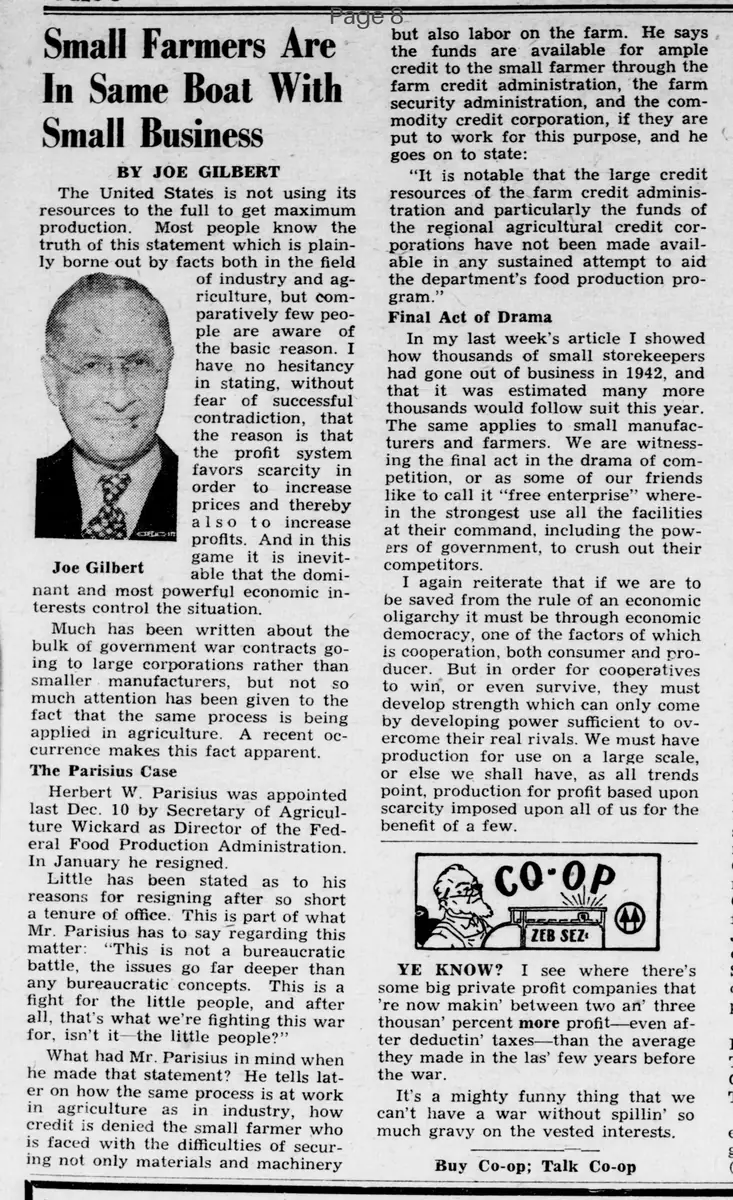
BY JOE GILBERT
The United States is not using its resources to the full to get maximum production. Most people know the truth of this statement which is plainly borne out by facts both in the field of industry and agriculture, but comparatively few people are aware of the basic reason. I have no hesitancy in stating, without fear of successful contradiction, that the reason is that the profit system favors scarcity in order to increase prices and thereby also to increase profits. And in this game it is inevitable that the dominant and most powerful economic interests control the situation.
Much has been written about the bulk of government war contracts going to large corporations rather than smaller manufacturers, but not so much attention has been given to the fact that the same process is being applied in agriculture. A recent occurrence makes this fact apparent.
The Parisius Case
Herbert W. Parisius was appointed last Dec. 10 by Secretary of Agriculture Wickard as Director of the Federal Food Production Administration. In January he resigned. Little has been stated as to his reasons for resigning after so short a tenure of office. This is part of what Mr. Parisius has to say regarding this matter:
"This is not a bureaucratic battle, the issues go far deeper than any bureaucratic concepts. This is a fight for the little people, and after all, that's what we're fighting this war for, isn't it—the little people?"
What had Mr. Parisius in mind when he made that statement? He tells later on how the same process is at work in agriculture as in industry, how credit is denied the small farmer who is faced with the difficulties of securing not only materials and machinery but also labor on the farm. He says the funds are available for ample credit to the small farmer through the farm credit administration, the farm security administration, and the commodity credit corporation, if they are put to work for this purpose, and he goes on to state:
"It is notable that the large credit resources of the farm credit administration and particularly the funds of the regional agricultural credit corporations have not been made available in any sustained attempt to aid the department's food production program."
Final Act of Drama
In my last week's article I showed how thousands of small storekeepers had gone out of business in 1942, and that it was estimated many more thousands would follow suit this year. The same applies to small manufacturers and farmers. We are witnessing the final act in the drama of competition, or as some of our friends like to call it "free enterprise" wherein the strongest use all the facilities at their command, including the powers of government, to crush out their competitors.
I again reiterate that if we are to be saved from the rule of an economic oligarchy it must be through economic democracy, one of the factors of which is cooperation, both consumer and producer. But in order for cooperatives to win, or even survive, they must develop strength which can only come by developing power sufficient to overcome their real rivals. We must have production for use on a large scale, or else we shall have, as all trends point, production for profit based upon scarcity imposed upon all of us for the benefit of a few.
YEKNOW?
I see where there's some big private profit companies that 're now makin' between two an' three thousan' percent more profit—even after deductin' taxes—than the average they made in the las' few years before the war.
It's a mighty funny thing that we can't have a war without spillin' so much gravy on the vested interests.
Buy Co-op;
Talk Co-op
What sub-type of article is it?
What themes does it cover?
What keywords are associated?
What entities or persons were involved?
Where did it happen?
Story Details
Key Persons
Location
United States
Event Date
1942 1943
Story Details
Article critiques how profit-driven system and government policies favor large entities over small farmers and businesses during WWII, highlighted by Herbert Parisius's brief tenure and resignation over denied credit for small farmers; calls for economic democracy via cooperatives.