Thank you for visiting SNEWPapers!
Sign up free
Editorial
May 27, 1795
Gazette Of The United States And Daily Evening Advertiser
Philadelphia, Philadelphia County, Pennsylvania
What is this article about?
An editorial from New-York on May 20 critiques the French Revolution's internal party conflicts, arguing that factionalism has led to the execution of patriots like Barrere, Robespierre, and others, and warns of ongoing dangers without constitutional checks like a bicameral legislature.
Clipping
OCR Quality
98%
Excellent
Full Text
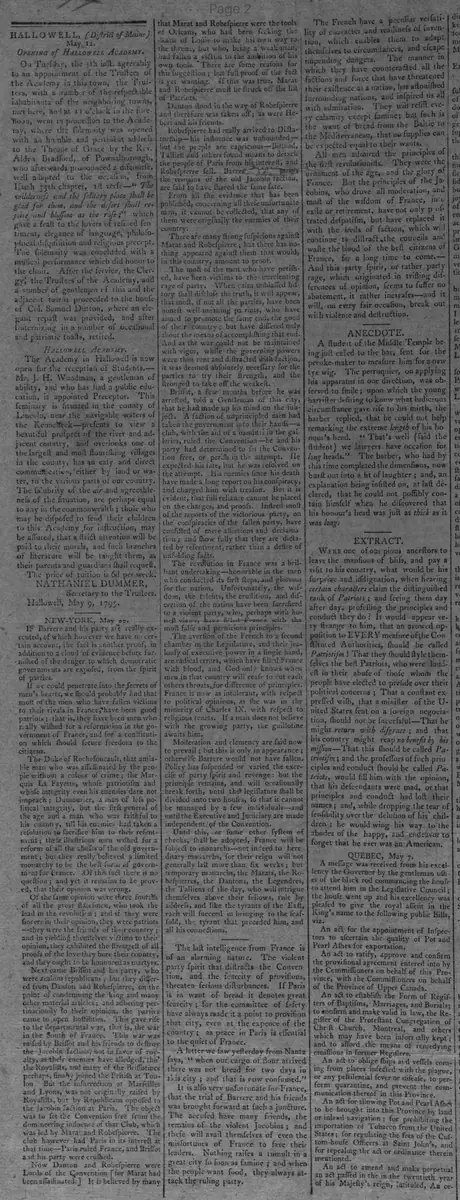
NEW-YORK, May 20.
If Barrere and his party are really executed, of which however we have no certain account, the act is another proof, in addition to a cloud of evidence before furnished of the danger to which democratic governments are exposed, from the spirit of parties.
If we could penetrate into the secrets of men's hearts, we should probably find that most of the men who have fallen victims to their rivals in France, have been good patriots; that is, they have been men who really wished for a reformation in the government of France, and for a constitution which should secure freedom to the citizens.
The Duke of Rochefoucauld, that amiable man who was assassinated by the people without a colour of crime; the Marquis La Fayette, whose patriotism and whose integrity even his enemies dare not impeach; Dumourier, a man of less political integrity, but the first general of the age and a man who was faithful to his country, till his enemies had taken a resolution to sacrifice him to their resentment; these illustrious men wished for a reform of all the abuses of the old government; but they really believed a limited monarchy to be the best form of government for France. Of this fact there is no question; and yet it remains to be proved, that their opinion was wrong.
Of the same opinion were three fourths of all the great statesmen, who took the lead in the revolution; and if they were sincere in their opinion, they were patriots --they were the friends of their country; and in yielding themselves victims to their opinion, they exhibited the strongest of all proofs of the love they bore their country, and they ought to be honoured as martyrs.
Next came Brissot and his party, who were zealous republicans; but they differed from Danton and Robespierre, on the point of condemning the king and many other material articles; and adhering pertinaciously to their opinion, the parties came to open hostilities. This gave rise to the departmental war, that is, the war in the South of France. This war was raised by Brissot and his friends to destroy the Jacobin faction, not in favor of royalty, as their enemies have alleged, tho the Royalists, and many of the Brissotines perhaps, finally joined the British at Toulon. But the insurrection at Marseilles and Lyons, was not originally raised by Royalists, but by Republicans opposed to the Jacobin faction at Paris. The object was to set the Convention free from the domineering influence of that Club, which was led by Marat and Robespierre. The club however had Paris in its interest at that time--Paris ruled France, and Brissot and his party were crushed.
Now Danton and Robespierre were Lords of the Convention for Marat had been assassinated. It is believed by many that Marat and Robespierre were the tools of Orleans, who had been seeking the death of Louis to make his own way to the throne, but who, being a weak man, had fallen a victim to the ambition of his own tools. There are some reasons for this suggestion; but full proof of the fact is yet wanting. If this was true, Marat and Robespierre must be struck off the list of Patriots.
Danton stood in the way of Robespierre and therefore was taken off; as were Hebert and his friends.
Robespierre had really arrived to Dictatorship-his influence was unbounded- but the people are capricious-Billaud, Tallien and others found means to detach the people of Paris from his interest, and Robespierre fell. Barrere and the remains of the old Jacobin faction, are said to have shared the same fate.
From all the evidence that has been published, concerning all these unfortunate men, it cannot be collected, that any of them were originally the enemies of their country.
There are many strong suspicions against Marat and Robespierre; but there has nothing appeared against them that would, in this country, amount to proof.
The most of the men who have perished, have been victims to the unrelenting rage of party. When calm unbiased history shall disclose the truth, it will appear, that most, if not all the parties, have been honest well meaning patriots, who have aimed to promote the same end, the good of their country; but have differed only about the means of accomplishing that end.
And as the war could not be maintained with vigor, while the governing powers were thus rent and distracted with faction, it was deemed absolutely necessary for the parties to try their strength, and the strongest to take off the weakest.
Brissot, a few months before he was arrested, told a Gentleman of this city, that he had made up his mind on the subject. A faction of unprincipled men had taken the government into their hands-a club, with the aid of a banditti in the galleries, ruled the Convention-he and his party had determined to set the Convention free, or perish in the attempt. He expected his fate, but he was resolved on the attempt. His enemies since his death have made a long report on his conspiracy, and charged him with treason. But it is evident, that full reliance cannot be placed on the charges, and proofs. Indeed most of the reports of the victorious party, on the conspiracies of the fallen party, have consisted of mere assertions and declamation ; and show fully that they are dictated by resentment, rather than a desire of unfolding facts.
The revolution in France was a brilliant undertaking-honorable in the men who conducted its first steps, and glorious for the nation. Unfortunately, the wisdom, the talents, the erudition, and discretion of the nation have been sacrificed to a violent party, who, perhaps with honest views, have filled France with the most false and pernicious principles.
The aversion of the French to a second chamber in the Legislature, and their jealousy of executive power in a single hand, are radical errors, which have filled France with blood, and God only knows when men in that country will cease to cut each others throats, for difference of principles.
France is now as intolerant, with respect to political opinions, as she was in the minority of Charles IX. with respect to religious tenets. If a man does not believe with the growing party, the guillotine awaits him.
Moderation and clemency are said now to prevail ; but this is only in appearance ; otherwise Barrere would not have fallen.
Policy has suspended or varied the exercise of party spirit and revenge: but the principle remains, and will occasionally break forth, until the legislature shall be divided into two houses, so that it cannot be managed by a few individuals---and until the Executive and Judiciary are made independent of the Convention.
Until this, or some other system of checks, shall be adopted, France will be subject to monarchs---not indeed to hereditary monarchs, for their reign will not generally last more than six weeks; but temporary monarchs, the Marats, the Robespierres, the Dantons, the Legendres, the Talliens of the day, who will intrigue themselves above their fellows, rule by address, and like the tyrants of the East, each will succeed in bringing to the scaffold, the tyrant that preceded him, and all his connections.
The last intelligence from France is of an alarming nature. The violent party spirit that distracts the Convention, and the scarcity of provisions, threaten serious disturbances. If Paris is in want of bread it denotes great scarcity; for the committee of safety have always made it a point to provision that city, even at the expense of the country ; as peace in Paris is essential to the quiet of France.
A letter we saw yesterday from Nantes says, " when our cargo of flour arrived there was not bread for two days in this city ; and that is now consumed."
It is also very unfortunate for France, that the trial of Barrere and his friends was brought forward at such a juncture. The accused have many friends, the remains of the violent Jacobins; and these will avail themselves of even the misfortunes of France to save their leaders. Nothing raises a tumult in a great city so soon as famine ; and when the people want food, they always attack the ruling party.
The French have a peculiar veracity, facility of character and readiness of invention, which enables them to adapt themselves to circumstances, and escape impending dangers. The manner in which they have counteracted all the factions and force that have threatened their existence as a nation, has astonished surrounding nations, and inspired us all with admiration. They will resist every calamity except famine; but such is the want of bread from the Baltic to the Mediterranean, that no supplies can be expected equal to their wants.
All men admired the principles of the first revolutionists. They were the ornament of the age, and the glory of France. But the principles of the Jacobins, who drove all moderation, and most of the wisdom of France, into exile or retirement, have not only prostrated despotism, but have replaced it with the seeds of faction, which will continue to distract the councils and waste the blood of the best citizens of France, for a long time to come.
And this party spirit, or rather party rage, which originated in trifling differences of opinion, seems to suffer no abatement, it rather increases and it will, on every fair occasion, break out with violence and destruction.
If Barrere and his party are really executed, of which however we have no certain account, the act is another proof, in addition to a cloud of evidence before furnished of the danger to which democratic governments are exposed, from the spirit of parties.
If we could penetrate into the secrets of men's hearts, we should probably find that most of the men who have fallen victims to their rivals in France, have been good patriots; that is, they have been men who really wished for a reformation in the government of France, and for a constitution which should secure freedom to the citizens.
The Duke of Rochefoucauld, that amiable man who was assassinated by the people without a colour of crime; the Marquis La Fayette, whose patriotism and whose integrity even his enemies dare not impeach; Dumourier, a man of less political integrity, but the first general of the age and a man who was faithful to his country, till his enemies had taken a resolution to sacrifice him to their resentment; these illustrious men wished for a reform of all the abuses of the old government; but they really believed a limited monarchy to be the best form of government for France. Of this fact there is no question; and yet it remains to be proved, that their opinion was wrong.
Of the same opinion were three fourths of all the great statesmen, who took the lead in the revolution; and if they were sincere in their opinion, they were patriots --they were the friends of their country; and in yielding themselves victims to their opinion, they exhibited the strongest of all proofs of the love they bore their country, and they ought to be honoured as martyrs.
Next came Brissot and his party, who were zealous republicans; but they differed from Danton and Robespierre, on the point of condemning the king and many other material articles; and adhering pertinaciously to their opinion, the parties came to open hostilities. This gave rise to the departmental war, that is, the war in the South of France. This war was raised by Brissot and his friends to destroy the Jacobin faction, not in favor of royalty, as their enemies have alleged, tho the Royalists, and many of the Brissotines perhaps, finally joined the British at Toulon. But the insurrection at Marseilles and Lyons, was not originally raised by Royalists, but by Republicans opposed to the Jacobin faction at Paris. The object was to set the Convention free from the domineering influence of that Club, which was led by Marat and Robespierre. The club however had Paris in its interest at that time--Paris ruled France, and Brissot and his party were crushed.
Now Danton and Robespierre were Lords of the Convention for Marat had been assassinated. It is believed by many that Marat and Robespierre were the tools of Orleans, who had been seeking the death of Louis to make his own way to the throne, but who, being a weak man, had fallen a victim to the ambition of his own tools. There are some reasons for this suggestion; but full proof of the fact is yet wanting. If this was true, Marat and Robespierre must be struck off the list of Patriots.
Danton stood in the way of Robespierre and therefore was taken off; as were Hebert and his friends.
Robespierre had really arrived to Dictatorship-his influence was unbounded- but the people are capricious-Billaud, Tallien and others found means to detach the people of Paris from his interest, and Robespierre fell. Barrere and the remains of the old Jacobin faction, are said to have shared the same fate.
From all the evidence that has been published, concerning all these unfortunate men, it cannot be collected, that any of them were originally the enemies of their country.
There are many strong suspicions against Marat and Robespierre; but there has nothing appeared against them that would, in this country, amount to proof.
The most of the men who have perished, have been victims to the unrelenting rage of party. When calm unbiased history shall disclose the truth, it will appear, that most, if not all the parties, have been honest well meaning patriots, who have aimed to promote the same end, the good of their country; but have differed only about the means of accomplishing that end.
And as the war could not be maintained with vigor, while the governing powers were thus rent and distracted with faction, it was deemed absolutely necessary for the parties to try their strength, and the strongest to take off the weakest.
Brissot, a few months before he was arrested, told a Gentleman of this city, that he had made up his mind on the subject. A faction of unprincipled men had taken the government into their hands-a club, with the aid of a banditti in the galleries, ruled the Convention-he and his party had determined to set the Convention free, or perish in the attempt. He expected his fate, but he was resolved on the attempt. His enemies since his death have made a long report on his conspiracy, and charged him with treason. But it is evident, that full reliance cannot be placed on the charges, and proofs. Indeed most of the reports of the victorious party, on the conspiracies of the fallen party, have consisted of mere assertions and declamation ; and show fully that they are dictated by resentment, rather than a desire of unfolding facts.
The revolution in France was a brilliant undertaking-honorable in the men who conducted its first steps, and glorious for the nation. Unfortunately, the wisdom, the talents, the erudition, and discretion of the nation have been sacrificed to a violent party, who, perhaps with honest views, have filled France with the most false and pernicious principles.
The aversion of the French to a second chamber in the Legislature, and their jealousy of executive power in a single hand, are radical errors, which have filled France with blood, and God only knows when men in that country will cease to cut each others throats, for difference of principles.
France is now as intolerant, with respect to political opinions, as she was in the minority of Charles IX. with respect to religious tenets. If a man does not believe with the growing party, the guillotine awaits him.
Moderation and clemency are said now to prevail ; but this is only in appearance ; otherwise Barrere would not have fallen.
Policy has suspended or varied the exercise of party spirit and revenge: but the principle remains, and will occasionally break forth, until the legislature shall be divided into two houses, so that it cannot be managed by a few individuals---and until the Executive and Judiciary are made independent of the Convention.
Until this, or some other system of checks, shall be adopted, France will be subject to monarchs---not indeed to hereditary monarchs, for their reign will not generally last more than six weeks; but temporary monarchs, the Marats, the Robespierres, the Dantons, the Legendres, the Talliens of the day, who will intrigue themselves above their fellows, rule by address, and like the tyrants of the East, each will succeed in bringing to the scaffold, the tyrant that preceded him, and all his connections.
The last intelligence from France is of an alarming nature. The violent party spirit that distracts the Convention, and the scarcity of provisions, threaten serious disturbances. If Paris is in want of bread it denotes great scarcity; for the committee of safety have always made it a point to provision that city, even at the expense of the country ; as peace in Paris is essential to the quiet of France.
A letter we saw yesterday from Nantes says, " when our cargo of flour arrived there was not bread for two days in this city ; and that is now consumed."
It is also very unfortunate for France, that the trial of Barrere and his friends was brought forward at such a juncture. The accused have many friends, the remains of the violent Jacobins; and these will avail themselves of even the misfortunes of France to save their leaders. Nothing raises a tumult in a great city so soon as famine ; and when the people want food, they always attack the ruling party.
The French have a peculiar veracity, facility of character and readiness of invention, which enables them to adapt themselves to circumstances, and escape impending dangers. The manner in which they have counteracted all the factions and force that have threatened their existence as a nation, has astonished surrounding nations, and inspired us all with admiration. They will resist every calamity except famine; but such is the want of bread from the Baltic to the Mediterranean, that no supplies can be expected equal to their wants.
All men admired the principles of the first revolutionists. They were the ornament of the age, and the glory of France. But the principles of the Jacobins, who drove all moderation, and most of the wisdom of France, into exile or retirement, have not only prostrated despotism, but have replaced it with the seeds of faction, which will continue to distract the councils and waste the blood of the best citizens of France, for a long time to come.
And this party spirit, or rather party rage, which originated in trifling differences of opinion, seems to suffer no abatement, it rather increases and it will, on every fair occasion, break out with violence and destruction.
What sub-type of article is it?
Partisan Politics
Constitutional
Foreign Affairs
What keywords are associated?
French Revolution
Party Spirit
Jacobins
Guillotine
Constitutional Checks
Factionalism
Brissotins
National Convention
What entities or persons were involved?
Barrere
Robespierre
Danton
Brissot
Marat
Lafayette
Duke Of Rochefoucauld
Dumourier
Orleans
Billaud
Tallien
Hebert
Editorial Details
Primary Topic
Dangers Of Party Spirit In The French Revolution
Stance / Tone
Critical Of Factionalism And Advocating Constitutional Checks
Key Figures
Barrere
Robespierre
Danton
Brissot
Marat
Lafayette
Duke Of Rochefoucauld
Dumourier
Orleans
Billaud
Tallien
Hebert
Key Arguments
Most Victims Of French Revolution Were Patriots Differing Only On Means To Reform
Party Conflicts Led To Departmental Wars And Executions
Lack Of Bicameral Legislature And Independent Executive Causes Instability
Jacobin Principles Replaced Despotism With Factional Tyranny
Current Scarcity And Trials Threaten Further Disturbances