Thank you for visiting SNEWPapers!
Sign up free
Literary
April 25, 1942
The West Virginia Digest
Charleston, Kanawha County, West Virginia
What is this article about?
In this excerpt from Native Son, Bigger Thomas anxiously tends to the furnace where he has burned Mary Dalton's body to cover up her accidental death. He interacts with the housekeeper Peggy, who suspects nothing, takes Mary's trunk to the train station as instructed, and returns to the Dalton household, hiding his guilt while listening for any signs of discovery.
Clipping
OCR Quality
95%
Excellent
Full Text
Native Son
BY
RICHARD WRIGHT
continued from last week
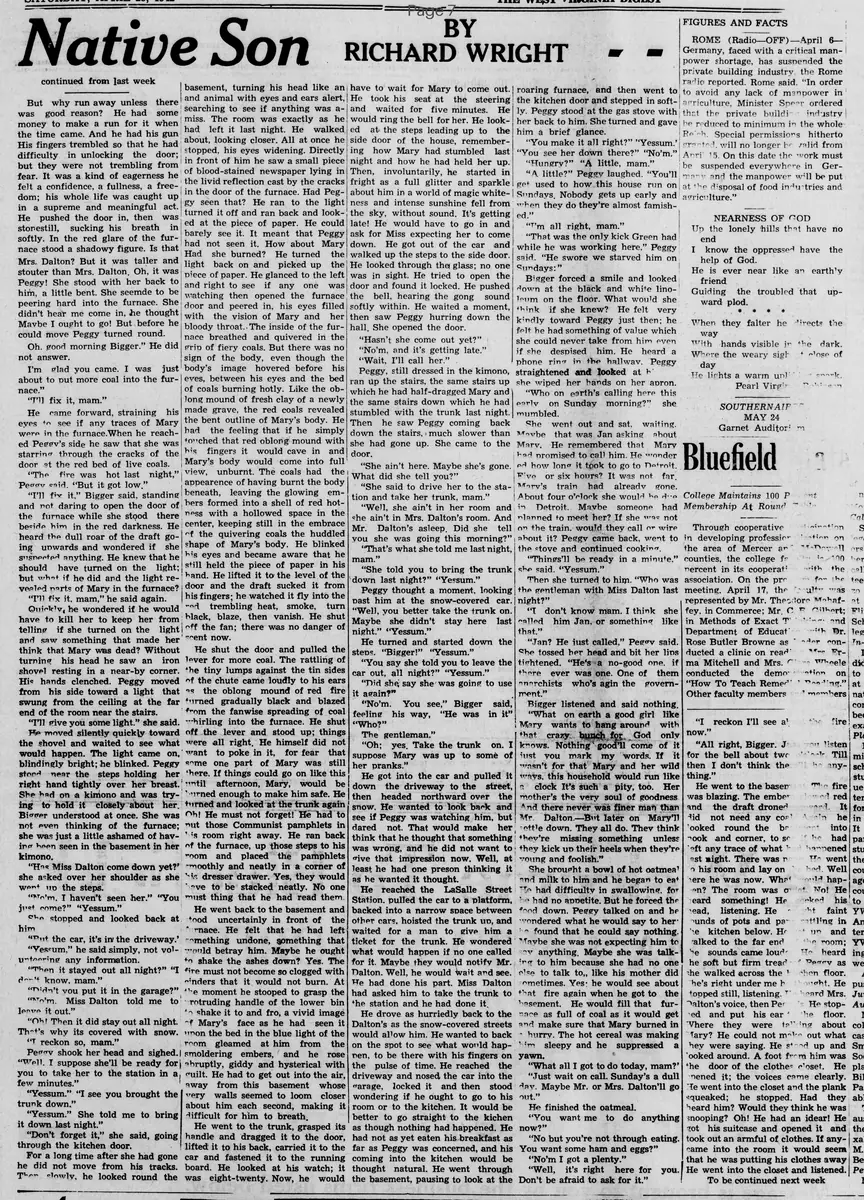
But why run away unless there was good reason? He had some money to make a run for it when the time came. And he had his gun. His fingers trembled so that he had difficulty in unlocking the door: but they were not trembling from fear. It was a kind of eagerness he felt a confidence, a fullness, a freedom; his whole life was caught up in a supreme and meaningful act. He pushed the door in, then was stock-still, sucking his breath in softly. In the red glare of the furnace stood a shadowy figure. Is that Mrs. Dalton? But it was taller and stouter than Mrs. Dalton. Oh, it was Peggy! She stood with her back to him, a little bent. She seemed to be peering hard into the furnace. She didn't hear me come in, he thought. Maybe I ought to go! But before he could move Peggy turned round. Oh, good morning Bigger. He did not answer. I'm glad you came. I was just about to put more coal into the furnace. "I'll fix it, ma'm." He came forward, straining his eyes to see if any traces of Mary were in the furnace. When he reached Peggy's side he saw that she was staring through the cracks of the door at the red bed of live coals. "The fire was hot last night," Peggy said. But it got low. "I'll fix it." Bigger said, standing and not daring to open the door of the furnace while she stood there beside him in the red darkness. He heard the dull roar of the draft going upwards and wondered if she suspected anything. He knew that he should have turned on the light; but what if he did and the light revealed parts of Mary in the furnace? "I'll fix it, ma'm." he said again. Quickly, he wondered if he would have to kill her to keep her from telling if she turned on the light and saw something that made her think that Mary was dead? Without turning his head he saw an iron shovel resting in a near-by corner. His hands clenched. Peggy moved from his side toward a light that swung from the ceiling at the far end of the room near the stairs. "I'll give you some light." she said. He moved silently quickly toward the shovel and waited to see what would happen. The light came on, blindingly bright; he blinked. Peggy stood near the steps holding her right hand tightly over her breast. She had on a kimono and was trying to hold it closely about her. Bigger understood at once. She was not even thinking of the furnace; she was just a little ashamed of having been seen in the basement in her kimono. "Has Miss Dalton come down yet?" she asked over her shoulder as she went up the steps. "No'm. I haven't seen her." "You just come?" "Yessum." She stopped and looked back at him. "Put the car, it's in the driveway." "Yessum." he said simply, not volunteering any information. "Then it stayed out all night?" "I don't know, ma'm." "Didn't you put it in the garage?" "No'm. Miss Dalton told me to leave it out." "Oh! Then it did stay out all night. That's why its covered with snow." "I reckon so, ma'm." Peggy shook her head and sighed. "Well, I suppose she'll be ready for you to take her to the station in a few minutes." "Yessum." "I see you brought the trunk down." "Yessum." She told me to bring it down last night. "Don't forget it," she said, going through the kitchen door. For a long time after she had gone he did not move from his tracks. There slowly, he looked round the basement, turning his head like an animal with eyes and ears alert, searching to see if anything was amiss. The room was exactly as he had left it last night. He walked about, looking closer. All at once he stopped, his eyes widening. Directly in front of him he saw a small piece of blood-stained newspaper lying in the livid reflection cast by the cracks in the door of the furnace. Had Peggy seen that? He ran to the light turned it off and ran back and looked at the piece of paper. He could barely see it. It meant that Peggy had not seen it. How about Mary. Had she burned? He turned the light back on and picked up the piece of paper. He glanced to the left and right to see if any one was watching then opened the furnace door and peered in, his eyes filled with the vision of Mary and her bloody throat. The inside of the furnace breathed and quivered in the grip of fiery coals. But there was no sign of the body, even though the body's image hovered before his eyes, between his eyes and the bed of coals burning hotly. Like the oblong mound of fresh clay of a newly made grave, the red coals revealed the bent outline of Mary's body. He had the feeling that if he simply touched that red oblong mound with his fingers it would cave in and Mary's body would come into full view, unburnt. The coals had the appearance of having burnt the body beneath, leaving the glowing embers formed into a shell of red hotness with a hollowed space in the center, keeping still in the embrace of the quivering coals the huddled shape of Mary's body. He blinked his eyes and became aware that he still held the piece of paper in his hand. He lifted it to the level of the door and the draft sucked it from his fingers: he watched it fly into the red trembling heat, smoke, turn black, blaze, then vanish. He shut off the fan: there was no danger of scent now. He shut the door and pulled the lever for more coal. The rattling of the tiny lumps against the tin sides of the chute came loudly to his ears as the oblong mound of red fire turned gradually black and blazed from the fanwise spreading of coal whirling into the furnace. He shut off the lever and stood up; things were all right. He himself did not want to poke in it, for fear that some one part of Mary was still there. If things could go on like this until afternoon, Mary, would be burned enough to make him safe. He turned and looked at the trunk again. Oh! He must not forget! He had to put those Communist pamphlets in his room right away. He ran back up the steps to his room and placed the pamphlets smoothly and neatly in a corner of his dresser drawer. Yes. they would have to be stacked neatly. No one must think that he had read them. He went back to the basement and to the furnace. He felt that he had left something undone, something that he had to do. What was it? Oh, yes; he had to shake the ashes down?. Yes. The fire must not become so clogged with cinders that it would not burn. At the moment he stooped to grasp the protruding handle of the lower bin the white face of Mary's face as he had seen it upon the bed in the blue light of the smoldering embers, and he rose abruptly, giddy and hysterical with guilt. He had to get out into the air, away from this basement whose very walls seemed to loom closer about him each second, making it difficult for him to breath. He went to the trunk, grasped its handle and dragged it to the door, lifted it to his back, carried it to the car and fastened it to the running board. He looked at his watch; it was eight-twenty. Now, he would have to wait for Mary to come out. He took his seat at the steering wheel and waited for five minutes. He would ring the bell for her. He looked at the steps leading up to the side door of the house, remembering how Mary had stumbled last night and how he had held her up. Then, involuntarily, he started in fright as a full glitter and sparkle about him in a world of magic whiteness and intense sunshine fell from the sky, without sound. It's getting late! He would have to go in and ask for Miss expecting her to come down. He got out of the car and walked up the steps to the side door. He looked through the glass; no one was in sight. He tried to open the door and found it locked. He pushed the bell, hearing the gong sound softly within. He waited a moment, then saw Peggy hurrying down the hall. She opened the door. "Hasn't she come out yet?" "No'm, and it's getting late." "Wait, I'll call her." Peggy, still dressed in the kimono, ran up the stairs, the same stairs up which he had half-dragged Mary and the same stairs down which he had stumbled with the trunk last night. Then he saw Peggy coming back down the stairs, much slower than she had gone up. She came to the door. "She ain't here. Maybe she's gone. What did she tell you?" "She said to drive her to the station and take her trunk, ma'm." "Well, she ain't in her room and she ain't in Mrs. Dalton's room. And Mr. Dalton's asleep. Did she tell you she was going this morning?" "That's what she told me last night, ma'm." "She told you to bring the trunk down last night?" "Yessum." Peggy thought a moment, looking past him at the snow-covered car. "Well, you better take the trunk on. Maybe she didn't stay here last night." "Yessum." He turned and started down the steps. "Bigger!" "Yessum." "You say she told you to leave the car out, all night?" "Yessum." "Did she say she was going to use it again?" "No'm. You see," Bigger said, feeling his way, "He was in it" "Who?" The gentleman. "Oh; yes. Take the trunk on. I suppose Mary was up to some of her pranks." He got into the car and pulled it down the driveway to the street, then headed northward over the snow. He wanted to look back and see if Peggy was watching him, but dared not. That would make her think that he thought that something was wrong, and he did not want to give that impression now. Well, at least he had one person thinking it as he wanted it thought. He reached the LaSalle Street Station, pulled the car to a platform, backed into a narrow space between other cars, hoisted the trunk up, and waited for a man to give him a ticket for the trunk. He wondered what would happen if no one called for it. Maybe they would notify Mr. Dalton. Well, he would wait and see. He had done his part. Miss Dalton had asked him to take the trunk to the station and he had done it. He drove as hurriedly back to the Dalton's as the snow-covered streets would allow him. He wanted to back on the spot to see what would happen, to be there with his fingers on the pulse of time. He reached the driveway and nosed the car into the garage, locked it and then stood wondering if he ought to go to his room or to the kitchen. It would be better to go straight to the kitchen as though nothing had happened. He had not as yet eaten his breakfast as far as Peggy was concerned, and his coming into the kitchen would be thought natural. He went through the basement, pausing to look at the roaring furnace, and then went to the kitchen door and stepped in softly. Peggy stood at the gas stove with her back to him. She turned and gave him a brief glance. "You make it all right?" "Yessum." "You see her down there?" "No'm." "Hungry?" "A little, ma'm." "A little?" Peggy laughed. "You'll get used to how this house run on Sundays. Nobody gets up early and when they do they're almost famished." "I'm all right, ma'm." "That was the only kick Green had while he was working here," Peggy said. "He swore we starved him on Sundays." Bigger forced a smile and looked down at the black and white linoleum on the floor. What would she think if she knew? He felt very kindly toward Peggy just then; he felt he had something of value which she could never take from him even if she despised him. He heard a phone ring in the hallway. Peggy straightened and looked at him; she wiped her hands on her apron. "Who on earth's calling here this early on Sunday morning?" she mumbled. She went out and sat, waiting. Maybe that was Jan asking about Mary. He remembered that Mary had promised to call him. He wondered how long it took to go to Detroit. Five or six hours? It was not far. Mary's train had already gone. About four o'clock she would be in Detroit. Maybe someone had planned to meet her? If she was not on the train, would they call or wire about it? Peggy came back, went to the stove and continued cooking. "Things'll be ready in a minute." she said. "Yessum." Then she turned to him. "Who was the gentleman with Miss Dalton last night?" "I don't know ma'm. I think she called him Jan, or something like that." "Jan? He just called." Peggy said. She tossed her head and bit her lips tightened. "He's a no-good one, if there ever was one. One of them anarchists who's agin the government." Bigger listened and said nothing. "What on earth a good girl like Mary wants to hang around with that crazy, bunch for. God only knows. Nothing good'll come of it just you mark my words. If it wasn't for that Mary and her wild ways, this household would run like a clock It's such a pity, too. Her mother's the very soul of goodness And there never was finer man than Mr. Dalton. But later on Mary'll settle down. They all do. They think they're missing something unless they kick up their heels when they're young and foolish." She brought a bowl of hot oatmeal and milk to him and he began to eat. He had difficulty in swallowing, for he had no appetite. But he forced the food down. Peggy talked on and he wondered what he would say to her if she found that he could say nothing. Maybe she was not expecting him to say anything. Maybe she was talking to him because she had no one else to talk to, like his mother did sometimes. Yes; he would see about that fire again when he got to the basement. He would fill that furnace as full of coal as it would get and make sure that Mary burned in a hurry. The hot cereal was making him sleepy and he suppressed a yawn. "What all I got to do today, ma'm?" "Just wait on call. Sunday's a dull day. Maybe Mr. or Mrs. Dalton'll go out." He finished the oatmeal. "You want me to do anything now?" "No but you're not through eating. You want some ham and eggs?" "No'm I got a plenty." "Well, it's right here for you. Don't be afraid to ask for it." I reckon I'll see about the fire now. "All right, Bigger. Just listen for the bell about twelve. Till then I don't think there'll be anything." He went to the basement. The fire was blazing. The embers glowed red and the draft droned onward. It did not need any coal again. He looked round the basement into nook and corner, to see if he had left any trace of what happened last night. There was nothing. He went to his room and lay on the bed. Well, here he was now. What would happen? The room was hot. No! He heard something! He jerked his head, listening. He caught faint sounds of pots and pans rattling in the kitchen below. He ran and walked to the far end of the room; the sounds came louder. He heard the soft but firm tread of Peggy as she walked across the kitchen floor. She's right under me now, he thought. He stopped still, listening. He heard Mrs. Dalton's voice, then Peggy's. He stopped and put his ear to the floor. Where they talking about Mary? He could not make out what they were saying. He stood up and looked around. A foot from him was the door of the clothes closet. He opened it; the voices came clearly. He went into the closet and the plank squeaked; he stopped. Had they heard him? Would they think he was snooping? Oh! He had an idea! He got his suitcase and opened it and took out an armful of clothes. If anyone came into the room it would seem that he was putting his clothes away. He went into the closet and listened. To be continued next week.
BY
RICHARD WRIGHT
continued from last week
But why run away unless there was good reason? He had some money to make a run for it when the time came. And he had his gun. His fingers trembled so that he had difficulty in unlocking the door: but they were not trembling from fear. It was a kind of eagerness he felt a confidence, a fullness, a freedom; his whole life was caught up in a supreme and meaningful act. He pushed the door in, then was stock-still, sucking his breath in softly. In the red glare of the furnace stood a shadowy figure. Is that Mrs. Dalton? But it was taller and stouter than Mrs. Dalton. Oh, it was Peggy! She stood with her back to him, a little bent. She seemed to be peering hard into the furnace. She didn't hear me come in, he thought. Maybe I ought to go! But before he could move Peggy turned round. Oh, good morning Bigger. He did not answer. I'm glad you came. I was just about to put more coal into the furnace. "I'll fix it, ma'm." He came forward, straining his eyes to see if any traces of Mary were in the furnace. When he reached Peggy's side he saw that she was staring through the cracks of the door at the red bed of live coals. "The fire was hot last night," Peggy said. But it got low. "I'll fix it." Bigger said, standing and not daring to open the door of the furnace while she stood there beside him in the red darkness. He heard the dull roar of the draft going upwards and wondered if she suspected anything. He knew that he should have turned on the light; but what if he did and the light revealed parts of Mary in the furnace? "I'll fix it, ma'm." he said again. Quickly, he wondered if he would have to kill her to keep her from telling if she turned on the light and saw something that made her think that Mary was dead? Without turning his head he saw an iron shovel resting in a near-by corner. His hands clenched. Peggy moved from his side toward a light that swung from the ceiling at the far end of the room near the stairs. "I'll give you some light." she said. He moved silently quickly toward the shovel and waited to see what would happen. The light came on, blindingly bright; he blinked. Peggy stood near the steps holding her right hand tightly over her breast. She had on a kimono and was trying to hold it closely about her. Bigger understood at once. She was not even thinking of the furnace; she was just a little ashamed of having been seen in the basement in her kimono. "Has Miss Dalton come down yet?" she asked over her shoulder as she went up the steps. "No'm. I haven't seen her." "You just come?" "Yessum." She stopped and looked back at him. "Put the car, it's in the driveway." "Yessum." he said simply, not volunteering any information. "Then it stayed out all night?" "I don't know, ma'm." "Didn't you put it in the garage?" "No'm. Miss Dalton told me to leave it out." "Oh! Then it did stay out all night. That's why its covered with snow." "I reckon so, ma'm." Peggy shook her head and sighed. "Well, I suppose she'll be ready for you to take her to the station in a few minutes." "Yessum." "I see you brought the trunk down." "Yessum." She told me to bring it down last night. "Don't forget it," she said, going through the kitchen door. For a long time after she had gone he did not move from his tracks. There slowly, he looked round the basement, turning his head like an animal with eyes and ears alert, searching to see if anything was amiss. The room was exactly as he had left it last night. He walked about, looking closer. All at once he stopped, his eyes widening. Directly in front of him he saw a small piece of blood-stained newspaper lying in the livid reflection cast by the cracks in the door of the furnace. Had Peggy seen that? He ran to the light turned it off and ran back and looked at the piece of paper. He could barely see it. It meant that Peggy had not seen it. How about Mary. Had she burned? He turned the light back on and picked up the piece of paper. He glanced to the left and right to see if any one was watching then opened the furnace door and peered in, his eyes filled with the vision of Mary and her bloody throat. The inside of the furnace breathed and quivered in the grip of fiery coals. But there was no sign of the body, even though the body's image hovered before his eyes, between his eyes and the bed of coals burning hotly. Like the oblong mound of fresh clay of a newly made grave, the red coals revealed the bent outline of Mary's body. He had the feeling that if he simply touched that red oblong mound with his fingers it would cave in and Mary's body would come into full view, unburnt. The coals had the appearance of having burnt the body beneath, leaving the glowing embers formed into a shell of red hotness with a hollowed space in the center, keeping still in the embrace of the quivering coals the huddled shape of Mary's body. He blinked his eyes and became aware that he still held the piece of paper in his hand. He lifted it to the level of the door and the draft sucked it from his fingers: he watched it fly into the red trembling heat, smoke, turn black, blaze, then vanish. He shut off the fan: there was no danger of scent now. He shut the door and pulled the lever for more coal. The rattling of the tiny lumps against the tin sides of the chute came loudly to his ears as the oblong mound of red fire turned gradually black and blazed from the fanwise spreading of coal whirling into the furnace. He shut off the lever and stood up; things were all right. He himself did not want to poke in it, for fear that some one part of Mary was still there. If things could go on like this until afternoon, Mary, would be burned enough to make him safe. He turned and looked at the trunk again. Oh! He must not forget! He had to put those Communist pamphlets in his room right away. He ran back up the steps to his room and placed the pamphlets smoothly and neatly in a corner of his dresser drawer. Yes. they would have to be stacked neatly. No one must think that he had read them. He went back to the basement and to the furnace. He felt that he had left something undone, something that he had to do. What was it? Oh, yes; he had to shake the ashes down?. Yes. The fire must not become so clogged with cinders that it would not burn. At the moment he stooped to grasp the protruding handle of the lower bin the white face of Mary's face as he had seen it upon the bed in the blue light of the smoldering embers, and he rose abruptly, giddy and hysterical with guilt. He had to get out into the air, away from this basement whose very walls seemed to loom closer about him each second, making it difficult for him to breath. He went to the trunk, grasped its handle and dragged it to the door, lifted it to his back, carried it to the car and fastened it to the running board. He looked at his watch; it was eight-twenty. Now, he would have to wait for Mary to come out. He took his seat at the steering wheel and waited for five minutes. He would ring the bell for her. He looked at the steps leading up to the side door of the house, remembering how Mary had stumbled last night and how he had held her up. Then, involuntarily, he started in fright as a full glitter and sparkle about him in a world of magic whiteness and intense sunshine fell from the sky, without sound. It's getting late! He would have to go in and ask for Miss expecting her to come down. He got out of the car and walked up the steps to the side door. He looked through the glass; no one was in sight. He tried to open the door and found it locked. He pushed the bell, hearing the gong sound softly within. He waited a moment, then saw Peggy hurrying down the hall. She opened the door. "Hasn't she come out yet?" "No'm, and it's getting late." "Wait, I'll call her." Peggy, still dressed in the kimono, ran up the stairs, the same stairs up which he had half-dragged Mary and the same stairs down which he had stumbled with the trunk last night. Then he saw Peggy coming back down the stairs, much slower than she had gone up. She came to the door. "She ain't here. Maybe she's gone. What did she tell you?" "She said to drive her to the station and take her trunk, ma'm." "Well, she ain't in her room and she ain't in Mrs. Dalton's room. And Mr. Dalton's asleep. Did she tell you she was going this morning?" "That's what she told me last night, ma'm." "She told you to bring the trunk down last night?" "Yessum." Peggy thought a moment, looking past him at the snow-covered car. "Well, you better take the trunk on. Maybe she didn't stay here last night." "Yessum." He turned and started down the steps. "Bigger!" "Yessum." "You say she told you to leave the car out, all night?" "Yessum." "Did she say she was going to use it again?" "No'm. You see," Bigger said, feeling his way, "He was in it" "Who?" The gentleman. "Oh; yes. Take the trunk on. I suppose Mary was up to some of her pranks." He got into the car and pulled it down the driveway to the street, then headed northward over the snow. He wanted to look back and see if Peggy was watching him, but dared not. That would make her think that he thought that something was wrong, and he did not want to give that impression now. Well, at least he had one person thinking it as he wanted it thought. He reached the LaSalle Street Station, pulled the car to a platform, backed into a narrow space between other cars, hoisted the trunk up, and waited for a man to give him a ticket for the trunk. He wondered what would happen if no one called for it. Maybe they would notify Mr. Dalton. Well, he would wait and see. He had done his part. Miss Dalton had asked him to take the trunk to the station and he had done it. He drove as hurriedly back to the Dalton's as the snow-covered streets would allow him. He wanted to back on the spot to see what would happen, to be there with his fingers on the pulse of time. He reached the driveway and nosed the car into the garage, locked it and then stood wondering if he ought to go to his room or to the kitchen. It would be better to go straight to the kitchen as though nothing had happened. He had not as yet eaten his breakfast as far as Peggy was concerned, and his coming into the kitchen would be thought natural. He went through the basement, pausing to look at the roaring furnace, and then went to the kitchen door and stepped in softly. Peggy stood at the gas stove with her back to him. She turned and gave him a brief glance. "You make it all right?" "Yessum." "You see her down there?" "No'm." "Hungry?" "A little, ma'm." "A little?" Peggy laughed. "You'll get used to how this house run on Sundays. Nobody gets up early and when they do they're almost famished." "I'm all right, ma'm." "That was the only kick Green had while he was working here," Peggy said. "He swore we starved him on Sundays." Bigger forced a smile and looked down at the black and white linoleum on the floor. What would she think if she knew? He felt very kindly toward Peggy just then; he felt he had something of value which she could never take from him even if she despised him. He heard a phone ring in the hallway. Peggy straightened and looked at him; she wiped her hands on her apron. "Who on earth's calling here this early on Sunday morning?" she mumbled. She went out and sat, waiting. Maybe that was Jan asking about Mary. He remembered that Mary had promised to call him. He wondered how long it took to go to Detroit. Five or six hours? It was not far. Mary's train had already gone. About four o'clock she would be in Detroit. Maybe someone had planned to meet her? If she was not on the train, would they call or wire about it? Peggy came back, went to the stove and continued cooking. "Things'll be ready in a minute." she said. "Yessum." Then she turned to him. "Who was the gentleman with Miss Dalton last night?" "I don't know ma'm. I think she called him Jan, or something like that." "Jan? He just called." Peggy said. She tossed her head and bit her lips tightened. "He's a no-good one, if there ever was one. One of them anarchists who's agin the government." Bigger listened and said nothing. "What on earth a good girl like Mary wants to hang around with that crazy, bunch for. God only knows. Nothing good'll come of it just you mark my words. If it wasn't for that Mary and her wild ways, this household would run like a clock It's such a pity, too. Her mother's the very soul of goodness And there never was finer man than Mr. Dalton. But later on Mary'll settle down. They all do. They think they're missing something unless they kick up their heels when they're young and foolish." She brought a bowl of hot oatmeal and milk to him and he began to eat. He had difficulty in swallowing, for he had no appetite. But he forced the food down. Peggy talked on and he wondered what he would say to her if she found that he could say nothing. Maybe she was not expecting him to say anything. Maybe she was talking to him because she had no one else to talk to, like his mother did sometimes. Yes; he would see about that fire again when he got to the basement. He would fill that furnace as full of coal as it would get and make sure that Mary burned in a hurry. The hot cereal was making him sleepy and he suppressed a yawn. "What all I got to do today, ma'm?" "Just wait on call. Sunday's a dull day. Maybe Mr. or Mrs. Dalton'll go out." He finished the oatmeal. "You want me to do anything now?" "No but you're not through eating. You want some ham and eggs?" "No'm I got a plenty." "Well, it's right here for you. Don't be afraid to ask for it." I reckon I'll see about the fire now. "All right, Bigger. Just listen for the bell about twelve. Till then I don't think there'll be anything." He went to the basement. The fire was blazing. The embers glowed red and the draft droned onward. It did not need any coal again. He looked round the basement into nook and corner, to see if he had left any trace of what happened last night. There was nothing. He went to his room and lay on the bed. Well, here he was now. What would happen? The room was hot. No! He heard something! He jerked his head, listening. He caught faint sounds of pots and pans rattling in the kitchen below. He ran and walked to the far end of the room; the sounds came louder. He heard the soft but firm tread of Peggy as she walked across the kitchen floor. She's right under me now, he thought. He stopped still, listening. He heard Mrs. Dalton's voice, then Peggy's. He stopped and put his ear to the floor. Where they talking about Mary? He could not make out what they were saying. He stood up and looked around. A foot from him was the door of the clothes closet. He opened it; the voices came clearly. He went into the closet and the plank squeaked; he stopped. Had they heard him? Would they think he was snooping? Oh! He had an idea! He got his suitcase and opened it and took out an armful of clothes. If anyone came into the room it would seem that he was putting his clothes away. He went into the closet and listened. To be continued next week.
What sub-type of article is it?
Prose Fiction
What themes does it cover?
Social Manners
Political
Death Mortality
What keywords are associated?
Bigger Thomas
Mary Dalton
Peggy
Furnace
Murder Cover Up
Dalton Household
Racial Tension
Guilt
Communist Pamphlets
What entities or persons were involved?
Richard Wright
Literary Details
Title
Native Son
Author
Richard Wright
Key Lines
Like The Oblong Mound Of Fresh Clay Of A Newly Made Grave, The Red Coals Revealed The Bent Outline Of Mary's Body.
He Had The Feeling That If He Simply Touched That Red Oblong Mound With His Fingers It Would Cave In And Mary's Body Would Come Into Full View, Unburnt.
He Felt Very Kindly Toward Peggy Just Then; He Felt He Had Something Of Value Which She Could Never Take From Him Even If She Despised Him.
Nothing Good'll Come Of It Just You Mark My Words. If It Wasn't For That Mary And Her Wild Ways, This Household Would Run Like A Clock
He Went Into The Closet And Listened.