Thank you for visiting SNEWPapers!
Sign up free
Editorial
June 5, 1815
Portland Gazette, And Maine Advertiser
Portland, Cumberland County, Maine
What is this article about?
An editorial from Baltimore criticizes the U.S. President's policy, announced through the Secretary of War, excluding experienced but infirm military officers from peace establishment positions, labeling it as Democratic ingratitude and questioning incentives for loyal service.
Clipping
OCR Quality
98%
Excellent
Full Text
BALTIMORE, MAY 27.
REPUBLICAN GRATITUDE.
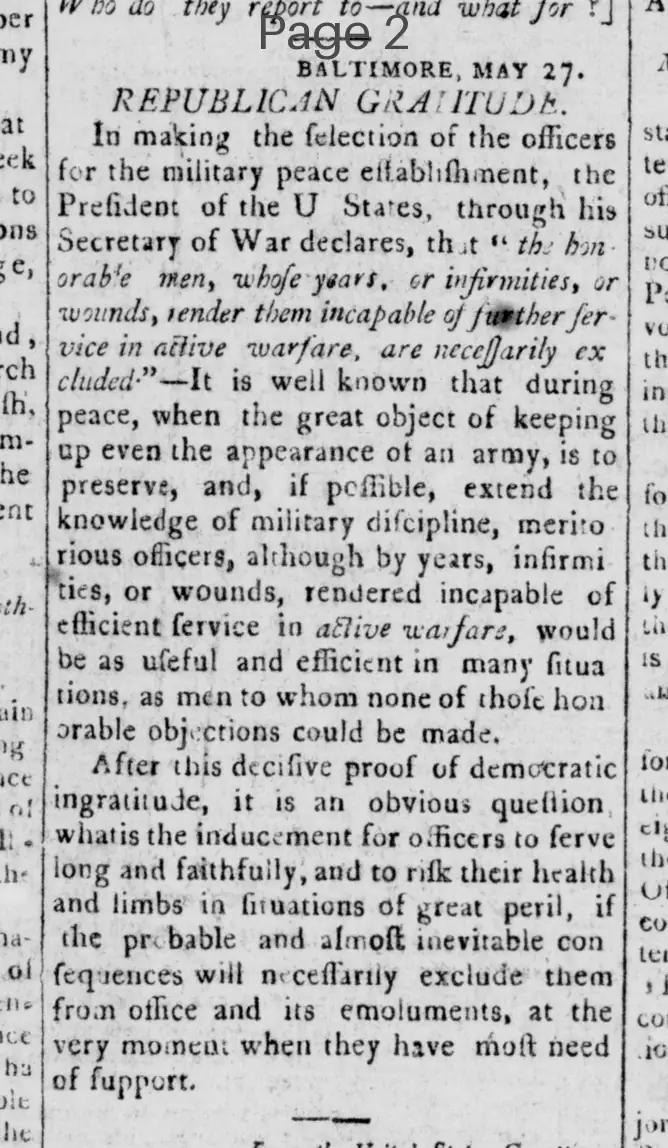
In making the election of the officers for the military peace establishment, the President of the U. States, through his Secretary of War declares, that 'the honorable men, whose years, or infirmities, or wounds, render them incapable of further service in active warfare, are necessarily excluded.'--It is well known that during peace, when the great object of keeping up even the appearance of an army, is to preserve, and, if possible, extend the knowledge of military discipline, meritorious officers, although by years, infirmities, or wounds, rendered incapable of efficient service in active warfare, would be as useful and efficient in many situations, as men to whom none of those honorable objections could be made.
After this decisive proof of democratic ingratitude, it is an obvious question, what is the inducement for officers to serve long and faithfully, and to risk their health and limbs in situations of great peril, if the probable and almost inevitable consequence will necessarily exclude them from office and its emoluments, at the very moment when they have most need of support.
REPUBLICAN GRATITUDE.
In making the election of the officers for the military peace establishment, the President of the U. States, through his Secretary of War declares, that 'the honorable men, whose years, or infirmities, or wounds, render them incapable of further service in active warfare, are necessarily excluded.'--It is well known that during peace, when the great object of keeping up even the appearance of an army, is to preserve, and, if possible, extend the knowledge of military discipline, meritorious officers, although by years, infirmities, or wounds, rendered incapable of efficient service in active warfare, would be as useful and efficient in many situations, as men to whom none of those honorable objections could be made.
After this decisive proof of democratic ingratitude, it is an obvious question, what is the inducement for officers to serve long and faithfully, and to risk their health and limbs in situations of great peril, if the probable and almost inevitable consequence will necessarily exclude them from office and its emoluments, at the very moment when they have most need of support.
What sub-type of article is it?
Military Affairs
Partisan Politics
What keywords are associated?
Military Officers
Veterans Exclusion
Democratic Ingratitude
Peace Establishment
Officer Service Incentives
What entities or persons were involved?
President Of The U. States
Secretary Of War
Editorial Details
Primary Topic
Exclusion Of Infirm Military Officers From Peace Establishment
Stance / Tone
Critical Of Democratic Ingratitude Towards Veterans
Key Figures
President Of The U. States
Secretary Of War
Key Arguments
Honorable But Infirm Officers Are Excluded From Military Peace Positions.
Such Officers Remain Useful For Preserving Military Discipline In Peacetime.
This Policy Demonstrates Democratic Ingratitude.
It Undermines Incentives For Officers To Serve Faithfully And Risk Their Health.