Thank you for visiting SNEWPapers!
Sign up free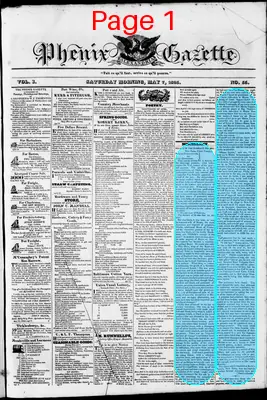
Phenix Gazette
Alexandria, Virginia
What is this article about?
In New Paltz, Ulster County, NY, black woman Phillis Schoonmaker sues Cuff Hogeboom for breach of marriage promise. Her counsel argues for justice despite race. Phillis testifies to courtship and gifts; Cuff claims conditional promise tied to emancipation. Jury awards $10 and costs; Cuff jailed for inability to pay.
Merged-components note: Continuation of the 'Breach of the Marriage Promise' story.
Clipping
OCR Quality
Full Text
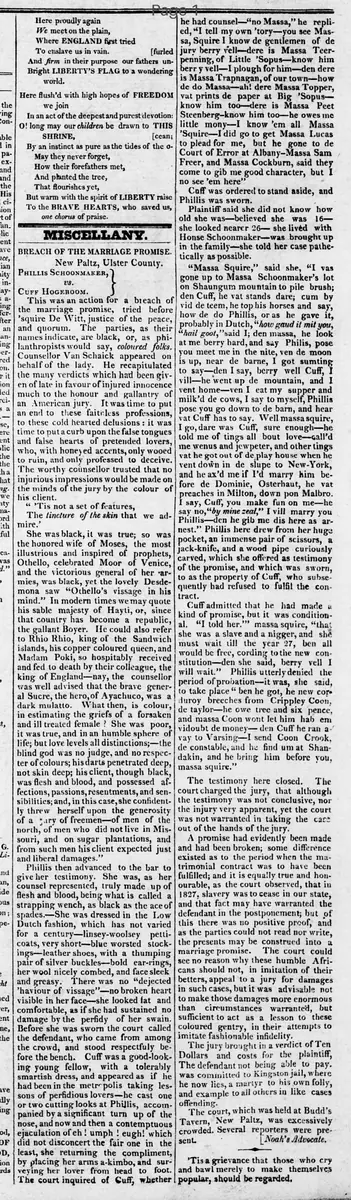
BREACH OF THE MARRIAGE PROMISE.
New Paltz, Ulster County.
Phillis Schoonmaker
VS.
Cuff Hogeboom.
This was an action for a breach of the marriage promise, tried before 'squire De Witt, justice of the peace, and quorum. The parties, as their names indicate, are black, or, as philanthropists would say, coloured folks.
Counsellor Van Schaick appeared on behalf of the lady. He recapitulated the many verdicts which had been given of late in favour of injured innocence much to the honour and gallantry of an American jury. It was time to put an end to these faithless professions, to these cold hearted delusions : it was time to put a curb upon the false tongues and false hearts of pretended lovers, who, with honeyed accents, only wooed to ruin, and only professed to deceive.
The worthy counsellor trusted that no injurious impressions would be made on the minds of the jury by the colour of his client.
“ 'Tis not a set of features,
The tincture of the skin that we admire.'
She was black, it was true; so was the honored wife of Moses, the most illustrious and inspired of prophets, Othello, celebrated Moor of Venice, and the victorious general of her armies, was black, yet the lovely Desdemona saw
"Othello's visage in his mind." In modern times we may quote his sable majesty of Hayti, or, since that country has become a republic, the gallant Boyer. He could also refer to Rhio Rhio, king of the Sandwich islands, his copper coloured queen, and Madam Poki, so hospitably received and fed to death by their colleague, the king of England—nay, the counsellor was well advised that the brave general Sucre, the hero of Ayacucho, was a dark mulatto. What then, is colour, in estimating the griefs of a forsaken and ill treated female ? She was poor, it was true, and in an humble sphere of life: but love levels all distinctions;—the blind god was no judge, and no respecter of colours; his darts penetrated deep. not skin deep; his client, though black, was flesh and blood, and possessed affections, passions, resentments, and sensibilities; and, in this case, she confidently threw herself upon the generosity of a jury of freemen—of men of the north, of men who did not live in Missouri, and on sugar plantations, and from such men his client expected just and liberal damages."
Phillis then advanced to the bar to give her testimony. She was, as her counsel represented, truly made up of flesh and blood, being what is called a strapping wench, as black as the ace of spades.—She was dressed in the Low Dutch fashion, which has not varied for a century—linsey-woolsey petticoats, very short—blue worsted stockings—leather shoes, with a thumping pair of silver buckles—bold ear-rings, her wool nicely combed, and face sleek and greasy. There was no "dejected 'haviour of visage"—no broken heart visible in her face—she looked fat and comfortable, as if she had sustained no damage by the perfidy of her swain.
Before she was sworn the court called the defendant, who came from among the crowd, and stood respectfully before the bench. Cuff was a good-looking young fellow, with a tolerably smartish dress, and appeared as if he had been in the metropolis taking lessons of perfidious lovers—he cast one or two cutting looks at Phillis, accompanied by a significant turn up of the nose, and now and then a contemptuous ejaculation of eh! umph! eugh! which did not disconcert the fair one in the least, she returning the compliment, by placing her arms a-kimbo, and surveying her lover from head to foot.
The court inquired of Cuff, whether
he had counsel "no Massa," he replied, "I tell my own 'tory—you see Massa 'Squire I know de gentlemen of de jury berry vell—dere is Massa Teerpenning, of Little 'Sopus—know him berry vell I plough for him—den dere is Massa Trapnagan, of our town—how de do Massa—ah! dere Massa Topper, vat prints de paper at Big 'Sopus—know him too—dere is Massa Peet Steenberg—know him too—he owes me little mony—I know 'em all Massa 'Squire—I did go to get Massa Lucas to plead for me, but he gone to de Court of Error at Albany—Massa Sam Freer, and Massa Cockburn, said they come to gib me good character, but I no see 'em here
Cuff was ordered to stand aside, and Phillis was sworn.
Plaintiff said she did not know how old she was—believed she was 16—she looked nearer 26— she lived with Honse Schoonmaker—was brought up in the family—she told her case pathetically as possible.
"Massa Squire," said she, "I vas gone up to Massa Schoonmaker's lot on Shaungum mountain to pile brush; den Cuff, he vat stands dare; cum by vid de teem, he tophis horses and say, how de do Phillis, or as he gave it, probably in Dutch, "how gaud it mit you, "hail goot," said I; den massa, he look at me berry hard, and say Philis, pose you meet me in de nite, ven de moon is up, near de barne, I got sumting to say—den I say, berry well Cuff, I vill—he went up de mountain, and I vent home—ven I eat my supper and milk'd de cows, I say to myself, Phillis pose you go down to de barn, and hear vat Cuff has to say. Well massa squire, I go, dare was Cuff, sure enough—he told me of tings all bout love—call'd me wenus and jewpeter, and other tings vat he got out of de play house when he vent down in de slupe to New-York, and he ax'd me if I'd marry him be fore de Dominie, Osterhaut, he vat preaches in Milton, down pon Malbro. I say, Cuff, you make fun on me—he say no, "by mine zeal," I vill marry you Phillis—den he gib me dis here as ar nest.". Phillis here drew from her huge pocket, an immense pair of scissors, a jack-knife, and a wood pipe curiously carved, which she offered as testimony of the promise, and which was sworn, to as the property of Cuff, who subsequently had refused to fulfil the contract.
Cuff admitted that he had made a kind of promise, but it was conditional. "I told her," massa squire, "that she was a slave and a nigger, and she must wait till de year 27, ben all would be frec, cording to de new constitution—den she said, berry vell I will wait." Phillis utterly denied the period of probation—it was, she said, to take place "ben he got, he new cor duroy breeches from Crippley Coon, de taylor—he owe tree and six pence, and nassa Coon wont let him hab em vidout de money— den Cuff he ran a-vay to Varsing—I send Coon Crook, de constable, and he find um at Shandakin, and he bring him before you, massa squire."
The testimony here closed. The court charged the jury, that although the testimony was not conclusive, nor the injury very apparent, yet the court was not warranted in taking the case out of the hands of the jury.
A promise had evidently been made and had been broken; some difference existed as to the period when the matrimonial contract was to have been fulfilled; and it is equally true and honourable, as the court observed, that in 1827. slavery was to cease in our state, and that fact may have warranted the defendant in the postponement; but of this there was no positive proof, and as the parties could not read nor write, the presents may be construed into a marriage promise. The court could see no reason why these humble Africans should not, in imitation of their betters, appeal to a jury for damages in such cases, but it was advisable not to make those damages more enormous than circumstances warranted, but sufficient to act as a lesson to these coloured gentry, in their attempts to imitate fashionable infidelity.
The jury brought in a verdict of Ten Dollars and costs for the plaintiff,
The defendant not being able to pay. was committed to Kingston jail, where he now lies, a martyr to his own folly, and example to all others in like cases offending.
The court, which was held at Budd's Tavern, New Paltz, was excessively crowded. Several reporters were present.
[Noah's Advocate.
'Tis a grievance that those who cry and bawl merely to make themselves popular, should be regarded.
What sub-type of article is it?
What themes does it cover?
What keywords are associated?
What entities or persons were involved?
Where did it happen?
Story Details
Key Persons
Location
New Paltz, Ulster County
Story Details
Phillis Schoonmaker sues Cuff Hogeboom for breaching a marriage promise made during a moonlight meeting, evidenced by gifts of scissors, knife, and pipe. Cuff claims the promise was conditional on emancipation in 1827. The jury awards Phillis $10 and costs; Cuff is imprisoned for non-payment.