Thank you for visiting SNEWPapers!
Sign up free
Story
June 23, 1837
Alexandria Gazette
Alexandria, Alexandria County, District Of Columbia
What is this article about?
Cultural observations on the polite and non-violent behavior of Russians when drunk, contrasting with other nations, including customs of salutations, embraces, and a personal anecdote about the author's faithful servant Ivan who drinks heavily on Sundays.
Clipping
OCR Quality
95%
Excellent
Full Text
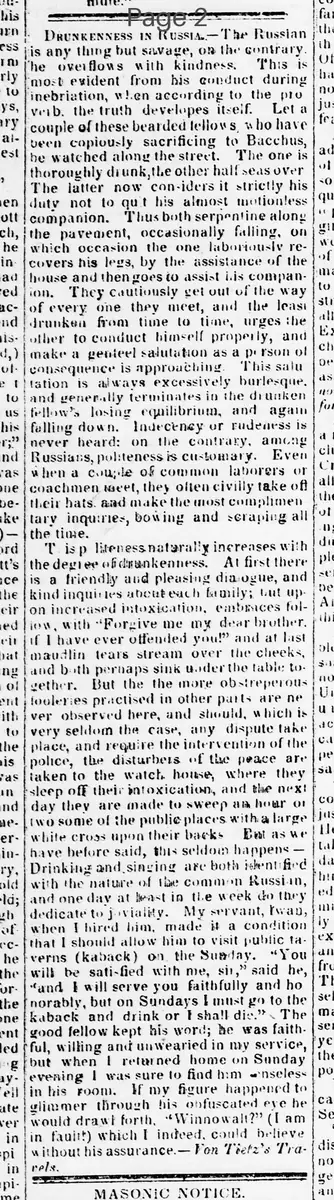
Drunkenness in Russia—The Russian is anything but savage, on the contrary. He is overflowingly with kindness. This is most evident from his conduct during inebriation, when according to the proverb, the truth develops itself. Let a couple of these bearded fellows, who have been copiously sacrificing to Bacchus, be watched along the street. The one is thoroughly drunk, the other half seas over. The latter now considers it strictly his duty not to quit his almost motionless companion. Thus both serpentine along the pavement, occasionally falling, on which occasion the one laboriously recovers his legs, by the assistance of the house and then goes to assist his companion. They cautiously get out of the way of everyone they meet, and the least drunken from time to time, urges the other to conduct himself properly, and make a genteel salutation as a person of consequence is approaching. This salutation is always excessively burlesque, and generally terminates in the drunken fellow's losing equilibrium, and again falling down. Indecency or rudeness is never heard: on the contrary, among Russians, politeness is customary. Even when a couple of common laborers or coachmen meet, they often civilly take off their hats, and make the most complimentary inquiries, bowing and scraping all the time. This politeness naturally increases with the degree of drunkenness. At first there is a friendly and pleasing dialogue, and kind inquiries about each family; but upon increased intoxication, embraces follow, with "Forgive me my dear brother, if I have ever offended you!" and at last maudlin tears stream over the cheeks, and both perhaps sink under the table together. But the more obstreperous fooleries practised in other parts are never observed here, and should, which is very seldom the case, any dispute take place, and require the intervention of the police, the disturbers of the peace are taken to the watch-house, where they sleep off their intoxication, and the next day they are made to sweep an hour or two some of the public places with a large white cross upon their backs. But as we have before said, this seldom happens—
Drinking and singing are both identified with the nature of the common Russian, and one day at least in the week do they dedicate to joviality. My servant, Ivan, when I hired him, made it a condition that I should allow him to visit public taverns (kaback) on the Sunday. "You will be satisfied with me, sir," said he, "and I will serve you faithfully and honorably, but on Sundays I must go to the kaback and drink or I shall die." The good fellow kept his word; he was faithful, willing and unwearied in my service, but when I returned home on Sunday evening I was sure to find him senseless in his room. If my figure happened to glimmer through his obfuscated eye he would draw forth, "Winnowalt?" (I am in fault!) which I indeed, could believe without his assurance.—Von Tietz's Travels.
Drinking and singing are both identified with the nature of the common Russian, and one day at least in the week do they dedicate to joviality. My servant, Ivan, when I hired him, made it a condition that I should allow him to visit public taverns (kaback) on the Sunday. "You will be satisfied with me, sir," said he, "and I will serve you faithfully and honorably, but on Sundays I must go to the kaback and drink or I shall die." The good fellow kept his word; he was faithful, willing and unwearied in my service, but when I returned home on Sunday evening I was sure to find him senseless in his room. If my figure happened to glimmer through his obfuscated eye he would draw forth, "Winnowalt?" (I am in fault!) which I indeed, could believe without his assurance.—Von Tietz's Travels.
What sub-type of article is it?
Curiosity
What themes does it cover?
Social Manners
Moral Virtue
What keywords are associated?
Russian Drunkenness
Politeness
Cultural Customs
Taverns
Servant Ivan
Bacchus Sacrifices
What entities or persons were involved?
Ivan
Von Tietz
Where did it happen?
Russia
Story Details
Key Persons
Ivan
Von Tietz
Location
Russia
Story Details
Description of Russians maintaining politeness and kindness even when drunk, with examples of street behavior, salutations, and embraces; anecdote of servant Ivan's faithful service and Sunday tavern visits leading to intoxication.