Thank you for visiting SNEWPapers!
Sign up free
Editorial
August 21, 1821
Richmond Enquirer
Richmond, Richmond County, Virginia
What is this article about?
An editorial criticizes the National Gazette for wanting to reopen the Missouri Question in Congress, defends the existing settlement and presidential proclamation, argues that courts should handle any constitutional issues, and accuses the Gazette's editor of exploiting the issue for political gain.
Clipping
OCR Quality
95%
Excellent
Full Text
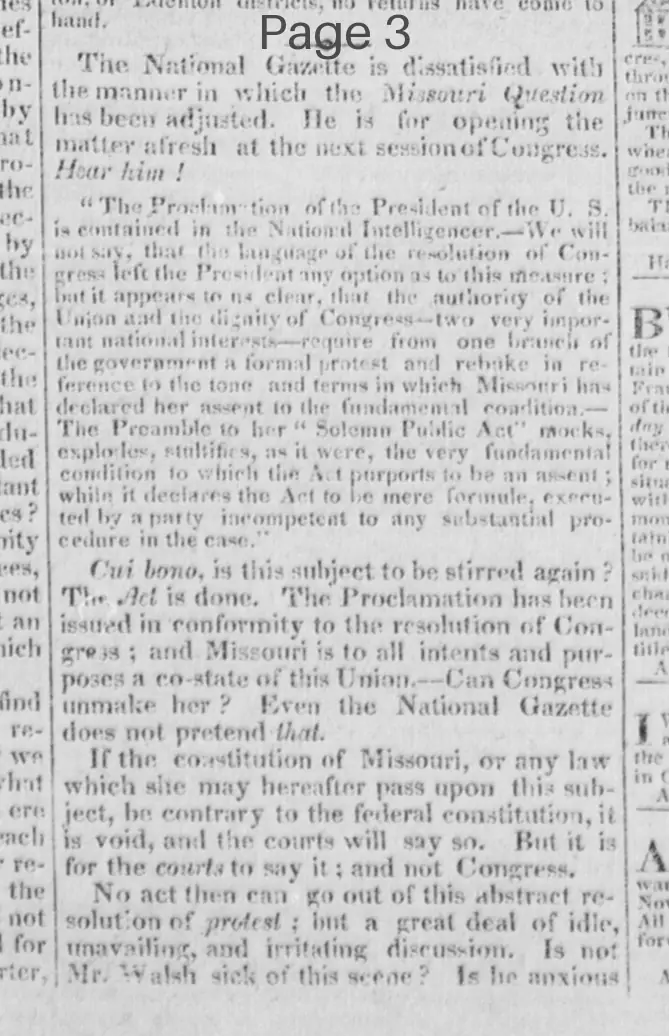
The National Gazette is dissatisfied with the manner in which the Missouri Question has been adjusted. He is for opening the matter afresh at the next session of Congress.
Hoar him!
"The Proclamation of the President of the U. S. is contained in the National Intelligencer.--We will not say, that the language of the resolution of Congress left the President any option as to this measure: but it appears to us clear, that the authority of the Union demands the dignity of Congress--two very important national interests--require from one branch of the government a formal protest and rebuke in reference to the tone and terms in which Missouri has declared her assent to the fundamental condition--The Preamble to her "Solemn Public Act" mocks, explodes, exultifies, as it were, the very fundamental condition to which the Act purports to be an assent: while it declares the Act to be mere Form, executed by a party incompetent to any substantial procedure in the case.'"
Cui bono, is this subject to be stirred again? The Act is done. The Proclamation has been issued in conformity to the resolution of Congress; and Missouri is to all intents and purposes a co-state of this Union.--Can Congress unmake her? Even the National Gazette does not pretend that. If the constitution of Missouri, or any law which she may hereafter pass upon this subject, be contrary to the federal constitution, it is void, and the courts will say so. But it is for the courts to say it; and not Congress. No act then can go out of this abstract resolution of protest: but a great deal of idle, unavailing, and irritating discussion. Is not Mr. Walsh sick of this scene? Is he anxious to see the time of Congress buttered away in these worse than useless disputes? --to see again the north divided against the south?—We are not willing to see such another scene; and therefore we protest against such attempts.—That he should be so solicitous to see these scenes re-acted, is not surprising when it is recollected, that it is this very question which gave rise to the Gazette--it was this, which caused the editor to throw out in his Prospectus the possibility of establishing a Northern confederacy--this question was the fixed capital on which he began to speculate.--He cannot therefore be very anxious to part with it at present.
Hoar him!
"The Proclamation of the President of the U. S. is contained in the National Intelligencer.--We will not say, that the language of the resolution of Congress left the President any option as to this measure: but it appears to us clear, that the authority of the Union demands the dignity of Congress--two very important national interests--require from one branch of the government a formal protest and rebuke in reference to the tone and terms in which Missouri has declared her assent to the fundamental condition--The Preamble to her "Solemn Public Act" mocks, explodes, exultifies, as it were, the very fundamental condition to which the Act purports to be an assent: while it declares the Act to be mere Form, executed by a party incompetent to any substantial procedure in the case.'"
Cui bono, is this subject to be stirred again? The Act is done. The Proclamation has been issued in conformity to the resolution of Congress; and Missouri is to all intents and purposes a co-state of this Union.--Can Congress unmake her? Even the National Gazette does not pretend that. If the constitution of Missouri, or any law which she may hereafter pass upon this subject, be contrary to the federal constitution, it is void, and the courts will say so. But it is for the courts to say it; and not Congress. No act then can go out of this abstract resolution of protest: but a great deal of idle, unavailing, and irritating discussion. Is not Mr. Walsh sick of this scene? Is he anxious to see the time of Congress buttered away in these worse than useless disputes? --to see again the north divided against the south?—We are not willing to see such another scene; and therefore we protest against such attempts.—That he should be so solicitous to see these scenes re-acted, is not surprising when it is recollected, that it is this very question which gave rise to the Gazette--it was this, which caused the editor to throw out in his Prospectus the possibility of establishing a Northern confederacy--this question was the fixed capital on which he began to speculate.--He cannot therefore be very anxious to part with it at present.
What sub-type of article is it?
Slavery Abolition
Constitutional
Partisan Politics
What keywords are associated?
Missouri Question
Slavery Compromise
Congressional Protest
National Gazette
Constitutional Authority
Northern Confederacy
What entities or persons were involved?
National Gazette
Mr. Walsh
President Of The U. S.
Congress
Missouri
Editorial Details
Primary Topic
Opposition To Reopening The Missouri Question
Stance / Tone
Defense Of Missouri Settlement And Criticism Of National Gazette
Key Figures
National Gazette
Mr. Walsh
President Of The U. S.
Congress
Missouri
Key Arguments
The Missouri Settlement Is Final And Missouri Is A State.
Congress Cannot Unmake Missouri.
Constitutional Violations By Missouri Should Be Handled By Courts, Not Congress.
Reopening The Issue Would Lead To Idle And Irritating Discussion.
Dividing North Against South Is Undesirable.
The National Gazette Exploits The Issue For Political Speculation.