Thank you for visiting SNEWPapers!
Sign up free
Editorial
October 3, 1896
The Cecil Whig
Elkton, Cecil County, Maryland
What is this article about?
Editorial from Philadelphia Ledger criticizes William Jennings Bryan's free silver policy, warning debtor farmers that his election on November 3, 1896, would cause currency depreciation, creditor distrust, higher interest rates, and financial losses for farmers, benefiting silver owners instead.
Clipping
OCR Quality
98%
Excellent
Full Text
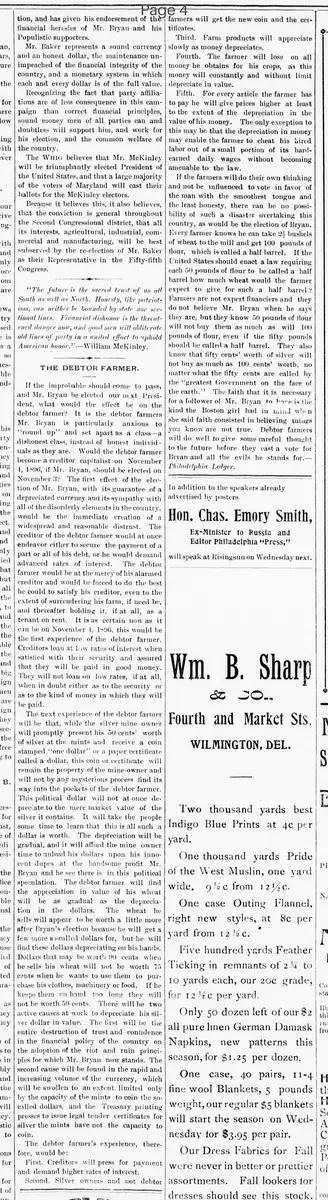
THE DEBTOR FARMER.
If the improbable should come to pass, and Mr. Bryan be elected our next President, what would the effect be on the debtor farmer? It is the debtor farmers Mr. Bryan is particularly anxious to 'round up' and set apart as a class-a dishonest class. instead of honest individuals as they are. Would the debtor farmer become a creditor capitalist on November 4, 1896. if Mr. Bryan, should be elected on November 3? The first effect of the election of Mr. Bryan, with its guarantee of a depreciated currency and its sympathy with all of the disorderly elements in the country. would be the immediate creation of a widespread and reasonable distrust. The creditor of the debtor farmer would at once endeavor either to secure the payment of a part or all of his debt, or he would demand advanced rates of interest. The debtor farmer would be at the mercy of his alarmed creditor and would be forced to do the best he could to satisfy his creditor, even to the extent of surrendering his farm, if need be. and thereafter holding it, if at all, as a tenant on rent. It is as certain now as it can be on November 4, 1896, this would be the first experience of the debtor farmer. Creditors loan at low rates of interest when satisfied with their security and assured that they will be paid in good money. They will not loan on low rates, if at all. when in doubt either as to the security or as to the kind of money in which they will be paid.
The next experience of the debtor farmer will be that. while the silver mine owner will promptly present his 50 cents' worth of silver at the mints and receive a coin stamped "one dollar" or a paper certificate called a dollar, this coin or certificate will remain the property of the mine-owner and will not by any mysterious process find its way into the pockets of the debtor farmer. This political dollar will not at once depreciate to the mere market value of the silver it contains. It will take the people some time to learn that this is all such a dollar is worth. The depreciation will be gradual, and it will afford the mine owner time to unload his dollars upon his innocent dupes at the handsome profit Mr. Bryan and he see there is in this political speculation. The debtor farmer will find the appreciation in value of his wheat will be as gradual as the depreciation in the dollars. The wheat he sells will appear to be worth a little more after Bryan's election because he will get a few more so-called dollars for, but he will find these dollars depreciating on his hands. Dollars that may be worth 90 cents when he sells his wheat will not be worth 75 cents when he wants to use them to purchase his clothes, machinery or food. If he keeps them on hand too long they will not be worth 50 cents. There will be two active causes at work to depreciate his silver dollar in value. The first will be the entire destruction of trust and confidence in the financial policy of the country on the adoption of the riot and ruin principles for which Mr. Bryan now stands. The second cause will be found in the rapid and increasing volume of the currency, which will be swollen to an extent limited only by the capacity of the mints to coin the so-called dollars, and the Treasury printing presses to issue legal tender certificates for silver the mints have not the capacity to coin.
The debtor farmer's experience, therefore, would be:
First. Creditors will press for payment and demand higher rates of interest.
Second. Silver owners and not debtor farmers will get the new coin and the certificates.
Third. Farm products will appreciate slowly as money depreciates.
Fourth. The farmer will lose on all money he obtains for his crops, as this money will constantly and without limit depreciate in value.
Fifth. For every article the farmer has to pay he will give prices higher at least to the extent of the depreciation in the value of his money. The only exception to this may be that the depreciation in money may enable the farmer to cheat his hired labor out of a small portion of its hard-earned daily wages without becoming amenable to the law.
If the farmers will do their own thinking and not be influenced to vote in favor of the man with the smoothest tongue and the least honesty, there can be no possibility of such a disaster overtaking this country, as would be the election of Bryan. Every farmer knows he can take 2 bushels of wheat to the mill and get 100 pounds of flour, which is called a half barrel. If the United States should enact a law requiring each 50 pounds of flour to be called a half barrel how much wheat would the farmer expect to give for such a half barrel? Farmers are not expert financiers and they do not believe Mr. Bryan when he says they are, but they know 50 pounds of flour will not buy them as much as will 100 pounds of flour, even if the fifty pounds should be called a half barrel. They also know that fifty cents' worth of silver will not buy as much as 100 cents' worth, no matter what the fifty cents are called by the "greatest Government on the face of the earth.' The faith that it is necessary for a follower of Mr. Bryan to have is the kind the Boston girl had in mind when she said faith consisted in believing things you know are not true. Debtor farmers will do well to give some careful thought to the future before they cast a vote for Bryan and all the evils he stands for.
—Philadelphia Ledger.
If the improbable should come to pass, and Mr. Bryan be elected our next President, what would the effect be on the debtor farmer? It is the debtor farmers Mr. Bryan is particularly anxious to 'round up' and set apart as a class-a dishonest class. instead of honest individuals as they are. Would the debtor farmer become a creditor capitalist on November 4, 1896. if Mr. Bryan, should be elected on November 3? The first effect of the election of Mr. Bryan, with its guarantee of a depreciated currency and its sympathy with all of the disorderly elements in the country. would be the immediate creation of a widespread and reasonable distrust. The creditor of the debtor farmer would at once endeavor either to secure the payment of a part or all of his debt, or he would demand advanced rates of interest. The debtor farmer would be at the mercy of his alarmed creditor and would be forced to do the best he could to satisfy his creditor, even to the extent of surrendering his farm, if need be. and thereafter holding it, if at all, as a tenant on rent. It is as certain now as it can be on November 4, 1896, this would be the first experience of the debtor farmer. Creditors loan at low rates of interest when satisfied with their security and assured that they will be paid in good money. They will not loan on low rates, if at all. when in doubt either as to the security or as to the kind of money in which they will be paid.
The next experience of the debtor farmer will be that. while the silver mine owner will promptly present his 50 cents' worth of silver at the mints and receive a coin stamped "one dollar" or a paper certificate called a dollar, this coin or certificate will remain the property of the mine-owner and will not by any mysterious process find its way into the pockets of the debtor farmer. This political dollar will not at once depreciate to the mere market value of the silver it contains. It will take the people some time to learn that this is all such a dollar is worth. The depreciation will be gradual, and it will afford the mine owner time to unload his dollars upon his innocent dupes at the handsome profit Mr. Bryan and he see there is in this political speculation. The debtor farmer will find the appreciation in value of his wheat will be as gradual as the depreciation in the dollars. The wheat he sells will appear to be worth a little more after Bryan's election because he will get a few more so-called dollars for, but he will find these dollars depreciating on his hands. Dollars that may be worth 90 cents when he sells his wheat will not be worth 75 cents when he wants to use them to purchase his clothes, machinery or food. If he keeps them on hand too long they will not be worth 50 cents. There will be two active causes at work to depreciate his silver dollar in value. The first will be the entire destruction of trust and confidence in the financial policy of the country on the adoption of the riot and ruin principles for which Mr. Bryan now stands. The second cause will be found in the rapid and increasing volume of the currency, which will be swollen to an extent limited only by the capacity of the mints to coin the so-called dollars, and the Treasury printing presses to issue legal tender certificates for silver the mints have not the capacity to coin.
The debtor farmer's experience, therefore, would be:
First. Creditors will press for payment and demand higher rates of interest.
Second. Silver owners and not debtor farmers will get the new coin and the certificates.
Third. Farm products will appreciate slowly as money depreciates.
Fourth. The farmer will lose on all money he obtains for his crops, as this money will constantly and without limit depreciate in value.
Fifth. For every article the farmer has to pay he will give prices higher at least to the extent of the depreciation in the value of his money. The only exception to this may be that the depreciation in money may enable the farmer to cheat his hired labor out of a small portion of its hard-earned daily wages without becoming amenable to the law.
If the farmers will do their own thinking and not be influenced to vote in favor of the man with the smoothest tongue and the least honesty, there can be no possibility of such a disaster overtaking this country, as would be the election of Bryan. Every farmer knows he can take 2 bushels of wheat to the mill and get 100 pounds of flour, which is called a half barrel. If the United States should enact a law requiring each 50 pounds of flour to be called a half barrel how much wheat would the farmer expect to give for such a half barrel? Farmers are not expert financiers and they do not believe Mr. Bryan when he says they are, but they know 50 pounds of flour will not buy them as much as will 100 pounds of flour, even if the fifty pounds should be called a half barrel. They also know that fifty cents' worth of silver will not buy as much as 100 cents' worth, no matter what the fifty cents are called by the "greatest Government on the face of the earth.' The faith that it is necessary for a follower of Mr. Bryan to have is the kind the Boston girl had in mind when she said faith consisted in believing things you know are not true. Debtor farmers will do well to give some careful thought to the future before they cast a vote for Bryan and all the evils he stands for.
—Philadelphia Ledger.
What sub-type of article is it?
Economic Policy
Partisan Politics
Agriculture
What keywords are associated?
Debtor Farmers
Free Silver
Currency Depreciation
1896 Election
William Jennings Bryan
Gold Standard
Agricultural Debt
What entities or persons were involved?
Mr. Bryan
Debtor Farmer
Creditor
Silver Mine Owner
Philadelphia Ledger
Editorial Details
Primary Topic
Impact Of Electing Bryan On Debtor Farmers
Stance / Tone
Strongly Anti Bryan And Anti Free Silver
Key Figures
Mr. Bryan
Debtor Farmer
Creditor
Silver Mine Owner
Philadelphia Ledger
Key Arguments
Election Of Bryan Would Create Distrust, Leading Creditors To Demand Payment Or Higher Interest From Debtor Farmers.
Silver Mine Owners Would Profit From New Currency, Not Farmers.
Farm Products Would Appreciate Slowly While Money Depreciates Rapidly.
Farmers Would Lose Value On Money From Crops Due To Depreciation.
Prices For Goods Would Rise With Depreciation, Except Possibly Cheating Labor.