Thank you for visiting SNEWPapers!
Sign up free
Editorial
September 11, 1847
Indiana State Sentinel
Indianapolis, Marion County, Indiana
What is this article about?
An editorial praises General Zachary Taylor's military achievements in the Mexican War but argues against his suitability for the presidency, citing a 1817 toast revealing sectional bias against Northern officers, urging to leave him in his glory to preserve national unity.
Clipping
OCR Quality
98%
Excellent
Full Text
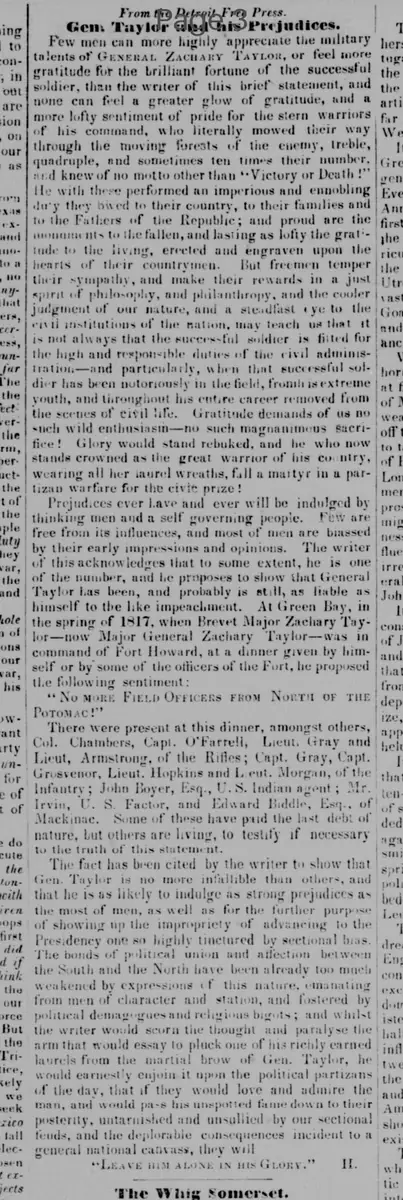
Few men can more highly appreciate the military talents of General Zachary Taylor, or feel more gratitude for the brilliant fortune of the successful soldier, than the writer of this brief statement, and none can feel a greater glow of gratitude, and a more lofty sentiment of pride for the stern warriors of his command, who literally mowed their way through the moving forests of the enemy, treble, quadruple, and sometimes ten times their number, and knew of no motto other than "Victory or Death!"
He with these performed an imperious and ennobling duty they owed to their country, to their families and to the Fathers of the Republic; and proud are the monuments to the fallen, and lasting as lofty the gratitude to the living, erected and engraven upon the hearts of their countrymen. But freemen temper their sympathy, and make their rewards in a just spirit of philosophy, and philanthropy, and the cooler judgment of our nature, and a steadfast eye to the chief institutions of the nation, may teach us that it is not always that the successful soldier is fitted for the high and responsible duties of the civil administration--and particularly, when that successful soldier has been notoriously in the field, from his extreme youth, and throughout his entire career removed from the scenes of civil life. Gratitude demands of us no such wild enthusiasm--no such magnanimous sacrifice! Glory would stand rebuked, and he who now stands crowned as the great warrior of his country, wearing all her laurel wreaths, fall a martyr in a partisan warfare for the civil prize!
Prejudices ever have and ever will be indulged by thinking men and a self governing people. Few are free from its influences, and most of men are biassed by their early impressions and opinions. The writer of this acknowledges that to some extent, he is one of the number, and he proposes to show that General Taylor has been, and probably is still, as liable as himself to the like impeachment. At Green Bay, in the spring of 1817, when Brevet Major Zachary Taylor--now Major General, Zachary Taylor--was in command of Fort Howard, at a dinner given by himself or by some of the officers of the Fort, he proposed the following sentiment:
"No More Field Officers from North of the Potomac!"
There were present at this dinner, amongst others, Col. Chambers, Capt. O'Farrell, Lieut. Gray and Lieut. Armstrong, of the Rifles: Capt. Gray, Capt. Grosvenor, Lieut. Hopkins and Lieut. Morgan, of the Infantry; John Boyer, Esq., U. S. Indian agent; Mr. Irvin, U. S. Factor, and Edward Biddle, Esq., of Mackinac. Some of these have paid the last debt of nature, but others are living, to testify if necessary to the truth of this statement.
The fact has been cited by the writer to show that Gen. Taylor is no more infallible than others, and that he is as likely to indulge as strong prejudices as the most of men, as well as for the further purpose of showing up the impropriety of advancing to the Presidency one so highly tinctured by sectional bias.
The bonds of political union and affection between the South and the North have been already too much weakened by expressions of this nature, emanating from men of character and station, and fostered by political demagogues and religious bigots; and whilst the writer would scorn the thought and paralyse the arm that would essay to pluck one of his richly earned laurels from the martial brow of Gen. Taylor, he would earnestly enjoin it upon the political partizans of the day, that if they would love and admire the man, and would pass his unspotted fame down to their posterity, untarnished and unsullied by our sectional feuds, and the deplorable consequences incident to a general national canvass, they will
"LEAVE HIM ALONE IN HIS GLORY."
He with these performed an imperious and ennobling duty they owed to their country, to their families and to the Fathers of the Republic; and proud are the monuments to the fallen, and lasting as lofty the gratitude to the living, erected and engraven upon the hearts of their countrymen. But freemen temper their sympathy, and make their rewards in a just spirit of philosophy, and philanthropy, and the cooler judgment of our nature, and a steadfast eye to the chief institutions of the nation, may teach us that it is not always that the successful soldier is fitted for the high and responsible duties of the civil administration--and particularly, when that successful soldier has been notoriously in the field, from his extreme youth, and throughout his entire career removed from the scenes of civil life. Gratitude demands of us no such wild enthusiasm--no such magnanimous sacrifice! Glory would stand rebuked, and he who now stands crowned as the great warrior of his country, wearing all her laurel wreaths, fall a martyr in a partisan warfare for the civil prize!
Prejudices ever have and ever will be indulged by thinking men and a self governing people. Few are free from its influences, and most of men are biassed by their early impressions and opinions. The writer of this acknowledges that to some extent, he is one of the number, and he proposes to show that General Taylor has been, and probably is still, as liable as himself to the like impeachment. At Green Bay, in the spring of 1817, when Brevet Major Zachary Taylor--now Major General, Zachary Taylor--was in command of Fort Howard, at a dinner given by himself or by some of the officers of the Fort, he proposed the following sentiment:
"No More Field Officers from North of the Potomac!"
There were present at this dinner, amongst others, Col. Chambers, Capt. O'Farrell, Lieut. Gray and Lieut. Armstrong, of the Rifles: Capt. Gray, Capt. Grosvenor, Lieut. Hopkins and Lieut. Morgan, of the Infantry; John Boyer, Esq., U. S. Indian agent; Mr. Irvin, U. S. Factor, and Edward Biddle, Esq., of Mackinac. Some of these have paid the last debt of nature, but others are living, to testify if necessary to the truth of this statement.
The fact has been cited by the writer to show that Gen. Taylor is no more infallible than others, and that he is as likely to indulge as strong prejudices as the most of men, as well as for the further purpose of showing up the impropriety of advancing to the Presidency one so highly tinctured by sectional bias.
The bonds of political union and affection between the South and the North have been already too much weakened by expressions of this nature, emanating from men of character and station, and fostered by political demagogues and religious bigots; and whilst the writer would scorn the thought and paralyse the arm that would essay to pluck one of his richly earned laurels from the martial brow of Gen. Taylor, he would earnestly enjoin it upon the political partizans of the day, that if they would love and admire the man, and would pass his unspotted fame down to their posterity, untarnished and unsullied by our sectional feuds, and the deplorable consequences incident to a general national canvass, they will
"LEAVE HIM ALONE IN HIS GLORY."
What sub-type of article is it?
Partisan Politics
Military Affairs
What keywords are associated?
Zachary Taylor
Presidency
Sectional Bias
Military Glory
Political Union
Fort Howard
Green Bay
What entities or persons were involved?
General Zachary Taylor
Col. Chambers
Capt. O'farrell
Lieut. Gray
Lieut. Armstrong
Capt. Gray
Capt. Grosvenor
Lieut. Hopkins
Lieut. Morgan
John Boyer
Mr. Irvin
Edward Biddle
Editorial Details
Primary Topic
Opposition To Zachary Taylor's Presidential Candidacy Due To Sectional Bias
Stance / Tone
Admiring Of Military Glory But Cautionary Against Political Elevation
Key Figures
General Zachary Taylor
Col. Chambers
Capt. O'farrell
Lieut. Gray
Lieut. Armstrong
Capt. Gray
Capt. Grosvenor
Lieut. Hopkins
Lieut. Morgan
John Boyer
Mr. Irvin
Edward Biddle
Key Arguments
Military Success Does Not Necessarily Qualify One For Civil Administration, Especially For Lifelong Soldiers.
General Taylor Proposed A Sectional Toast In 1817: 'No More Field Officers From North Of The Potomac!'
Such Prejudices Weaken North South Political Union.
Political Partisans Should Leave Taylor In His Military Glory To Avoid Tarnishing His Fame In Partisan Warfare.