Thank you for visiting SNEWPapers!
Sign up free
Jackson Advocate
Jackson, Hinds County, Mississippi
What is this article about?
Senate braces for debate on Sparkman housing bill, backed by AFL-CIO for authorizing $2.9B in public housing, slum clearance, and elderly programs through 1962, exceeding Administration's proposal; calls for fair housing access.
Clipping
OCR Quality
Full Text
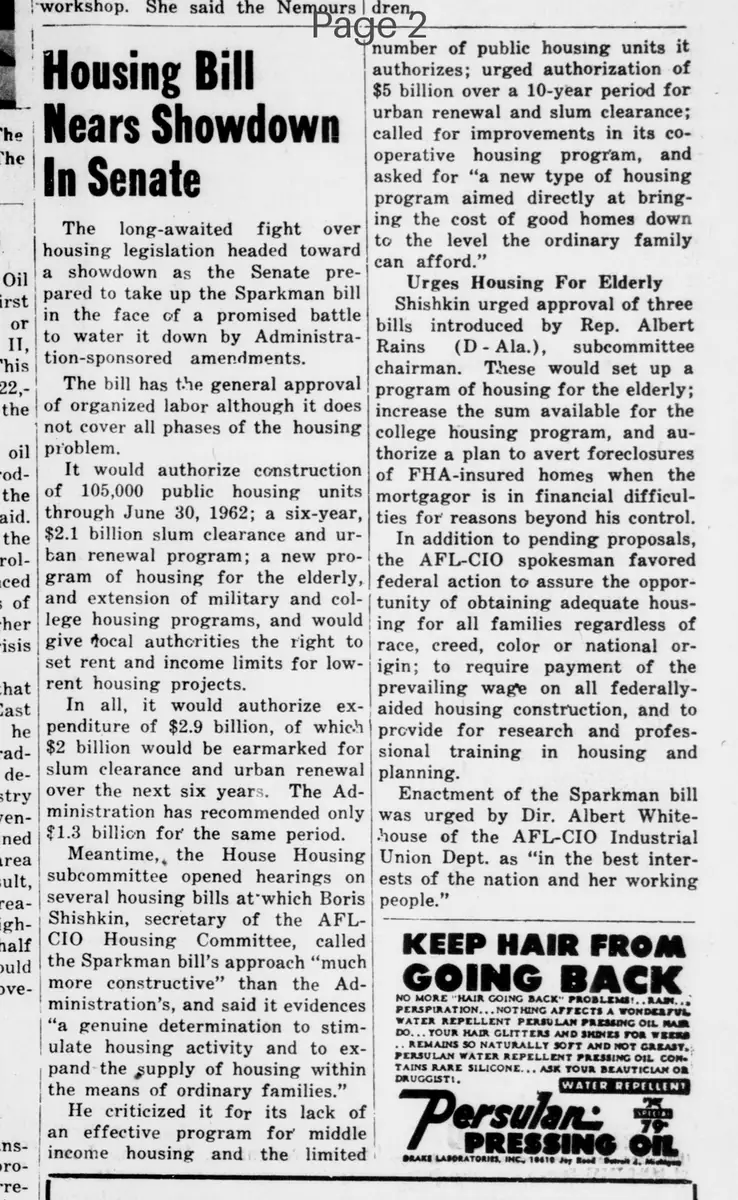
The long-awaited fight over housing legislation headed toward a showdown as the Senate prepared to take up the Sparkman bill in the face of a promised battle to water it down by Administration-sponsored amendments.
The bill has the general approval of organized labor although it does not cover all phases of the housing problem.
It would authorize construction of 105,000 public housing units through June 30, 1962; a six-year, $2.1 billion slum clearance and urban renewal program; a new program of housing for the elderly, and extension of military and college housing programs, and would give local authorities the right to set rent and income limits for low-rent housing projects.
In all, it would authorize expenditure of $2.9 billion, of which $2 billion would be earmarked for slum clearance and urban renewal over the next six years. The Administration has recommended only $1.3 billion for the same period.
Meantime, the House Housing subcommittee opened hearings on several housing bills at which Boris Shishkin, secretary of the AFL-CIO Housing Committee, called the Sparkman bill's approach "much more constructive" than the Administration's, and said it evidences "a genuine determination to stimulate housing activity and to expand the supply of housing within the means of ordinary families."
number of public housing units it authorizes; urged authorization of $5 billion over a 10-year period for urban renewal and slum clearance; called for improvements in its co-operative housing program, and asked for "a new type of housing program aimed directly at bringing the cost of good homes down to the level the ordinary family can afford."
Urges Housing For Elderly
Shishkin urged approval of three bills introduced by Rep. Albert Rains (D - Ala.), subcommittee chairman.
These would set up a program of housing for the elderly; increase the sum available for the college housing program, and authorize a plan to avert foreclosures of FHA-insured homes when the mortgagor is in financial difficulties for reasons beyond his control.
In addition to pending proposals, the AFL-CIO spokesman favored federal action to assure the opportunity of obtaining adequate housing for all families regardless of race, creed, color or national origin; to require payment of the prevailing wage on all federally-aided housing construction, and to provide for research and professional training in housing and planning.
Enactment of the Sparkman bill was urged by Dir. Albert Whitehouse of the AFL-CIO Industrial Union Dept. as "in the best interests of the nation and her working people."
He criticized it for its lack of an effective program for middle income housing and the limited
What sub-type of article is it?
What themes does it cover?
What keywords are associated?
What entities or persons were involved?
Where did it happen?
Story Details
Key Persons
Location
Senate
Event Date
Through June 30, 1962
Story Details
The Senate nears a showdown on the Sparkman housing bill, which authorizes 105,000 public housing units, $2.1 billion for slum clearance and urban renewal over six years, housing for the elderly, and extensions of other programs, totaling $2.9 billion. Labor supports it over the Administration's $1.3 billion proposal. AFL-CIO's Shishkin praises it and urges more funding and anti-discrimination measures. Whitehouse also endorses it but criticizes lack of middle-income housing.