Thank you for visiting SNEWPapers!
Sign up free
Domestic News
January 24, 1957
The Glacier Reporter
Browning, Glacier County, Montana
What is this article about?
Article advises livestock owners on preventing diseases through sanitation, isolation of new animals, proper feeding, and vaccination, emphasizing that prevention is better than treatment despite advances in veterinary medicine.
Clipping
OCR Quality
95%
Excellent
Full Text
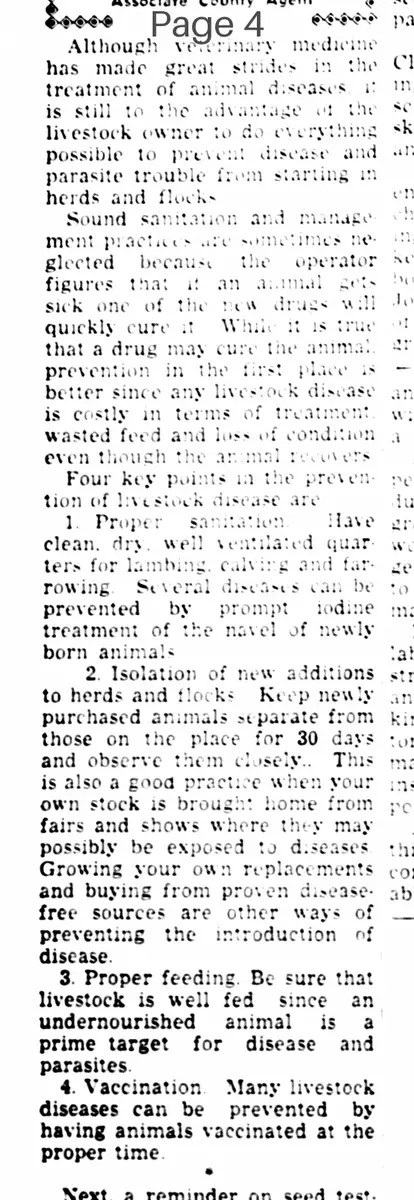
Although veterinary medicine has made great strides in the treatment of animal diseases it is still to the advantage of the livestock owner to do everything possible to prevent disease and parasite trouble from starting in herds and flocks.
Sound sanitation and management practices are sometimes neglected because the operator figures that if an animal gets sick one of the new drugs will quickly cure it. While it is true that a drug may cure the animal prevention in the first place is better since any livestock disease is costly in terms of treatment wasted feed and loss of condition even though the animal recovers.
Four key points in the prevention of livestock disease are
1. Proper sanitation. Have clean, dry, well ventilated quarters for lambing, calving and farrowing. Several diseases can be prevented by prompt iodine treatment of the navel of newly born animals.
2. Isolation of new additions to herds and flocks. Keep newly purchased animals separate from those on the place for 30 days and observe them closely. This is also a good practice when your own stock is brought home from fairs and shows where they may possibly be exposed to diseases. Growing your own replacements and buying from proven disease-free sources are other ways of preventing the introduction of disease.
3. Proper feeding. Be sure that livestock is well fed since an undernourished animal is a prime target for disease and parasites.
4. Vaccination. Many livestock diseases can be prevented by having animals vaccinated at the proper time.
Sound sanitation and management practices are sometimes neglected because the operator figures that if an animal gets sick one of the new drugs will quickly cure it. While it is true that a drug may cure the animal prevention in the first place is better since any livestock disease is costly in terms of treatment wasted feed and loss of condition even though the animal recovers.
Four key points in the prevention of livestock disease are
1. Proper sanitation. Have clean, dry, well ventilated quarters for lambing, calving and farrowing. Several diseases can be prevented by prompt iodine treatment of the navel of newly born animals.
2. Isolation of new additions to herds and flocks. Keep newly purchased animals separate from those on the place for 30 days and observe them closely. This is also a good practice when your own stock is brought home from fairs and shows where they may possibly be exposed to diseases. Growing your own replacements and buying from proven disease-free sources are other ways of preventing the introduction of disease.
3. Proper feeding. Be sure that livestock is well fed since an undernourished animal is a prime target for disease and parasites.
4. Vaccination. Many livestock diseases can be prevented by having animals vaccinated at the proper time.
What sub-type of article is it?
Agriculture
What keywords are associated?
Livestock Disease Prevention
Sanitation Practices
Animal Isolation
Proper Feeding
Vaccination
Domestic News Details
Event Details
Advises on preventing livestock diseases via proper sanitation including clean quarters and iodine treatment for newborns, isolating new animals for 30 days, ensuring proper feeding to avoid undernourishment, and timely vaccination.