Thank you for visiting SNEWPapers!
Sign up free
Editorial
January 8, 1814
Norfolk Gazette And Publick Ledger
Norfolk, Virginia
What is this article about?
Editorial celebrates Napoleon's impending downfall, anticipates restoration of European independence and Bourbon rule in France, and predicts these events will hasten peace between the US and Britain, ending the war over impressment and commerce.
Clipping
OCR Quality
98%
Excellent
Full Text
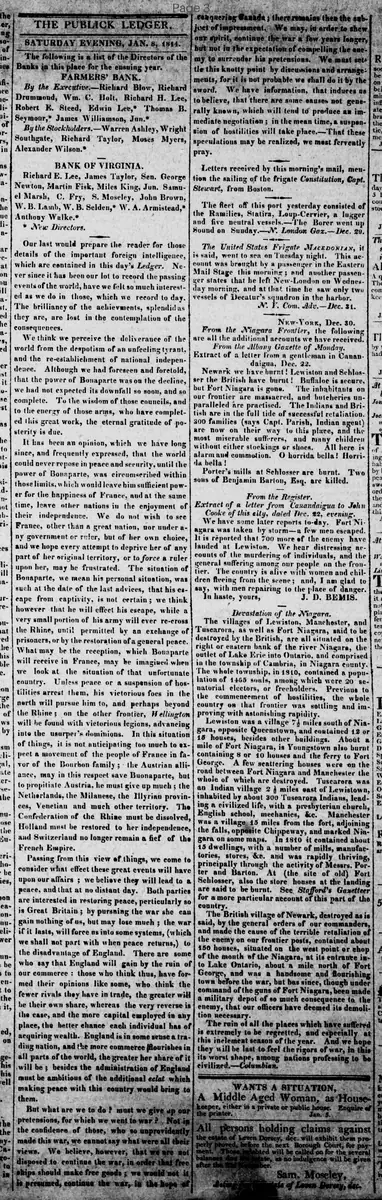
Our last would prepare the reader for those details of the important foreign intelligence, which are contained in this day's Ledger. Never since it has been our lot to record the passing events of the world, have we felt so much interested as we do in those, which we record to day. The brilliancy of the achievements, splendid as they are, are lost in the contemplation of the consequences.
We think we perceive the deliverance of the world from the despotism of an unfeeling tyrant, and the re-establishment of national independence. Although we had foreseen and foretold, that the power of Bonaparte was on the decline, we had not expected its downfall so soon, and so complete. To the wisdom of those councils, and to the energy of those arms, who have completed this great work, the eternal gratitude of posterity is due.
It has been an opinion, which we have long since, and frequently expressed, that the world could never repose in peace and security, until the power of Bonaparte, was circumscribed within those limits, which would leave him sufficient power for the happiness of France, and at the same time, leave other nations in the enjoyment of their independence. We do not wish to see France, other than a great nation, nor under any government or ruler, but of her own choice, and we hope every attempt to deprive her of any part of her original territory, or to force a ruler upon her, may be frustrated. The situation of Bonaparte, we mean his personal situation, was such at the date of the last advices, that his escape from captivity, is not certain; we think however that he will effect his escape, while a very small portion of his army will ever re-cross the Rhine, until permitted by an exchange of prisoners, or by the restoration of a general peace.
What may be the reception, which Bonaparte will receive in France, may be imagined when we look at the situation of that unfortunate country. Unless peace or a suspension of hostilities arrest them, his victorious foes in the north will pursue him to, and perhaps beyond the Rhine; on the other frontier, Wellington will be found with victorious legions, advancing into the usurper's dominions. In this situation of things, it is not anticipating too much to expect a movement of the people of France in favor of the Bourbon family; the Austrian alliance, may in this respect save Buonaparte, but to propitiate Austria, he must give up much; the Netherlands, the Milanese, the Illyrian provinces, Venetian and much other territory. The Confederation of the Rhine must be dissolved, Holland must be restored to her independence, and Switzerland no longer remain a fief of the French Empire.
Passing from this view of things, we come to consider what effect these great events will have upon our affairs; we believe they will lead to a peace, and that at no distant day. Both parties are interested in restoring peace, particularly so is Great Britain; by pursuing the war she can gain nothing of us, but may lose much; the war if it lasts, will force us into some systems, (which we shall not part with when peace returns,) to the disadvantage of England. There are some who say that England will gain by the ruin of our commerce: those who think thus, have formed their opinions like some, who think the fewer rivals they have in trade, the greater will be their own share, whereas the very reverse is the case, and the more capital employed in any place, the better chance each individual has of acquiring wealth. England is in some sense a trading nation, and the more commerce flourishes in all parts of the world, the greater her share of it will be; besides the administration of England must be ambitious of the additional eclat which making peace with this country would bring to them.
But what are we to do? must we give up our pretensions, for which we went to war? Not in the confidence of those, who so unprovidently made this war, we cannot say what were all their views. We believe, however, that we are not disposed to continue the war, in order that free ships should make free goods; we would not continue the war, in the hope of conquering Canada; there remains then the subject of impressment. We may in order to shew our spirit, continue the war a few years longer but not in the expectation of compelling the enemy to surrender his pretensions. We must settle this knotty point by discussions and arrangements, for it is not probable we shall do it by the sword. We have information, that induces us to believe, that there are some causes not generally known, which will tend to produce an immediate negotiation; in the mean time, a suspension of hostilities will take place. That these speculations may be realized, we most fervently pray.
We think we perceive the deliverance of the world from the despotism of an unfeeling tyrant, and the re-establishment of national independence. Although we had foreseen and foretold, that the power of Bonaparte was on the decline, we had not expected its downfall so soon, and so complete. To the wisdom of those councils, and to the energy of those arms, who have completed this great work, the eternal gratitude of posterity is due.
It has been an opinion, which we have long since, and frequently expressed, that the world could never repose in peace and security, until the power of Bonaparte, was circumscribed within those limits, which would leave him sufficient power for the happiness of France, and at the same time, leave other nations in the enjoyment of their independence. We do not wish to see France, other than a great nation, nor under any government or ruler, but of her own choice, and we hope every attempt to deprive her of any part of her original territory, or to force a ruler upon her, may be frustrated. The situation of Bonaparte, we mean his personal situation, was such at the date of the last advices, that his escape from captivity, is not certain; we think however that he will effect his escape, while a very small portion of his army will ever re-cross the Rhine, until permitted by an exchange of prisoners, or by the restoration of a general peace.
What may be the reception, which Bonaparte will receive in France, may be imagined when we look at the situation of that unfortunate country. Unless peace or a suspension of hostilities arrest them, his victorious foes in the north will pursue him to, and perhaps beyond the Rhine; on the other frontier, Wellington will be found with victorious legions, advancing into the usurper's dominions. In this situation of things, it is not anticipating too much to expect a movement of the people of France in favor of the Bourbon family; the Austrian alliance, may in this respect save Buonaparte, but to propitiate Austria, he must give up much; the Netherlands, the Milanese, the Illyrian provinces, Venetian and much other territory. The Confederation of the Rhine must be dissolved, Holland must be restored to her independence, and Switzerland no longer remain a fief of the French Empire.
Passing from this view of things, we come to consider what effect these great events will have upon our affairs; we believe they will lead to a peace, and that at no distant day. Both parties are interested in restoring peace, particularly so is Great Britain; by pursuing the war she can gain nothing of us, but may lose much; the war if it lasts, will force us into some systems, (which we shall not part with when peace returns,) to the disadvantage of England. There are some who say that England will gain by the ruin of our commerce: those who think thus, have formed their opinions like some, who think the fewer rivals they have in trade, the greater will be their own share, whereas the very reverse is the case, and the more capital employed in any place, the better chance each individual has of acquiring wealth. England is in some sense a trading nation, and the more commerce flourishes in all parts of the world, the greater her share of it will be; besides the administration of England must be ambitious of the additional eclat which making peace with this country would bring to them.
But what are we to do? must we give up our pretensions, for which we went to war? Not in the confidence of those, who so unprovidently made this war, we cannot say what were all their views. We believe, however, that we are not disposed to continue the war, in order that free ships should make free goods; we would not continue the war, in the hope of conquering Canada; there remains then the subject of impressment. We may in order to shew our spirit, continue the war a few years longer but not in the expectation of compelling the enemy to surrender his pretensions. We must settle this knotty point by discussions and arrangements, for it is not probable we shall do it by the sword. We have information, that induces us to believe, that there are some causes not generally known, which will tend to produce an immediate negotiation; in the mean time, a suspension of hostilities will take place. That these speculations may be realized, we most fervently pray.
What sub-type of article is it?
Foreign Affairs
War Or Peace
Trade Or Commerce
What keywords are associated?
Napoleon Downfall
European Peace
Anglo American War
Bonaparte Captivity
Bourbon Restoration
Commercial Peace
What entities or persons were involved?
Bonaparte
Wellington
Bourbon Family
Austria
Great Britain
France
Editorial Details
Primary Topic
Downfall Of Napoleon Bonaparte And Implications For Peace
Stance / Tone
Optimistic About Deliverance From Tyranny And Prospects For Peace
Key Figures
Bonaparte
Wellington
Bourbon Family
Austria
Great Britain
France
Key Arguments
Achievements Against Bonaparte Lead To World Deliverance From Despotism
Bonaparte's Power Must Be Limited To Allow French Happiness And Other Nations' Independence
Expect French Movement Favoring Bourbons; Concessions Needed To Austria
Events Will Lead To Peace Between Us And Britain Soon
War Continuation Disadvantages Britain; Peace Restores Commerce
Us Should Not Continue War For Impressment Or Canada; Settle By Negotiation