Thank you for visiting SNEWPapers!
Sign up free
Literary
October 2, 1911
University Missourian
Columbia, Boone County, Missouri
What is this article about?
Dr. R. H. Jesse recounts his 1905 visit to President William Rainey Harper at the University of Chicago, including a memorable supper where Harper presciently asked scholars to remember him annually. Jesse reflects on Harper's scholarly pursuits, broad sympathies, educational ideals, and foundational role in building the university despite challenges.
Clipping
OCR Quality
95%
Excellent
Full Text
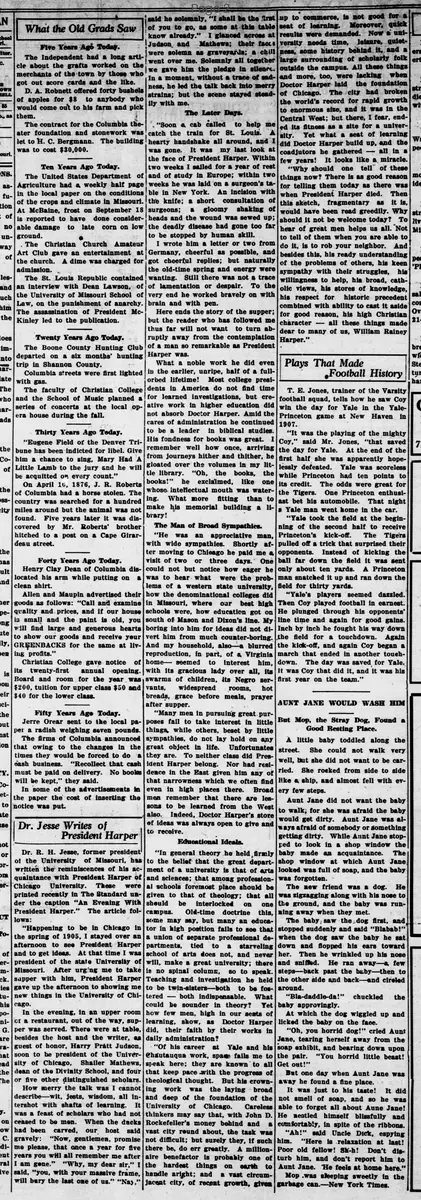
Dr. Jesse Writes of
President Harper
Dr. R. H. Jesse, former president of the University of Missouri, has written the reminiscences of his acquaintance with President Harper of Chicago University. These were printed recently in The Standard under the caption "An Evening With President Harper."
The article follows:
"Happening to be in Chicago in the spring of 1905, I stayed over an afternoon to see President Harper and to get ideas. At that time I was president of the state University of Missouri. After urging me to take Supper with him, President Harper gave up the afternoon to showing me new things in the University of Chicago.
In the evening, in an upper room of a restaurant, out of the way, supper was served. There were at table, besides the host and the writer, as guest of honor, Harry Pratt Judson, soon to be president of the University of Chicago, Shailer Mathews dean of the Divinity School, and four or five other distinguished scholars.
How merry the talk was I cannot describe—wit, jests, wisdom, all intershot with shafts of learning. It was a feast of scholars who had not ceased to be men. When the ducks had been carved, our host said gravely: "Now, gentlemen, promise me please, that once a year for five years you will all remember me after I am gone." "Why, my dear sir," I said, "you, with your massive frame, will bury the last one of us." "Nay," said he solemnly, "I shall be the first of you to go, as some at this table know already." I glanced across at Judson and Mathews; their faces were solemn as graveyards; a chill went over me. Solemnly all together we gave him the pledge in silence.
In a moment, without a trace of sadness, he led the talk back into merry strains; but the scene stayed steadily with me.
The Later Days.
Soon a cab called to help me catch the train for St. Louis. A hearty handshake all around, and I was gone. It was my last look at the face of President Harper. Within two weeks I sailed for a year of rest and of study in Europe; within two weeks he was laid on a surgeon's table in New York. An incision with the knife; a short consultation of surgeons; a gloomy shaking of heads and the wound was sewed up; the deadly disease had gone too far to be stopped by human skill.
I wrote him a letter or two from Germany, cheerful as possible, and got cheerful replies; but naturally the old-time spring and energy were wanting. Still there was not a trace of lamentation or despair. To the very end he worked bravely on with brain and with pen.
Here ends the story of the supper; but the reader who has followed me thus far will not want to turn abruptly away from the contemplation of a man so remarkable as President Harper was.
What a noble work he did even in the earlier, unripe, half of a full-orbed lifetime! Most college presidents in America do not find time for learned investigations, but creative work in higher education did not absorb Doctor Harper. Amid the cares of administration he continued to be a leader in biblical studies.
His fondness for books was great. I remember well how once, arriving from journeys hither and thither, he gloated over the volumes in my little library.
"Oh.
the books, the
books!"
he
exclaimed,
like one whose intellectual mouth was watering.
What more fitting than to make his memorial building a library!
The Man of Broad Sympathies.
"He was an appreciative man, with wide sympathies. Shortly after moving to Chicago he paid me a visit of two or three days. One could not but notice how eager he was to hear what were the problems of a western state university, how the denominational colleges did in Missouri, where our best high schools were, how education got on south of Mason and Dixon's line. My boring into him for ideas did not divert him from much counter-boring.
And my household, also—a blurred reproduction, in part, of a Virginia home—seemed to interest him, with its gracious lady over all, its swarms of children, its Negro servants, widespread rooms, hot breads, grace before meals, prayer after supper.
"Many men in pursuing great purposes fail to take interest in little things while others, beset by little sympathies, do not lay hold on any great object in life. Unfortunates they are. To neither class did President Harper belong. Nor had residence in the East given him any of that narrowness which we often find even in high places there. Broad men remember that there are lessons to be learned from the West also. Indeed, Doctor Harper's store of ideas was always open to give and to receive.
Educational Ideals
"In general theory he held firmly to the belief that the great department of a university is that of arts and sciences; that among professional schools foremost place should be given to that of theology; that all should be interlocked on one campus. Old-time doctrine this, some may say, but many an educator in high position fails to see that a union of separate professional departments, tied to a starveling school of arts does not, and never will, make a great university; there is no spinal column, so to speak.
Teaching and investigation he held to be twin-sisters—both to be fostered—both indispensable. What could be sounder in theory? Yet how few men, high in our seats of learning, show, as Doctor Harper did, their faith by their works in daily administration?
"Of his career at Yale and his Chautauqua work, space fails me to speak here; they are known to all that keep pace with the progress of theological thought. But his crowning work was the laying broad and deep of the foundation of the University of Chicago. Careless thinkers may say that, with John D. Rockefeller's money behind and a vast city round about, the task was not difficult; but surely they, if such there be, do err greatly. A millionaire benefactor is probably one of the hardest things on earth to handle aright; and a vast circumjacent city, of recent growth, given up to commerce, is not good for a seat of learning. Moreover, quick results were demanded. Now a university needs time, leisure, quietness, some history behind it, and a large surrounding of scholarly folk outside the campus. All these things and more, too, were lacking when Doctor Harper laid the foundation of Chicago. The city had broken the world's record for rapid growth to enormous size, and it was in the Central West; but there, I fear, ended its fitness as a site for a university. Yet what a seat of learning did Doctor Harper build up, and the coadjutors he gathered—all in a few years! It looks like a miracle.
"Why should one tell of these things now? There is as good reason for telling them today as there was when President Harper died. Then this sketch, fragmentary as it is, would have been read greedily. Why should it not be welcome today? To hear of great men helps us all. Not to tell of them when you are able to do it, is to rob your neighbor. And besides this, his ready understanding of the problems of others, his keen sympathy with their struggles, his willingness to help, his broad, catholic views, his stores of knowledge, his respect for historic precedent combined with ability to cast it aside for good reason, his high Christian character—all these things made dear to many of us, William Rainey Harper."
President Harper
Dr. R. H. Jesse, former president of the University of Missouri, has written the reminiscences of his acquaintance with President Harper of Chicago University. These were printed recently in The Standard under the caption "An Evening With President Harper."
The article follows:
"Happening to be in Chicago in the spring of 1905, I stayed over an afternoon to see President Harper and to get ideas. At that time I was president of the state University of Missouri. After urging me to take Supper with him, President Harper gave up the afternoon to showing me new things in the University of Chicago.
In the evening, in an upper room of a restaurant, out of the way, supper was served. There were at table, besides the host and the writer, as guest of honor, Harry Pratt Judson, soon to be president of the University of Chicago, Shailer Mathews dean of the Divinity School, and four or five other distinguished scholars.
How merry the talk was I cannot describe—wit, jests, wisdom, all intershot with shafts of learning. It was a feast of scholars who had not ceased to be men. When the ducks had been carved, our host said gravely: "Now, gentlemen, promise me please, that once a year for five years you will all remember me after I am gone." "Why, my dear sir," I said, "you, with your massive frame, will bury the last one of us." "Nay," said he solemnly, "I shall be the first of you to go, as some at this table know already." I glanced across at Judson and Mathews; their faces were solemn as graveyards; a chill went over me. Solemnly all together we gave him the pledge in silence.
In a moment, without a trace of sadness, he led the talk back into merry strains; but the scene stayed steadily with me.
The Later Days.
Soon a cab called to help me catch the train for St. Louis. A hearty handshake all around, and I was gone. It was my last look at the face of President Harper. Within two weeks I sailed for a year of rest and of study in Europe; within two weeks he was laid on a surgeon's table in New York. An incision with the knife; a short consultation of surgeons; a gloomy shaking of heads and the wound was sewed up; the deadly disease had gone too far to be stopped by human skill.
I wrote him a letter or two from Germany, cheerful as possible, and got cheerful replies; but naturally the old-time spring and energy were wanting. Still there was not a trace of lamentation or despair. To the very end he worked bravely on with brain and with pen.
Here ends the story of the supper; but the reader who has followed me thus far will not want to turn abruptly away from the contemplation of a man so remarkable as President Harper was.
What a noble work he did even in the earlier, unripe, half of a full-orbed lifetime! Most college presidents in America do not find time for learned investigations, but creative work in higher education did not absorb Doctor Harper. Amid the cares of administration he continued to be a leader in biblical studies.
His fondness for books was great. I remember well how once, arriving from journeys hither and thither, he gloated over the volumes in my little library.
"Oh.
the books, the
books!"
he
exclaimed,
like one whose intellectual mouth was watering.
What more fitting than to make his memorial building a library!
The Man of Broad Sympathies.
"He was an appreciative man, with wide sympathies. Shortly after moving to Chicago he paid me a visit of two or three days. One could not but notice how eager he was to hear what were the problems of a western state university, how the denominational colleges did in Missouri, where our best high schools were, how education got on south of Mason and Dixon's line. My boring into him for ideas did not divert him from much counter-boring.
And my household, also—a blurred reproduction, in part, of a Virginia home—seemed to interest him, with its gracious lady over all, its swarms of children, its Negro servants, widespread rooms, hot breads, grace before meals, prayer after supper.
"Many men in pursuing great purposes fail to take interest in little things while others, beset by little sympathies, do not lay hold on any great object in life. Unfortunates they are. To neither class did President Harper belong. Nor had residence in the East given him any of that narrowness which we often find even in high places there. Broad men remember that there are lessons to be learned from the West also. Indeed, Doctor Harper's store of ideas was always open to give and to receive.
Educational Ideals
"In general theory he held firmly to the belief that the great department of a university is that of arts and sciences; that among professional schools foremost place should be given to that of theology; that all should be interlocked on one campus. Old-time doctrine this, some may say, but many an educator in high position fails to see that a union of separate professional departments, tied to a starveling school of arts does not, and never will, make a great university; there is no spinal column, so to speak.
Teaching and investigation he held to be twin-sisters—both to be fostered—both indispensable. What could be sounder in theory? Yet how few men, high in our seats of learning, show, as Doctor Harper did, their faith by their works in daily administration?
"Of his career at Yale and his Chautauqua work, space fails me to speak here; they are known to all that keep pace with the progress of theological thought. But his crowning work was the laying broad and deep of the foundation of the University of Chicago. Careless thinkers may say that, with John D. Rockefeller's money behind and a vast city round about, the task was not difficult; but surely they, if such there be, do err greatly. A millionaire benefactor is probably one of the hardest things on earth to handle aright; and a vast circumjacent city, of recent growth, given up to commerce, is not good for a seat of learning. Moreover, quick results were demanded. Now a university needs time, leisure, quietness, some history behind it, and a large surrounding of scholarly folk outside the campus. All these things and more, too, were lacking when Doctor Harper laid the foundation of Chicago. The city had broken the world's record for rapid growth to enormous size, and it was in the Central West; but there, I fear, ended its fitness as a site for a university. Yet what a seat of learning did Doctor Harper build up, and the coadjutors he gathered—all in a few years! It looks like a miracle.
"Why should one tell of these things now? There is as good reason for telling them today as there was when President Harper died. Then this sketch, fragmentary as it is, would have been read greedily. Why should it not be welcome today? To hear of great men helps us all. Not to tell of them when you are able to do it, is to rob your neighbor. And besides this, his ready understanding of the problems of others, his keen sympathy with their struggles, his willingness to help, his broad, catholic views, his stores of knowledge, his respect for historic precedent combined with ability to cast it aside for good reason, his high Christian character—all these things made dear to many of us, William Rainey Harper."
What sub-type of article is it?
Essay
What keywords are associated?
President Harper
University Chicago
Reminiscence
Education
Scholarship
Biblical Studies
Leadership
What entities or persons were involved?
Dr. R. H. Jesse
Literary Details
Title
An Evening With President Harper
Author
Dr. R. H. Jesse
Subject
Reminiscences Of Acquaintance With President Harper
Form / Style
Personal Reminiscence In Prose
Key Lines
"Now, Gentlemen, Promise Me Please, That Once A Year For Five Years You Will All Remember Me After I Am Gone."
"Why, My Dear Sir," I Said, "You, With Your Massive Frame, Will Bury The Last One Of Us."
"Oh. The Books, The Books!" He Exclaimed, Like One Whose Intellectual Mouth Was Watering.
"In General Theory He Held Firmly To The Belief That The Great Department Of A University Is That Of Arts And Sciences; That Among Professional Schools Foremost Place Should Be Given To That Of Theology; That All Should Be Interlocked On One Campus."