Thank you for visiting SNEWPapers!
Sign up free
Literary
May 8, 1890
The Advance
Jamesburg, Middlesex County, New Jersey
What is this article about?
In this moral tale, idle boy Dick is inspired by his grandfather's criticism to work harder. He rescues a calf from drovers, raises it into a valuable cow despite challenges, earns wages from his father, and receives land from grandfather, learning the rewards of diligence over play.
Clipping
OCR Quality
98%
Excellent
Full Text
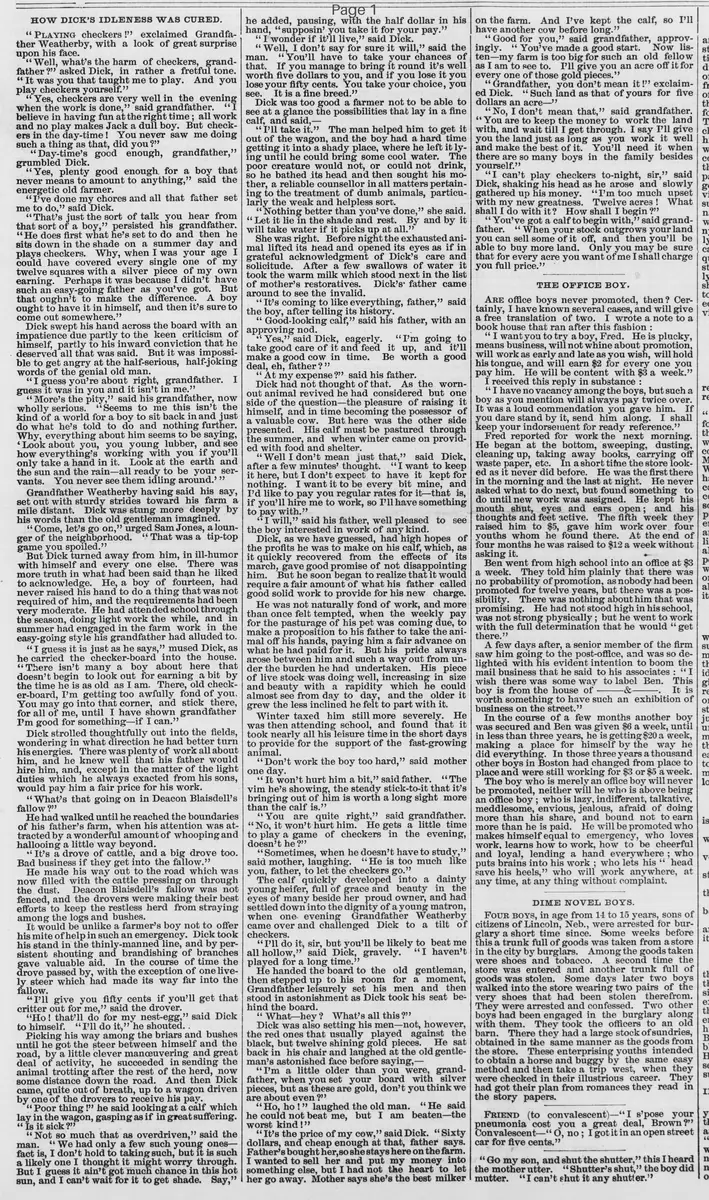
HOW DICK'S IDLENESS WAS CURED.
"Playing checkers!" exclaimed Grandfather Weatherby, with a look of great surprise upon his face.
"Well, what's the harm of checkers, grandfather?" asked Dick, in rather a fretful tone.
"It was you that taught me to play. And you play checkers yourself."
"Yes, checkers are very well in the evening when the work is done," said grandfather. "I believe in having fun at the right time; all work and no play makes Jack a dull boy. But checkers in the day-time! You never saw me doing such a thing as that, did you?"
"Day-time's good enough, grandfather," grumbled Dick.
"Yes, plenty good enough, for a boy that never means to amount to anything," said the energetic old farmer.
"I've done my chores and all that father set me to do," said Dick.
"That's just the sort of talk you hear from that sort of a boy," persisted his grandfather.
"He does first what he's set to do and then he sits down in the shade on a summer day and plays checkers. Why, when I was your age I could have covered every single one of my twelve squares with a silver piece of my own earning. Perhaps it was because I didn't have such an easy-going father as you've got. But that oughtn't to make the difference. A boy ought to have it in himself, and then it's sure to come out somewhere."
Dick swept his hand across the board with an impatience due partly to the keen criticism of himself, partly to his inward conviction that he deserved all that was said. But it was impossible to get angry at the half-serious, half-joking words of the genial old man.
"I guess you're about right, grandfather. I guess it was in you and it isn't in me."
"More's the pity," said his grandfather, now wholly serious. "Seems to me this isn't the kind of a world for a boy to sit back in and just do what he's told to do and nothing further. Why, everything about him seems to be saying, 'Look about you, you young lubber, and see how everything's working with you if you'll only take a hand in it. Look at the earth and the sun and the rain—all ready to be your servants. You never see them idling around.'"
Grandfather Weatherby having said his say, set out with sturdy strides toward his farm a mile distant. Dick was stung more deeply by his words than the old gentleman imagined.
"Come, let's go on," urged Sam Jones, a lounger of the neighborhood. "That was a tip-top game you spoiled."
But Dick turned away from him, in ill-humor with himself and every one else. There was more truth in what had been said than he liked to acknowledge. He, a boy of fourteen, had never raised his hand to do a thing that was not required of him, and the requirements had been very moderate. He had attended school through the season, doing light work the while, and in summer had engaged in the farm work in the easy-going style his grandfather had alluded to.
"I guess it is just as he says," mused Dick, as he carried the checker-board into the house.
"There isn't many a boy about here that doesn't begin to look out for earning a bit by the time he is as old as I am. There, old checker-board, I'm getting too awfully fond of you. You may go into that corner, and stick there, for all of me, until I have shown grandfather I'm good for something—if I can."
Dick strolled thoughtfully out into the fields, wondering in what direction he had better turn his energies. There was plenty of work all about him, and he knew well that his father would hire him, and, except in the matter of the light duties which he always exacted from his sons, would pay him a fair price for his work.
"What's that going on in Deacon Blaisdell's fallow?"
He had walked until he reached the boundaries of his father's farm, when his attention was attracted by a wonderful amount of whooping and hallooing a little way beyond.
"It's a drove of cattle, and a big drove too. Bad business if they get into the fallow."
He made his way out to the road which was now filled with the cattle pressing on through the dust. Deacon Blaisdell's fallow was not fenced, and the drovers were making their best efforts to keep the restless herd from straying among the logs and bushes.
It would be unlike a farmer's boy not to offer his mite of help in such an emergency. Dick took his stand in the thinly-manned line, and by persistent shouting and brandishing of branches gave valuable aid. In the course of time the drove passed by, with the exception of one lively steer which had made its way far into the fallow.
"I'll give you fifty cents if you'll get that critter out for me," said the drover.
"Ho! that'll do for my nest-egg," said Dick to himself. "I'll do it," he shouted.
Picking his way among the briars and bushes until he got the steer between himself and the road, by a little clever maneuvering and great deal of activity, he succeeded in sending the animal trotting after the rest of the herd, now some distance down the road. And then Dick came, quite out of breath, up to a wagon driven by one of the drovers to receive his pay.
"Poor thing!" he said looking at a calf which lay in the wagon, gasping as if in great suffering.
"Is it sick?"
"Not so much that as overdriven," said the man. "We had only a few such young ones. The fact is, I don't hold to taking such, but it is such a likely one I thought it might worry through. But I guess it ain't got much chance in this hot sun, and I can't wait for it to get shade. Say,"
he added, pausing, with the half dollar in his hand, "supposin' you take it for your pay."
"I wonder if it'll live," said Dick.
"Well, I don't say for sure it will," said the man.
"You'll have to take your chances of that. If you manage to bring it round it's well worth five dollars to you, and if you lose it you lose your fifty cents. You take your choice, you see. It is a fine breed."
Dick was too good a farmer not to be able to see at a glance the possibilities that lay in a fine calf, and said,
"I'll take it."
The man helped him to get it out of the wagon, and the boy had a hard time getting it into a shady place, where he left it lying until he could bring some cool water. The poor creature would not, or could not drink, so he bathed its head and then sought his mother, a reliable counsellor in all matters pertaining to the treatment of dumb animals, particularly the weak and helpless sort.
"Nothing better than you've done," she said.
"Let it lie in the shade and rest. By and by it will take water if it picks up at all."
She was right. Before night the exhausted animal lifted its head and opened its eyes as if in grateful acknowledgment of Dick's care and solicitude. After a few swallows of water it took the warm milk which stood next in the list of mother's restoratives.
Dick's father came around to see the invalid.
"It's coming to like everything, father," said the boy, after telling its history.
"Good-looking calf," said his father, with an approving nod.
"Yes," said Dick, eagerly.
"I'm going to take good care of it and feed it up, and it'll make a good cow in time. Be worth a good deal, eh, father?"
"At my expense?" said his father.
Dick had not thought of that. As the worn-out animal revived he had considered but one side of the question—the pleasure of raising it himself, and in time becoming the possessor of a valuable cow. But here was the other side presented. His calf must be pastured through the summer, and when winter came on provided with food and shelter.
"Well I don't mean just that," said Dick, after a few minutes' thought. "I want to keep it here, but I don't expect to have it kept for nothing. I want it to be every bit mine, and I'd like to pay you regular rates for it—that is, if you'll hire me to work, so I'll have something to pay with."
"I will," said his father, well pleased to see the boy interested in work of any kind.
Dick, as we have guessed, had high hopes of the profits he was to make on his calf, which, as it quickly recovered from the effects of its march, gave good promise of not disappointing him. But he soon began to realize that it would require a fair amount of what his father called good solid work to provide for his new charge. He was not naturally fond of work, and more than once felt tempted, when the weekly pay for the pasturage of his pet was coming due, to make a proposition to his father to take the animal off his hands, paying him a fair advance on what he had paid for it. But his pride always arose between him and such a way out from under the burden he had undertaken. His piece of live stock was doing well, increasing in size and beauty with a rapidity which he could almost see from day to day, and the older it grew the less inclined he felt to part with it.
Winter taxed him still more severely. He was then attending school, and found that it took nearly all his leisure time in the short days to provide for the support of the fast-growing animal.
"Don't work the boy too hard," said mother one day.
"It won't hurt him a bit," said father.
"The vim he's showing, the steady stick-to-it that it's bringing out of him is worth a long sight more than the calf is."
"You are quite right," said grandfather.
"No, it won't hurt him. He gets a little time to play a game of checkers in the evening, doesn't he?"
"Sometimes, when he doesn't have to study," said mother, laughing. "He is too much like you, father, to let the checkers go."
The calf quickly developed into a dainty young heifer, full of grace and beauty in the eyes of many beside her proud owner, and had settled down into the dignity of a young matron, when one evening Grandfather Weatherby came over and challenged Dick to a tilt of checkers.
"I'll do it, sir, but you'll be likely to beat me all hollow," said Dick, gravely.
"I haven't played for a long time."
He handed the board to the old gentleman, then stepped up to his room for a moment. Grandfather leisurely set his men and then stood in astonishment as Dick took his seat behind the board.
"What—hey? What's all this?"
Dick was also setting his men—not, however, the red ones that usually played against the black, but twelve shining gold pieces. He sat back in his chair and laughed at the old gentleman's astonished face before saying,
"I'm a little older than you were, grandfather, when you set your board with silver pieces, but as these are gold, don't you think we are about even?"
"Ho, ho!" laughed the old man. "He said he could not beat me, but I am beaten—the worst kind!"
"It's the price of my cow," said Dick. "Sixty dollars, and cheap enough at that, father says. Father's bought her, so she stays here on the farm. I wanted to sell her and put my money into something else, but I had not the heart to let her go away. Mother says she's the best milker on the farm. And I've kept the calf, so I'll have another cow before long."
"Good for you," said grandfather, approvingly. "You've made a good start. Now listen—my farm is too big for such an old fellow as I am to see to. I'll give you an acre off it for every one of those gold pieces."
"Grandfather, you don't mean it!" exclaimed Dick. "Such land as that of yours for five dollars an acre—"
"No, I don't mean that," said grandfather.
"You are to keep the money to work the land with, and wait till I get through. I say I'll give you the land just as long as you work it well and make the best of it. You'll need it when there are so many boys in the family besides yourself."
"I can't play checkers to-night, sir," said Dick, shaking his head as he arose and slowly gathered up his money.
"I'm too much upset with my new greatness. Twelve acres! What shall I do with it? How shall I begin?"
"You've got a calf to begin with," said grandfather. "When your stock outgrows your land you can sell some of it off, and then you'll be able to buy more land. Only you may be sure that for every acre you want of me I shall charge you full price."
"Playing checkers!" exclaimed Grandfather Weatherby, with a look of great surprise upon his face.
"Well, what's the harm of checkers, grandfather?" asked Dick, in rather a fretful tone.
"It was you that taught me to play. And you play checkers yourself."
"Yes, checkers are very well in the evening when the work is done," said grandfather. "I believe in having fun at the right time; all work and no play makes Jack a dull boy. But checkers in the day-time! You never saw me doing such a thing as that, did you?"
"Day-time's good enough, grandfather," grumbled Dick.
"Yes, plenty good enough, for a boy that never means to amount to anything," said the energetic old farmer.
"I've done my chores and all that father set me to do," said Dick.
"That's just the sort of talk you hear from that sort of a boy," persisted his grandfather.
"He does first what he's set to do and then he sits down in the shade on a summer day and plays checkers. Why, when I was your age I could have covered every single one of my twelve squares with a silver piece of my own earning. Perhaps it was because I didn't have such an easy-going father as you've got. But that oughtn't to make the difference. A boy ought to have it in himself, and then it's sure to come out somewhere."
Dick swept his hand across the board with an impatience due partly to the keen criticism of himself, partly to his inward conviction that he deserved all that was said. But it was impossible to get angry at the half-serious, half-joking words of the genial old man.
"I guess you're about right, grandfather. I guess it was in you and it isn't in me."
"More's the pity," said his grandfather, now wholly serious. "Seems to me this isn't the kind of a world for a boy to sit back in and just do what he's told to do and nothing further. Why, everything about him seems to be saying, 'Look about you, you young lubber, and see how everything's working with you if you'll only take a hand in it. Look at the earth and the sun and the rain—all ready to be your servants. You never see them idling around.'"
Grandfather Weatherby having said his say, set out with sturdy strides toward his farm a mile distant. Dick was stung more deeply by his words than the old gentleman imagined.
"Come, let's go on," urged Sam Jones, a lounger of the neighborhood. "That was a tip-top game you spoiled."
But Dick turned away from him, in ill-humor with himself and every one else. There was more truth in what had been said than he liked to acknowledge. He, a boy of fourteen, had never raised his hand to do a thing that was not required of him, and the requirements had been very moderate. He had attended school through the season, doing light work the while, and in summer had engaged in the farm work in the easy-going style his grandfather had alluded to.
"I guess it is just as he says," mused Dick, as he carried the checker-board into the house.
"There isn't many a boy about here that doesn't begin to look out for earning a bit by the time he is as old as I am. There, old checker-board, I'm getting too awfully fond of you. You may go into that corner, and stick there, for all of me, until I have shown grandfather I'm good for something—if I can."
Dick strolled thoughtfully out into the fields, wondering in what direction he had better turn his energies. There was plenty of work all about him, and he knew well that his father would hire him, and, except in the matter of the light duties which he always exacted from his sons, would pay him a fair price for his work.
"What's that going on in Deacon Blaisdell's fallow?"
He had walked until he reached the boundaries of his father's farm, when his attention was attracted by a wonderful amount of whooping and hallooing a little way beyond.
"It's a drove of cattle, and a big drove too. Bad business if they get into the fallow."
He made his way out to the road which was now filled with the cattle pressing on through the dust. Deacon Blaisdell's fallow was not fenced, and the drovers were making their best efforts to keep the restless herd from straying among the logs and bushes.
It would be unlike a farmer's boy not to offer his mite of help in such an emergency. Dick took his stand in the thinly-manned line, and by persistent shouting and brandishing of branches gave valuable aid. In the course of time the drove passed by, with the exception of one lively steer which had made its way far into the fallow.
"I'll give you fifty cents if you'll get that critter out for me," said the drover.
"Ho! that'll do for my nest-egg," said Dick to himself. "I'll do it," he shouted.
Picking his way among the briars and bushes until he got the steer between himself and the road, by a little clever maneuvering and great deal of activity, he succeeded in sending the animal trotting after the rest of the herd, now some distance down the road. And then Dick came, quite out of breath, up to a wagon driven by one of the drovers to receive his pay.
"Poor thing!" he said looking at a calf which lay in the wagon, gasping as if in great suffering.
"Is it sick?"
"Not so much that as overdriven," said the man. "We had only a few such young ones. The fact is, I don't hold to taking such, but it is such a likely one I thought it might worry through. But I guess it ain't got much chance in this hot sun, and I can't wait for it to get shade. Say,"
he added, pausing, with the half dollar in his hand, "supposin' you take it for your pay."
"I wonder if it'll live," said Dick.
"Well, I don't say for sure it will," said the man.
"You'll have to take your chances of that. If you manage to bring it round it's well worth five dollars to you, and if you lose it you lose your fifty cents. You take your choice, you see. It is a fine breed."
Dick was too good a farmer not to be able to see at a glance the possibilities that lay in a fine calf, and said,
"I'll take it."
The man helped him to get it out of the wagon, and the boy had a hard time getting it into a shady place, where he left it lying until he could bring some cool water. The poor creature would not, or could not drink, so he bathed its head and then sought his mother, a reliable counsellor in all matters pertaining to the treatment of dumb animals, particularly the weak and helpless sort.
"Nothing better than you've done," she said.
"Let it lie in the shade and rest. By and by it will take water if it picks up at all."
She was right. Before night the exhausted animal lifted its head and opened its eyes as if in grateful acknowledgment of Dick's care and solicitude. After a few swallows of water it took the warm milk which stood next in the list of mother's restoratives.
Dick's father came around to see the invalid.
"It's coming to like everything, father," said the boy, after telling its history.
"Good-looking calf," said his father, with an approving nod.
"Yes," said Dick, eagerly.
"I'm going to take good care of it and feed it up, and it'll make a good cow in time. Be worth a good deal, eh, father?"
"At my expense?" said his father.
Dick had not thought of that. As the worn-out animal revived he had considered but one side of the question—the pleasure of raising it himself, and in time becoming the possessor of a valuable cow. But here was the other side presented. His calf must be pastured through the summer, and when winter came on provided with food and shelter.
"Well I don't mean just that," said Dick, after a few minutes' thought. "I want to keep it here, but I don't expect to have it kept for nothing. I want it to be every bit mine, and I'd like to pay you regular rates for it—that is, if you'll hire me to work, so I'll have something to pay with."
"I will," said his father, well pleased to see the boy interested in work of any kind.
Dick, as we have guessed, had high hopes of the profits he was to make on his calf, which, as it quickly recovered from the effects of its march, gave good promise of not disappointing him. But he soon began to realize that it would require a fair amount of what his father called good solid work to provide for his new charge. He was not naturally fond of work, and more than once felt tempted, when the weekly pay for the pasturage of his pet was coming due, to make a proposition to his father to take the animal off his hands, paying him a fair advance on what he had paid for it. But his pride always arose between him and such a way out from under the burden he had undertaken. His piece of live stock was doing well, increasing in size and beauty with a rapidity which he could almost see from day to day, and the older it grew the less inclined he felt to part with it.
Winter taxed him still more severely. He was then attending school, and found that it took nearly all his leisure time in the short days to provide for the support of the fast-growing animal.
"Don't work the boy too hard," said mother one day.
"It won't hurt him a bit," said father.
"The vim he's showing, the steady stick-to-it that it's bringing out of him is worth a long sight more than the calf is."
"You are quite right," said grandfather.
"No, it won't hurt him. He gets a little time to play a game of checkers in the evening, doesn't he?"
"Sometimes, when he doesn't have to study," said mother, laughing. "He is too much like you, father, to let the checkers go."
The calf quickly developed into a dainty young heifer, full of grace and beauty in the eyes of many beside her proud owner, and had settled down into the dignity of a young matron, when one evening Grandfather Weatherby came over and challenged Dick to a tilt of checkers.
"I'll do it, sir, but you'll be likely to beat me all hollow," said Dick, gravely.
"I haven't played for a long time."
He handed the board to the old gentleman, then stepped up to his room for a moment. Grandfather leisurely set his men and then stood in astonishment as Dick took his seat behind the board.
"What—hey? What's all this?"
Dick was also setting his men—not, however, the red ones that usually played against the black, but twelve shining gold pieces. He sat back in his chair and laughed at the old gentleman's astonished face before saying,
"I'm a little older than you were, grandfather, when you set your board with silver pieces, but as these are gold, don't you think we are about even?"
"Ho, ho!" laughed the old man. "He said he could not beat me, but I am beaten—the worst kind!"
"It's the price of my cow," said Dick. "Sixty dollars, and cheap enough at that, father says. Father's bought her, so she stays here on the farm. I wanted to sell her and put my money into something else, but I had not the heart to let her go away. Mother says she's the best milker on the farm. And I've kept the calf, so I'll have another cow before long."
"Good for you," said grandfather, approvingly. "You've made a good start. Now listen—my farm is too big for such an old fellow as I am to see to. I'll give you an acre off it for every one of those gold pieces."
"Grandfather, you don't mean it!" exclaimed Dick. "Such land as that of yours for five dollars an acre—"
"No, I don't mean that," said grandfather.
"You are to keep the money to work the land with, and wait till I get through. I say I'll give you the land just as long as you work it well and make the best of it. You'll need it when there are so many boys in the family besides yourself."
"I can't play checkers to-night, sir," said Dick, shaking his head as he arose and slowly gathered up his money.
"I'm too much upset with my new greatness. Twelve acres! What shall I do with it? How shall I begin?"
"You've got a calf to begin with," said grandfather. "When your stock outgrows your land you can sell some of it off, and then you'll be able to buy more land. Only you may be sure that for every acre you want of me I shall charge you full price."
What sub-type of article is it?
Prose Fiction
What themes does it cover?
Moral Virtue
Agriculture Rural
What keywords are associated?
Idleness
Work Ethic
Farming
Calf Raising
Moral Instruction
Boyhood Labor
Family Farm
Literary Details
Title
How Dick's Idleness Was Cured.
Key Lines
"All Work And No Play Makes Jack A Dull Boy. But Checkers In The Day Time! You Never Saw Me Doing Such A Thing As That, Did You?"
"Seems To Me This Isn't The Kind Of A World For A Boy To Sit Back In And Just Do What He's Told To Do And Nothing Further."
"I'll Take It."
"The Vim He's Showing, The Steady Stick To It That It's Bringing Out Of Him Is Worth A Long Sight More Than The Calf Is."
"I'm A Little Older Than You Were, Grandfather, When You Set Your Board With Silver Pieces, But As These Are Gold, Don't You Think We Are About Even?"