Thank you for visiting SNEWPapers!
Sign up free
Editorial
June 3, 1850
Democratic Banner
Louisiana, Bowling Green, Pike County, Missouri
What is this article about?
This editorial advocates for settling the slavery question by adhering to constitutional non-interference principles, praises the Democratic Party's role in maintaining Union harmony, criticizes anti-slavery agitation and the Wilmot Proviso, and supports compromise measures like the Committee of Thirteen's report to end sectional strife.
Clipping
OCR Quality
95%
Excellent
Full Text
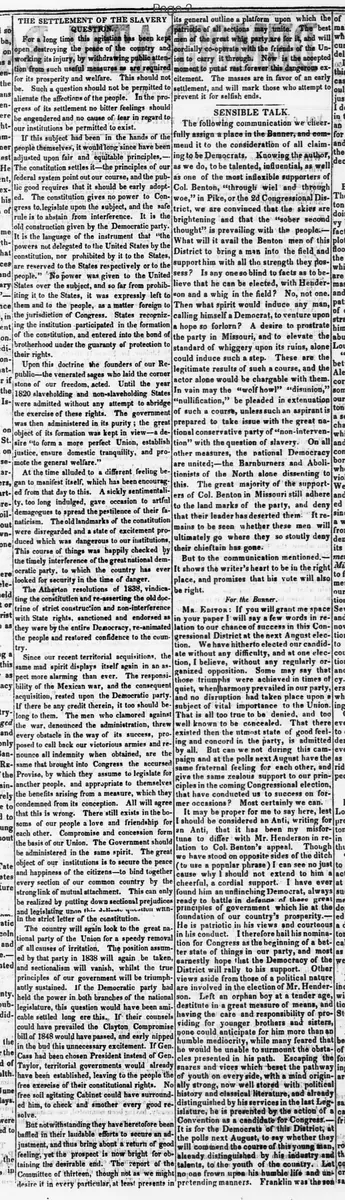
THE SETTLEMENT OF THE SLAVERY QUESTION
For a long time this agitation has been kept open destroying the peace of the country and working its injury, by withdrawing public attention from such useful measures as are required for its prosperity and welfare. This should not be. Such a question should not be permitted to alienate the affections of the people. In the progress of its settlement no bitter feelings should be engendered and no cause of fear in regard to our institutions be permitted to exist.
If this subject had been in the hands of the people themselves, it would long since have been adjusted upon fair and equitable principles. The constitution settles it-the principles of our federal system point out our course, and the public good requires that it should be early adopted. The constitution gives no power to Congress to legislate upon the subject, and the safe rule is to abstain from interference. It is the old construction given by the Democratic party. It is the language of the instrument that 'the powers not delegated to the United States by the constitution, nor prohibited by it to the States, are reserved to the States respectively or to the people.'
No power was given to the United States over the subject, and so far from prohibiting it to the States, it was expressly left to them and to the people, as a matter foreign to the jurisdiction of Congress. States recognizing the institution participated in the formation of the constitution, and entered into the bond of brotherhood under the guaranty of protection to their rights.
Upon this doctrine the founders of our Republic-the venerated sages who laid the corner stone of our freedom, acted. Until the year 1820 slaveholding and non-slaveholding States were admitted without any attempt to abridge the exercise of these rights. The government was then administered in its purity; the great object of its formation was kept in view--a desire 'to form a more perfect Union, establish justice, ensure domestic tranquility, and promote the general welfare.'
At the time alluded to a different feeling began to manifest itself, which has been encouraged from that day to this. A sickly sentimentality, too long indulged, gave occasion to artful demagogues to spread the pestilence of their fanaticism.
The old landmarks of the constitution were disregarded and a state of excitement produced which was dangerous to our institutions. This course of things was happily checked by the timely interference of the great national democratic party, to which the country has ever looked for security in the time of danger.
The Alton resolutions of 1838, vindicating the constitution and re-asserting the old doctrine of strict construction and non-interference with State rights, sanctioned and endorsed as they were by the entire Democracy, re-animated the people and restored confidence to the country.
Since our recent territorial acquisitions, the same mad spirit displays itself again in an aspect more alarming than ever. The responsibility of the Mexican war, and the consequent acquisition, rested upon the Democratic party. If there be any credit therein, it too should belong to them. The men who clamored against the war, denounced the administration, threw every obstacle in the way of its success, proposed to call back our victorious armies and renounce all indemnity when obtained, are the same that brought into Congress the accursed Proviso, by which they assume to legislate for another people, and appropriate to themselves the benefits arising from a measure, which they condemned from its conception.
All will agree that this is wrong. There still exists in the bosoms of our people a love and friendship for each other. Compromise and concession form the basis of our Union. The Government should be administered in the same spirit. The great object of our institutions is to secure the peace and happiness of the citizens-to bind together every section of our common country by the strong link of mutual attachment. This can only be realized by putting down sectional prejudices and legislating upon this delicate question within the strict letter of the constitution.
The country will again look to the great national party of the Union for a speedy removal of all causes of irritation. The position assumed by that party in 1838 will again be taken, and sectionalism will vanish, whilst the true principles of our government will be triumphantly sustained. If the Democratic party had held the power in both branches of the national legislature, this question would have been amicably settled long ere this. If their counsels could have prevailed the Clayton Compromise bill of 1848 would have passed, and early nipped in the bud this unnecessary excitement. If Gen. Cass had been chosen President instead of Gen. Taylor, territorial governments would already have been established, leaving to the people the free exercise of their constitutional rights. No free soil agitating Cabinet could have surrounded him, to check and smother every good resolve.
But notwithstanding they have heretofore been baffled in their laudable efforts to secure an adjustment, and thus bring about a return of good feeling, yet the prospect is now bright for obtaining the desirable end. The report of the Committee of thirteen, though not as we might desire it in every particular, at least presents in its general outline a platform upon which the patriotic of all sections may unite. The best men of the great whig party are for it, and will cordially co-operate with the friends of the Union to carry it through. Now is the accepted moment to put at rest forever this dangerous excitement. The masses are in favor of an early settlement, and will mark those who attempt to prevent it for selfish ends.
For a long time this agitation has been kept open destroying the peace of the country and working its injury, by withdrawing public attention from such useful measures as are required for its prosperity and welfare. This should not be. Such a question should not be permitted to alienate the affections of the people. In the progress of its settlement no bitter feelings should be engendered and no cause of fear in regard to our institutions be permitted to exist.
If this subject had been in the hands of the people themselves, it would long since have been adjusted upon fair and equitable principles. The constitution settles it-the principles of our federal system point out our course, and the public good requires that it should be early adopted. The constitution gives no power to Congress to legislate upon the subject, and the safe rule is to abstain from interference. It is the old construction given by the Democratic party. It is the language of the instrument that 'the powers not delegated to the United States by the constitution, nor prohibited by it to the States, are reserved to the States respectively or to the people.'
No power was given to the United States over the subject, and so far from prohibiting it to the States, it was expressly left to them and to the people, as a matter foreign to the jurisdiction of Congress. States recognizing the institution participated in the formation of the constitution, and entered into the bond of brotherhood under the guaranty of protection to their rights.
Upon this doctrine the founders of our Republic-the venerated sages who laid the corner stone of our freedom, acted. Until the year 1820 slaveholding and non-slaveholding States were admitted without any attempt to abridge the exercise of these rights. The government was then administered in its purity; the great object of its formation was kept in view--a desire 'to form a more perfect Union, establish justice, ensure domestic tranquility, and promote the general welfare.'
At the time alluded to a different feeling began to manifest itself, which has been encouraged from that day to this. A sickly sentimentality, too long indulged, gave occasion to artful demagogues to spread the pestilence of their fanaticism.
The old landmarks of the constitution were disregarded and a state of excitement produced which was dangerous to our institutions. This course of things was happily checked by the timely interference of the great national democratic party, to which the country has ever looked for security in the time of danger.
The Alton resolutions of 1838, vindicating the constitution and re-asserting the old doctrine of strict construction and non-interference with State rights, sanctioned and endorsed as they were by the entire Democracy, re-animated the people and restored confidence to the country.
Since our recent territorial acquisitions, the same mad spirit displays itself again in an aspect more alarming than ever. The responsibility of the Mexican war, and the consequent acquisition, rested upon the Democratic party. If there be any credit therein, it too should belong to them. The men who clamored against the war, denounced the administration, threw every obstacle in the way of its success, proposed to call back our victorious armies and renounce all indemnity when obtained, are the same that brought into Congress the accursed Proviso, by which they assume to legislate for another people, and appropriate to themselves the benefits arising from a measure, which they condemned from its conception.
All will agree that this is wrong. There still exists in the bosoms of our people a love and friendship for each other. Compromise and concession form the basis of our Union. The Government should be administered in the same spirit. The great object of our institutions is to secure the peace and happiness of the citizens-to bind together every section of our common country by the strong link of mutual attachment. This can only be realized by putting down sectional prejudices and legislating upon this delicate question within the strict letter of the constitution.
The country will again look to the great national party of the Union for a speedy removal of all causes of irritation. The position assumed by that party in 1838 will again be taken, and sectionalism will vanish, whilst the true principles of our government will be triumphantly sustained. If the Democratic party had held the power in both branches of the national legislature, this question would have been amicably settled long ere this. If their counsels could have prevailed the Clayton Compromise bill of 1848 would have passed, and early nipped in the bud this unnecessary excitement. If Gen. Cass had been chosen President instead of Gen. Taylor, territorial governments would already have been established, leaving to the people the free exercise of their constitutional rights. No free soil agitating Cabinet could have surrounded him, to check and smother every good resolve.
But notwithstanding they have heretofore been baffled in their laudable efforts to secure an adjustment, and thus bring about a return of good feeling, yet the prospect is now bright for obtaining the desirable end. The report of the Committee of thirteen, though not as we might desire it in every particular, at least presents in its general outline a platform upon which the patriotic of all sections may unite. The best men of the great whig party are for it, and will cordially co-operate with the friends of the Union to carry it through. Now is the accepted moment to put at rest forever this dangerous excitement. The masses are in favor of an early settlement, and will mark those who attempt to prevent it for selfish ends.
What sub-type of article is it?
Constitutional
Slavery Abolition
Partisan Politics
What keywords are associated?
Slavery Question
Constitutional Rights
Democratic Party
Non Interference
Wilmot Proviso
Territorial Acquisitions
Union Compromise
Alton Resolutions
What entities or persons were involved?
Democratic Party
Congress
Gen. Cass
Gen. Taylor
Committee Of Thirteen
Alton Resolutions
Whig Party
Editorial Details
Primary Topic
Settlement Of The Slavery Question Via Constitutional Non Interference
Stance / Tone
Supportive Of Democratic Non Intervention And Compromise To Preserve Union
Key Figures
Democratic Party
Congress
Gen. Cass
Gen. Taylor
Committee Of Thirteen
Alton Resolutions
Whig Party
Key Arguments
Agitation Over Slavery Destroys National Peace And Diverts Attention From Prosperity
Constitution Gives No Power To Congress Over Slavery; Abstain From Interference
States' Rights Reserved; Slaveholding States Protected Under Constitution
Democratic Party Upholds Strict Construction And Non Interference
Anti Slavery Fanaticism And Wilmot Proviso Threaten Institutions
Mexican War Acquisitions Should Allow Free Exercise Of Rights In Territories
Compromise Essential For Union; Support Committee Of Thirteen's Report