Thank you for visiting SNEWPapers!
Sign up free
National Gazette
Philadelphia, Philadelphia County, Pennsylvania
What is this article about?
A letter to the editor defends a state legislator's comparison of lotteries to papal indulgences, citing historical sales of indulgences for sins, references to Luther's reformation, and biblical criticism of the Pope as the 'man of sin.' The writer expresses respect for good-intentioned Roman Catholics while condemning certain practices. Signed Verus.
Clipping
OCR Quality
Full Text
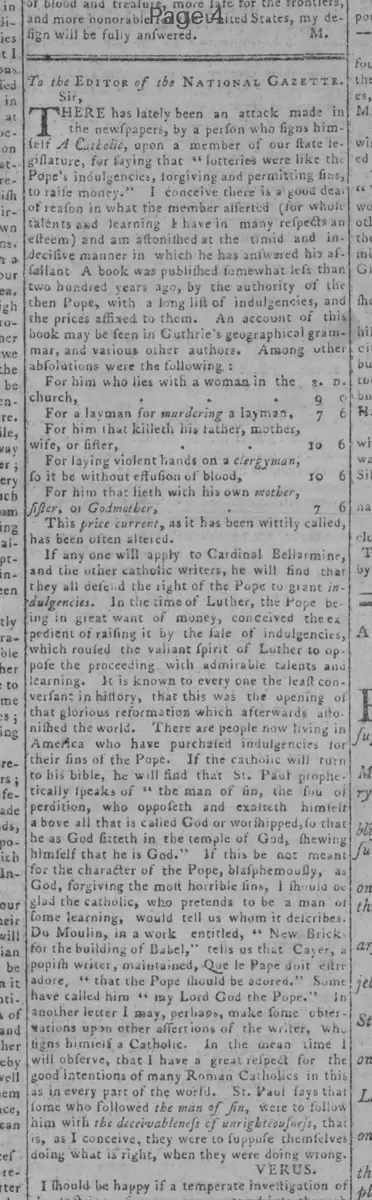
Sir,
THERE has lately been an attack made in the newspapers, by a person who signs himself A Catholic, upon a member of our state legislature, for saying that "lotteries were like the Pope's indulgencies, forgiving and permitting sins, to raise money." I conceive there is a good deal of reason in what the member asserted (for whose talents and learning I have in many respects an esteem) and am astonished at the timid and indecisive manner in which he has answered his assailant A book was published somewhat less than two hundred years ago, by the authority of the then Pope, with a long list of indulgencies, and the prices affixed to them. An account of this book may be seen in Guthrie's geographical grammar, and various other authors. Among other absolutions were the following. :
For him who lies with a woman in the S. D. church, 9 C
For a layman for murdering a layman, 7 6
For him that killeth his father, mother, wife, or sister, 30 6
For laying violent hands on a clergyman, so it be without effusion of blood, 10 6
For him that lieth with his own mother, sister, or godmother, 7 6
This price current, as it has been wittily called, has been often altered.
If any one will apply to Cardinal Bellarmine, and the other catholic writers, he will find that they all defend the right of the Pope to grant indulgencies. In the time of Luther, the Pope being in great want of money, conceived the expedient of raising it by the sale of indulgencies, which roused the valiant spirit of Luther to oppose the proceeding with admirable talents and learning. It is known to every one the least conversant in history, that this was the opening of that glorious reformation which afterwards astonished the world. There are people now living in America who have purchased indulgencies for their sins of the Pope. If the catholic will turn to his bible, he will find that St. Paul prophetically speaks of "the man of sin, the son of perdition, who opposeth and exalteth himself above all that is called God or worshipped, so that he as God sitteth in the temple of God, shewing himself that he is God." If this be not meant for the character of the Pope, blasphemously, as God, forgiving the most horrible sins, I should be glad the catholic, who pretends to be a man of some learning, would tell us whom it describes.
Du Moulin, in a work entitled, "New Brick for the building of Babel," tells us that Cayer, a popish writer, maintained, Que le Pape doit etre adore, "that the Pope should be adored." Some have called him "my Lord God the Pope." In another letter I may, perhaps, make some other observations upon other assertions of the writer, who signs himself a Catholic. In the mean time I will observe, that I have a great respect for the good intentions of many Roman Catholics in this as in every part of the world. St. Paul says that some who followed the man of sin, were to follow him with the deceivableness of unrighteousness, that is, as I conceive, they were to suppose themselves doing what is right, when they were doing wrong.
VERUS.
What sub-type of article is it?
What themes does it cover?
What keywords are associated?
What entities or persons were involved?
Letter to Editor Details
Author
Verus.
Recipient
Editor Of The National Gazette
Main Argument
defends the legislator's analogy between lotteries and papal indulgences as both mechanisms to raise money by forgiving or permitting sins, citing historical evidence of indulgences sales, luther's opposition leading to the reformation, and biblical prophecies against the pope.
Notable Details