Thank you for visiting SNEWPapers!
Sign up free
The Daily Madisonian
Washington, District Of Columbia
What is this article about?
In 1842, dying Samuel Mann confesses to helping murder joiner Hodgdon 44 years earlier in Llandaff, NH, burying him northeast of Jonathan Noyes's house. Watchers report a crimson light and ghostly man appearing, prompting the confession amid agony.
Clipping
OCR Quality
Full Text
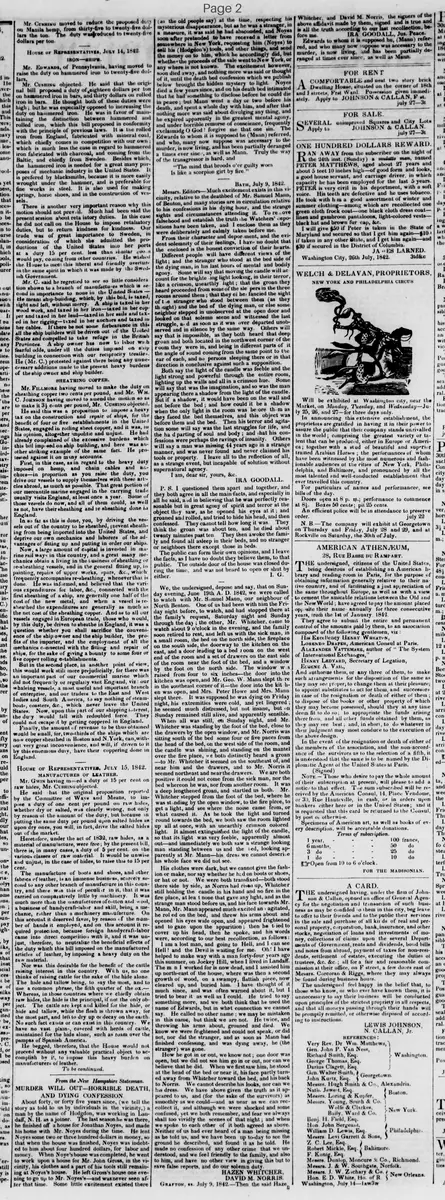
MURDER WILL OUT—HORRIBLE DEATH AND DYING CONFESSION.
About forty, or forty five years since, (we tell the story as told to us by individuals in the vicinity,) a man by the name of Hodgdon, was working in Llandaff, N. H. as a joiner. The last season he was there, he finished off a house for Jonathan Noyes, and made his home with Mr. Noyes during the time. He lent Noyes some two or three hundred dollars in money, so that when the house was finished, Noyes was indebted to him about four hundred dollars, for labor and money. When Noyes's house was completed, he went to work upon a house for Mr. John Gross, in the vicinity, his clothes and a part of his tools still remaining at Noyes's house. He left Gross's house one evening to go up to Mr. Noyes's—and was never seen after that time. Some little excitement existed there (as the old people say) at the time, respecting his mysterious disappearance, but as he was a stranger, in a measure, it was said he had absconded, and soon after pretended to have received a letter from him somewhere in New York, requesting him (Noyes) to sell his (Hodgdon's) tools, and other things, and send the money on to him, which he accordingly did, but whether the proceeds of the sale went to New York, or any where is not known. The excitement however, soon died away, and nothing more was said or thought of it, until the death bed confession which we publish below brought the hidden mystery to light. Noyes died a few years since, and on his death bed intimated that he had something to disclose before he could die in peace; but Mann went a day or two before his death, and spent a whole day with him, and after that nothing more was said about divulging any thing, and he expired apparently in the greatest mental agony, and under horrible remorse of conscience, frequently exclaiming O God! forgive me that one sin. The Edwards to whom it is supposed he (Mann) referred, and who, many now suppose was accessary to the murder, is now living, and has been partially deranged at times ever since, as well as Mann. Truly the way of the transgressor is hard, and
"The mind that broods o'er guilty woes
Is like a scorpion girt by fire."
Bath, July 9, 1842.
Messrs. Editors—Much excitement exists in this vicinity, relative to the deathbed of Mr. Samuel Mann, of Benton, and many stories are in circulation relative to his confessions in his dying hour, and the strange sights and circumstances attending it. To remove falsehood and establish the truth the Watchers' depositions have been taken, and I enclose them as they were deliberately and calmly taken before me. From their character and deportment, and the evident solemnity of their feelings, I have no doubt that the enclosed is the honest conviction of their hearts. Different people will have different views of the light; and the stranger who stood at the bed side of the dying man, in his last hours of mental and bodily agony. Some will say that moving the candle will account for the brightening light looking, in their terror, like a crimson, unearthly light; that the groan they heard proceeded from some of the sleepers in the three rooms around them; that they either fancied the sight (as they thought) and the bed of the dying man, or else some neighbor stepped in unobserved at the open door and looked on that solemn scene and witnessed the last struggle, and as soon as it was over departed unobserved and in silence by the same way. Others will say that is impossible, as they both heard that deep groan and both located in the northwest corner of the room they were in, and being in different parts of it the angle of sound coming from the same point to the ear of each, and no persons sleeping there or in that direction is conclusive against such a supposition. Both say the light of the candle was feeble and the light strong and powerful through the entire room, lighting up the walls and all in a crimson hue. Some will say that was the imagination, and so was the man appearing there a shadow from the light of the candle. But if a shadow, it would have been on the wall and not before the bed; and how could it be a shadow when the only light in the room was before them as they faced the bed themselves, and this object was before them and the bed. Then his terror and agitation some will say was the last struggles for life, and the hard parting of soul and body; and that his confessions were perhaps the ravings of insanity. Others will say a man was missing 44 years ago in a strange manner, and was never found and never claimed his tools or property. I leave all to the reflection of all, as a strange event, but incapable of solution without supernatural agency.
I am, dear sir, yours, &c.
IRA GOODALL.
P. S. I questioned them apart and together, and they both agree in all the main facts, and especially in all he said, and in believing that he was perfectly reasonable but in great agony of spirit and terror at the object they saw, as he opened his eyes at it; and groaned and rolled, and tried to hide his head, and then confessed. They cannot tell how long it was. They think the groan was about ten, and he died about twenty minutes past ten They then awoke the family and found all asleep in their beds, and no stranger or neighbors there except those in beds. The public can form their own opinions, and I leave the facts, as I have no doubt they believe them, to that public. The outside door of the house was closed during the time, and was not heard to open or shut by either.
I. G.
We, the undersigned, depose and say, that on Sunday evening, June 19th A. D. 1842, we were called to watch with Mr. Samuel Mann, our neighbour of North Benton. One of us had been with him the Friday night before, to watch, and had stopped there at the family's request, Saturday night and Sunday through the day ; the other, Mr. Whitcher, Came to watch about 9 o'clock in the evening, and the family soon retired to rest, and left us with the sick man, in a small room, the bed on the north side, the fireplace on the east, and a door leading to a bed room on the west end of the room and a set of drawers on the east side of the room near the foot of the bed, and a window by the foot on the north side. The window was raised from four to six inches--the door into the kitchen was open, and Mr. Geo. W. Mann slept there in the southeast corner of it-the door into the kitchen was open, and Mrs. Peter Howe and Mrs. Mann slept there. It was supposed he was dying on Friday night, his extremities were cold, and yet lingered; he seemed much distressed, but not insane, but on Sunday remained still alive, and apparently sensible.
When all was still, on Sunday night, and Mr. Whitcher was standing by the foot of the bed, close to the drawers by the open window, and Mr. Norris was sitting south of the bed some four or five paces from the head of the bed, on the west side of the room, and the candle was shining, and standing on the mantel over the fire place, we both distinctly heard a groan —to Mr. Whitcher it seemed on the southeast of, and near him and the drawers, and to Mr. Norris it seemed northeast and near the drawers. We are both positive it could not come from the sick man, nor the bed whereon he was, nor from another room. It was a deep lengthened groan, and startled us both. Mr. Whitcher stepped from the foot of the bed, where he was standing by the open window, to the fire place, to get a light, and see where the noise came from, or what caused it. As he took the light and turned round towards the bed, we both saw the room lighted up all at once, with an unearthly crimson colored light. It almost extinguished the light of the candle, so that its light was very feeble, apparently almost out—and immediately we both saw a strange looking man standing between us and the bed, looking apparently at Mr. Mann-his dress we cannot describe his whole face we did not see. His clothes were dark, but we cannot give the fashion or make, nor say whether he had on boots or shoes, or hat or not. We were both transfixed-both stood there side by side, as Norris had risen up, Whitcher still holding the candle in his hand and no fire in the fire place, at least none that gave any light, and as the strange man stood before us, and his face towards Mr. Mann, Mr. Mann appeared much excited and agitated, he rolled on the bed, and threw his arms about and opened his eyes wide open, and appeared frightened and to gaze upon the apparition; then he tried to cover up his head, then he spoke, and his words were, according to our best recollection, as follows:
I am a lost man, and going to Hell, and I can see Hell! and the Devil is waiting for me. Oh! I have helped to make way with a man forty-four years ago this summer, on Jockey Hill, when I lived in Landaff. The man I worked for is now dead, and I assisted him up north-east of the house, where was then a second growth of wood, on a swampy, flattish piece, now cleared up, and buried him. I have thought of it much since, and was often warned about it, but I tried to bear it as well as I could. He tried to say something more, and we both think that he used the name of Edwards, but in what connection we cannot say. He called no other name; we may be mistaken in this name, but think we are not. He twice, and throwing his arms about, groaned and died. We know we were frightened and could not speak, or did not, nor did the stranger, and as soon as Mann had finished confessing, and was dying away, he (the stranger) was gone.
How he got in or out, we know not; one door was open, but we did not see him go in or out, nor can we believe that he did. When we first saw him, he stood at the head of the bed or near it, his face partly turned away from Whitcher toward the bed, and his back to Norris. We cannot describe his looks, nor can we his dress. We have above given the truth as it appeared to us, and (for the sake of the survivors) as smoothly as we could—and as near as we can recollect it, and although we were shocked and some confused, yet we both remember, and fear we always shall too vividly the scenes of that night; and when we spoke to each other of it both agreed as above. Neither of us had ever heard of a man being missing as he told us, and we have been up to-day to see the ground he described, and found it as he told. He made no confession of any other crime that we understood, and we feel friendly to the family, and also to him, and have no other view in giving this but to save false reports. and do our solemn duty,
HAZEN WHITCHER.
DAVID M. NORRIS.
Grafton, N. H. July 9, 1842.—Then the said Hazen Whitcher. and David M. Norris, the signers of the above affidavit made by them, signed and is true and is all the truth according to our last recollection, before me.
IRA GOODALL, Jus. Peace.
Edwards to whom it is supposed he, (Mann) referred, and who many now suppose was accessary to the murder, is now living, and has been partially deranged at times ever since, as well as Mann.
What sub-type of article is it?
What themes does it cover?
What keywords are associated?
What entities or persons were involved?
Where did it happen?
Story Details
Key Persons
Location
Llandaff, N. H.; Benton, N. H.; Bath, N. H.; Grafton, N. H.
Event Date
June 19, 1842; About Forty Four Years Prior
Story Details
Joiner Hodgdon disappears after working for Noyes in Llandaff, NH, around 1798. Noyes claims he absconded to New York. In 1842, dying Mann confesses to assisting Noyes and possibly Edwards in murdering and burying Hodgdon northeast of the house on Jockey Hill. Watchers Whitcher and Norris see crimson light and ghostly man, prompting Mann's terrified confession before death.