Thank you for visiting SNEWPapers!
Sign up free
Story
April 1, 1868
The Fairfield Herald
Winnsboro, Fairfield County, South Carolina
What is this article about?
Alexander H. Stephens shares views on judiciary independence, dangers of black enfranchisement in the South leading to racial conflict, support for Johnson's reconstruction policy, and criticism of Radical legislation, warning of ruin for whites.
Clipping
OCR Quality
88%
Good
Full Text
Alexander H. Stephens.
HIS VIEWS ON RECONSTRUCTION, CONGRESS, AND THE NEGRO.
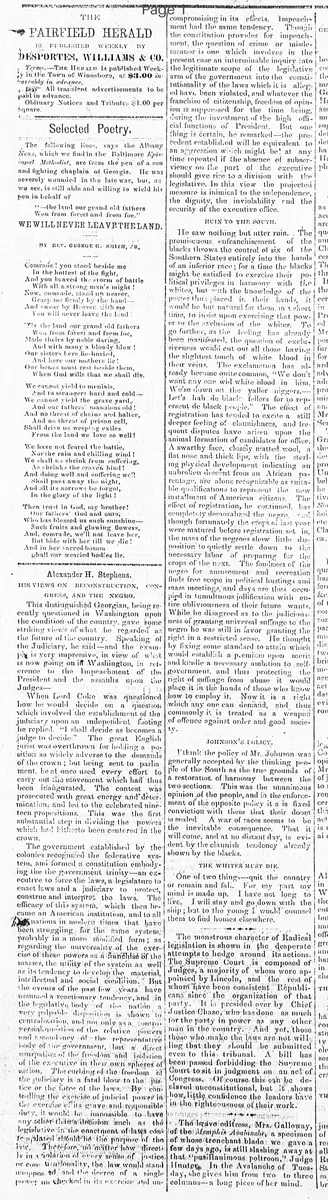
This distinguished Georgian, being recently questioned in Washington upon the condition of the country, gave some striking views of what he regarded as the future of the country. Speaking of the Judiciary, he said--and the exam. is very impressive, in view of what is now going on in Washington, in reference to the Impeachment of the President and the assaults upon the Judges--
When Lord Coke was questioned how he would decide on a question which involved the establishment of the judiciary upon an independent footing he replied, "I shall decide as becomes a judge to decide."
The great English jurist was overthrown for holding a position so widely adverse to the demands of the crown; but being sent to parliament, he at once used every effort to carry out this movement which had thus been inaugurated. The contest was prosecuted with great energy and determination: and led to the celebrated nineteen propositions. This was the first substantial step in dividing the powers which had hitherto been centered in the crown.
The government established by the colonies recognized the federative system, and formed a constitution embodying the government trinity--an executive to force the laws, legislature to enact laws and judiciary to protect, construe and interpret the laws. The efficacy of this system, which then became an American institution, and to all nations in modern times that have been struggling for the same system; probably in a more modified form; as regarding the universality of the exercise of these powers as franchises of the masses, the utility of the system as well as its tendency to develop the material, intellectual and social condition. But the events of the past few years have assumed a reactionary tendency, and in the legislative body of the nation a very palpable disposition is shown to centralization, and not only as a controversial question of the relative powers at and as a means of the representative body of the government, but a direct usurpation of the freedom and isolation of the executive in their own spheres of action. The curbing of the freedom of the judiciary is a fatal blow to the justice or the force of the laws, as by curbing the exercise of judicial power in the exercise of its grave and responsible duty, it would be impossible to have any other check or guard such as the legislative in the enactment of laws contemplated should be the purpose of the law. "Therefore," no matter how directly it is in violation of every sense of justice or constitutionality, the law would stand unopposed and the decree of a single power unchecked in its exercise and uncompromising in its effects. Impeachment had the same tendency. Though the constitution provides for impeachment, the question of crime or misdemeanor is one which involves in the present case an interminable inquiry into the legitimate scope of the legislative arm of the government into the constitutionality of the laws which it is alleged have been violated, and whatever the franchise of citizenship, freedom of opinion is suppressed for the time being during the investment of the high official functions of President. But one thing is certain, he remarked--the precedent established will be equivalent to an aggression which might be at any time repeated if the absence of subserviency on the part of the executive should give rise to a division with the legislative. In this view the projected measure is inimical to the independence, the dignity, the inviolability and the security of the executive office.
JOIN TO THE SOUTH.
He saw nothing but utter ruin. The promiscuous enfranchisement of the blacks throws the control of six of the Southern States entirely into the hands of an inferior race: for a time the blacks might be satisfied to exercise their political privileges in harmony with the whites, but with the knowledge of the power thus placed in their hands it would be but natural for them, in a short time, to insist upon exercising that power to the exclusion of the whites. To go further, as the feeling has already been manifested, the question of exclusiveness would cut out all those having the slightest touch of white blood in their veins. The exclamation has already become quite common, "We don't want any one wid white blood in him. We'se down on the yaller niggors.-- Let's hab de black fellers for to represent de black people." The effect of registration has tended to excite a still deeper feeling of clannishness, and frequent disputes have arisen upon the animal formation of candidates for office. A swarthy face, closely matted wool, a flat nose and thick lips, with the sterling physical development indicating an unbroken descent from an African parentage, are alone recognizable as suitable qualifications to represent the new installment of American citizens. The effect of registration, he continued, has completely demoralized the negro, and though fortunately the crops of last year were matured before registration set in, the mass of the negroes show little disposition to quietly settle down to the necessary labor of preparing for the crops of the next. The fondness of the negro for amusement and recreation finds free scope in political meetings and mass meetings, and days are thus occupied in tumultuous jollification with entire obliviousness of their future wants. While he disagreed as to the judiciousness of granting universal suffrage to the negro he was still in favor granting the right in a restricted sense. He thought by fixing some standard to attain which would establish a premium upon merit and kindle a necessary ambition to self-government, and thus protecting the right of suffrage from abuse it would place it in the hands of those who know how to employ it. Now it is a right which any one can demand, and thus commonly it is treated as a weapon of offence against order and good society.
JOHNSON'S POLICY.
I think the policy of Mr. Johnson was generally accepted by the thinking people of the South as the true grounds of a restoration of harmony between the two sections. This was the unanimous opinion of the people, and in the enforcement of the opposite policy it is a fixed conviction with them that their doom is sealed. A war of races seems to be the inevitable consequence. That it will come, and at no distant day, is evident by the clannish tendency already shown by the blacks.
THE WHITES MUST DIE.
One of two things--quit the country or remain and fall. For my part my mind is made up. I have not long to live. I will stay and go down with the ship; but to the young I would counsel them to find homes elsewhere. The monstrous character of Radical legislation is shown in the desperate attempts to hedge around its actions. The Supreme Court is composed of Judges, a majority of whom were appointed by Lincoln, and the rest of whom have been consistent Republicans since the organization of that party. It is presided over by Chief Justice Chase, who has done as much for the party in power as any other man in the country. And yet, those who make the laws are not willing that they should be submitted even to this tribunal. A bill has been passed forbidding the Supreme Court to sit in judgment on an act of Congress. Of course this can be declared unconstitutional, but it shows how little confidence the leaders have in the righteousness of their work. The brave editress, Mrs. Galloway, of the Memphis Avalanche, a specimen of whose trenchant blade we gave a few days ago, is still slashing away at that "pusillanimous poltroon," Judge Hunter. In the Avalanche of Tuesday, she gives him from two to three columns--a long piece of her mind.
HIS VIEWS ON RECONSTRUCTION, CONGRESS, AND THE NEGRO.
This distinguished Georgian, being recently questioned in Washington upon the condition of the country, gave some striking views of what he regarded as the future of the country. Speaking of the Judiciary, he said--and the exam. is very impressive, in view of what is now going on in Washington, in reference to the Impeachment of the President and the assaults upon the Judges--
When Lord Coke was questioned how he would decide on a question which involved the establishment of the judiciary upon an independent footing he replied, "I shall decide as becomes a judge to decide."
The great English jurist was overthrown for holding a position so widely adverse to the demands of the crown; but being sent to parliament, he at once used every effort to carry out this movement which had thus been inaugurated. The contest was prosecuted with great energy and determination: and led to the celebrated nineteen propositions. This was the first substantial step in dividing the powers which had hitherto been centered in the crown.
The government established by the colonies recognized the federative system, and formed a constitution embodying the government trinity--an executive to force the laws, legislature to enact laws and judiciary to protect, construe and interpret the laws. The efficacy of this system, which then became an American institution, and to all nations in modern times that have been struggling for the same system; probably in a more modified form; as regarding the universality of the exercise of these powers as franchises of the masses, the utility of the system as well as its tendency to develop the material, intellectual and social condition. But the events of the past few years have assumed a reactionary tendency, and in the legislative body of the nation a very palpable disposition is shown to centralization, and not only as a controversial question of the relative powers at and as a means of the representative body of the government, but a direct usurpation of the freedom and isolation of the executive in their own spheres of action. The curbing of the freedom of the judiciary is a fatal blow to the justice or the force of the laws, as by curbing the exercise of judicial power in the exercise of its grave and responsible duty, it would be impossible to have any other check or guard such as the legislative in the enactment of laws contemplated should be the purpose of the law. "Therefore," no matter how directly it is in violation of every sense of justice or constitutionality, the law would stand unopposed and the decree of a single power unchecked in its exercise and uncompromising in its effects. Impeachment had the same tendency. Though the constitution provides for impeachment, the question of crime or misdemeanor is one which involves in the present case an interminable inquiry into the legitimate scope of the legislative arm of the government into the constitutionality of the laws which it is alleged have been violated, and whatever the franchise of citizenship, freedom of opinion is suppressed for the time being during the investment of the high official functions of President. But one thing is certain, he remarked--the precedent established will be equivalent to an aggression which might be at any time repeated if the absence of subserviency on the part of the executive should give rise to a division with the legislative. In this view the projected measure is inimical to the independence, the dignity, the inviolability and the security of the executive office.
JOIN TO THE SOUTH.
He saw nothing but utter ruin. The promiscuous enfranchisement of the blacks throws the control of six of the Southern States entirely into the hands of an inferior race: for a time the blacks might be satisfied to exercise their political privileges in harmony with the whites, but with the knowledge of the power thus placed in their hands it would be but natural for them, in a short time, to insist upon exercising that power to the exclusion of the whites. To go further, as the feeling has already been manifested, the question of exclusiveness would cut out all those having the slightest touch of white blood in their veins. The exclamation has already become quite common, "We don't want any one wid white blood in him. We'se down on the yaller niggors.-- Let's hab de black fellers for to represent de black people." The effect of registration has tended to excite a still deeper feeling of clannishness, and frequent disputes have arisen upon the animal formation of candidates for office. A swarthy face, closely matted wool, a flat nose and thick lips, with the sterling physical development indicating an unbroken descent from an African parentage, are alone recognizable as suitable qualifications to represent the new installment of American citizens. The effect of registration, he continued, has completely demoralized the negro, and though fortunately the crops of last year were matured before registration set in, the mass of the negroes show little disposition to quietly settle down to the necessary labor of preparing for the crops of the next. The fondness of the negro for amusement and recreation finds free scope in political meetings and mass meetings, and days are thus occupied in tumultuous jollification with entire obliviousness of their future wants. While he disagreed as to the judiciousness of granting universal suffrage to the negro he was still in favor granting the right in a restricted sense. He thought by fixing some standard to attain which would establish a premium upon merit and kindle a necessary ambition to self-government, and thus protecting the right of suffrage from abuse it would place it in the hands of those who know how to employ it. Now it is a right which any one can demand, and thus commonly it is treated as a weapon of offence against order and good society.
JOHNSON'S POLICY.
I think the policy of Mr. Johnson was generally accepted by the thinking people of the South as the true grounds of a restoration of harmony between the two sections. This was the unanimous opinion of the people, and in the enforcement of the opposite policy it is a fixed conviction with them that their doom is sealed. A war of races seems to be the inevitable consequence. That it will come, and at no distant day, is evident by the clannish tendency already shown by the blacks.
THE WHITES MUST DIE.
One of two things--quit the country or remain and fall. For my part my mind is made up. I have not long to live. I will stay and go down with the ship; but to the young I would counsel them to find homes elsewhere. The monstrous character of Radical legislation is shown in the desperate attempts to hedge around its actions. The Supreme Court is composed of Judges, a majority of whom were appointed by Lincoln, and the rest of whom have been consistent Republicans since the organization of that party. It is presided over by Chief Justice Chase, who has done as much for the party in power as any other man in the country. And yet, those who make the laws are not willing that they should be submitted even to this tribunal. A bill has been passed forbidding the Supreme Court to sit in judgment on an act of Congress. Of course this can be declared unconstitutional, but it shows how little confidence the leaders have in the righteousness of their work. The brave editress, Mrs. Galloway, of the Memphis Avalanche, a specimen of whose trenchant blade we gave a few days ago, is still slashing away at that "pusillanimous poltroon," Judge Hunter. In the Avalanche of Tuesday, she gives him from two to three columns--a long piece of her mind.
What sub-type of article is it?
Biography
Historical Event
What themes does it cover?
Misfortune
Justice
Social Manners
What keywords are associated?
Reconstruction
Judiciary Independence
Negro Enfranchisement
Racial Conflict
Johnson Policy
Radical Legislation
What entities or persons were involved?
Alexander H. Stephens
Lord Coke
Mr. Johnson
Mrs. Galloway
Judge Hunter
Chief Justice Chase
Where did it happen?
Washington, Southern States
Story Details
Key Persons
Alexander H. Stephens
Lord Coke
Mr. Johnson
Mrs. Galloway
Judge Hunter
Chief Justice Chase
Location
Washington, Southern States
Event Date
Recently
Story Details
Stephens critiques threats to judicial and executive independence, warns of ruin from black enfranchisement leading to racial exclusion and conflict in the South, supports restricted suffrage and Johnson's policy, and criticizes Radical measures limiting court review.