Thank you for visiting SNEWPapers!
Sign up free
Literary
January 24, 1903
Willmar Tribune
Willmar, Kandiyohi County, Minnesota
What is this article about?
A historical narrative recounting the January 11, 1863, naval battle off Galveston where the Confederate cruiser Alabama lured and sank the Union gunboat Hatteras in 13 minutes, capturing its crew. Written for the 40th anniversary by George L. Kilmer.
Clipping
OCR Quality
95%
Excellent
Full Text
TWICE-A-WEEK WILLMAR TRIBUNE
A FORTIETH ANNIVERSARY WAR STORY
First Fight of January 11, 1863 The Alabama
[Copyright, 1903, by G. L. Kilmer.]
Soon after noon the 11th of January, 1863, the Confederate cruiser Alabama was sighted by the Federal blockading fleet off the port of Galveston. Captain Semmes of the Alabama had steered his course for Galveston in the expectation of stirring adventures with the enemy's transport ships which he supposed to be in the harbor of Galveston. To his surprise he found warships guarding the port, and also to his surprise as well as satisfaction the outlook in the cruiser's tops called out in succession, "Sail ho!" and, "One of the steamers, sir, is coming out in chase of us." Semmes decided to be chased until he had lured the stranger away from her consorts.
Using her sails and a small head of steam, the Alabama drew the stranger, which proved to be the United States steam gunboat Hatteras, a distance of twenty miles from the rest of the fleet. Then the sails were furled on the cruiser, the crew summoned to quarters, and her head put about as a signal for combat. The ships kept their course until within 100 yards of each other, when the Hatteras hailed and received the answer, "This is her Britannic majesty's steamer Petrel." Then the Alabama hailed and heard only the words, "United States ship"—but that was enough for Semmes. There was an awkward pause, during which the Alabama's officers got ready for action and her executive officer sang out through his trumpet, "This is the Confederate States steamer Alabama," while a broadside from the guns emphasized the startling message.
Captain Blake of the Hatteras was not deceived by the ruse of denying colors. He had come out expecting to meet the Alabama, and his men stood at the guns. The Confederate broadside was instantly returned. Blake was anxious to fight, for his ship was foul and in poor trim for a long chase. He tried to lay the Hatteras alongside of the cruiser and attack by boarders, but the Alabama was the fleeter ship and kept out of reach of her antagonist. However, the ships were only thirty yards apart at one time, and the fighting men aboard exchanged pistol and musket shots.
After the failure to board, the ships steamed along on parallel lines, fighting broadside to broadside. Semmes' crew handled their guns with spirit, for it was the first fight of the cruiser, her previous adventures while crossing the Atlantic from England having been the capture of unarmed ships flying the United States flag.
The shells of the Hatteras tore several holes in the cruiser, one at the water line, but the damage didn't cripple her fighting powers. But the Hatteras was severely punished from the start. She was not in the first class as a warship and soon took fire in two places from the enemy's shells. One shell smashed her steam cylinder, filling the engine room and deck with steam, and another smashed the walking beam, making her engine useless.
Blake quickly saw that the Alabama was more than his match, but he hoped to prolong the fight until his consorts reached the scene. But calamities greater than the firing of the ship and the loss of the engine power soon followed. Several of the Alabama's shells crashed through the Hatteras, at the water line, and the water rushed in in a flood which threatened to sink the ship. The loss of the steam cylinder disabled the pumps and also crippled the steering machinery. Meanwhile the Alabama kept a safe distance and so maneuvered as to rake the helpless Federal across the deck.
With the pumps disabled Blake had no means of fighting the fire, which was nearing the magazine. To save the ship from explosion he flooded the ammunition chamber, thus rendering the guns useless. The ship was slowly sinking. Every moment of delay in the catastrophe meant the saving of lives and Blake ordered the guns not engaged to be cast overboard to lighten ship. At the same time a gun fired to leeward announced to the Alabama that the Hatteras gave up the fight.
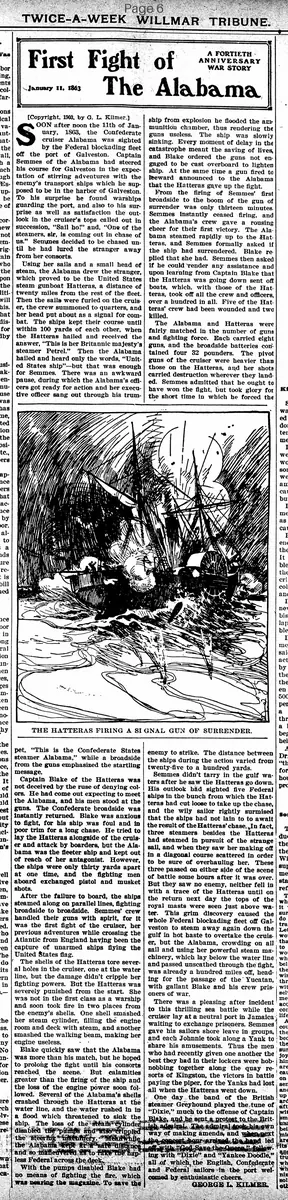
From the firing of Semmes' first broadside to the boom of the gun of surrender was only thirteen minutes. Semmes instantly ceased firing, and the Alabama's crew gave a rousing cheer for their first victory. The Alabama steamed rapidly up to the Hatteras, and Semmes formally asked if the ship had surrendered. Blake replied that she had. Semmes then asked if he could render any assistance and upon learning from Captain Blake that the Hatteras was going down sent off boats, which, with those of the Hatteras, took off all the crew and officers over a hundred in all. Five of the Hatteras' crew had been wounded and two killed.
The Alabama and Hatteras were fairly matched in the number of guns and fighting force. Each carried eight guns, and the broadside batteries contained four 32 pounders. The pivot guns of the cruiser were heavier than those on the Hatteras, and her shots carried destruction wherever they landed. Semmes admitted that he ought to have won the fight, but took glory for the short time in which he forced the enemy to strike. The distance between the ships during the action varied from twenty-five to a hundred yards.
Semmes didn't tarry in the gulf waters after he saw the Hatteras go down. His lookout had sighted five Federal ships in the bunch from which the Hatteras had cut loose to take up the chase, and the wily sailor rightly surmised that the ships had not lain to to await the result of the Hatteras' chase. In fact, three steamers besides the Hatteras had steamed in pursuit of the strange sail, and when they saw her making off in a diagonal course scattered in order to be sure of overhauling her. These three passed on either side of the scene of battle some hours after it was over. But they saw no enemy, neither fell in with a trace of the Hatteras until on the return next day the tops of the royal masts were seen just above water. This grim discovery caused the whole Federal blockading fleet off Galveston to steam away again down the gulf in hot haste to overtake the cruiser, but the Alabama, crowding on all sail and using her powerful steam machinery, which lay below the water line and passed unscathed through the fight was already a hundred miles off, heading for the passage of the Yucatan, with gallant Blake and his crew prisoners of war.
There was a pleasing after incident to this thrilling sea battle while the cruiser lay at a neutral port in Jamaica waiting to exchange prisoners. Semmes gave his sailors shore leave in groups, and each Johnnie took along a Yank to share his amusements. Thus the men who had recently given one another the best they had in their lockers were hobnobbing together along the quay resorts of Kingston, the victors in battle paying the piper, for the Yanks had lost all when the Hatteras went down.
One day the band of the British steamer Greyhound played the tune of "Dixie," much to the offense of Captain Blake, and he sent a protest to the British admiral. The admiral took his own way of making amends, and when next the concert hour arrived the band led off with "God Save the Queen," following with "Dixie" and "Yankee Doodle," all of which the English, Confederate and Federal sailors in the port welcomed by enthusiastic cheers.
GEORGE L. KILMER
A FORTIETH ANNIVERSARY WAR STORY
First Fight of January 11, 1863 The Alabama
[Copyright, 1903, by G. L. Kilmer.]
Soon after noon the 11th of January, 1863, the Confederate cruiser Alabama was sighted by the Federal blockading fleet off the port of Galveston. Captain Semmes of the Alabama had steered his course for Galveston in the expectation of stirring adventures with the enemy's transport ships which he supposed to be in the harbor of Galveston. To his surprise he found warships guarding the port, and also to his surprise as well as satisfaction the outlook in the cruiser's tops called out in succession, "Sail ho!" and, "One of the steamers, sir, is coming out in chase of us." Semmes decided to be chased until he had lured the stranger away from her consorts.
Using her sails and a small head of steam, the Alabama drew the stranger, which proved to be the United States steam gunboat Hatteras, a distance of twenty miles from the rest of the fleet. Then the sails were furled on the cruiser, the crew summoned to quarters, and her head put about as a signal for combat. The ships kept their course until within 100 yards of each other, when the Hatteras hailed and received the answer, "This is her Britannic majesty's steamer Petrel." Then the Alabama hailed and heard only the words, "United States ship"—but that was enough for Semmes. There was an awkward pause, during which the Alabama's officers got ready for action and her executive officer sang out through his trumpet, "This is the Confederate States steamer Alabama," while a broadside from the guns emphasized the startling message.
Captain Blake of the Hatteras was not deceived by the ruse of denying colors. He had come out expecting to meet the Alabama, and his men stood at the guns. The Confederate broadside was instantly returned. Blake was anxious to fight, for his ship was foul and in poor trim for a long chase. He tried to lay the Hatteras alongside of the cruiser and attack by boarders, but the Alabama was the fleeter ship and kept out of reach of her antagonist. However, the ships were only thirty yards apart at one time, and the fighting men aboard exchanged pistol and musket shots.
After the failure to board, the ships steamed along on parallel lines, fighting broadside to broadside. Semmes' crew handled their guns with spirit, for it was the first fight of the cruiser, her previous adventures while crossing the Atlantic from England having been the capture of unarmed ships flying the United States flag.
The shells of the Hatteras tore several holes in the cruiser, one at the water line, but the damage didn't cripple her fighting powers. But the Hatteras was severely punished from the start. She was not in the first class as a warship and soon took fire in two places from the enemy's shells. One shell smashed her steam cylinder, filling the engine room and deck with steam, and another smashed the walking beam, making her engine useless.
Blake quickly saw that the Alabama was more than his match, but he hoped to prolong the fight until his consorts reached the scene. But calamities greater than the firing of the ship and the loss of the engine power soon followed. Several of the Alabama's shells crashed through the Hatteras, at the water line, and the water rushed in in a flood which threatened to sink the ship. The loss of the steam cylinder disabled the pumps and also crippled the steering machinery. Meanwhile the Alabama kept a safe distance and so maneuvered as to rake the helpless Federal across the deck.
With the pumps disabled Blake had no means of fighting the fire, which was nearing the magazine. To save the ship from explosion he flooded the ammunition chamber, thus rendering the guns useless. The ship was slowly sinking. Every moment of delay in the catastrophe meant the saving of lives and Blake ordered the guns not engaged to be cast overboard to lighten ship. At the same time a gun fired to leeward announced to the Alabama that the Hatteras gave up the fight.
From the firing of Semmes' first broadside to the boom of the gun of surrender was only thirteen minutes. Semmes instantly ceased firing, and the Alabama's crew gave a rousing cheer for their first victory. The Alabama steamed rapidly up to the Hatteras, and Semmes formally asked if the ship had surrendered. Blake replied that she had. Semmes then asked if he could render any assistance and upon learning from Captain Blake that the Hatteras was going down sent off boats, which, with those of the Hatteras, took off all the crew and officers over a hundred in all. Five of the Hatteras' crew had been wounded and two killed.
The Alabama and Hatteras were fairly matched in the number of guns and fighting force. Each carried eight guns, and the broadside batteries contained four 32 pounders. The pivot guns of the cruiser were heavier than those on the Hatteras, and her shots carried destruction wherever they landed. Semmes admitted that he ought to have won the fight, but took glory for the short time in which he forced the enemy to strike. The distance between the ships during the action varied from twenty-five to a hundred yards.
Semmes didn't tarry in the gulf waters after he saw the Hatteras go down. His lookout had sighted five Federal ships in the bunch from which the Hatteras had cut loose to take up the chase, and the wily sailor rightly surmised that the ships had not lain to to await the result of the Hatteras' chase. In fact, three steamers besides the Hatteras had steamed in pursuit of the strange sail, and when they saw her making off in a diagonal course scattered in order to be sure of overhauling her. These three passed on either side of the scene of battle some hours after it was over. But they saw no enemy, neither fell in with a trace of the Hatteras until on the return next day the tops of the royal masts were seen just above water. This grim discovery caused the whole Federal blockading fleet off Galveston to steam away again down the gulf in hot haste to overtake the cruiser, but the Alabama, crowding on all sail and using her powerful steam machinery, which lay below the water line and passed unscathed through the fight was already a hundred miles off, heading for the passage of the Yucatan, with gallant Blake and his crew prisoners of war.
There was a pleasing after incident to this thrilling sea battle while the cruiser lay at a neutral port in Jamaica waiting to exchange prisoners. Semmes gave his sailors shore leave in groups, and each Johnnie took along a Yank to share his amusements. Thus the men who had recently given one another the best they had in their lockers were hobnobbing together along the quay resorts of Kingston, the victors in battle paying the piper, for the Yanks had lost all when the Hatteras went down.
One day the band of the British steamer Greyhound played the tune of "Dixie," much to the offense of Captain Blake, and he sent a protest to the British admiral. The admiral took his own way of making amends, and when next the concert hour arrived the band led off with "God Save the Queen," following with "Dixie" and "Yankee Doodle," all of which the English, Confederate and Federal sailors in the port welcomed by enthusiastic cheers.
GEORGE L. KILMER
What sub-type of article is it?
Prose Fiction
What themes does it cover?
War Peace
What keywords are associated?
Civil War
Naval Battle
Alabama
Hatteras
Semmes
Blake
Galveston
Confederate Cruiser
What entities or persons were involved?
George L. Kilmer [Copyright, 1903, By G. L. Kilmer.]
Literary Details
Title
A Fortieth Anniversary War Story First Fight Of January 11, 1863 The Alabama
Author
George L. Kilmer [Copyright, 1903, By G. L. Kilmer.]
Subject
Fortieth Anniversary Of The Alabama Hatteras Battle
Form / Style
Historical Naval Battle Narrative In Prose
Key Lines
Soon After Noon The 11th Of January, 1863, The Confederate Cruiser Alabama Was Sighted By The Federal Blockading Fleet Off The Port Of Galveston.
From The Firing Of Semmes' First Broadside To The Boom Of The Gun Of Surrender Was Only Thirteen Minutes.
Semmes Instantly Ceased Firing, And The Alabama's Crew Gave A Rousing Cheer For Their First Victory.