Thank you for visiting SNEWPapers!
Sign up free
Editorial
July 21, 1809
Virginia Argus
Richmond, Virginia
What is this article about?
An editorial criticizes Federalist newspapers for exaggerating French captures of American vessels while ignoring British impressments of seamen. It accuses Federalists of loyalty to the British government and warns Republicans against uniting with them on Federalist terms, seeing it as a ploy to regain influence.
Clipping
OCR Quality
98%
Excellent
Full Text
WHAT DOES IT PROVE?
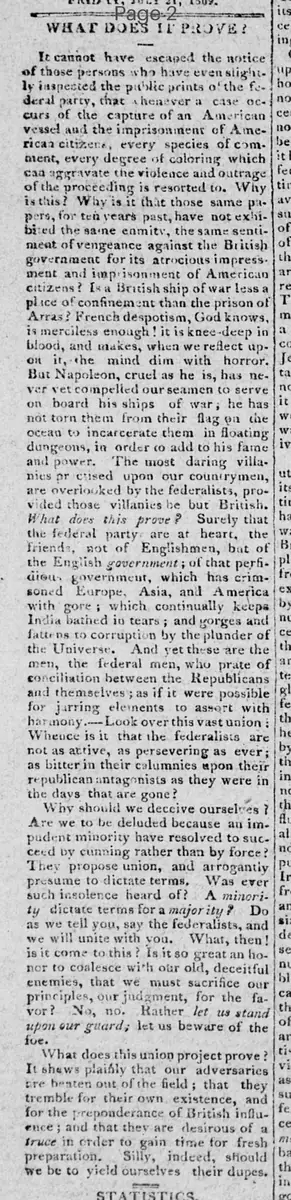
It cannot have escaped the notice of those persons who have even slightly inspected the public prints of the federal party, that whenever a case occurs of the capture of an American vessel and the imprisonment of American citizens, every species of comment, every degree of coloring which can aggravate the violence and outrage of the proceeding is resorted to. Why is this? Why is it that those same papers, for ten years past, have not exhibited the same enmity, the same sentiment of vengeance against the British government for its atrocious impressment and imprisonment of American citizens? Is a British ship of war less a place of confinement than the prison of Arras? French despotism, God knows, is merciless enough! It is knee-deep in blood, and makes, when we reflect upon it, the mind dim with horror. But Napoleon, cruel as he is, has never yet compelled our seamen to serve on board his ships of war; he has not torn them from their flag on the ocean to incarcerate them in floating dungeons, in order to add to his fame and power. The most daring villainies practiced upon our countrymen, are overlooked by the federalists, provided those villainies be but British. What does this prove? Surely that the federal party are at heart, the friends, not of Englishmen, but of the English government; of that perfidious government, which has crimsoned Europe, Asia, and America with gore; which continually keeps India bathed in tears; and gorges and fattens to corruption by the plunder of the Universe. And yet these are the men, the federal men, who prate of conciliation between the Republicans and themselves; as if it were possible for jarring elements to assort with harmony.… Look over this vast union: Whence is it that the federalists are not as active, as persevering as ever; as bitter in their calumnies upon their republican antagonists as they were in the days that are gone? Why should we deceive ourselves? Are we to be deluded because an impudent minority have resolved to succeed by cunning rather than by force? They propose union, and arrogantly presume to dictate terms. Was ever such insolence heard of? A minority dictate terms for a majority? Do as we tell you, say the federalists, and we will unite with you. What, then! is it come to this? Is it so great an honor to coalesce with our old, deceitful enemies, that we must sacrifice our principles, our judgment, for the favor? No, no. Rather let us stand upon our guard; let us beware of the foe. What does this union project prove? It shews plainly that our adversaries are beaten out of the field; that they tremble for their own existence, and for the preponderance of British influence; and that they are desirous of a truce in order to gain time for fresh preparation. Silly, indeed, should we be to yield ourselves their dupes.
It cannot have escaped the notice of those persons who have even slightly inspected the public prints of the federal party, that whenever a case occurs of the capture of an American vessel and the imprisonment of American citizens, every species of comment, every degree of coloring which can aggravate the violence and outrage of the proceeding is resorted to. Why is this? Why is it that those same papers, for ten years past, have not exhibited the same enmity, the same sentiment of vengeance against the British government for its atrocious impressment and imprisonment of American citizens? Is a British ship of war less a place of confinement than the prison of Arras? French despotism, God knows, is merciless enough! It is knee-deep in blood, and makes, when we reflect upon it, the mind dim with horror. But Napoleon, cruel as he is, has never yet compelled our seamen to serve on board his ships of war; he has not torn them from their flag on the ocean to incarcerate them in floating dungeons, in order to add to his fame and power. The most daring villainies practiced upon our countrymen, are overlooked by the federalists, provided those villainies be but British. What does this prove? Surely that the federal party are at heart, the friends, not of Englishmen, but of the English government; of that perfidious government, which has crimsoned Europe, Asia, and America with gore; which continually keeps India bathed in tears; and gorges and fattens to corruption by the plunder of the Universe. And yet these are the men, the federal men, who prate of conciliation between the Republicans and themselves; as if it were possible for jarring elements to assort with harmony.… Look over this vast union: Whence is it that the federalists are not as active, as persevering as ever; as bitter in their calumnies upon their republican antagonists as they were in the days that are gone? Why should we deceive ourselves? Are we to be deluded because an impudent minority have resolved to succeed by cunning rather than by force? They propose union, and arrogantly presume to dictate terms. Was ever such insolence heard of? A minority dictate terms for a majority? Do as we tell you, say the federalists, and we will unite with you. What, then! is it come to this? Is it so great an honor to coalesce with our old, deceitful enemies, that we must sacrifice our principles, our judgment, for the favor? No, no. Rather let us stand upon our guard; let us beware of the foe. What does this union project prove? It shews plainly that our adversaries are beaten out of the field; that they tremble for their own existence, and for the preponderance of British influence; and that they are desirous of a truce in order to gain time for fresh preparation. Silly, indeed, should we be to yield ourselves their dupes.
What sub-type of article is it?
Partisan Politics
Foreign Affairs
What keywords are associated?
Federalist Hypocrisy
British Impressment
American Seamen
Political Union
Republican Principles
British Influence
What entities or persons were involved?
Federal Party
Republicans
British Government
Napoleon
Editorial Details
Primary Topic
Federalist Bias Toward Britain And Rejection Of Political Union
Stance / Tone
Strongly Anti Federalist And Anti British Government
Key Figures
Federal Party
Republicans
British Government
Napoleon
Key Arguments
Federalist Papers Exaggerate French Captures But Ignore British Impressments
Federalists Are Loyal To The British Government Despite Its Atrocities
French Despotism Is Cruel But Does Not Impress American Seamen
Federalists Propose Union To Dictate Terms To The Republican Majority
Republicans Should Resist Federalist Deception And Maintain Guard