Thank you for visiting SNEWPapers!
Sign up free
Alexandria Gazette & Advertiser
Alexandria, Virginia
What is this article about?
A Canadian correspondent in the New York Albion praises the recent commissioners' decision on the US-Canada boundary under the Treaty of Ghent's 6th article, noting favorable outcomes for Great Britain, including key islands like Grand Island near Kingston and Isle Bois-Blanc, enhancing military and territorial interests.
Clipping
OCR Quality
Full Text
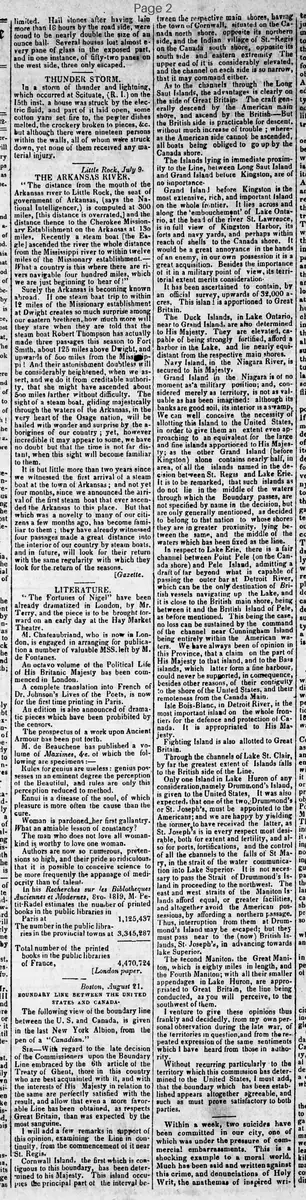
The following view of the boundary line between the U.S. and Canada, is given in the last New York Albion, from the pen of a "Canadian."
SIR—With regard to the late decision of the Commissioners upon the Boundary Line embraced by the 6th article of the Treaty of Ghent, those in this country who are best acquainted with it, and with the interests of His Majesty in relation to the same are perfectly satisfied with the result, and allow that even a more favorable Line has been obtained, as respects Great Britain, than was expected by the most sanguine.
I will add a few remarks in support of this opinion, examining the Line in continuity, from the commencement of it near St. Regis.
Cornwall Island, the first which is contiguous to this boundary, has been determined to his Majesty. This island occupies the principal part of the interval between the respective main shores, having the town of Cornwall, situated on the Canada north shore, opposite its northern side, and the Indian village of St. Regis on the Canada south shore, opposite its south side and eastern extremity. The upper end of it is considerably elevated, and the channel on each side is so narrow, that it may command either.
As to the channels through the Long Saut Islands, the advantage is clearly on the side of Great Britain. The craft generally descend by the American main shore, and ascend by the British. But the British side is practicable for descent, without much increase of trouble; whereas the American side cannot be ascended, all boats being obliged to go up by the Canada shore.
The Islands lying in immediate proximity to the Line, between Long Saut Island and Grand Island before Kingston, are of no importance.
Grand Island before Kingston is the most extensive, rich, and important Island on the whole frontier. It lies across and along the 'embouchement' of Lake Ontario, at the head of the river St. Lawrence, is in full view of Kingston Harbor, its forts and navy yards, and perhaps within reach of shells to the Canada shore. It would be a great annoyance in the hands of an enemy, in our own possession it is a great acquisition. Besides the importance of it in a military point of view, its territorial extent merits consideration—It has been ascertained to contain, by an official survey, upwards of 32,000 acres. This island is apportioned to Great Britain.
The Duck Islands, in Lake Ontario, near to Grand Island, are also determined to His Majesty. They are elevated, capable of being strongly fortified, afford a harbor in the Lake, and lie nearly equidistant from the respective main shores.
Navy Island, in the Niagara River, is secured to his Majesty.
Grand Island in the Niagara is of no moment as a military position; and, considered merely as territory, is not as valuable as has been imagined: although its banks are good soil, its interior is a swamp.
We can well conceive the necessity of allotting this Island to the United States, in order to give them an extent even approaching to an equivalent for the large and fine islands apportioned to His Majesty; as the other Grand Island (before Kingston) alone contains nearly half, in area, of all the islands named in the decision between St. Regis and Lake Erie.
It is to be remarked, that such islands as do not lie in the middle of the waters through which the Boundary passes, are not specified by name in the decision, but are only generally mentioned, as decided to belong to that nation to whose shores they are in greater proximity, lying between the same, and the middle of the waters which has been fixed as the line.
In respect to Lake Erie, there is a fair channel between Point Pele (on the Canada shore) and Pele Island, admitting a draft of far beyond what is capable of passing the outer bar at Detroit River, which can be the only destination of British vessels navigating up the Lake, and it is close to the British main shore, being between it and the British Island of Pele, as before mentioned. This being the case, no loss can be sustained by the command of the channel near Cunningham Island being entirely within the American waters. We have always been of opinion in this Province, that a claim on the part of His Majesty to that island, and to the Bass islands, which latter form a fine harbour, could never be supported, in consequence, besides other reasons, of their contiguity to the shore of the United States, and their remoteness from the Canada Main.
Isle Bois-Blanc, in Detroit River, is the most important island on the whole frontier, for the defence and protection of Canada. It is appropriated to His Majesty.
Fighting Island is also allotted to Great Britain.
Through the channels of Lake St. Clair, by far the greatest extent of Islands falls to the British side of the Line.
Only one Island in Lake Huron of any consideration, namely Drummond's Island, is given to the United States. It was also expected, that one of the two, Drummond's or St. Joseph's, must be appointed to the Americans; and we are happy by yielding the former to have received the latter, as St. Joseph's is in every respect most desirable, both for extent and fertility, and also for ports, fortifications, and the control of all the channels to the falls of St. Mary, in the strait of the water communication into Lake Superior. It is not necessary to pass the Strait of Drummond's Island in proceeding to the northwest. The east and west straits of the Maniton Islands afford equal, or greater facilities, and altogether avoid the American possessions, by affording a northern passage. Thus, interruption from them at Drummond's Island may be escaped; but they must pass near to the (now) British Islands, St. Joseph's, in advancing towards Lake Superior.
The second Maniton, the Great Maniton, which is eighty miles in length, and the Fourth Maniton; with all their smaller appendages in Lake Huron, are appropriated to Great Britain, the line being conducted, as you will perceive, to the southwest of them.
I venture to give these opinions thus frankly and decidedly, from my own personal observation during the late war, of the territories in question, and from the repeated expression of the same sentiments which I have heard from those in authority.
Without recurring particularly to the territory which this commission has determined to the United States, I must add, that the boundary which has been established appears altogether agreeable, and such as must prove satisfactory to both parties.
What sub-type of article is it?
What keywords are associated?
What entities or persons were involved?
Where did it happen?
Foreign News Details
Primary Location
Us Canada Boundary
Event Date
Late Decision Of The Commissioners
Key Persons
Outcome
favorable boundary line for great britain, including key islands like grand island (kingston), duck islands, navy island, isle bois-blanc, fighting island, st. joseph's island, and manitoulin islands; united states receives grand island (niagara), drummond's island, and others for equivalence.
Event Details
The commissioners' decision on the 6th article of the Treaty of Ghent assigns most significant islands and channels along the St. Lawrence River and Great Lakes to Great Britain, enhancing military and navigational advantages, while providing the US with compensatory territory; the author, a Canadian, expresses satisfaction based on personal observations.