Thank you for visiting SNEWPapers!
Sign up free
Editorial
October 21, 1911
The Gazette
Cleveland, Cuyahoga County, Ohio
What is this article about?
An editorial by R. D. Johnson advocates for educating children to develop observation skills, willpower, thought, action, citizenship, and practical Christian living, emphasizing its value over short-term economic savings in rural Arkansas.
Clipping
OCR Quality
98%
Excellent
Full Text
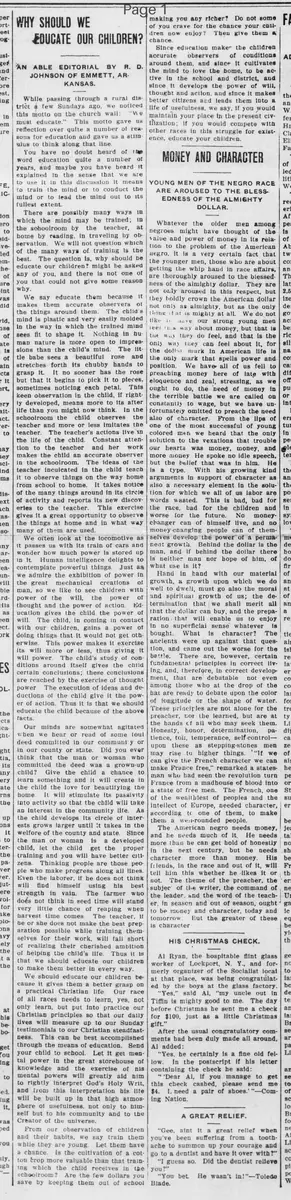
WHY SHOULD WE EDUCATE OUR CHILDREN?
AN ABLE EDITORIAL BY R. D. JOHNSON OF EMMETT, ARKANSAS.
While passing through a rural district a few Sundays ago, we noticed this motto on the church wall: "We must educate."
This motto gave us reflection over quite a number of reasons for education and gave us a stimulus to think along that line.
You have no doubt heard of the word education quite a number of years, and maybe you have heard it explained in the sense that we are to use it in this discussion it means to train the mind or to conduct the mind or to lead the mind out to its fullest extent.
There are possibly many ways in which the mind may be trained; in the schoolroom by the teacher, at home by reading, in traveling by observation. We will not question which of the many ways of training is the best. The question is, why should we educate our children? might be asked any of you, and there is not one of you that could not give some reason why.
We say educate them because it makes them accurate observers of the things around them. The child's mind is plastic and very easily molded in the way in which the trained mind sees fit to shape it. Nothing in human nature is more open to impressions than the child's mind. The little babe sees a beautiful rose and stretches forth its chubby hands to grasp it. It no sooner has the rose but that it begins to pick it to pieces, sometimes noticing each petal. This keen observation in the child, if rightly developed, means more to its after life than you might now think. In the schoolroom the child observes the teacher and more or less imitates the teacher. The teacher's actions live in the life of the child. Constant attention to the teacher and her work makes the child an accurate observer in the schoolroom. The ideas of the teacher inculcated in the child teach it to observe things on the way home from school to home. It takes notice of the many things around in its circle of activity and reports its new discoveries to the teacher. This exercise gives it a great opportunity to observe the things at home and in what way many of them are used.
We often look at the locomotive as it passes us with its train of cars and wonder how much power is stored up in it. Human intelligence delights to contemplate powerful things. Just as we admire the exhibition of power in the great mechanical creations of man, so we like to see children with power of the will, the power of thought and the power of action. Education gives the child the power of will. The child, in coming in contact with our children, gains a power of doing things that it would not get otherwise. This power makes it exercise its will more or less, thus giving it will power. The child's study of conditions around itself gives the child certain conclusions: these conclusions are reached by the exercise of thought power. The execution of ideas and deductions of the child give it the power of action. Thus it is that we should educate the child because of the above facts.
Our minds are somewhat agitated when we hear or read of some foul deed committed in our community or in our county or state. Did you ever think that the man or woman who committed the deed was a grown-up child? Give the child a chance to learn something and it will create in the child the love for beautifying the home. It will stimulate its passivity into activity so that the child will take an interest in the community life. As the child develops its circle of interests grows larger until it takes in the welfare of the county and state. Since the man or woman is a developed child, let the child get the proper training and you will have better citizens. Thinking people are those people who make progress along all lines. Even the laborer, if he does not think will find himself using his best strength in vain.
The farmer who does not think in seed time will stand very little chance of reaping when harvest time comes.
The teacher, if he or she does not make the best preparation possible while training themselves for their work, will fall short of realizing their cherished ambition of helping the child's life. Thus it is that we should educate our children to make them better in every way.
We should educate our children because it gives them a better grasp on a practical Christian life. Our race of all races needs to learn, yes, not only learn, but put into practice our Christian principles so that our daily lives will measure up to our Sunday testimonials to our Christian steadfastness. This can be best accomplished through the means of education. Send your child to school. Let it get mental power in the great storehouse of knowledge and the exercise of its mental powers will greatly aid him to rightly interpret God's Holy Writ, and from this interpretation his life will be built up in that high atmosphere of usefulness, not only to himself but to his community and to the Creator of the universe.
From our observation of children and their habits, we say train them while they are young. Let them have a chance. Is the cultivation of a cotton crop more valuable than that training which the child receives in the schoolroom? Are the few dollars you save by keeping them out of school making you any richer? Do not some of you crave for the chance your children now enjoy? Then give them a chance.
Since education makes the children accurate observers of conditions around them, and since it cultivates the mind to love the home, to be active in the school and district, and since it develops the power of will, thought and action, and since it makes better citizens and leads them into a life of usefulness, we say, if you would maintain your place in the present civilization; if you would compete with other races in this struggle for existence, educate your children.
AN ABLE EDITORIAL BY R. D. JOHNSON OF EMMETT, ARKANSAS.
While passing through a rural district a few Sundays ago, we noticed this motto on the church wall: "We must educate."
This motto gave us reflection over quite a number of reasons for education and gave us a stimulus to think along that line.
You have no doubt heard of the word education quite a number of years, and maybe you have heard it explained in the sense that we are to use it in this discussion it means to train the mind or to conduct the mind or to lead the mind out to its fullest extent.
There are possibly many ways in which the mind may be trained; in the schoolroom by the teacher, at home by reading, in traveling by observation. We will not question which of the many ways of training is the best. The question is, why should we educate our children? might be asked any of you, and there is not one of you that could not give some reason why.
We say educate them because it makes them accurate observers of the things around them. The child's mind is plastic and very easily molded in the way in which the trained mind sees fit to shape it. Nothing in human nature is more open to impressions than the child's mind. The little babe sees a beautiful rose and stretches forth its chubby hands to grasp it. It no sooner has the rose but that it begins to pick it to pieces, sometimes noticing each petal. This keen observation in the child, if rightly developed, means more to its after life than you might now think. In the schoolroom the child observes the teacher and more or less imitates the teacher. The teacher's actions live in the life of the child. Constant attention to the teacher and her work makes the child an accurate observer in the schoolroom. The ideas of the teacher inculcated in the child teach it to observe things on the way home from school to home. It takes notice of the many things around in its circle of activity and reports its new discoveries to the teacher. This exercise gives it a great opportunity to observe the things at home and in what way many of them are used.
We often look at the locomotive as it passes us with its train of cars and wonder how much power is stored up in it. Human intelligence delights to contemplate powerful things. Just as we admire the exhibition of power in the great mechanical creations of man, so we like to see children with power of the will, the power of thought and the power of action. Education gives the child the power of will. The child, in coming in contact with our children, gains a power of doing things that it would not get otherwise. This power makes it exercise its will more or less, thus giving it will power. The child's study of conditions around itself gives the child certain conclusions: these conclusions are reached by the exercise of thought power. The execution of ideas and deductions of the child give it the power of action. Thus it is that we should educate the child because of the above facts.
Our minds are somewhat agitated when we hear or read of some foul deed committed in our community or in our county or state. Did you ever think that the man or woman who committed the deed was a grown-up child? Give the child a chance to learn something and it will create in the child the love for beautifying the home. It will stimulate its passivity into activity so that the child will take an interest in the community life. As the child develops its circle of interests grows larger until it takes in the welfare of the county and state. Since the man or woman is a developed child, let the child get the proper training and you will have better citizens. Thinking people are those people who make progress along all lines. Even the laborer, if he does not think will find himself using his best strength in vain.
The farmer who does not think in seed time will stand very little chance of reaping when harvest time comes.
The teacher, if he or she does not make the best preparation possible while training themselves for their work, will fall short of realizing their cherished ambition of helping the child's life. Thus it is that we should educate our children to make them better in every way.
We should educate our children because it gives them a better grasp on a practical Christian life. Our race of all races needs to learn, yes, not only learn, but put into practice our Christian principles so that our daily lives will measure up to our Sunday testimonials to our Christian steadfastness. This can be best accomplished through the means of education. Send your child to school. Let it get mental power in the great storehouse of knowledge and the exercise of its mental powers will greatly aid him to rightly interpret God's Holy Writ, and from this interpretation his life will be built up in that high atmosphere of usefulness, not only to himself but to his community and to the Creator of the universe.
From our observation of children and their habits, we say train them while they are young. Let them have a chance. Is the cultivation of a cotton crop more valuable than that training which the child receives in the schoolroom? Are the few dollars you save by keeping them out of school making you any richer? Do not some of you crave for the chance your children now enjoy? Then give them a chance.
Since education makes the children accurate observers of conditions around them, and since it cultivates the mind to love the home, to be active in the school and district, and since it develops the power of will, thought and action, and since it makes better citizens and leads them into a life of usefulness, we say, if you would maintain your place in the present civilization; if you would compete with other races in this struggle for existence, educate your children.
What sub-type of article is it?
Education
Moral Or Religious
Social Reform
What keywords are associated?
Child Education
Observation Skills
Will Power
Christian Principles
Better Citizens
Rural Education
What entities or persons were involved?
R. D. Johnson
Children
Teachers
Editorial Details
Primary Topic
Reasons To Educate Children
Stance / Tone
Strong Advocacy For Child Education
Key Figures
R. D. Johnson
Children
Teachers
Key Arguments
Education Develops Accurate Observation Skills In Children
Education Builds Power Of Will, Thought, And Action
Educated Children Become Better Citizens And Reduce Crime
Education Fosters Practical Christian Living And Moral Principles
Prioritizing Education Over Farm Work Or Short Term Savings Benefits Society