Thank you for visiting SNEWPapers!
Sign up free
Literary
July 28, 1955
The Camas Hot Springs Exchange
Hot Springs, Camas, Sanders County, Montana
What is this article about?
An informative essay on Blue Phlox, a beautiful wildflower found in woodlands from Quebec to Florida. Describes its appearance, habitat, cultivation, and the National Wildlife Federation's appreciation for its natural balance, warning against over-collection. By E. Laurence Palmer, 1954.
Clipping
OCR Quality
98%
Excellent
Full Text
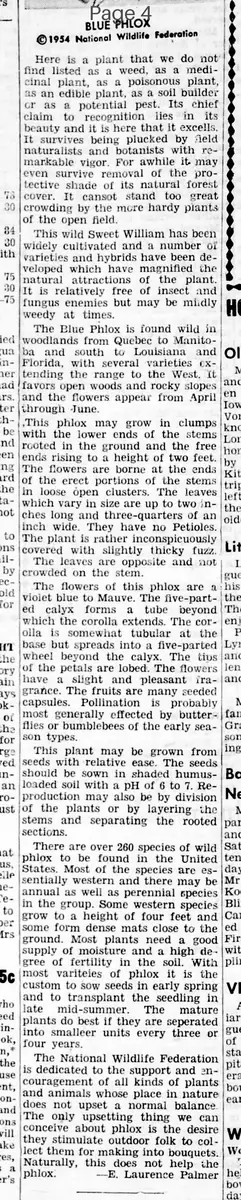
BLUE PHLOX
©1954 National Wildlife Federation
Here is a plant that we do not find listed as a weed, as a medicinal plant, as a poisonous plant, as an edible plant, as a soil builder or as a potential pest. Its chief claim to recognition lies in its beauty and it is here that it excels.
It survives being plucked by field naturalists and botanists with remarkable vigor. For awhile it may even survive removal of the protective shade of its natural forest cover. It cannot stand too great crowding by the more hardy plants of the open field.
This wild Sweet William has been widely cultivated and a number of varieties and hybrids have been developed which have magnified the natural attractions of the plant.
It is relatively free of insect and fungus enemies but may be mildly weedy at times.
The Blue Phlox is found wild in woodlands from Quebec to Manitoba and south to Louisiana and Florida, with several varieties extending the range to the West. It favors open woods and rocky slopes and the flowers appear from April through June.
This phlox may grow in clumps with the lower ends of the stems rooted in the ground and the free ends rising to a height of two feet.
The flowers are borne at the ends of the erect portions of the stems in loose open clusters. The leaves which vary in size are up to two inches long and three-quarters of an inch wide. They have no Petioles.
The plant is rather inconspicuously covered with slightly thicky fuzz.
The leaves are opposite and not crowded on the stem.
The flowers of this phlox are a violet blue to Mauve. The five-parted calyx forms a tube beyond which the corolla extends. The corolla is somewhat tubular at the base but spreads into a five-parted wheel beyond the calyx. The tips of the petals are lobed. The flowers have a slight and pleasant fragrance. The fruits are many seeded capsules. Pollination is probably most generally effected by butterflies or bumblebees of the early season types.
This plant may be grown from seeds with relative ease. The seeds should be sown in shaded humus-loaded soil with a pH of 6 to 7. Reproduction may also be by division of the plants or by layering the stems and separating the rooted sections.
There are over 260 species of wild phlox to be found in the United States. Most of the species are essentially western and there may be annual as well as perennial species in the group. Some western species grow to a height of four feet and some form dense mats close to the ground. Most plants need a good supply of moisture and a high degree of fertility in the soil. With most varieties of phlox it is the custom to sow seeds in early spring and to transplant the seedling in late mid-summer. The mature plants do best if they are separated into smaller units every three or four years.
The National Wildlife Federation is dedicated to the support and encouragement of all kinds of plants and animals whose place in nature does not upset a normal balance.
The only upsetting thing we can conceive about phlox is the desire they stimulate outdoor folk to collect them for making into bouquets.
Naturally, this does not help the phlox.
E. Laurence Palmer
©1954 National Wildlife Federation
Here is a plant that we do not find listed as a weed, as a medicinal plant, as a poisonous plant, as an edible plant, as a soil builder or as a potential pest. Its chief claim to recognition lies in its beauty and it is here that it excels.
It survives being plucked by field naturalists and botanists with remarkable vigor. For awhile it may even survive removal of the protective shade of its natural forest cover. It cannot stand too great crowding by the more hardy plants of the open field.
This wild Sweet William has been widely cultivated and a number of varieties and hybrids have been developed which have magnified the natural attractions of the plant.
It is relatively free of insect and fungus enemies but may be mildly weedy at times.
The Blue Phlox is found wild in woodlands from Quebec to Manitoba and south to Louisiana and Florida, with several varieties extending the range to the West. It favors open woods and rocky slopes and the flowers appear from April through June.
This phlox may grow in clumps with the lower ends of the stems rooted in the ground and the free ends rising to a height of two feet.
The flowers are borne at the ends of the erect portions of the stems in loose open clusters. The leaves which vary in size are up to two inches long and three-quarters of an inch wide. They have no Petioles.
The plant is rather inconspicuously covered with slightly thicky fuzz.
The leaves are opposite and not crowded on the stem.
The flowers of this phlox are a violet blue to Mauve. The five-parted calyx forms a tube beyond which the corolla extends. The corolla is somewhat tubular at the base but spreads into a five-parted wheel beyond the calyx. The tips of the petals are lobed. The flowers have a slight and pleasant fragrance. The fruits are many seeded capsules. Pollination is probably most generally effected by butterflies or bumblebees of the early season types.
This plant may be grown from seeds with relative ease. The seeds should be sown in shaded humus-loaded soil with a pH of 6 to 7. Reproduction may also be by division of the plants or by layering the stems and separating the rooted sections.
There are over 260 species of wild phlox to be found in the United States. Most of the species are essentially western and there may be annual as well as perennial species in the group. Some western species grow to a height of four feet and some form dense mats close to the ground. Most plants need a good supply of moisture and a high degree of fertility in the soil. With most varieties of phlox it is the custom to sow seeds in early spring and to transplant the seedling in late mid-summer. The mature plants do best if they are separated into smaller units every three or four years.
The National Wildlife Federation is dedicated to the support and encouragement of all kinds of plants and animals whose place in nature does not upset a normal balance.
The only upsetting thing we can conceive about phlox is the desire they stimulate outdoor folk to collect them for making into bouquets.
Naturally, this does not help the phlox.
E. Laurence Palmer
What sub-type of article is it?
Essay
What themes does it cover?
Nature
What keywords are associated?
Blue Phlox
Wildflower
Botany
Cultivation
National Wildlife Federation
Plant Description
What entities or persons were involved?
E. Laurence Palmer
Literary Details
Title
Blue Phlox
Author
E. Laurence Palmer
Key Lines
Its Chief Claim To Recognition Lies In Its Beauty And It Is Here That It Excels.
The Blue Phlox Is Found Wild In Woodlands From Quebec To Manitoba And South To Louisiana And Florida.
The Only Upsetting Thing We Can Conceive About Phlox Is The Desire They Stimulate Outdoor Folk To Collect Them For Making Into Bouquets.