Thank you for visiting SNEWPapers!
Sign up free
National Gazette
Philadelphia, Philadelphia County, Pennsylvania
What is this article about?
A citizen visiting the federal seat critiques the public debt's inflation as a tool for power rather than necessity, involving indents, state funds, and debt assumption. Questions officials' integrity amid stock-jobbery and urges freemen to elect disinterested men to prevent corruption and private passions overriding public good.
Clipping
OCR Quality
Full Text
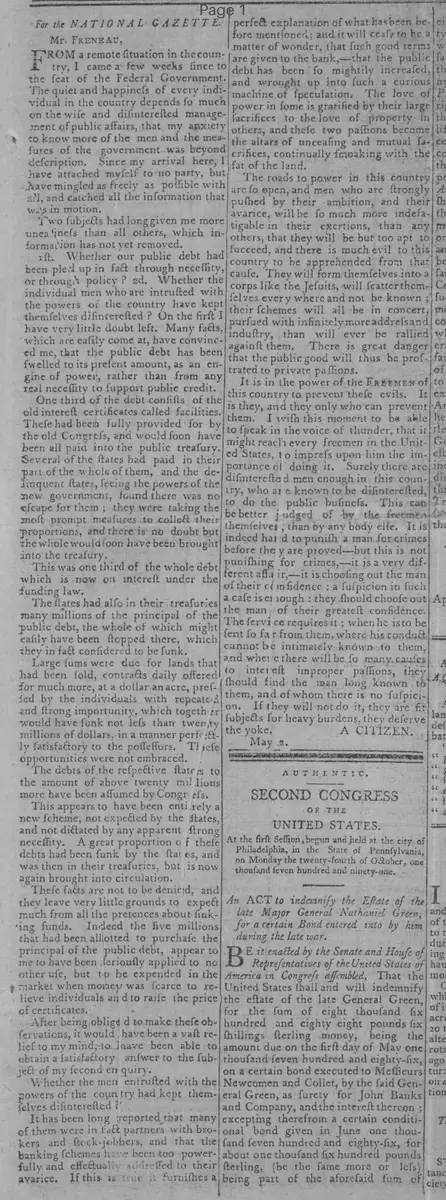
Mr. FRENEAU,
From a remote situation in the country, I came a few weeks since to the seat of the Federal Government. The quiet and happiness of every individual in the country depends so much on the wise and disinterested management of public affairs, that my anxiety to know more of the men and the measures of the government was beyond description. Since my arrival here, I have attached myself to no party, but have mingled as freely as possible with all, and caught all the information that was in motion.
Two subjects had long given me more uneasiness than all others, which information has not yet removed. 1st. Whether our public debt had been piled up in fact through necessity, or through policy? 2d. Whether the individual men who are intrusted with the powers of the country have kept themselves disinterested? On the first I have very little doubt left. Many facts, which are easily come at, have convinced me, that the public debt has been swelled to its present amount, as an engine of power, rather than from any real necessity to support public credit.
One third of the debt consists of the old interest certificates called indents. These had been fully provided for by the old Congress, and would soon have been all paid into the public treasury. Several of the states had paid in their part of the whole of them, and the delinquent states, seeing the powers of the new government, found there was no escape for them; they were taking the most prompt measures to collect their proportions, and there is no doubt but the whole would soon have been brought into the treasury.
This was one third of the whole debt which is now on interest under the funding law.
The states had also in their treasuries many millions of the principal of the public debt, the whole of which might easily have been stopped there, which they in fact considered to be sunk. Large sums were due for lands that had been sold, contracts daily offered for much more, at a dollar an acre, pressed by the individuals with repeated and strong importunity, which together would have sunk not less than twenty millions of dollars, in a manner perfectly satisfactory to the people. These opportunities were not embraced.
The debts of the respective states to the amount of above twenty millions more have been assumed by Congress. This appears to have been entirely a new scheme, not expected by the states, and not dictated by any apparent strong necessity. A great proportion of these debts had been sunk by the states, and was then in their treasuries, but is now again brought into circulation.
These facts are not to be denied, and they leave very little grounds to expect much from all the pretences about sinking funds. Indeed the five millions that had been allotted to purchase the principal of the public debt, appear to me to have been seriously applied to no other use, but to be expended in the market when money was scarce to relieve individuals and to raise the price of certificates.
After being obliged to make these observations, it would have been a vast relief to my mind, to have been able to obtain a satisfactory answer to the subject of my second enquiry.
Whether the men intrusted with the powers of the country had kept themselves disinterested?
It has been long reported that many of them were in fact partners with brokers and stock-jobbers, and that the banking schemes have been too powerfully and effectually directed to their avarice. If this is true it furnishes a perfect explanation of what has been before mentioned; and it will cease to be a matter of wonder, that such good terms are given to the bank,—that the public debt has been so mightily increased, and wrought up into such a curious machine of peculation: The love of power in some is gratified by their large sacrifices to the love of property in others, and these two passions become the altars of unceasing and mutual sacrifices, continually smoking with the fat of the land.
The roads to power in this country are so open, and men who are strongly pushed by their ambition, and their avarice, will be so much more indefatigable in their exertions, than any others, that they will be but too apt to succeed, and there is much evil to this country to be apprehended from that cause. They will form themselves into a corps like the Jesuits, will scatter themselves every where and not be known; their schemes will all be in concert, pursued with infinitely more address and industry, than will ever be rallied against them. There is great danger that the public good will thus be prostrated to private passions.
It is in the power of the FREEMEN of this country to prevent these evils. It is they, and they only who can prevent them. I wish this moment to be able to speak in the voice of thunder, that it might reach every freeman in the United States, to impress upon him the importance of doing it. Surely there are disinterested men enough in this country, who are known to be disinterested, to do the public business. This can be better judged of by the freemen themselves, than by any body else. It is indeed hard to punish a man for crimes before they are proved—but this is not punishing for crimes,—it is a very different affair,—it is choosing out the man of their confidence: a suspicion in such a case is enough: they should choose out the man of their greatest confidence.
The service requires it; when he is to be sent so far from them, where his conduct cannot be intimately known to them, and where there will be so many causes to interest improper passions, they should find the man long known to them, and of whom there is no suspicion. If they will not do it, they are fit subjects for heavy burdens, they deserve the yoke.
A CITIZEN.
May 2.
What sub-type of article is it?
What themes does it cover?
What keywords are associated?
What entities or persons were involved?
Letter to Editor Details
Author
A Citizen
Recipient
Mr. Freneau
Main Argument
the public debt was inflated through policy as an engine of power rather than necessity, involving indents, state treasuries, and debt assumption; officials may be disinterested and involved with stock-jobbers, leading to corruption; freemen must elect known disinterested men to safeguard the public good.
Notable Details