Thank you for visiting SNEWPapers!
Sign up free
Literary
April 6, 1833
New Hampshire Statesman And State Journal
Concord, Merrimack County, New Hampshire
What is this article about?
This essay advocates for reforming handwriting instruction in American schools, criticizing neglect by leaders and praising the Chirographic Society's adoption of A. Wrifford's systematic method. It highlights handwriting's historical value in England and France, quoting its importance as 'the soul of commerce' and contrasts American innovations with European practices.
Clipping
OCR Quality
95%
Excellent
Full Text
CHIROGRAPHY.
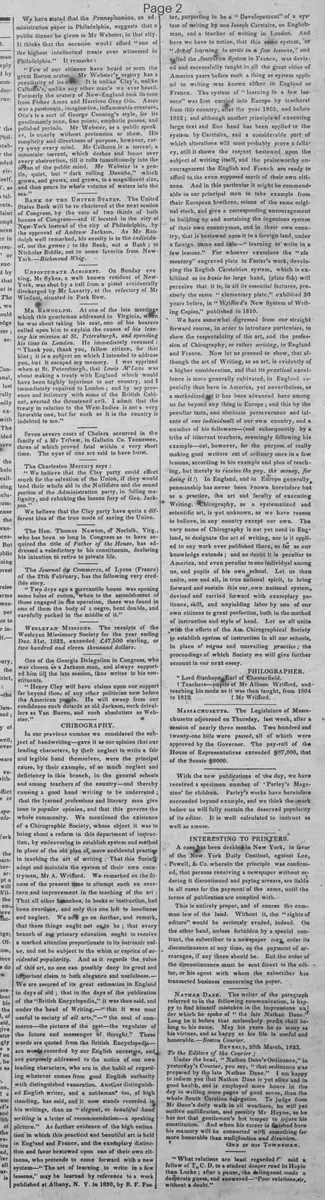
In our previous number we considered the subject of handwriting—gave it as our opinion that our leading characters, by their neglect to write a fair and legible hand themselves, were the principal cause, by their example, of so much neglect and deficiency in this branch, in the general schools and among teachers of the country—and thereby causing a good hand writing to be underrated; that the learned professions and literary men give tone to popular opinion, and that this governs the whole community. We mentioned the existence of a Chirographic Society, whose object it was to bring about a reform in this department of instruction, by endeavoring to establish system and method in place of the old plan of mere accidental practice in teaching the art of writing : That this Society adopt and maintain the system of their own countryman, Mr A. Wrifford. We remarked on the fitness of the present time to attempt such an overturn and improvement in the teaching of the art : That all other branches, in books or instruction, had been overdone, and only this one left to loneliness and neglect. We now go on further, and remark, that these things ought not so to be ; that every branch of our primary education ought to receive a marked attention proportionate to its intrinsic value, and not be subject to the whim or caprice of accidental popularity. And as it regards the value of this art, no one can possibly deny its great and important claim to both elegance and usefulness. We are assured of its great estimation in England in days of old ; that in the days of the publication of the 'British Encyclopedia,' it was then said, and under the head of Writing—'that it was most useful to society of all arts.' 'the soul of commerce—the picture of the past—the regulator of the future and messenger of thought.' These words are quoted from the British Encyclopedia—are words recorded by our English ancestors, and are purposely addressed to the notice of our own leading characters, who are in the habit of regarding whatever comes from good English authority with distinguished veneration. Another distinguished English writer, and a nobleman* too, of high standing, has said, and it now stands recorded in his writings, that an 'elegant, or beautiful hand writing is a letter of recommendation—a speaking picture.' As further evidence of the high estimation in which this practical and beautiful art is held in England and France, and the exemplary distinction and favor bestowed upon one of their own citizens, who pretends to come forward with a new system—'The art of learning to write in a few lessons,' may be learned by reference to a work published at Albany, N. Y. in 1830, by B. F. Foster, purporting to be a 'Developement' of a system of writing by one Joseph Carstairs, an Englishman, and a teacher of writing in London. And here we have to notice, that this same system, or 'Art of learning to write in a few lessons,' and called the American System in France, was devised and successfully taught in all the great cities of America years before such a thing as system applied to writing was known either in England or France. The system of 'learning in a few lessons' was first carried into Europe by teachers from this country, after the year 1805, and before 1812; and although another principle of executing large text and fine hand has been applied to the system by Carstairs, and a considerable part of which alterations will most probably prove a fallacy, still it shows the respect bestowed upon the subject of writing itself, and the praiseworthy encouragement the English and French are ready to afford to the even supposed merit of their own citizens. And in this particular it might be commendable in our principal men to take example from their European brethren, scions of the same original stock, and give a corresponding encouragement in building up and sustaining the ingenious system of their own countryman, and in their own country, that is bestowed upon it in a foreign land, under a foreign name and title—'learning to write in a few lessons.' For whoever examines the 'elementary' engraved plate in Foster's work, developing the English Carstairian system, which is exhibited as its basis for large hand, (plate 6th) will perceive that it is, in all its essential features, precisely the same 'elementary plate,' exhibited 20 years before, in 'Wrifford's New System of Writing Copies,' published in 1810.
We have somewhat digressed from our straight forward course, in order to introduce particulars, to show the respectability of the art, and the profession of Chirography, or rather writing, in England and France. Now let us proceed to show, that although the art of Writing, as an art, is evidently of a higher consideration, and that its practical excellence is more generally cultivated, in England especially than here in America, yet nevertheless, as a methodized art it has been advanced here among us far beyond any thing in Europe; and this by the peculiar taste, and obstinate perseverance and talents of one individual of our own country, and a number of his followers—(and subsequently by a tribe of itinerant teachers, seemingly following his example—not, however, for the purpose of really making good writers out of ordinary ones in a few lessons, according to his example and plan of teaching, but merely to receive the pay, the money, for doing it!) In England, and in Europe generally, penmanship has never been known heretofore but as a practice, the art and faculty of executing Writing. Chirography, as a systematized and scientific art, is yet unknown, as we have reason to believe, in any country except our own. The very name of Chirography is not yet used in England, to designate the art of writing, nor is it applied to any work ever published there, so far as our knowledge extends; and no doubt it is peculiar to America, and even peculiar to one individual among us, and pupils of his own school. Let us then unite, one and all, in true national spirit, to bring forward and sustain this our own national system, devised and carried forward with exemplary patience, skill, and unyielding labor by one of our own citizens to great perfection, both in the method of instruction and style of hand. Let us all unite with the efforts of the Am. Chirographical Society to establish system of instruction in all our schools, in place of vague and unavailing practice; the proceedings of which Society we will give further account in our next essay.
PHILOGRAPHER.
* Lord Stanhope. Earl of Chesterfield.
† Teachers—pupils of Mr Allison Wrifford, and teaching his mode as it was then taught, from 1804 to 1812.
Mr Wrifford.
In our previous number we considered the subject of handwriting—gave it as our opinion that our leading characters, by their neglect to write a fair and legible hand themselves, were the principal cause, by their example, of so much neglect and deficiency in this branch, in the general schools and among teachers of the country—and thereby causing a good hand writing to be underrated; that the learned professions and literary men give tone to popular opinion, and that this governs the whole community. We mentioned the existence of a Chirographic Society, whose object it was to bring about a reform in this department of instruction, by endeavoring to establish system and method in place of the old plan of mere accidental practice in teaching the art of writing : That this Society adopt and maintain the system of their own countryman, Mr A. Wrifford. We remarked on the fitness of the present time to attempt such an overturn and improvement in the teaching of the art : That all other branches, in books or instruction, had been overdone, and only this one left to loneliness and neglect. We now go on further, and remark, that these things ought not so to be ; that every branch of our primary education ought to receive a marked attention proportionate to its intrinsic value, and not be subject to the whim or caprice of accidental popularity. And as it regards the value of this art, no one can possibly deny its great and important claim to both elegance and usefulness. We are assured of its great estimation in England in days of old ; that in the days of the publication of the 'British Encyclopedia,' it was then said, and under the head of Writing—'that it was most useful to society of all arts.' 'the soul of commerce—the picture of the past—the regulator of the future and messenger of thought.' These words are quoted from the British Encyclopedia—are words recorded by our English ancestors, and are purposely addressed to the notice of our own leading characters, who are in the habit of regarding whatever comes from good English authority with distinguished veneration. Another distinguished English writer, and a nobleman* too, of high standing, has said, and it now stands recorded in his writings, that an 'elegant, or beautiful hand writing is a letter of recommendation—a speaking picture.' As further evidence of the high estimation in which this practical and beautiful art is held in England and France, and the exemplary distinction and favor bestowed upon one of their own citizens, who pretends to come forward with a new system—'The art of learning to write in a few lessons,' may be learned by reference to a work published at Albany, N. Y. in 1830, by B. F. Foster, purporting to be a 'Developement' of a system of writing by one Joseph Carstairs, an Englishman, and a teacher of writing in London. And here we have to notice, that this same system, or 'Art of learning to write in a few lessons,' and called the American System in France, was devised and successfully taught in all the great cities of America years before such a thing as system applied to writing was known either in England or France. The system of 'learning in a few lessons' was first carried into Europe by teachers from this country, after the year 1805, and before 1812; and although another principle of executing large text and fine hand has been applied to the system by Carstairs, and a considerable part of which alterations will most probably prove a fallacy, still it shows the respect bestowed upon the subject of writing itself, and the praiseworthy encouragement the English and French are ready to afford to the even supposed merit of their own citizens. And in this particular it might be commendable in our principal men to take example from their European brethren, scions of the same original stock, and give a corresponding encouragement in building up and sustaining the ingenious system of their own countryman, and in their own country, that is bestowed upon it in a foreign land, under a foreign name and title—'learning to write in a few lessons.' For whoever examines the 'elementary' engraved plate in Foster's work, developing the English Carstairian system, which is exhibited as its basis for large hand, (plate 6th) will perceive that it is, in all its essential features, precisely the same 'elementary plate,' exhibited 20 years before, in 'Wrifford's New System of Writing Copies,' published in 1810.
We have somewhat digressed from our straight forward course, in order to introduce particulars, to show the respectability of the art, and the profession of Chirography, or rather writing, in England and France. Now let us proceed to show, that although the art of Writing, as an art, is evidently of a higher consideration, and that its practical excellence is more generally cultivated, in England especially than here in America, yet nevertheless, as a methodized art it has been advanced here among us far beyond any thing in Europe; and this by the peculiar taste, and obstinate perseverance and talents of one individual of our own country, and a number of his followers—(and subsequently by a tribe of itinerant teachers, seemingly following his example—not, however, for the purpose of really making good writers out of ordinary ones in a few lessons, according to his example and plan of teaching, but merely to receive the pay, the money, for doing it!) In England, and in Europe generally, penmanship has never been known heretofore but as a practice, the art and faculty of executing Writing. Chirography, as a systematized and scientific art, is yet unknown, as we have reason to believe, in any country except our own. The very name of Chirography is not yet used in England, to designate the art of writing, nor is it applied to any work ever published there, so far as our knowledge extends; and no doubt it is peculiar to America, and even peculiar to one individual among us, and pupils of his own school. Let us then unite, one and all, in true national spirit, to bring forward and sustain this our own national system, devised and carried forward with exemplary patience, skill, and unyielding labor by one of our own citizens to great perfection, both in the method of instruction and style of hand. Let us all unite with the efforts of the Am. Chirographical Society to establish system of instruction in all our schools, in place of vague and unavailing practice; the proceedings of which Society we will give further account in our next essay.
PHILOGRAPHER.
* Lord Stanhope. Earl of Chesterfield.
† Teachers—pupils of Mr Allison Wrifford, and teaching his mode as it was then taught, from 1804 to 1812.
Mr Wrifford.
What sub-type of article is it?
Essay
What themes does it cover?
Commerce Trade
Moral Virtue
Political
What keywords are associated?
Chirography
Handwriting
Penmanship
Education Reform
Wrifford
Chirographic Society
Systematic Writing
What entities or persons were involved?
Philographer
Literary Details
Title
Chirography
Author
Philographer
Subject
Reform In The Teaching Of Handwriting
Key Lines
'The Soul Of Commerce—The Picture Of The Past—The Regulator Of The Future And Messenger Of Thought.'
An 'Elegant, Or Beautiful Hand Writing Is A Letter Of Recommendation—A Speaking Picture.'